Meditation on Greek Tragedy Explores Identity & Power In The 21st Century [NYFF]
Dec 17, 2025
A metatextual exploration of identity, race, privilege, communication, and betrayal, “Gavagai” is a small story with a massive scope. A movie about a movie which is itself an inversion of classic tropes and themes, the film exists on several levels and maintains a remarkable amount of balance using just a handful of characters and settings.
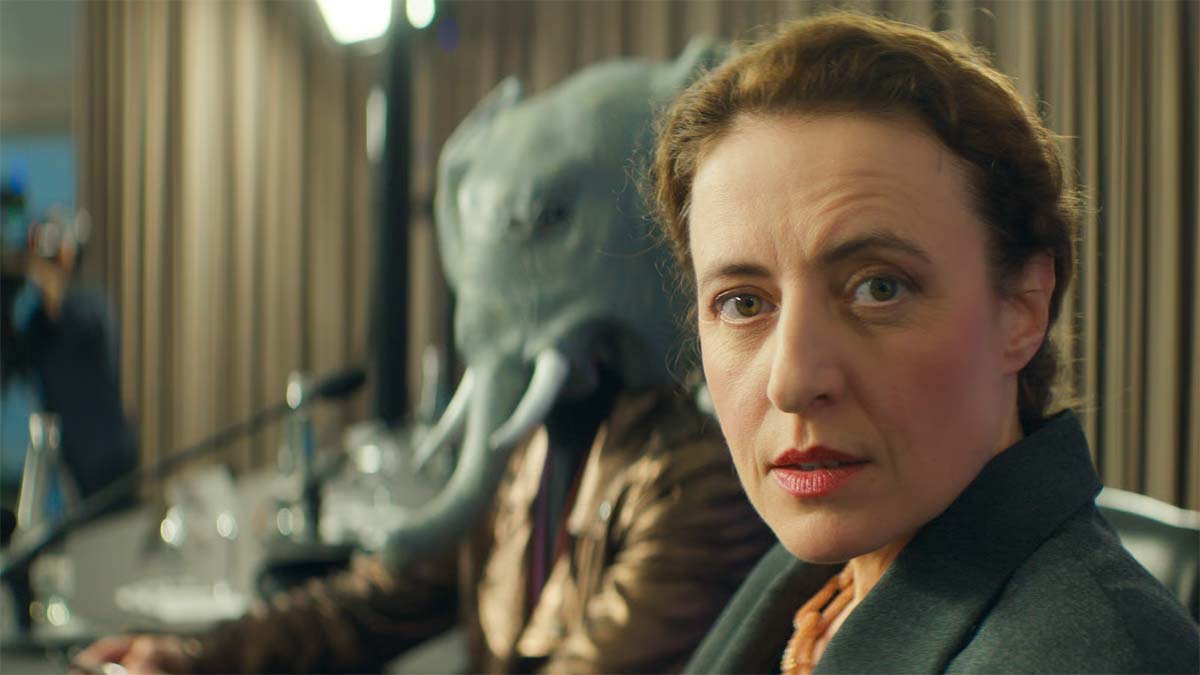
“Gavagai” opens on a film set in Senegal, where frazzled director, Caroline (Nathalie Richard), is trying to keep her wobbly production in motion. Her movie is a retelling of the Greek tragedy, “Medea,” though she’s updated the story to a modern African setting where the eponymous character is a white European woman losing her family to her African husband’s people. German actress, Maja (Maren Eggert), plays Medea opposite Senegalese actor, Nourou (Jean-Christophe Folly), as Jason, and the two carry on a not-so-secret affair as the production nears its conclusion.
While on location, the pair experience a similar power dynamic as their characters, what with Maja being an outsider amongst Nourou’s people, but once in Berlin for the film’s premiere a few months later, everything flips. The sunny, bustling streets of Dakar couldn’t feel more distant in the cold, impersonal Berlin, where Nourou has trouble communicating, and even gets racially profiled by a security guard. Worse still, when Maja gets involved in the profiling incident and aftermath, she insists on pursuing the matter with the hotel’s manager, going full Karen-mode while Nourou is sidelined and becomes almost an afterthought.
A series of self-reflective parallels, “Gavagai” is an inversion of norms that are themselves inverted between the film and the in-movie production, with characters that also take turns on both sides of the power dynamic. Writer/director Ulrich Köhler isn’t just having fun juggling themes and tropes, however, he’s using “Medea” as a launching pad to explore foundational dramatic topics that go back to the ancient Greeks. In “Medea,” Euripides wrote about a power struggle between a man and woman that transcended a simple relationship, turning it into a dialectic about politics, gender, jealousy, and control. Köhler is similarly interested in the ways that his characters experience varying levels of agency and authority in the different settings presented.
Caroline is nominally in charge on the film set and as the voice of the picture during the press junket, yet in both arenas, she proves that she is hopelessly out of her depth and not at all in control. Nourou is comfortable in Dakar, on and off-set, while his time in Berlin is defined by his otherness regardless of the company he keeps (or his face on the poster at the Berlindale premiere). Like the Corinth of “Medea,” the world of “Gavagai” is an ever-shifting landscape where one’s power and identity are prone to challenge from minute to minute, and its leads are quietly electric through each stage of this discovery.
Breathlessly cool, collected, and in-charge in Senegal, Nourou struggles not just with Berlin, but his sense of self while there. Folly’s use of his body to demonstrate his fatigue in one setting and confidence in another is a masterful use of posture and compliments a performance that is the unquestionable anchor of the effort. Eggert has a thankless role as the somewhat smarmy actress who uses her power and privilege to get what she wants when she wants it, only to shrug off any responsibility when things get tough. She eschews a sympathetic reading to give the character the bite the role requires, and “Gavagai” is a better movie because of it.
Köhler’s attention to detail at all levels of the production keeps the story tight and efficient, avoiding the need for narration, title cards, or even a score to imply mood, time, or narrative functions by way of good writing and clever hair and make-up design. That said, some extra context and character work would have helped to flesh out the leads, who the audience generally understands, though only broadly. Maja is estranged from her daughter’s father, yet it is unclear if her relationship with Nourou is the cause of that friction/disaffection, or just a byproduct of it.
At the end of the day, it doesn’t matter that much, not for what Köhler is going for, anyway. The audience knows enough about these characters to put the important pieces together, and while thin in places, this stripped-down approach allows “Gavagai” to drift from one setting to another with ease, drawing out the thematic doublets and parallels with startling efficiency. And while there may have been some question about who Caroline, Maja, and Nourou’s movie is for, what with the overreliance on white savior character tropes and hazy politics, there should be no doubt about the need or relevance of “Gavagai.” [B+]
Publisher: Source link





![Born Again’ Stars Explain Why Bullseye Is So Dangerous in Season 2 [Exclusive]](https://www.filmibee.com/wp-content/uploads/2026/03/Born-Again-Stars-Explain-Why-Bullseye-Is-So-Dangerous-in-1200x675.jpg)
Born Again’ Stars Explain Why Bullseye Is So Dangerous in Season 2 [Exclusive]
Along with Charlie Cox's Matt Murdock and Vincent D'Ofnorio's Wilson Fisk, Daredevil: Born Again Season 1 brought back one of The Man Without Fear's most notorious villains: Wilson Bethel's Benjamin Poindexter, better known as Bullseye. Not only was he back…
Mar 19, 2026
Born Again’ Showrunner Confirms ‘Avengers’ Character Is Key to Street Level MCU [Exclusive]
Ahead of the Avengers' return to the big screen later this year, Marvel Studios will return to street-level storytelling with the second season of Daredevil: Born Again on Disney+. Along with making the show canon to everything that happened in…
Mar 18, 2026

Taylor Sheridan’s Underrated Action Thriller Series Roars to Streaming Success
It’s now been two years since we last saw anything from the underrated action thriller series created by Yellowstone’s Taylor Sheridan, but having finally had some promising word about the new season, the show has now shot up the streaming…
Mar 17, 2026
Netflix’s ‘One Piece’ Fails To Replicate Success of Season 1 on Streaming
It's been a little over two months since Stranger Things came to an epic conclusion on Netflix that left a massive hole in our hearts in more ways than one. However, the show's biggest replacement in terms of sheer production…
Mar 16, 2026