
Melissa Barrera and Peacock’s ‘Copenhagen Test’ Cast Explain How the Sci-Fi Finale Sets Up Season 2
Dec 28, 2025
Editor’s Note: The following contains spoilers for The Copenhagen Test, Season 1.
Summary
In an interview with Collider, Melissa Barrera, Sinclair Daniel, Brian d’Arcy James, Kathleen Chalfant, and Mark O’Brien discuss the biggest revelations from The Copenhagen Test Season 1 finale.
Barrera explains that Michelle’s “way out” was never real, saying the finale confirms “there’s never really going to be freedom,” even after the mission ends.
Chalfant acknowledges the finale leaves St. George torn between preserving The Orphanage and believing it can become something better, admitting those goals may be in conflict.
If you’re still picking your jaw off the floor after The Copenhagen Test finale, you’re not alone. For as many questions as streaming’s latest sci-fi spy thriller just answered, it also replaced everything we thought we knew with something far worse: certainty. The once theoretical test taken by Simu Liu’s Alexander Hale isn’t just some vague loyalty exercise anymore. By the time we reach the episode’s final moments, we see Alexander and countless others are living with a real-time hack in their heads, courtesy of a living program that is spreading beyond their basic understanding. With Alexander having the choice of turning his hack on and off, like a switch, it’s the kind of setup that also leaves characters “literally and figuratively” stuck in a cage, as Brian d’Arcy James tells Collider alongside his castmates, Melissa Barrera, Sinclair Daniel, Kathleen Chalfant, and Mark O’Brien, when breaking down the episode’s biggest plot twists. For Barrera, that collapse of certainty and surveillance lands hardest in Michelle’s final moments, especially the subway reunion that recontextualizes her entire relationship with Alexander. But between the characters’ wanting to escape and the watchful eye of surveillance after their every move, all of that tension ripples outward across the finale, shaping Parker’s promotion, Moira’s offer to Alexander, Michelle’s future, and the uneasy alliances that follow in The Orphanage for Season 2.
Melissa Barrera Reveals Michelle’s “Way Out” Was Always a Trap
Barrera gets candid about Michelle’s risky subway goodbye — and why being “out” still means being watched.
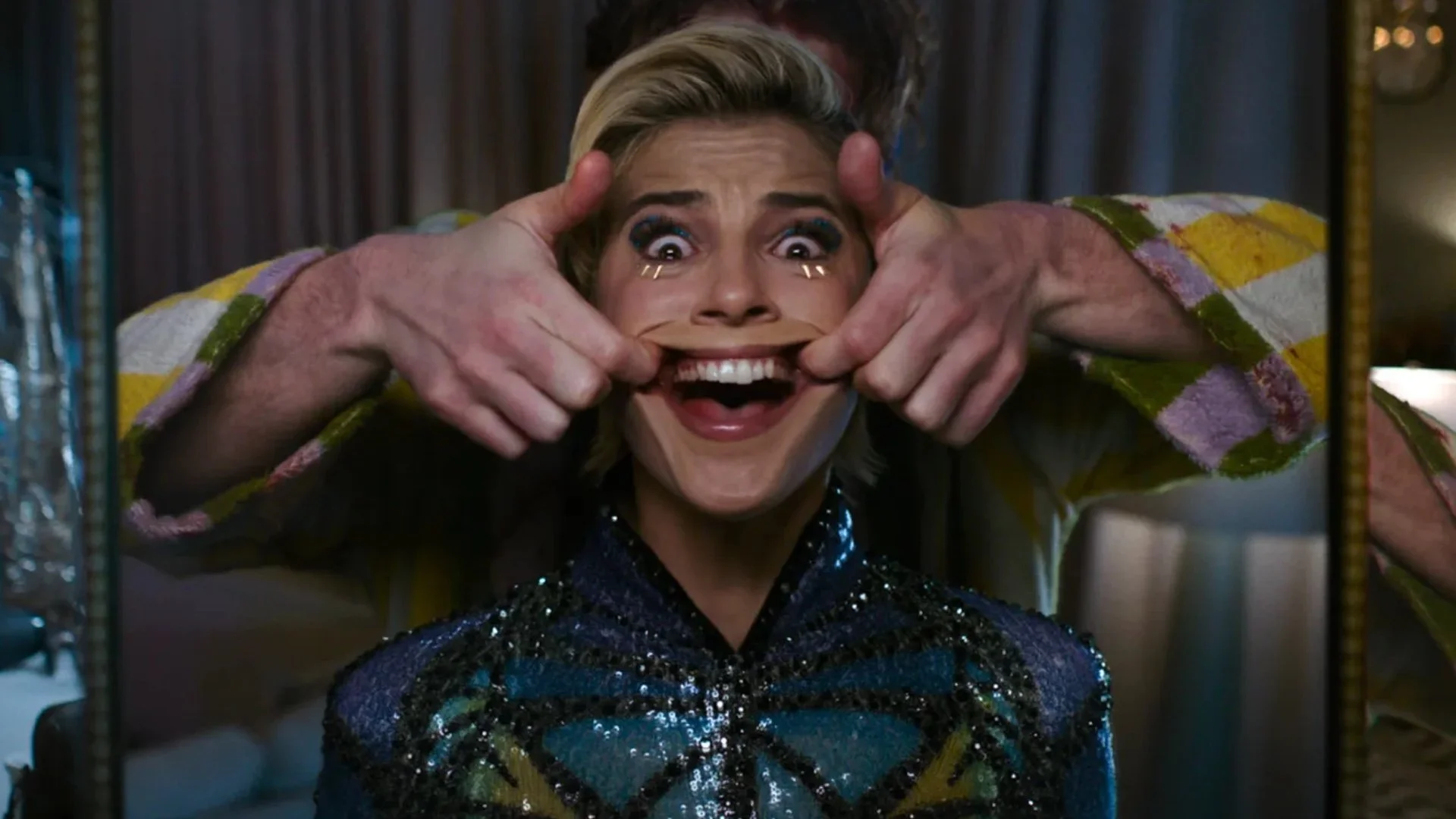
Image via Peacock, NBC Universal
By the time Michelle returns in the season finale, The Copenhagen Test quietly reframes her entire role and makes her more of an ally than we assumed. The former bartender Liu’s Alexander met by chance, the woman from Belarus, and the operative embedded in the Copenhagen Test is finally recognized as the same person — someone who agreed to be burned by the system in exchange for the promise of a way out (enter Daniel’s analyst, Parker). But the finale makes it clear that her idea of “out” is conditional, as we see her being tracked. Even after the operation is supposedly over, Michelle is still being considered a loose end. But if Alexander knows, does Michelle?
She’s very smart. I think she’s always two steps ahead. The reason that she accepted this mission, the reason that she became Michelle, is because they told her that after this, she could be out, because she would be burned, and then she could say goodbye to this life that she’s sick of, because what other reason would someone have to say yes to a mission that will burn your face to the enemy? It means that you’re basically going to be in witness protection afterwards, and the motivation behind a decision like that has to be something really, really big.
Barrera adds that while Michelle might feel part of it is “true” and she might get a clean break, she knows better than to think it’ll ever really happen. “I feel like in the end, when you see that she’s being followed, and she clocks that this person is following her, it’s like, ‘Of course. There’s never really going to be freedom.’” That kind of mindset also ends up giving us another look at what that subway reunion really meant. If Michelle is “always two steps ahead,” then that final contact with Alexander doesn’t just read as romantic, but more as a calculated vulnerability with a risk:
I had to decide how to play that because I had to decide how much vulnerability there is in that moment, how much she’s allowing herself to do this thing that she’s not supposed to do. Having that one final contact with him is clearly something that she normally wouldn’t do. She’s done. She should be out, but she decides to go back. Because it’s Michelle, and you never know what you’re going to get with her, I was like, ‘Is she trying to recruit him for something, or is she genuinely telling him, ‘I’ve been through this. They say that they’ve got your back, and they never do. If you want to know the real, come find me?’ So, is it honest or is it with another intention?
Daniel on being “the closest” to Alexander, and O’Brien on why Cobb can’t let the mission be a lie.
Image via Peacock, NBC Universal
If Michelle’s arc in the finale reveals just how hard it is to ever truly get out, Parker’s storyline shows what happens when you move further up the chain in The Orphanage. With the finale positioning Daniel’s predictive analyst as the next generation of leadership, Chalfant’s old guard, St. George, offering her a promotion that comes with both validation and responsibility. But it’s also a moment that shifts Parker’s season-long proximity to Alexander from watching him “day and night” to learning more about him than anyone else. For Daniel, the offer from St. George isn’t just about status. It’s about being trusted to fix what’s broken, even as Parker realizes she’s inheriting the same system that manipulated Alexander in the first place. “I think St. George, in that moment, is offering a promotion, but also an opportunity and a concession that they need to do better,” Daniel explains. “Yes, I’ve always wanted to feel like I belong somewhere and that I’m good at something, but I also am realizing that I want to do good. To be given the tools and the resources and the trust to do something good is actually what she’s been searching for.” But that belief is complicated by how Parker personally experiences Alexander’s perceived betrayal earlier in the episode, that if he turned, she’d kill him herself. It’s a reaction that Daniel says feels less professional than she’d like to admit:
It felt like a betrayal and also like disappointed in myself that I didn’t see it coming, that Parker wasn’t able to be good enough at her job to predict this. But also, Alexander feels like her creation, and to have your creation defy you, it’s deeply personal.
All that tension that floats between belief in the mission and doubt about the institution plays out differently for O’Brien’s Cobb, whose moments in the finale underline him not as an antagonist, but as someone who’s been quietly testing the limits of his loyalty all along. By the last episode of Season 1, Cobb openly calls himself “a disgraced refugee of The Orphanage,” even as he admits he’s been undercover for it the entire time. O’Brien says Cobb’s crisis isn’t about losing faith in the work — it’s about realizing how much of his life has been built on trust that may not have been earned.
I’ve given my whole life to this, so this has to be done correctly. Otherwise, my life has been wasted to some degree. Once he realizes the truth and he realizes the true nature of Simu’s character — which is not someone who’s going against this country — he now realizes the role Cobb can have. It’s different than what he thought before, but it’s better, and now it’s clearer for him.
Moira’s “Choice,” St. George’s Succession Plan, and the Orphanage’s Big Lie
James discusses how the watch is a “choice,” while Chalfant teases saving The Orphanage vs. making it better.
Image via Peacock, NBC Universal
Now, while Parker and Cobb represent two very different ways of living through the truth, The Orphanage’s Director of Operations, Moira, and St. George are the ones deciding what happens after everything is finally exposed. Controlling the narrative as best they can by the end of the finale, both characters feel less like people reacting and more like operators adjusting a chessboard. For James, Moira’s final gesture toward Alexander — gifting him the watch that allows him to toggle the hack — isn’t meant to read as forgiveness or closure. It’s a negotiation, one that fine-tunes control while keeping Alexander tethered to The Orphanage.
I wouldn’t call it manipulation — Moira wouldn’t. I wouldn’t see it as anything other than a step forward in the relationship. Believing in what I’m saying as a genuine thing is, ‘Look, this is your choice. We have this control, and we will respect your wishes, but maybe you can tell me what you want to do if you want to participate for the greater good.’
That kind of gesture matters deeply because, even with the watch in Alexander’s hands, the power imbalance hasn’t completely gone, but rather formalized. James notes that the gesture doesn’t open a door so much as help redefine the terms of his current captivity. “I think that keeps the door open for these two characters to stay in the cage, literally and figuratively,” he adds, pointing to the “new wrinkle” that still leaves Moira deeply embedded in Alexander’s future.
Related
Peacock’s Spy Sci-Fi ‘The Copenhagen Test’ Uses This Classic Movie’s Bold Twist, Plus 5 Things We Learned From Set
The line between reality and illusion is blurred in this gripping sci-fi thriller that keeps you guessing until the very end.
But that same long-view pragmatism defines Chalfant’s St. George, whose decision to elevate Parker reads as succession planning. When asked whether St. George sees herself in Parker, Chalfant doesn’t soften the answer: “No,” she says. “I think she’s hoping Parker will do the job better.”
It’s a blunt assessment, but a revealing one. As Chalfant explains, St. George’s real strength has always been her ability to read people and think past the current crisis. Even in the finale’s final conversations with her team, she’s balancing preservation with belief and hope.
What we get at the end of St. George’s final conversations is her continuing commitment to solving this problem and saving The Orphanage on the one hand, and on the other hand, her hope for a better future, a better way to do this.
Between Moira giving Alexander a “choice” with the watch, Parker stepping into a new job title, and Michelle realizing she’s still being tracked by foreign entities, the finale keeps circling the same contradiction — saving The Orphanage versus making it better, and as Chalfant says, “It’s not clear that those two things aren’t in conflict here.” The Copenhagen Test is now streaming on Peacock.
Release Date
December 27, 2025
Network
Peacock
Directors
Jet Wilkinson
Publisher: Source link






Wuthering Heights Review | Flickreel
As far as adaptations go, I’ve never viewed any source material as sacred, including The Bible. While a faithful adaptation is always welcome, I’m open to a filmmaker leaving their signature on a classic story, especially one that’s been told…
Mar 17, 2026

Amy Adams Sinks In Vapid, Misguided Alcoholism Drama By ‘Pieces of a Woman’ Director [Berlin]
For a solid decade, starting in the late 2000s with Disney’s charming fairytale comedy “Enchanted” all the way to Denis Villeneuve’s melancholy sci-fi “Arrival,” it was easy to trust Amy Adams, a six-time Academy Award nominee. Then, somewhere around Ron…
Mar 17, 2026
Mason Gooding & James Van Der Beek’s Bad Night Is Aggressively Dull
Ever since the Scream franchise helped put him on the map, Mason Gooding has been a great talent to watch. The genre-bending slasher Heart Eyes is still his best non-franchise role yet, but he's also branched outside of horror in…
Mar 15, 2026

A Grumpy Nick Offerman Keeps This Fish Tale Swimming Along
Animated fish films have been done. Finding Nemo. Shark Tale. Ponyo. So to hear about another doesn't feel like anything new. However, The Pout-Pout Fish, starring Nick Offerman as a grumpy ocean pout named Mr. Fish, is a little different.…
Mar 15, 2026