Music as Nourishment: Max Richter on Scoring “Hamnet”
Dec 3, 2025
Paul Mescal in Hamnet
With Songs My Brother Taught Me (2015) and The Rider (2017), Chloé Zhao constructed tender epics out of prolonged time spent at the Pine Ridge Reservation in South Dakota. Much like her Oscar-winning Nomadland (2020), these films are born out of geography, setting characters yearning for freedom and belonging against vast American landscapes..
Zhao’s fifth feature, Hamnet, likewise finds a synthesis between the natural world and the interiority of her characters in telling a story of creation in every sense of the word — the genesis of new life and the mysterious place within where creativity and artistic processes emerge. An adaptation of Maggie O’Farrell’s eponymous book, the film depicts how William Shakespeare (Paul Mescal) embarked on his most ambitious and iconic play after the loss of his titular son. More so, it’s the story of his wife Agnes (Jessie Buckley), a loving mother of two who has a profound connection with the nature that surrounds her in the English countryside. Much like her other films, Zhao is looking here for a synthesis between the natural world and the rich interiority of her characters. Gorgeously shot by Łukasz Żal, and edited by Zhao herself alongside Affonso Gonçalves, Hamnet aspires to near-Malickian transcendence in its depiction of how life on earth inevitably crosses over to the afterworld.
These highly ambitious themes are not only grounded by an emotionally devastating and relatively straightforward melodramatic screenplay, but also by the nourishing score of Max Richter. The famed composer handsomely manages to alleviate the material in its more ethereal moments, feeding the soil of the narrative with an identifiable musical throughline that gradually envelops as the storyworld expands. Richter is a renowned contemporary composer who shook up the traditionalist classical world with his ambitious spins on modern minimalist music. Ever since he composed his first film score for Ari Folman’s Waltz with Bashir (2008), he’s also a highly in-demand collaborator of directors, including James Grey, Joe Wright and Martin Scorsese. Hamnet is arguably his best score to date, one in which he channels the epoch appropriate organizing principles of Elizabethan music in a texturally dense and highly layered composition that stays on the minimal side of things until it suddenly crescendos towards the heavens.
While William Shakespeare’s fame threatens to eclipse the other characters, Richter’s score reveals that Agnes is the actual protagonist of Hamnet. Employing a divine-sounding Elizabethan choir and sustained string instruments, Richter constantly echoes her journey through life, using music as a kind of emotional support system in moments of dire need. For Filmmaker, the German-born and UK-based composer called in from his state of the art Studio Richter Mahr, in which he composed much of Hamnet’s score long before Zhao started shooting on set.
Filmmaker: Chloé Zhao is known for her intuitive and instinctual approach to filmmaking. As she also did the editing alongside Affonso Gonçalves, I’m curious how that intuitiveness fed into the ways you approached the scoring of Hamnet.
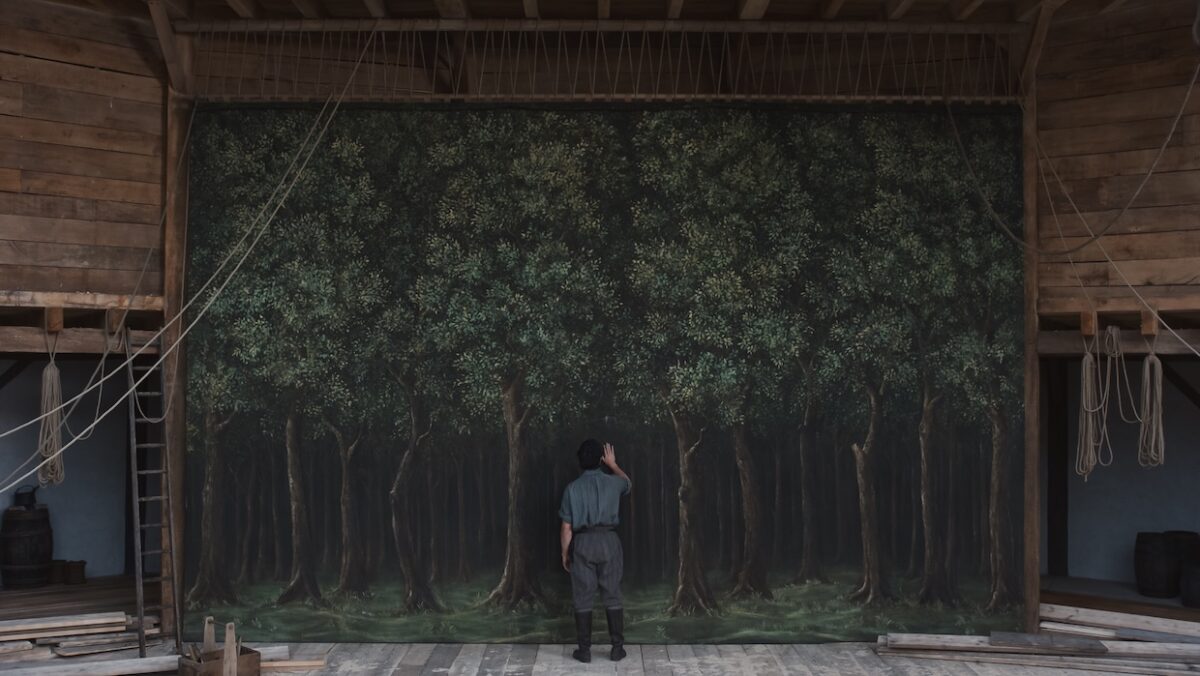
Richter: Chloé works intuitively, led by her emotional responses to the material. The way we collaborated was actually ideal for me. I was stunned by the screenplay and wrote about half-an-hour of music straight away—essentially sketches—which Chloé immediately connected to. We discussed the major themes of the film: changing dynamics within a family, grief, motherhood and how our lives play out in relation to the natural world which surrounds us. The film opens with this incredible shot of Jessie Buckley in the womb of the forest, which immediately signifies our connection to the things we can’t talk about—the beyond, or “the undiscovered country,” as Hamnet puts it. I tried to grapple with all these big ideas in my music, and Chloé dove into those thirty minutes of material when she was driving around, scouting for locations, rehearsing with actors and designing the sets. At the very onset, it already became a part of the world of the film. Even during the shoot, they played this music on set, then it became part of the edit. As the first cut of the film progressed, I started to shape and develop the music in parallel. So, the score and the film coevolved together, which I think is the perfect way to do it. Often, with a film, you’ll get a locked cut with the assignment to replace the temp tracks within a month. That’s pretty terrible, right? It’s just not that creative. This was a beautiful, artistic creative process.
Filmmaker: You constructed the score around the organizing principles of Elizabethan music at the height of the British renaissance. I know your background in music education has been quite scholarly and cerebral. What does it mean for you, at this stage of your career, having consciously unlearned so many rules of classical music for your own musical works, to revisit such principles in the context of Hamnet?
Richter: I absolutely adore the music of that period and wanted to express some aspects of it within the musical language of Hamnet. I took the principles of choral and vocal music of British renaissance composers like William Byrd, Thomas Tallis and Thomas Weelkes. However, I didn’t want to simply mimic someone like Tallis; that wouldn’t make any sense.So, I made recordings with a musical choir specialised in Renaissance music. They have very particular sonic timbres without any vibrato. I also used some instruments that I could shape in quite sculptural ways as the film evolved, like bowed instruments of the Elizabethan period and folk string instruments. To embrace some of the witchy energy in the film, that earth magic that imbues the narrative, I leaned on the rougher and more texturally dense sounds we could get out of those early instruments. Finally, I tried to stay on the minimal side of things, as Hamnet is a powerful story that could easily veer into sentimentality. I think of the relation between the film and the music as if Hamnet itself were a baby, and the score, the amniotic fluid that nourishes it
Filmmaker: There are recurring motifs, where the vocal music ascends and almost literally lifts off the imagery. But underneath, you employ this strong synthetic sub-bass that grounds everything into something more primal and mysterious. I wanted to ask about this clash between darkness and light—between the higher end of the sonic spectrum and the deep rumbling of the low end — and how you strike a balance between those polarities.
Richter: The film is about motherhood and attaining happiness in all of its dimensions, which the choral voices evoke. However, it’s also a story about the beyond, which can be as beautiful as it is scary. There is a lot of heavy material in the film, and a significant part of the score is quite electronic, because it explores the unknown. The subsonics are there because those frequencies way down low can’t be generated with traditional acoustic instruments. You can literally feel a low 25 Hz or 30 Hz bass note in your stomach; it’s a bodily experience that feels like something bigger than you. There’s something magical about that—these tones have a supernatural quality, which responds to the supernatural elements of the film.
Filmmaker: So, how do you approach the score in a way that it doesn’t simply result in a schematic binary between the timbre of the acoustic instruments and the low-end trembling of the subsonics? I was listening quite attentively to the score in the cinema and love that there are traces of electronics hidden in between the more acoustic sequences. The full range of the score seems to segue into each other in such an organic way that resembles how the film quite fluidly moves between its earthly and otherworldly dimensions.
Richter: All the electronic material in the film is actually sourced from the acoustic instruments. The Elizabethan strings, for example, are resampled, down-pitched and processed, allowing me to work with them in an almost sculptural sense. So, all the various sound sources share a certain genealogy. It’s not like I’m throwing in some random synths to give the score more weight. Everything emerged from the world of this film and is handcrafted for it specifically.
Filmmaker: If I think about your albums, it seems you trace the hardships of the human experience in the 21st century—dealing with political shifts, the necessity of finding inner calm, and also exploring the mysterious world of the beyond when we fall asleep. With your recent works, you also explored aspects of polarization and filter bubbles and how we perceive ourselves in the modern world. So, where does the impetus to create reside for you?
Richter: Artists are people, right? We all have certain things on our mind we want to talk about. I am drawn to the same questions everyone else is, but I have the opportunity to explore them through the language of music. It’s a way for me to shine a light on questions I believe are important, but also a way for me to explore them for myself. Hopefully, through those explorations, other people can also gain something from that. Creative work allows you to experience how another mind sees the world—that’s the magic of it.
Filmmaker: In that sense, you’ve been fortunate enough to have worked with incredible directors like Chloé Zhao, James Gray, Ari Folman and Martin Scorsese, among others. In what sense does composing film scores influence your approach to the music you compose for your own projects?
Richter: I’m probably the worst person to answer that question because I’m too close to it. However, I do see them as quite different processes. If I’m writing a concert piece or making a record, that’s me sitting in this room on my own, without asking anybody what they think or need. I’m just doing what I’m doing, finding my way towards something over a period of months. Working on a film is completely different. It’s a collaborative process—figuring out how best to discover the music within a story and a world, based on a series of conversations. It’s a very real-time problem-solving exercise to figure things out. Filmmaking is essentially about provisional decisions, right? “Let’s decide that.” “No, let’s change it.” “Now, let’s do it like this.” It has this kind of organic feedback loop, which I enjoy a lot, like a voyage into a place you don’t know.
Filmmaker: In the case of Zhao, I’m curious about the kind of language you use to communicate that process. Is she someone who might say, “Make it bigger,” “Give me more emotion,” or “make it feel more like this color”? What kind of dialogue do you have with her to shape the material?
Richter: Chloé didn’t leave me alone completely, but she also did very little of what you’ve described, partly because I wrote a lot of music based on the screenplay itself, which they were using throughout the development of the film. So, in the edit, she was responding to things that already existed. There was zero “add more trombones, please” type of feedback. She would never say anything like that anyway. She’s a sophisticated, thoughtful artist with a capital A. She really gave me the space to do my thing, which was wonderful.
Filmmaker: In an earlier interview, you mentioned that every piece of music, regardless of how grim or severe its subject matter, should incorporate at least 10% of hope. I wonder what you think of that in the case of Agnes’s story, which deals with such great anguish.
Richter: With Agnes, I opted for a minimal approach. Much of her music is centered around recordings of women’s voices based on Renaissance choral language, albeit used very abstractly and minimally. There are sections of the film that consist of just one note.
Filmmaker: But it’s interesting how such a droning note can be so rich and layered.
Richter: The note, indeed, is beautiful. It’s only one note, so it feels like nothing, but it’s a beautiful nothing. I suppose I always wanted the score to feel like it was on her side. It’s as if the score is empathetic toward Agnes, which is the instinctual feeling I have as a human towards that character. I wanted that to be part of the film, but in an understated way; I didn’t want any sentimentality.
Filmmaker: It seems like we’re in an era where relatively iconoclastic musicians are scoring major films. We could certainly count yourself as one, but simultaneously we have people like Nala Sinephro working with Benny Safdie on The Smashing Machine, Oneohtrix Point Never’s recurring collaboration with the Safdies, including his recent score for Marty Supreme, and, of course, Trent Reznor and Atticus Ross, who have opened up avenues for a different approach to what’s perceived as traditional film scoring. How do you view these developments?
Richter: Directors have realized they can ask the musicians whose work they love to score their films. It’s as simple as that. Previously, there may have been a feeling that this wasn’t feasible, but many of the technical hurdles to score a film have evaporated with more accessible technology. This has allowed a broader range of artists to engage with film, although it still remains a very technical process. For instance, you still have to make that cue exactly 48 seconds long. You do need to deliver on those kinds of things, but it’s much easier now than it used to be, when you were calculating BPMs on paper and measuring reels of film. Meanwhile, culture has become atomized; there is no longer one way to do anything. I think this level of openness and multiplicity is great. I’m really all for it.
Filmmaker: I’m wondering about your own relationship with cinema before you ventured into a career as film composer. Has cinema significantly influenced your sensibilities as a person and artist?
Richter: Absolutely! When I was supposed to be at music college, I mostly spent my time in the cinema watching movies, not because I wanted to be a film composer—I never thought of that—but because I love film. My involvement as a film composer was accidental. I received an email from Ari Folman: “I’ve written this film, Waltz with Bashir. I was listening to your record all day long while I was writing it, and now you have to score the film, please.” I read the script, thought it was amazing and decided to do it despite having no idea as to how. I read a couple of books that simply explained how to score a film. The biggest challenges were technical. For Waltz with Bashir, I also wrote most of the original sketches based off of the script. That experience was fantastic. Ari is a wonderful filmmaker, a great guy and the film was amazing.
Filmmaker: Did the offers for next scoring works come in soon after or did you actively seek out more collaborations in film?
Richter: It was slow for a couple of years. In the meantime, I was making records and doing other things.
Filmmaker: You’re in a unique position in your life and career now, in which you collaborate with dance troupes, curate musical installations, compose lengthy pieces and manage your own studio. Do all these various aspects of your work influence each other in positive ways? How do you find a healthy balance between all of the types of commissions and projects that are demanded from you?
Richter: I do all of those things because I enjoy them. I love the solitary focus of my own projects beside collaborations of all sorts. It’s an amazing privilege to spend my time doing what I dreamed of as a child. Most people don’t get that opportunity; they have to make compromises. I’m aware of how extraordinary my situation is and what a privilege it is. I’m driven by my curiosity about the world, and I think that’s what drives artists generally. We live in the world, and there are questions we want to answer and stories we want to tell.
Publisher: Source link




Wuthering Heights Review | Flickreel
As far as adaptations go, I’ve never viewed any source material as sacred, including The Bible. While a faithful adaptation is always welcome, I’m open to a filmmaker leaving their signature on a classic story, especially one that’s been told…
Mar 17, 2026

Amy Adams Sinks In Vapid, Misguided Alcoholism Drama By ‘Pieces of a Woman’ Director [Berlin]
For a solid decade, starting in the late 2000s with Disney’s charming fairytale comedy “Enchanted” all the way to Denis Villeneuve’s melancholy sci-fi “Arrival,” it was easy to trust Amy Adams, a six-time Academy Award nominee. Then, somewhere around Ron…
Mar 17, 2026
Mason Gooding & James Van Der Beek’s Bad Night Is Aggressively Dull
Ever since the Scream franchise helped put him on the map, Mason Gooding has been a great talent to watch. The genre-bending slasher Heart Eyes is still his best non-franchise role yet, but he's also branched outside of horror in…
Mar 15, 2026

A Grumpy Nick Offerman Keeps This Fish Tale Swimming Along
Animated fish films have been done. Finding Nemo. Shark Tale. Ponyo. So to hear about another doesn't feel like anything new. However, The Pout-Pout Fish, starring Nick Offerman as a grumpy ocean pout named Mr. Fish, is a little different.…
Mar 15, 2026