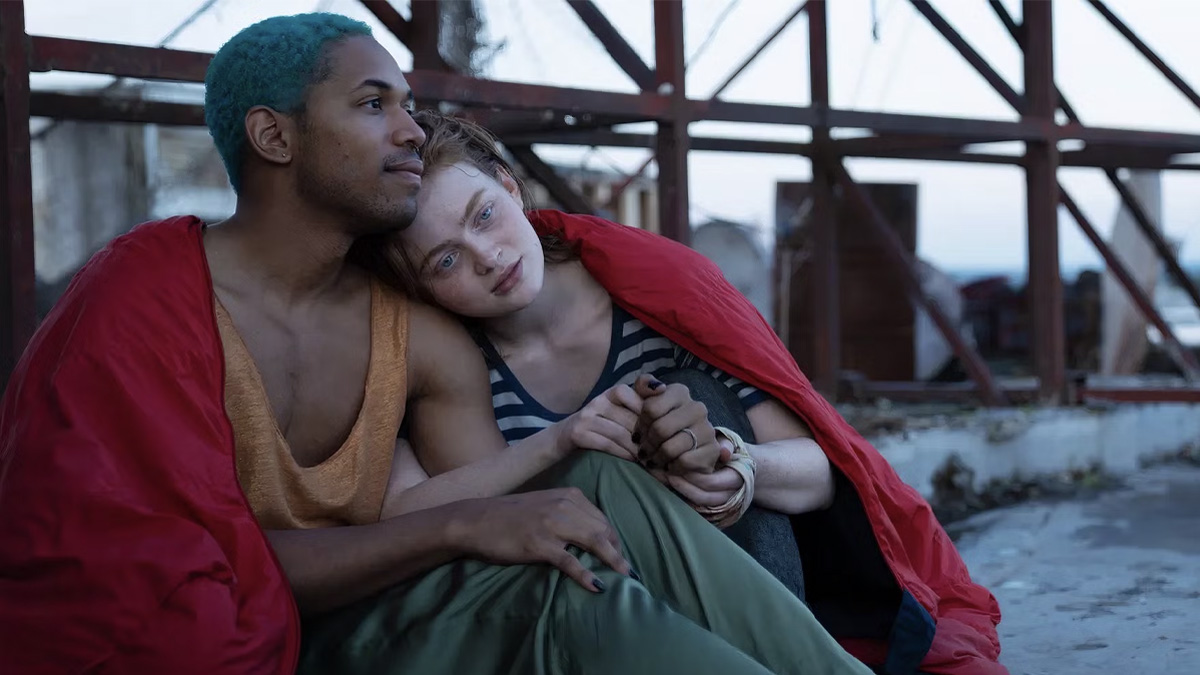
‘O’Dessa’ Film Review: Love, Music, and Greek Myth
Mar 19, 2025
A lot of thought went into creating the music for writer-director Geremy Jasper’s sophomore feature, O’Dessa. Jasper collaborated with Jason Binnick to create memorable odes to freedom and love. A good deal of the soundtrack has a fire that grabs the audience from the first scene and sets the tone for something emotionally earnest and unique. It is unfortunate to find that, with so many things going on, Jasper’s film is a pastiche of well-worn ideas that brings nothing new to the table. The film isn’t a failure, as there are things to admire, but the screenplay and direction can’t seem to bring it all together.
O’Dessa strives to be a dystopian retelling of Orpheus and Eurydice done as a Rock Opera. Such great heights are a commendable reach, but Jasper’s screenplay is too overstuffed. With all the pomp and circumstance that blazes across the screen every second, the emotional core fails to hit. It isn’t anyone’s fault that Jean Cocteau’s 1950 work Orpheus and Marcel Camus’s 1959 Black Orpheus exist as THE two cinematic masterpieces to distinctively tell the Greek myth. You have never seen anything like those two pictures and their unmatched visions stand the test of time. Unfortunately, audiences have seen many of the ideas that permeate this film, time and time again.
It will be difficult for viewers to fully immerse themselves into the story, as there are near minute by minute comparisons to be found. Darren Lynn Bousman’s 2008 cult favorite, Repo! The Genetic Opera and George Miller’s Mad Max series are front and center throughout the film’s run time. Sharp eyes will also spot a cocktail of references/homages to just about every post-apocalyptic movie ever made, and even a few jabs at today’s modern cult-worship culture. Whatever the allegory the filmmakers are striving to achieve, it all gets lost in a muddled visual style and clunky editing.
In a fantastic performance, Sadie Sink is O’Dessa Galloway, a farm girl who sets out to fulfill her destiny as “the Seventh Son,” a singer whose music will lead an oppressed people to a free-thinking life. The young woman’s farm life is a simple and satisfying one. She lives with her dying mother (Bree Elrod) on a patch of beautiful land surrounded by comforting mountains. O’Dessa and her mother spend their last days together singing songs and preparing her for her life journey. Mom tells her she is “bound to ramble”, as it is in her blood. O’Dessa’s father (singer-songwriter Pokey LaFarge) left the family to follow the music. It is the family heirloom (a guitar named The Willa) that kept dad on the road and away from his responsibilities.
When her mother dies, O’Dessa takes the guitar and sets out on her journey to “Satellite City”, an industrial, neon-hued, wasteland that is “Bartertown” by way of Hunger Games, by way of every other film set in a dystopian future. The city is under the dictatorial rule of a megalomaniacal tyrant named Platonovich. Played by Murray Bartlett, the character is an amalgam of annoying line deliveries and over-the-top presentation that becomes this film’s equivalent of Chris Tucker’s excruciating turn in Luc Besson’s The Fifth Element. Platonovich’s rule is enforced by Neon Dion (how very George Miller), a deadly enforcer who isn’t given enough to do and wastes the talents of the great Regina Hall.
Once in Satellite City, O’Dessa finds Euri Dervish (Kelvin Harrison Jr.) a rock star who will win her heart. This is where the deeper parts of the Greek myth will take shape, but also where the film gets lost in its own style.
O’Dessa is a film full of energy. There is always something happening and the goings-on are almost always filled with music. The varied musical styles (Rockabilly, Rock and Roll, Rap, Synth Pop) work well. With the exception of Plantonovich’s purposely awful voice-enhanced Pop tune, all of the songs hit. Sadie Sink proves herself a great singer and traverses the different musical genres with ease. The actress just may have a side career as a folk singer. It is a shame how the screenplay isn’t strong enough to back up the film’s energy nor the story on which it is based.
Working against the already unbalanced text, Jay Rabinowitz and Jane Rizzo don’t seem to have a firm grasp on their editing, losing the emotional links that should tether the audience to the characters. The clumsily structured scenes never find a cohesive thread, playing out in scattershot moments of varying interest.
While Jasper’s ideas are overwhelmed by a tendency for over-direction, the picture’s energy simply cannot be denied. Most of the musical sequences soar and Scott Dougan’s production design (while overly-familiar) is committed to dazzle. Rina Yang’s cinematography throws too much neon over everything, but the film does look good.
Of the performances, Sadie Sink truly rises above the inconsistencies and carves out an excellent performance. Her commitment to the character combined with her talent as a singer sustains the interest level long after the picture loses its way.
I am always impressed when a director does something far from the cookie-cutter normalcy of today’s cinema. As he did with his 2017 debut, Patti Cake$, Geremy Jasper strives for a different moviegoing experience. The filmmaker certainly does so here. It doesn’t fully make the grade, but it is far from a bad film.
O’Dessa is a misfire, but a damned ambitious one.
Now available on HULU
O’Dessa
Written and Directed by Geremy Jasper
Starring Sadie Sink, Kelvin Harrison Jr., Regina Hall, Murray Bartlett, Mark Boone Jr.
PG-13, 106 Minutes, Searchlight Pictures
Publisher: Source link



A Flame The Colour of Air – Film Threat
SLAMDANCE FILM FESTIVAL 2026 REVIEW! You will shimmer and shake, like you’re riding the snake while being wowed by the dynamite animated short A Flame The Colour of Air, written and directed by talented Canadian filmmaker Emily Pelstring. Jessica Mensch’s…
Mar 3, 2026

‘9-1-1’ Can’t Decide What It Wants To Focus On in a Lackluster Season 9
Editor's Note: The following contains spoilers for 9-1-1 Season 9, Episode 11.I was hoping that 9-1-1 would take advantage of its month-long hiatus and course-correct after its most recent episode, but while this week is certainly an improvement from last…
Mar 3, 2026
Good Luck, Have Fun, Don’t Die Review
Mercy was a film about AI that AI could’ve written. Good Luck, Have Fun, Don’t Die also tackles AI, although it could only come from the mind of Gore Verbinski. As he did with his Pirates of the Caribbean trilogy…
Mar 1, 2026

Investigative Screenplay Review: Suspenseful but Weak Antagonist
Vadh 2 (2026): When Murder Is Justified — Starring Sanjay Mishra as prison guard Shambhunath Mishra When evil tries to take control, its destruction becomes necessary. With this theme, Bollywood brings you a spiritual sequel to its 2022 crime-thriller “Vadh”.…
Mar 1, 2026