Oral HIstory: Nobuhiro Yamashita, Doona Bae, and James Iha on “Linda Linda Linda” at 20
Nov 2, 2025
Linda Linda Linda
Indie director Nobuhiro Yamashita was not under the impression that he had much insight into the lives of high-school girls. For his first three features (Hazy Life (1999), No One’s Ark (2003), and Ramblers (also 2003)) he’d focused on what he knew best—“lazy men.” But Yamashita’s fifth feature, Linda Linda Linda (2005), would prove pivotal, expanding the horizons of his career, his cast and Japanese independent cinema itself.
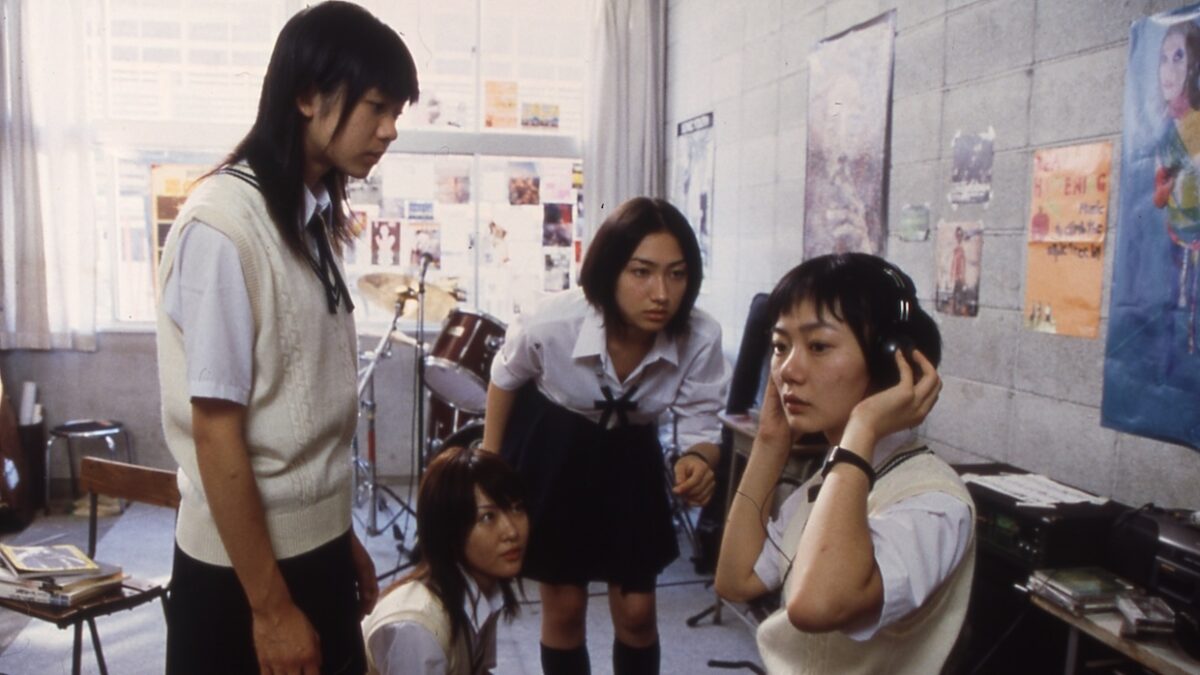
A gentle slice-of-life drama, Linda Linda Linda tells a story in snapshots of four high-school girls as they prepare for their debut performance as a band at their school’s culture festival. “I took it on as a challenge to myself,” a Beanie-clad and smiling Yamashita told me at Frankfurt’s Nippon Connection Festival in May, a few months before the film returned to theaters worldwide in a new 4K restoration. When he first came aboard , Yamashita didn’t have high expectations. The first draft of the screenplay, written by Wakako Miyashita, centered around a high-school cover band competing in a contest that had winners and losers. “I didn’t like that,” reflected Yamashita, who had his regular creative partner Kosuke Mukai rewrite the screenplay. “I wanted to make it more about the joy of playing music, so we switched it to a school festival context.”
The festival is just days away when two members of Paranmaum, a cover band of Japanese punk group The Blue Hearts, quit, leaving keyboardist Kei (Yuu Kashii), bassist Nozomi (Shiori Sekine) and drummer Kyoko (Aki Maeda) in desperate need of a vocalist. Enter Korean transfer student Son (Doona Bae). Timid with her limited Japanese, she’s nonetheless full of wide-eyed curiosity, capturing everyone’s attention.
“Originally, the vocalist was going to be a Japanese girl,” reflected Yamashita. “But that didn’t motivate me. I felt the film was lacking something. Around that time, I happened to watch Barking Dogs Never Bite, which starred Doona Bae, and found her really fascinating. I know it was a bit of a ridiculous idea -to offer a role to a Korean actress just to motivate myself. After casting her, we had to rewrite the screenplay. But, in the end, that enabled us to tell an additional story—about a girl who communicates through music to overcome the language barrier”.
“I was still a new actor, only a few years into my career,” remembered Bae. “My focus was on learning the craft and gaining experience through Korean productions. International projects weren’t on my radar. It was actually through Bong Joon-ho that I first heard a highly-respected Japanese filmmaker was interested in casting me. I watched all of Yamashita’s films and was completely mesmerized by his distinctive style of directing. I embraced the challenge—cultural and linguistic barriers included—because I was so captivated by his unique cinematic world.”
Many surprises awaited the Korean actress on set. “The overarching structure was similar to a Korean production; however, there were differences. One was the concept of ‘office rehearsals.’ To minimize on-set delays and shorten the overall shoot, the production team rented an office space and we all spent about a week rehearsing lines and blocking in real time. I also noticed a strong sense of independence among the cast—all the actors commuted to and from the set on their own by subway.”
A Korean character in a Japanese high-school drama is unusual, and Bae makes the character unmistakably her own. “On my first read, I found certain aspects of my character, Son, a bit difficult to understand, one example being her intense curiosity about other people’s love lives,” she said. “But I realized that these characteristics could simply be a reflection of broader perceptions that Japanese people had about Koreans. With that in mind, I gave a lot of thought and consideration into how I could portray those qualities in a way that felt endearing rather than intrusive or off-putting.” She equally found herself out of her depth with her character’s talents. “I told the director upfront that I wasn’t the best singer, but he reassured me, saying, ‘That actually suits the character even better.’ His words put me at ease and allowed me to fully commit to the role.”
The music of The Blue Hearts—including title track “Linda Linda”—is complemented by an original instrumental score by The Smashing Pumpkins guitarist James Iha. Later that decade, Iha would compose the score for Momoko Ando’s Kakera: A Piece of Our Life (2009), but Linda Linda Linda was his first score for a Japanese feature. “I watched the movie and tried to understand the different characters and their feelings,” reflected Iha. “Sonically, I thought that acoustic guitar, clean electric guitars, piano and synth (Juno 60) were the kind of instruments that seemed to fit.”
There’s a delicate and furtive quality to Iha’s score for the film, whose gently plucked chords assert themselves through repetition. It feels appropriately adolescent, like something about to blossom—a self-actualization. “Both then and now, this reflective, growing bloom type of sound—these are musical emotions that come out easily,” said Iha. “I also think the story in the movie is something I partly experienced myself being part of a band. There’s a universality to its emotions.”
What dominates Yamashita and Bae’s memories of the shoot is the immense rapport between the group. “One thing I remember well is the actress for the bassist’s character, Shiori Sekine.” said Yamashita. “She actually didn’t have any acting experience at all. She was a real bassist from a rock band, [Base Ball Bear, who also contributed songs], so we gave her a role that didn’t require much in the way of dramatic acting. The chemistry between the group was something that the four girls created naturally themselves. They got along really well as the filming went on. Sekine became the most popular, and she took on a leadership-like role within the group.”
“The atmosphere on-set was truly perfect,” said Bae. “Everyone was so supportive and eager to help one another as we went all-in on practicing our instruments. It genuinely felt like we were real bandmates and close school friends. One of my most lasting memories is when my three bandmates and I secretly went to Shimokitazawa after wrapping one day. The other girls were much younger than me and under strict management from their agencies, so they usually had to go straight home after filming. But we hatched a plan to all pretend to leave, then meet at the train station instead. Chasing after them through the narrow alleyways of Shimokitazawa was such a special moment. It was hard to tell whether it was a scene from the film or reality. I still hold that memory very close”.
“Looking back, Linda Linda Linda could have been a difficult experience for me. It was my first time working outside of Korea, and there were definite language barriers. But thanks to the support and kindness of my castmates, I was able to overcome those challenges,” said Bae. “Their encouragement gave me the confidence to later take on roles not just in other Japanese productions, but even Western films as well. Of course, there were moments of difficulty. Because I relied on a translator to communicate with the director, I often felt frustrated that I couldn’t speak with him directly to understand his intentions more clearly. It wasn’t an easy dynamic to navigate. But that experience became a turning point for me. It motivated me to learn to work without a translator in the future, and that’s exactly what I did when I eventually worked on an American film.”
Linda Linda Linda has received an outpouring of love from around the world since the announcement of its restoration, and Yamashita continued to receive copious fanmail about the film in the intervening years. It’s a surprising fate for an unassuming indie that has been out-of-print internationally for some time. “I believe that the simplicity as a film, and the influence and the universality of The Blue Hearts’ music, became a huge weapon for this film,” reflected Yamashita. “Rather than incorporating something that was trendy at that time, we made this film using something simple and universal. The drama and relationship depicted in this film could happen anytime.”
“I am not sure how the younger generation today will find this film,” he continued. “But I hear a lot of people saying they want to start a band after watching this film, so I believe there is something that moves people in this film. If someone is finding their personal life boring and this film made them want to try something new, I think it serves an important purpose.”
Iha remembers the film fondly, whose legacy follows him to this day. “I am thankful for the opportunity to be a part of such a great movie and I’m proud of the music. It still gets brought up and mentioned to me,” he said. “Also, The Smashing Pumpkins just toured with the Los Angeles band The Linda Lindas last year [who took their name from the film]”.
But the person for whom Linda Linda Linda was perhaps most life-changing is the one who stepped up to the microphone and allowed her voice to be heard by a new audience. “Linda Linda Linda is the film that opened my heart and gave me the courage to embrace challenges beyond my familiar world,” said Bae. “Thanks to the positive experience I had, I no longer feared stepping outside my comfort zone to try new things. This film remains one I am deeply grateful for. I believe it captures the truest version of myself”.
With thanks to Yuki Fujiwara and Iris Jang for translating.
Publisher: Source link



Wuthering Heights Review | Flickreel
As far as adaptations go, I’ve never viewed any source material as sacred, including The Bible. While a faithful adaptation is always welcome, I’m open to a filmmaker leaving their signature on a classic story, especially one that’s been told…
Mar 17, 2026
Amy Adams Sinks In Vapid, Misguided Alcoholism Drama By ‘Pieces of a Woman’ Director [Berlin]
For a solid decade, starting in the late 2000s with Disney’s charming fairytale comedy “Enchanted” all the way to Denis Villeneuve’s melancholy sci-fi “Arrival,” it was easy to trust Amy Adams, a six-time Academy Award nominee. Then, somewhere around Ron…
Mar 17, 2026
Mason Gooding & James Van Der Beek’s Bad Night Is Aggressively Dull
Ever since the Scream franchise helped put him on the map, Mason Gooding has been a great talent to watch. The genre-bending slasher Heart Eyes is still his best non-franchise role yet, but he's also branched outside of horror in…
Mar 15, 2026
A Grumpy Nick Offerman Keeps This Fish Tale Swimming Along
Animated fish films have been done. Finding Nemo. Shark Tale. Ponyo. So to hear about another doesn't feel like anything new. However, The Pout-Pout Fish, starring Nick Offerman as a grumpy ocean pout named Mr. Fish, is a little different.…
Mar 15, 2026