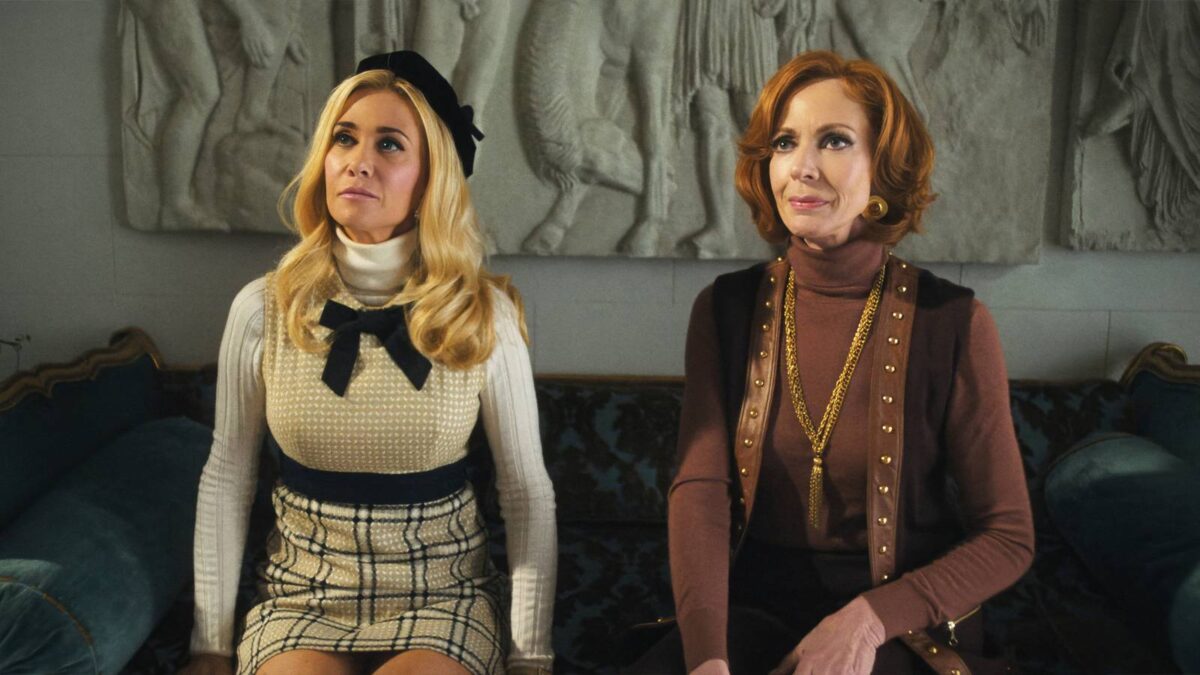
‘Palm Royale’ Showrunner Addresses Those Kubrick Easter Eggs, Douglas’ Dark Turn, and “Trouble” in Season 3
Jan 15, 2026
Editor’s Note: The following contains spoilers for the Palm Royale, Season 2 finale.
Summary
In an interview with Collider about the Palm Royale Season 2 finale, showrunner and creator Abe Sylvia says the ending may feel happy, but “trouble is around the corner” for the girls.
Sylvia explains Douglas’ “You’re going to regret this” isn’t a throwaway line — it’s a darker warning.
The showrunner goes on to reveal the Palm Beach Mole clue was “hiding in plain sight.”
The Palm Royale Season 2 finale is equal parts screwball, classic Hollywood homage, and emotional gut punch — a culmination that showrunner Abe Sylvia describes to Collider as a “musical comedy biddy movie.” While so much of its sophomore catalog is also infused with Hitchcockian tension and MGM-style optimism, Episode 10’s “Maxine Does Something Good” closes the book on a lengthy list of moles, deaths, and secrets that open the door to something far more unsettling. By the time wedding bells ring for Maxine (Kristen Wiig) and Robert (Ricky Martin), Carol Burnett’s voice carries the season out on The Sound of Music classic, “Something Good,” to deliver a finale that feels celebratory on the surface, yet suggests that power rarely comes without consequence. With Maxine and Evelyn (Allison Janney) now standing at the center of Palm Beach and looking like they can take on anything, Sylvia warns that, despite the happy ending, “trouble is around the corner.” In an exclusive interview with Collider, the showrunner spoke about constructing that tonal balancing act, including improvised choices that defined the finale (like that now-iconic decision to “throw him in the dumbwaiter”), as well as the season’s fixation on power, ambition, and storytelling. Sylvia also breaks down the unexpected Stanley Kubrick influence threaded throughout Season 2, from its precise language to the quiet menace lurking beneath the Apple TV show’s glossy, mid-century sheen.
From split diopters to ‘Mildred Pierce’ lighting — the season’s references were hiding in plain sight.
Image via Apple TV
COLLIDER: Abe, I love this show! This season was phenomenal, and it’s such an elevation from the first season that we got to meet all these new characters. Marjorie was one of my favorites because she’s so different. But something that I was so fascinated by was how there are little bits of references to hag movies and psycho-biddies. Were there any specific classic films — or even just one scene that you and the team kept circling as a tonal reference when building Season 2? ABE SYLVIA: Well, we did it throughout, so I appreciate you picking up on that. We did say this is our musical comedy biddy movie. That’s our mash-up, with a lot of Hitchcock, as well. In fact, you probably saw in Episode 6 the movie that Robert and Tom are watching in the motel is Hush…Hush, Sweet Charlotte, with Bruce Dern, Laura’s father, who actually acted in our show. So, there were several moments. I think, in particular, the moment Mitzi comes down the stairs in the first episode, and we’ve got that beautiful Bernard Herrmann-esque score. It’s mostly in the flashes of light through the woman’s eyes. We’re really leaning into not only biddy movies, but the photography of Mildred Pierce. We talked a lot about Kubrick, actually. There’s a lot of Stanley Kubrick references throughout the season, so I’ll just leave that to the fans to look for it. There’s lots of split diopter work, in homage to ‘60s filmmaking, and we really had split diopters on set, lining up those shots perfectly. Also, it’s like women of this age in that time, those would have been the movies they would have been in. So, I really appreciate you picking up on that because not everybody does.
Related
‘Palm Royale’s Midseason Twist Completely Tears Laura Dern’s Character Apart
Patti LuPone teases her introduction to Palm Beach means drinking the “blood of her victims.”
Well, it’s been such a fun season, and I loved how it had this MGM-esque and Hitchcock feel. After Mirabelle’s death, it built up to a nice mystery, so I do appreciate that. But, I have to say — the women moving Jed’s body was such a fun screwball moment, and then Maxine talking to the corpse while she’s in the dumbwaiter. That was so sharp and funny. I was wondering if that was something that was actually in the script, or was that something that you guys worked with Kristen [Wiig] on? Because of her delivery, I feel like she lives in that role, and that’s one of the best parts of her performance is that she gets very much lost in it. SYLVIA: You’re picking up on some really wonderful things. First of all, the screwball comedy aspect of trying to hide Jed’s body is sort of a metaphor for the way these women have had to carry the burden of toxic masculinity around with them. Not until they are rid of Jed’s body is Maxine able to say goodbye to Douglas, and Evelyn’s able to say goodbye to Eddie, because he sort of represents all of that. Now, that moment was so heartening to me because it was a moment where, by the time you’re shooting the finale, we were a rep company. We shoot very quickly. We rehearse very quickly. Actors have gotten really good at working with one another. I come out of musical comedy; people take months on the road to figure out that physical comedy and perfect it to bring it to a New York stage, and we’re doing it in maybe 10 minutes before. Of course, the dumbwaiter has been there for the entire time. Of course, you’re not thinking of every little thing at the moment. So, we started staging the scene. They took the body down the stairs, and then it was like the physical act of them going to throw the body back under the bed, and Maxine was going to hide under the bed with Jed. So, they’re dragging the body just naturally. Allison [Janney] and Kristen are just rehearsing. They’re doing their dialogue, they’re dragging the body farther and farther away from the bed, and I’m like, “Oh, it’s scripted that they throw him under the bed. Well, that’s not going to work,” And I just said, “Throw him in the dumbwaiter!” And they threw him in the dumbwaiter, and then Kristen’s standing there, and I’m like, “Get in!” So, it happened on the fly in rehearsal. I mean, it was planned, but we made that up on the day, and then we’re like, “Now Maxine’s stuck with the dead body in the dumbwaiter.” I turned to the director, Stephanie [Laing], like, “Just put a camera on Kristen and let her riff.” So, those scenes we actually shot simultaneously. So, as Allison is having her scene with Jason Canela as Eddie outside, the set is connected, [and] we just set up a camera on Kristen to react to the dead body in the scene that was going on. So that was all improvised, obviously on Kristen’s part, but it came out of this informed knowledge, and all of us just working together so well and trusting each other. And then, of course, it builds. It’s my favorite scene of the season. She gets out of the dumbwaiter, and you had sex with the waiter in the dumbwaiter. All of a sudden. None of that was originally there.
Sylvia Explains the One Shocking Detail That Reframes the Finale
The showrunner explains how Rafael’s “they bought it” moment is a clue that “truth… matters less than persuasion” ahead of Season 3.
Image via Apple TV
When we learned that Marjorie was the Palm Beach Mole all along, it kind of reframes everything. Looking back, what was the tell that you wanted the audience to miss so that when they go back to rewatch it, it was kind of hiding in plain sight? SYLVIA: We were scared it was too obvious. She is a collector of Faberge eggs, which are Russian eggs. We went around in the writers’ room like, “Maybe we just need to do a couple things that are on the nose for the audience,” and no one has picked up on it. But in reality, Marjorie Merriweather Post was the biggest collector of Czarist art, and single-handedly — I’m probably gonna get my history a little wrong here, but in reality, sort of financed the Communist Party by buying all of this confiscated Czarist art. She really was a hoarder of Russian art. But to this day, you go to the Post museums, and there’s all this Czarist art on the walls that she bought. So, we’re really playing with real history there now. Now, who knows? I don’t think she was a Russian spy, but we’re having fun with history with that. There’s enough reality. She really did want to give Nixon Mar-A-Lago. That’s a reality. Fingers crossed in Season 3 that we do get to see more of her. I want to see what else she does because Patti [LuPone] is amazing. She’s a complementary addition to the entire show, which is so great. Pair all of that, though, with Raphael’s final “they bought it” call, and it suggests that the truth matters less than the power of persuasion. Is Palm Royale now interested in secrets coming out? Like, who controls the story and who controls the narrative? SYLVIA: Oh, it’s probably both. I love that actor, Ian [Inigo], who plays Rafael. That could have been kind of a one-note, cheesy kid, and he came in and was very nuanced. We sort of whispered to him, “You’re the bad guy,” to say, “Okay, here’s the next place this story is going to go.” And it’s really hard with a young actor to be able to play that sweetness and that complexity with very few lines, and I just think he knocked it out of the park.
‘Palm Royale’ Creator Teases Douglas’ Dark Turn in Season 3 With One Word
Douglas’ threat hits harder after Sylvia casually confirms the next direction.
Image via Apple TV
He really did — and so did Josh Lucas as Douglas. I was so shocked by his turn that final line where he says, “You’re going to regret this.” It lands like a threat, and I’m wondering, should we be reading that as manipulation or maybe something darker for Season 3? SYLVIA: Yes. [Laughs] Okay. So we have the plan already in writing… SYLVIA: Oh, yeah. You and I are never done. Wow… it’ll be exciting to see him in another, very different layer. SYLVIA: Isn’t he wonderful in that scene? The fact that he’s so willing to go there when I think so many actors are concerned about their likability or are always trying to preserve their character. It’s like, oh, no, no, no, Douglas was kind of this Labrador retriever. “I don’t know what’s going on. I’m just being pulled in different directions with my white male privilege.” Like, that’s why you’re the bad guy. Yes — and the way he kind of sat in with those feelings when she’s talking to him? The performance is so good. You can tell he’s cracking, and how he was trying to hold it in. Then, at the end, when he said that to her, he’s on a murderous path now. He’s not happy. If he can’t have her, it kind of feels like no one can, and that’s scary. SYLVIA: Yeah, maybe I’m going off on a tangent here that I’m interested in, but that scene had this wonderful adventure with these women, and they have banded together. Ostensibly, they don’t like each other. They’ve been there for one another in these most ridiculous ways to get through these ridiculous circumstances that make up their lives, and most of it’s in support of getting Douglas his birthright. All these things that these people have gone through, she’s been doing it for him and them all along. So when she says to him, “Do this for the girls. We’ve done all of this for you. Can you do one thing for us?” And he can’t. We wrote that probably on the heels of Michelle Obama’s speech during the election, where she appealed to men, “Please do this for your mom, for your sisters, for your daughters,” and we know how that ended up. So, it is, “Can you come through for us now?” And for Douglas and for so many men, the answer is no.
Why Linda and Norma’s Reunion Was the Emotional Truth of Season 2
Sylvia says Norma and Linda were always shaped by that mother-daughter “rift” — and Paris is where it finally releases.
Image via Apple TV
Jumping into the final moments: Linda’s line, “I finally found love,” I really teared up watching that. That is such a sweet moment. You see, Norma, you see the two of them in Paris, and it really disarms you. What did you want that last feeling of Season 2 to be for the audience? SYLVIA: Well, what the audience didn’t realize the whole time was that Norma and Linda, their lives have been ruled by this initial rift between mother and daughter, that all the choices they’ve made in their lives, whether it be Norma/Agnes trying to hang on to everything she has so she can make up for having to have given up her daughter, or if you look at Linda and say all of her casting about looking for purpose is because there’s this essential wound that she’ll never heal. So in this last moment, it’s like neither of them has to worry about those things anymore because they’re back together. And it’s not necessarily a relationship the audience saw coming. But if you reflect back on all of their interactions and all of their behaviors, both of them go back to the fact that Norma/Agnes had to give Linda up all those years ago.
Why Maxine Marrying Robert Is Her Sweetest “Grace Note”
Sylvia says Maxine’s ending works because it turns a long-held burden into relief — and kindness becomes the solution.
Image via Apple TV
It’s such a sweet moment. I thought it was such a good way to end it — and then Maxine marrying Robert is framed as romantic, but it’s also deeply pragmatic, and it’s just the two of them being best friends. Do you see that marriage as her happiest ending so far, or maybe something just self-sacrificial, that she’s just really helping her best friend? SYLVIA: Her whole thing has been, “I’ve always wanted to give the man I love a child.” Everything she’s done over two seasons has been because she thought that she couldn’t do this thing for Douglas, and then she learns in Episode 9 that it was never her, that Douglas was the reason she couldn’t get pregnant, and it frees her of a burden, in a way. It’s just sort of a beautiful kind of grace note that she goes, “Well, I can give you your child. I can give the man I love a child.” She finally gets what she wanted. So, it’s sort of healing that wound that was a lie. She probably could have gotten pregnant with another husband, but she put it on herself. Even you saying that makes me tear up right now because it’s very sweet. It’s just such a wholesome conclusion for the two of them, and I love that. SYLVIA: Also, it’s this selfless act. She goes, “Wait a minute. This unlocks the baby trust.” She didn’t even mean to. Doing something selfless and kind was the thing that solved everything.
‘Palm Royale’s Sylvia Says Season 2’s “Happy Ending” Means Trouble Is Next for Everyone
Sylvia also pushes back on the expectation that women characters must be noble, arguing that audiences don’t demand that from male antiheroes like Tony Soprano.
I wonder now that if Season 2 was about ambition, what’s the emotional engine driving what comes next for everybody? Because I feel like, at the end, they kind of get what they wanted, but not what they deserve — at least for most of them.
SYLVIA: I think you can go back to Maxine and Evelyn’s last walk and talk by the pool. “Look at us. We are the two women at the center of the town that runs the world.” She says, “Easy, tiger. We took Palm Beach. What next?” The world. So, the whole thing is an allegory for right now, and it’s like these two women, they got everything they wanted. Now they are at the center of the town that runs the world, which is literally the truth as we’re living it today. So, I like to say it feels like a happy ending, but trouble is around the corner. Also, the quote from Dinah, when she says, “Sometimes someone else’s desire is a woman’s best path to power.” What a beautiful line. Leslie [Bibb] delivers it amazingly. Do you think Season 2 ultimately agrees with that idea, or is the finale sort of showing the cracks in that philosophy when we’re going into Season 3? Because, as you said, looking at that scene at the pool, there’s so much more that the two of them and the other girls can conquer, so to speak. SYLVIA: Thank you for noticing that line. That was written by Sheri Holman, one of our writers. Even though Sharr [White] and I wrote the episode, Sheri took a pass at that moment, and she goes, “There’s something here not quite working,” and she came up with that line, and it really stuck the landing. But I would remember she says “sometimes.” “Sometimes someone else’s desire is a woman’s best path.” You may not be able to get it for yourself. Getting it for someone else, and you can be adjacent, that’s as much as Dinah in that moment… And for many people, I wouldn’t just say women, their co-dependence, their investment in another person’s success, is their only way they’re going to have fulfillment. It’s a sad truth. I would like to think everyone’s evolving, but we’re not. I don’t necessarily always reward my characters with their… They never act necessarily in their best interests, and I think those are the people worth writing about, situations worth writing about. I think because our show is a show primarily about women, they’re expected to be a little bit more heroic, and I just think that’s so unfair to the character, or a little bit more noble. We don’t put that on male characters. We don’t expect Tony Soprano to be more; we love him for being the brute asshole that he is. And it’s not necessarily that Maxine is an antihero or any of our women are antiheroes, but to expect them to make the noble choice is deeply unfair to the characters.
‘Palm Royale’ Creator Reveals Season 2 Was a “Love Letter” To Carol Burnett
Sylvia calls reuniting Burnett with Vicki Lawrence a major “triumph,” and frames the “Something Good” number as classic-Hollywood sweetness.
Image via Apple TV
The MGM number, “Something Good,” was so sweet. I love how it plays over this moral wreckage for everybody. Were you aiming for that classic Hollywood optimism to clash with the reality of who these people actually are? Because firstly, I loved hearing Carol [Burnett] sing. She’s such a gem. I love her so much, and God bless her for who she is. But then that whole sequence was so well done. I love how in the premiere of the show, we have that voiceover of her, and then we have it with her ending it. SYLVIA: Well, our not-so-secret mission was to make the entire season a bit of a love letter to Carol, and there are Easter eggs throughout. You can look at the drapes in the foyer and her costume in Episode 3 and know that we’re paying homage to “Went With the Wind!” And of course, our triumph in this regard was reuniting her with Vicki Lawrence. What an honor. But that particular sequence, we’ve all seen weddings on TV shows, and we all know what the script is. Even if it goes awry, we know what the dialogue is on stage. So I wanted to have it be a scene about what people are thinking when they’re at a wedding, like how it’s impacting the people. Most brides and grooms on a wedding day, you talk to people, and if they’re being honest, they’re like, “I wasn’t present. I was out of my mind. I was so nervous.” But the way it impacts the people who are bearing witness, that’s what I wanted the scene to be about. For Norma, all of the wicked stuff that she has done in her life has brought her to this one sweet, tender moment. So, “I must have done something good along the way, because look at this.” The fact that Carol agreed to sing on the show was a triumph. Just a quick anecdote, when I approached her about it, I was nervous to ask her to sing on the show. She’d always hum on the set, or she’d sing a little something, and so one day she was singing a little bit, and I hadn’t asked her yet, and I was like, “Oh, this is my opening.” I just said, “Would you ever consider singing on our show?” And she said, “Well, that depends. It depends on the scene.” So I explained to her what the scene was — the script hadn’t come out yet — and she goes, “Okay.” I didn’t want to publish the script and have her see it the first time I’m asking her to sing. She was a little dubious of me as I was like, “It’s all in Norma’s head, and she’s singing a song, and it’s about the feelings of people.” She’s like, “Okay. That sounds good.” She said, “What’s the song?” And I said, “‘Something Good.’” And she said, “That’s Julie’s song.” And she said, “I’ll do it.” And so, there’s this other layer of it that’s in our Easter egging of wonderful tributes to Carol. Not only does the song make perfect sense for the moment, but she’s singing in real life one of her best friend’s signature songs. Palm Royale is now streaming on Apple TV.
Release Date
March 19, 2024
Network
Apple TV+
Writers
Abe Sylvia
Carol Burnett
Norma Dellacorte
Publisher: Source link





Wuthering Heights Review | Flickreel
As far as adaptations go, I’ve never viewed any source material as sacred, including The Bible. While a faithful adaptation is always welcome, I’m open to a filmmaker leaving their signature on a classic story, especially one that’s been told…
Mar 17, 2026

Amy Adams Sinks In Vapid, Misguided Alcoholism Drama By ‘Pieces of a Woman’ Director [Berlin]
For a solid decade, starting in the late 2000s with Disney’s charming fairytale comedy “Enchanted” all the way to Denis Villeneuve’s melancholy sci-fi “Arrival,” it was easy to trust Amy Adams, a six-time Academy Award nominee. Then, somewhere around Ron…
Mar 17, 2026
Mason Gooding & James Van Der Beek’s Bad Night Is Aggressively Dull
Ever since the Scream franchise helped put him on the map, Mason Gooding has been a great talent to watch. The genre-bending slasher Heart Eyes is still his best non-franchise role yet, but he's also branched outside of horror in…
Mar 15, 2026
A Grumpy Nick Offerman Keeps This Fish Tale Swimming Along
Animated fish films have been done. Finding Nemo. Shark Tale. Ponyo. So to hear about another doesn't feel like anything new. However, The Pout-Pout Fish, starring Nick Offerman as a grumpy ocean pout named Mr. Fish, is a little different.…
Mar 15, 2026