Paul Schrader’s Loose Trilogy Ends With A Whimper
May 18, 2023
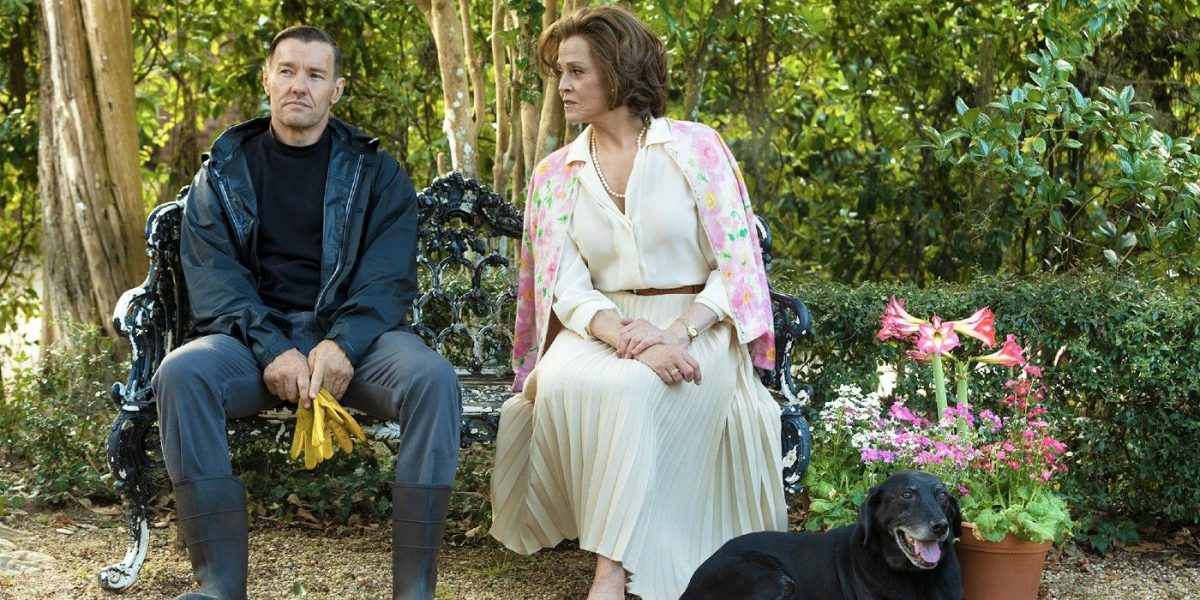
Paul Schrader’s loose trilogy, comprising First Reformed, The Card Counter, and now Master Gardener, has centered lonely men coping with the sins of their past while searching for a way forward in a world that feels alien. In Master Gardener, Joel Edgerton stars as Narvel Roth, a man who tends to the vast and abundant gardens of Sigourney Weaver’s Mrs. Haverhill, seemingly the only person who knows about his violent neo-Nazi past. In a striking moment of intimacy, Haverhill takes Narvel’s shirt off to reveal a canvas of neo-Nazi imagery splayed across his back, but she is not fazed. This scene is intended to be shocking or, at the very least, evocative, but, like Master Gardener itself, it is staid and muted, the last gasp of an effort to connect his two previous films via a thematic framework that has become a bit tired. While Schrader’s directing and the casts’ performances are more than up to standard, Master Gardener somehow ends up being less than the sum of its parts.
SCREENRANT VIDEO OF THE DAYSCROLL TO CONTINUE WITH CONTENT
Narvel is meticulous in his tending to Mrs. Haverhill’s gardening, dedicating himself to the physical act of pruning, planting, and caretaking as well as the exercise of learning about horticulture, its history, and its therapeutic benefits. It is through this that he finds release. Edgerton’s performance makes it clear that Narvel’s rage is festering just below the surface and when Mrs. Haverhill tasks him with taking care of her grandniece Maya (Quintessa Swindell), that rage threatens to rear its ugly head. Narvel’s past is told in quick flashbacks, not lingering too long on the violence that has permeated his life and mimicking the way the mind processes trauma in interesting ways.
Joel Edgerton and Quintessa Swindell in Master Gardener
Underneath all the strife, isolation, and sadness, though, is a clear sentimentality that stands in contrast to the uglier elements of the film’s plot. When Maya enters the picture, a new layer is revealed to Weaver’s character, one that, like Narvel’s rage, sits right below her prim surface. Mrs. Haverhill may be acting under the guise of wanting to protect Maya, but there’s a clear condescension that highlights the dynamic between the two characters — a rich white woman and a young woman of color whose background would be deemed unsavory by those with prejudice. Narvel responds to Mrs. Haverhill’s arrogance by developing a relationship with Maya that becomes Master Gardener’s beating heart.
This beating heart isn’t enough to elevate the film to greatness, though. For all its parts that are working (Schrader’s direction, Weaver and Edgerton’s performances), there are as many parts where Master Gardener fails to live up to the greatness teased. Swindell’s Maya is a stand-in for ideas rather than a fully fleshed character and the script can’t help but let her fall into a damsel-in-distress trope made all the more uncomfortable by the fact that her white savior is a former neo-Nazi. That Master Gardener fails to interrogate this idea in any meaningful way leaves behind a feeling of half-baked-ness that can’t be forgotten.
Joel Edgerton in Master Gardener
The film also has the disadvantage of coming at the tale end of this trilogy. Its first entry, First Reformed, earned Schrader a Best Original Screenplay nomination. While The Card Counter didn’t reach similar levels of acclaim, it was an overall sturdier piece of storytelling that looked at man’s moral responsibility with a more keen eye. Compared to those films, Master Gardener is an unexciting film, its central premise of a neo-Nazi turned horticulturalist too on the nose to hold up a film that’s already in a default state of withholding.
Is it reflecting on what it means to carry a legacy of violence, or is it a metaphor for how, with careful tending, a formerly violent man can become something akin to a flower in a preserved garden — stately, monastic, to be looked at and beheld, but nothing more? Edgerton is undoubtedly a master in the role — he rarely turns in a bad performance — and as Narvel he’s both empathetic and steely. Weaver and Swindell are both formidable scene partners, too. Still, when compared to the other films in Schrader’s trilogy of lonesome men, Master Gardner is clearly the weakest. That Schrader’s work here is still as good as it is, then, is an achievement in itself.
Master Gardener premieres in theaters on May 19. The film is 111 minutes long and rated R for language, brief sexual content and nudity.
Publisher: Source link



The SpongeBob Movie: Search for SquarePants Review
It raised more than a few eyebrows when The SpongeBob Movie: Search for SquarePants was selected as a closing night film at AFI Fest. It made more sense within the screening’s first few minutes. Not because of the film itself, but the…
Feb 5, 2026
28 Years Later: The Bone Temple Review: An Evolving Chaos
Although Danny Boyle started this franchise, director Nia DaCosta steps up to the plate to helm 28 Years Later: The Bone Temple, and the results are glorious. This is a bold, unsettling, and unexpectedly thoughtful continuation of one of modern…
Feb 5, 2026
Olivia Wilde’s Foursome Is an Expertly Crafted, Bitingly Hilarious Game of Marital Jenga
If you've lived in any city, anywhere, you've probably had the experience of hearing your neighbors have sex. Depending on how secure you are in your own relationship, you may end up wondering if you've ever had an orgasm quite…
Feb 3, 2026
Will Poulter Is Sensational In An Addiction Drama That Avoids Sensationalizing [Sundance]
Despite all the movies made about addiction, the topic does not naturally lend itself to tidy cinematic narratives. (At least, when portrayed accurately.) While actors often visualize the condition of substance dependency through expressive physical outbursts, the reality of recovery…
Feb 3, 2026