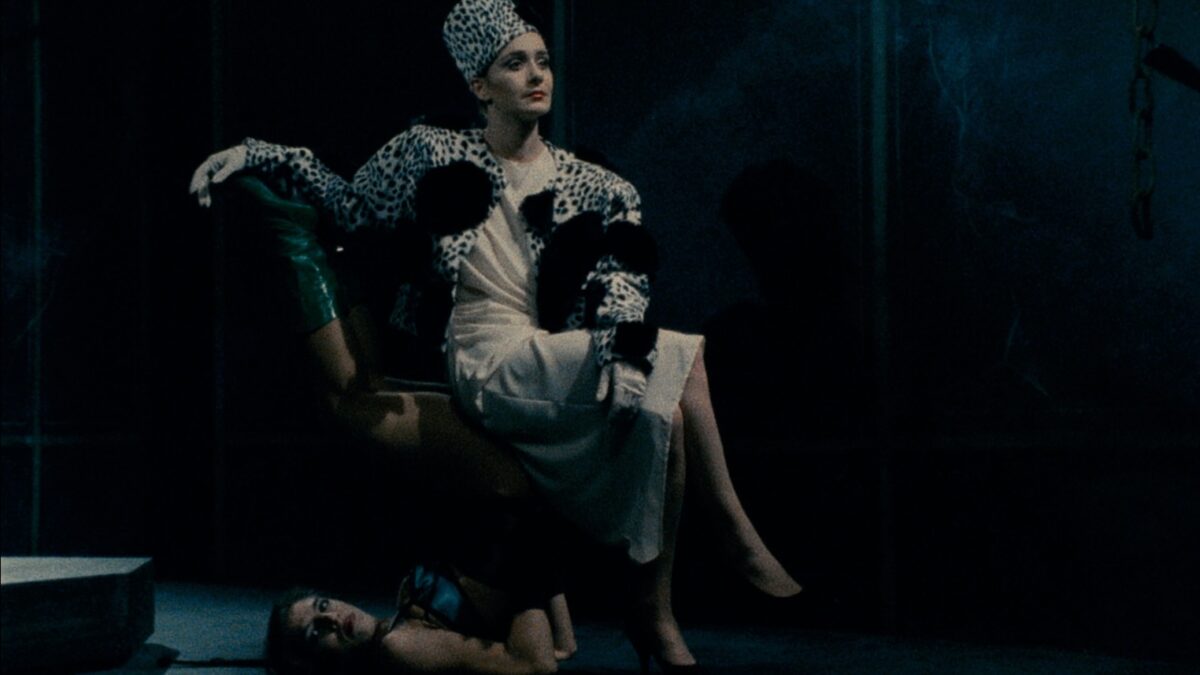
“Seduction: the Cruel Woman Was Banned for 18 Years”: Monika Treut on her Queer Trailblazing Career
Oct 11, 2025
Seduction: The Cruel Woman
It’s hard to believe that it’s been a decade since I last interviewed queer film pioneer Monika Treut. At the time trans identity was just starting to become tentatively accepted. Fifty Shades of Grey (a story centered around two straight, white, privileged cisgender protagonists into BDSM) had been released earlier that year, and was well on its way to becoming a glitzy Hollywood franchise. In other words, marginalized subjects the German filmmaker had been deeply and cinematically exploring for over three decades — Seduction: The Cruel Woman (Verführung: Die grausame Frau) hit screens in 1985! — were just beginning to enter the mainstream consciousness. Which inevitably proved to be both a blessing and a curse.
And that’s why it’s an honor to catch up once again with Treut, whose eclectic oeuvre also includes docs like 2001’s Warrior of Light, a portrait of the human rights activist Yvonne Bezerra de Mello, and 2012’s The Raw and the Cooked, a dive into Taiwan’s culinary traditions, just prior to the Anthology Film Archives run of “Female Misbehavior: The Films of Monika Treut” (October 11-19), a seven-film retrospective of the icon’s recently restored early works.
Filmmaker: How did this retrospective come about and why now? (I believe you had a virtual retro during the pandemic.) How involved were you in the selection of the films?
Treut: You’re right, there was a small duo digital retrospective of Elfi Mikesch’s and my films at the Anthology during the pandemic in 2020 (organized by the German Goethe Institute with a Zoom Q&A). Apart from this nothing much was going on with my films in the US. First Run Features was still sitting on them without actively promoting them. And then Liz Purchell expressed interest in rereleasing some of the films.
Luckily Liz and I met in New York last October, and so the idea became more real that she’d take over. She chose seven titles that she believed could attract a new audience. Since I haven’t spent much time in the US within the last few years, I haven’t a clue as to what a younger audience especially is interested in. Liz has that hands-on experience with certain audiences, and knows the films well, so I trust her. Plus, with the recent political developments I’m really not sure how cinema can work these days.
Filmmaker: I’m hoping you might talk a bit about your films’ restorations by the Hamburg Kinemathek. How involved were you? What did that process entail?
Treut: Well I guess it went like the usual process — sitting there with a color grader and checking the original scene by scene. I was lucky to have a very dedicated person to work with who did a great job. Money-wise it was a collaboration between the cultural ministry of the city state of Hamburg, the Metropolis Kino & Kinemathek Hamburg, and my German distributor Edition Salzgeber in Berlin.
Filmmaker: Two decades separates Genderation from your most recent film, 2021’s Gendernauts. So what prompted you to revisit these characters all these years later?
Treut: The protagonists and I stayed in touch over all those years, we had become friends. And Gendernauts kept being screened at festivals in Germany and other countries, in series on trans and queer issues. Sometimes I could be there for Q&As. One question was asked by audiences again and again: How are the protagonists doing these days? So basically the audience inspired me to do a sequel. Also, I was quite interested in focusing on aging and how to cope with “unfriendly politics.”
Filmmaker: I also wondered how you choose your participants. It seems you not only alternate between fiction and nonfiction filmmaking, but have done so with some of the same people (notably Annie Sprinkle).
Treut: Yes, Annie was in My Father is Coming, Female Misbehavior, Gendernauts and Genderation. I can’t think of any other actor I’ve used in both forms. She is and was always a fountain of inspiration with her talent to reinvent herself over and over, from sex worker to porn movie star, to performance artist, photographer, filmmaker and activist — and I’m sure her journey will go on. Really I’m just a total fan of Annie’s.
Filmmaker: I’m likewise curious to hear how the reactions, both here and in Europe, to your early work has changed over time. After all, subjects like gender fluidity and sadomasochistic practices have gone from near-invisibility or pariah status, to near-acceptance, to the current inevitable backlash (at least in the US).
Treut: That’s a big question. For one thing, after Seduction: the Cruel Woman was banned for 18 years by the German federal board of censorship, it finally got off that list about 10 years ago. (Though we still secretly showed it in movie theaters, which actually raised interest in the film.) Virgin Machine also was met with a lot of prejudice in Germany, but slowly these two especially became little cult classics.
Maybe because I never stopped making films as the stubborn person I seem to be, and because queer film festivals around the world kept screening most of my work, plus most of them were supported by the Berlinale, they never died. Though interest was sleepier in the US. I don’t know exactly why, but I guess the cultural climate for films is just tougher since there is very little financial support and films need to perform strongly at the box office. In Europe we still have more support.
That said, this might change in the near future because right-wing politics are getting stronger. Their agenda is not too different from what’s going on in the US right now, targeting trans people, queer and leftist people. Now at my age (I’m 71) my personal status as a total outsider has finally changed. I’ve gotten some recognition as a trailblazer for equal rights, women’s rights, queer rights, and trans rights.
Publisher: Source link





Wuthering Heights Review | Flickreel
As far as adaptations go, I’ve never viewed any source material as sacred, including The Bible. While a faithful adaptation is always welcome, I’m open to a filmmaker leaving their signature on a classic story, especially one that’s been told…
Mar 17, 2026

Amy Adams Sinks In Vapid, Misguided Alcoholism Drama By ‘Pieces of a Woman’ Director [Berlin]
For a solid decade, starting in the late 2000s with Disney’s charming fairytale comedy “Enchanted” all the way to Denis Villeneuve’s melancholy sci-fi “Arrival,” it was easy to trust Amy Adams, a six-time Academy Award nominee. Then, somewhere around Ron…
Mar 17, 2026
Mason Gooding & James Van Der Beek’s Bad Night Is Aggressively Dull
Ever since the Scream franchise helped put him on the map, Mason Gooding has been a great talent to watch. The genre-bending slasher Heart Eyes is still his best non-franchise role yet, but he's also branched outside of horror in…
Mar 15, 2026
A Grumpy Nick Offerman Keeps This Fish Tale Swimming Along
Animated fish films have been done. Finding Nemo. Shark Tale. Ponyo. So to hear about another doesn't feel like anything new. However, The Pout-Pout Fish, starring Nick Offerman as a grumpy ocean pout named Mr. Fish, is a little different.…
Mar 15, 2026