‘Sirât’ Review: I Was Just Getting Comfortable With This Cannes Film — Then It Shattered Me
May 16, 2025
When you hear the logline for Sirât, you can quickly conjure up a faint idea of how the film will unfold. The first half plays exactly how you expect it would, with fairly predictable beats and character quirks. A father and son looking for their daughter and sister at a rave in the middle of the Moroccan desert lead them to cross paths with a group of misfit ravers living off the grid. Unlikely friendships, exchange of perspectives, and a warm road trip adventure story unfold. And then, towards the end of the second act, just when you’re fully eased into the story, director Oliver Laxe yanks any comfort away from you in the most devastating way possible. From there, Sirât becomes a completely different film, one you may have predicted with a close eye, but, largely, it’s one that feels totally unprecedented.
Operating somewhere between the baron, random meanness of Mad Max and the ethereal existentialism of Picnic at Hanging Rock, Laxe packs two hours with a revolving door of tone, ideas, and overall sentiments, as a small story of a family’s search for a loved one becomes an analogy for one of the biggest crises in our world today. It’s ambitious to say the least, but this 180 two-thirds into the film, and how the movie so suddenly and harshly changes its angle, is almost too destabilizing to follow the film’s last act. Laxe is aiming to shock the audience, and in that, he succeeds, but the final product suffers as a result.
What is ‘Sirât’ About?
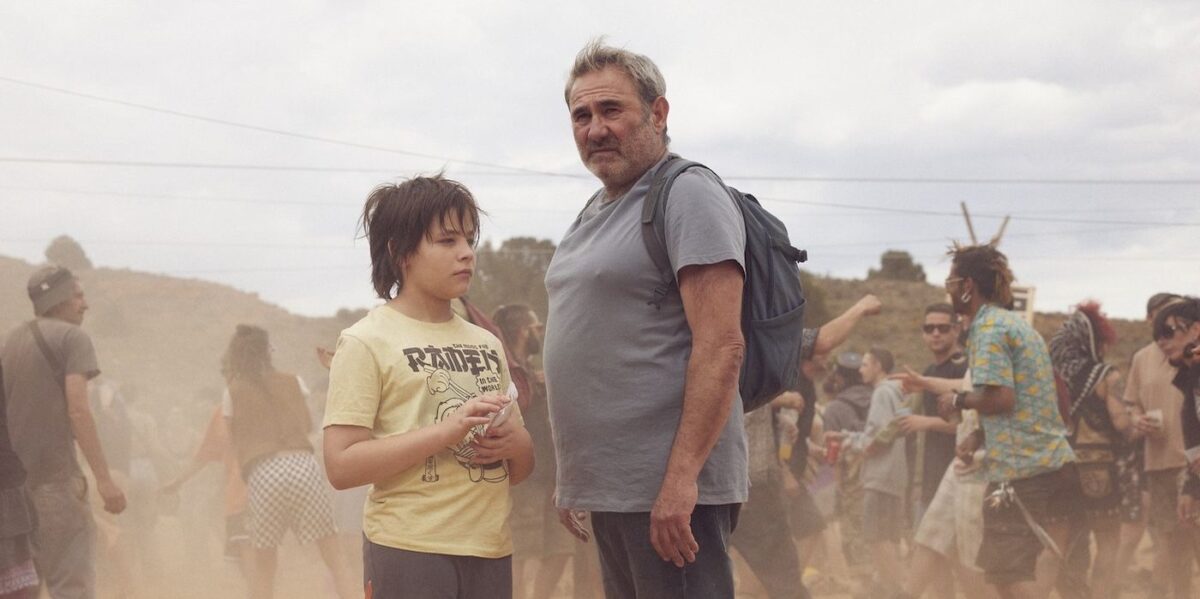
Luis (Pan’s Labyrinth’s Sergi Lopez) and his 12-year-old son, Esteban (Bruno Nuñez), travel to the hot and remote mountains of Morocco to an electronic rave that they look and feel out of place in. They are passing around flyers with images of Mar, their daughter and sister, who walked out on them five months prior, and they haven’t heard from her since. They were told that she could be at this rave, and they give the missing flyer to anyone who will listen. When they start speaking to a group of seasoned ravers and travelers, they hear of a secret second rave, where they believe they could find Mar. The first rave is cut short by the armed forces, who come to deport everyone back to their home countries.
As the group — made up of Jade (Jade Oukid), Tonin (Josh January), Bigui (Richard Bellamy), Stephy (Stefania Gadda), and Josh (Joshua Liam Herderson) — flees from the guards, Esteban wills his father to follow them. Despite initial hesitation, the group allows the father and son to follow suit. As they traverse the mountains and desert of Morocco, staying as far away from the national unrest and warfare as possible, this mishmash of characters all stand to learn something from each other. Luis is constantly challenged in his views of the people who live far different lives from his, and Esteban sees firsthand that family doesn’t always mean biological. It’s all surprisingly sweet and earnest, as these lost souls forge familial bonds and learn to depend on each other. And then, something happens.
To ruin the twist of sorts (it’s less a smart narrative tactic and more a devastating and shocking plot point) would be to take away from the film entirely. Despite Laxe conjuring a faint but very present air of dread in the lead-up, it’s something you immediately shake off as you would never think the film would go that far, or it would be something close to danger that would resolve itself just as quickly. It’s also so jarring that I felt it took me the better part of 10 minutes before I could fully reenter the film. And then, it only gets more devastating from there. The final shot makes it clear that Laxe is crafting an analogy for the refugee crisis and the growing displacement of millions of people, and how their journey to safety puts them on the brink of death at all times. The characters, like the very real people forced out of their homelands every day, are all in pursuit of something — a rave, a loved one, some form of family, or somewhere to simply exist freely.
‘Sirât’s Last Act Takes a Shocking and Tragic Turn
Image Via BTeam Pictures
When the credits roll, and you’re finally given time to digest everything you’ve just seen, Laxe’s execution and intention don’t seem that harmonious. Instead of being a harsh but true confrontation with how fragile mortality is for those fighting for the right to exist, Laxe’s final act just feels mean-spirited. This is mainly due to the lack of interiority in many of the characters. While we do get glimmers into each of their backgrounds and how they ended up in the depths of the desert, choosing to a live a life of shitting while on acid and living off food rations, it all remains surface-level.
These are all clearly vulnerable characters, and Laxe and co-writer Santiago Fillol do succeed in making us invested in them so that when any of them are in peril, it feels like a shot to the stomach. But at times, Laxe’s bluntness can tilt over into a stark lack of tact, mishandling both the trauma on screen and the sensitivity of what he wants it to stand in for. The search for Mar is abandoned entirely, losing the crux of the entire story. We’re not here for a rip-roaring time through the desert, but to see a loving father and son find their lost family member. Laxe reaches out to give us a precious stake in the story before, rather coldly, dropping it and letting it shatter right in front of us.
Related
‘Mission: Impossible — The Final Reckoning’ Review: Tom Cruise Gives a Fitting Conclusion to One of the Greatest Action Franchises Ever Made
If they choose to make this their final mission, this would be a solid note to go out on.
But where Laxe can’t be faulted is the direction. Don’t expect the immediately identifiable style of George Miller or Peter Weir here — this is a distinctly European production — but Laxe’s more toned-down shooting does help to digest the desolate hellscape that the desert becomes. Music and sound are just as crucial as the cinematography here — Mauro Herce captures the desert with kinetic awe before turning into the grounds of fleeting destruction — David Kangding Ray’s score is as dizzying as it is sobering. It’s the type of music Jade says is supposed to be danced to, not listened to, with an underlying hum of an emergency siren that creates the perfect soundtrack for this meeting point of hedonism and brutality.
Oliver Laxe Doesn’t Achieve Everything He Sets Out to with ‘Sirât’
Image Via BTeam Pictures
While the movie is an emotional rollercoaster where each turn is hidden until you’re in the throes of being pulled upwards and sideways, the cast remains a grounding force throughout all the chaos. Sergi Lopez is instantly perfect as the devoted Dad out of his depth, struggling to climb a small hill to hand out fliers. When cinema dads looking for their daughters are usually just Liam Neeson shooting as many people as possible, Luis is a gentle, thoughtful, but just as devoted substitute. He and Nuñez create a believable and tender flow right from the beginning, and it’s Nuñez’s openness to the world, something his dad has lost, that ties the entire cast together. And when tragedy strikes, Lopez is asked to add a whole other world of pain to his performance, becoming the tragic hero of this Shakespearan-Biblical odyssey. The extended cast fills their roles well, not falling into the party people tropes of obnoxious kids running away from a broken home. They’re older, wiser, and more soulful, with Richard Bellamy’s Bigui and Jade Oukid’s Jade bringing a doleful warmth in their conversations with Luis and Esteban.
Sirât doesn’t accomplish everything it sets out to achieve. The last act will lose some audiences, and the abandonment of the narrative the movie sets out in the first half makes the journey feel a bit disingenuous. But it’s still a gorgeous-looking and sounding film, held together by a cast of soulful performances. Compared to Sound of Falling, another Palme d’Or contender with death and destruction galore, Sirât gives some meaning to its despair. It doesn’t revel in the tragedy, but the bluntness and unrelenting nature of Laxe’s exploration of morality does work to take the focus away from the very real issues that are simmering under the plot.
Sirát premiered at the 2025 Cannes Film Festival, where it will compete in the main competition for the Palme d’Or.
Publisher: Source link





‘Off Campus’ Teaser and Release Date Revealed by Prime Video
No one expected a love story between rival hockey players to become one of the most talked-about TV shows of 2025, but there's a lot more where Heated Rivalry came from, as a new teaser for Prime Video's foray into…
Mar 21, 2026

Sarah Michelle Gellar Urges ‘Buffy’ Fans to Avoid Reading Leaked Reboot Scripts
Buffy the Vampire Slayer fans have had a rough few days after Hulu officially pulled the plug on a revival of the series, which would have brought star Sarah Michelle Gellar back as the titular heroine. Described as a continuation…
Mar 20, 2026
![Born Again’ Stars Explain Why Bullseye Is So Dangerous in Season 2 [Exclusive]](https://www.filmibee.com/wp-content/uploads/2026/03/Born-Again-Stars-Explain-Why-Bullseye-Is-So-Dangerous-in-1200x675.jpg)
Born Again’ Stars Explain Why Bullseye Is So Dangerous in Season 2 [Exclusive]
Along with Charlie Cox's Matt Murdock and Vincent D'Ofnorio's Wilson Fisk, Daredevil: Born Again Season 1 brought back one of The Man Without Fear's most notorious villains: Wilson Bethel's Benjamin Poindexter, better known as Bullseye. Not only was he back…
Mar 19, 2026
Born Again’ Showrunner Confirms ‘Avengers’ Character Is Key to Street Level MCU [Exclusive]
Ahead of the Avengers' return to the big screen later this year, Marvel Studios will return to street-level storytelling with the second season of Daredevil: Born Again on Disney+. Along with making the show canon to everything that happened in…
Mar 18, 2026