‘The Color Purple’ Review — Musical Update Loses Some of the Story’s Power
Dec 19, 2023
The Big Picture
The Color Purple’s adaptation to a musical format is a celebration of life and a reminder that change is possible. The bolder and more extroverted characters, such as Sofia and Shug Avery, work best in the musical format. While the musical format is impressive, it doesn’t capture the power and complexity of Celie’s character as effectively as the original film adaptation.
In 1985, Steven Spielberg released The Color Purple, his adaptation of Alice Walker’s Pulitzer Prize-winning novel, which would go on to be nominated for 11 Academy Awards. While Spielberg was an odd choice to bring this book to the screen, it was his penchant for capturing magic on screen that made this such a tremendous adaptation. In telling the story of the insular, quiet Celie Harris (played by Whoopi Goldberg) and her difficult life in Georgia, Spielberg was able to make us feel the power of the small joys in life, whether it was trying on makeup for the first time in years, or hearing a song dedicated to her in a bar. Celie almost always keeps her emotions hidden, and when that changes, that moment hits like a ton of bricks—a relief after so much built-up tension. Even though Celie keeps to herself, Spielberg and Goldberg’s performance made silence a powerful statement.
In what seemed like another odd choice considering the subject material, The Color Purple received a musical adaptation in 2005, which, strangely enough, also received 11 Tony Award nominations. And now, in 2023, director Blitz Bazawule (Black Is King) has adapted this musical to the screen—a fascinating film to watch in comparison to Spielberg’s take. While Spielberg focused on the pain and trauma that Celie went through, Bazawule’s adaptation is more of a celebration, a reminder that life can always start anew, and that great change is possible. However, while Bazawule’s adaptation of Walker’s book is an important counterpoint to Spielberg’s film and a strong musical in its own right, The Color Purple can’t help but lose some of its power due to this medium.
The Color Purple A decades-spanning tale of love and resilience and of one woman’s journey to independence. Celie faces many hardships in her life, but ultimately finds extraordinary strength and hope in the unbreakable bonds of sisterhood. Release Date December 25, 2023 Director Blitz Bazawule
What Is ‘The Color Purple’ About?
The Color Purple immediately introduces us to Celie (Phylicia Pearl Mpasi) and Nettie (Halle Bailey), two sisters who do everything together. Celie is pregnant with her second child from her father, and as with the first baby, upon giving birth, the second baby is taken from her as well. Soon after this birth, Celie is sent to get married to “Mister” (Colman Domingo), who has a home with unruly children of his own. After Nettie comes to live with Mister and Celie, the two are ripped apart when Mister sends Nettie away, threatening to shoot her if she ever comes back.
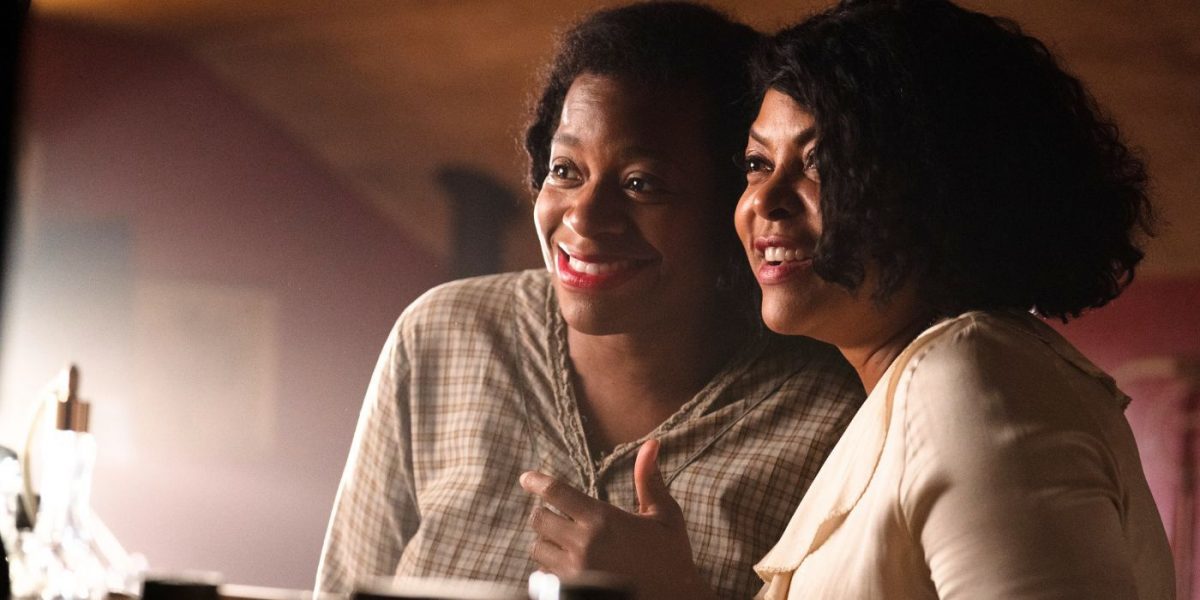
The Color Purple then introduces us to the grown Celie (Fantasia Barrino), who lives a lonely life, cleaning, suffering the abuses of Mister, and hoping that one day, she’ll receive some note from her long-lost sister. As we watch Celie over the decades, we see the moments of joy that are sprinkled too sparingly throughout her life. These small periods of respite come from the people she meets in her life, such as Sofia (Danielle Brooks), a loud, strong woman who marries Mister’s son Harpo (Corey Hawkins), and Shug Avery (Taraji P. Henson), a singer who Mister has had a longtime affair with.
‘The Color Purple’ Naturally Works Best With the Bolder Characters
Image via Warner Bros.
Bazawule’s musical format works best with characters who are bold and extroverted already, such as Sofia and Shug Avery. For example, when Harpo attempts to hit his wife, Sofia retaliates with the formidable song “Hell No,” flanked by other women not willing to take this sort of abuse. Shug Avery is inherently musical, and this makes her arrival on the scene a light in Celie’s dark world. Through just a song and a little attention, we can understand why Celie would immediately become drawn to this natural performer.
Both Brooks and Henson are giving performances that put their own spin on these characters in truly wonderful ways. Brooks had big shoes to fill, portraying a role originally played by Oprah Winfrey, but Brooks’ attitude and sense of humor makes her the primary scene-stealer in this already impressive cast. Similarly, Henson’s Shug is a character that lives in the spotlight, and Henson knows exactly how to be the center of attention in a way that makes her feel like a celebration personified.
Fantasia Barrino’s Celie Suffers the Most From the Musical Format
Image via Warner Bros.
Yet despite Barrino’s crucial, and often fabulous performance, the musical format doesn’t do the character of Celie any favors. Celie is a character who keeps to herself, remains quiet for most of the story, and hides her pain in her internal monologue and letters. It’s this isolated nature that makes Celie such a magnificent presence once she stands up to the cruelty brought about by Mister, and makes those rare moments of happiness all the more important. These moments don’t leave the same impression when a character can stop the narrative to have her own musical number—regardless of how phenomenal a singer Barrino is. In the third act, when Celie has found her own version of independence, Fantasia certainly shines in some of the film’s best musical numbers that make us feel the plight that she’s gone through. But in the build-up to that, the structure leaves some of the power lost in the translation. In Celie, we feel the disappointment, but lack the hatred, the anger, and the exhaustion that is underneath her every action.
Bazawule’s adaptation, written by Marcus Gardley, also structurally loses some of the build in the film’s drama. The passing of time isn’t as pronounced as it probably should be, the emotions of the characters are often muted, and the occasional stopping of the film in its tracks to give a musical number all makes this story seem more compressed and without the time necessarily to aptly set up the tension within this story. In one of this story’s most striking moments, we watch how Sofia struggles with years of her life taken away from her, and in this retelling of The Color Purple, we don’t feel this assemblage of time. We can’t feel the precious life that she’s lost through this period. We know the feelings that Bazawule and Gardley want us to feel, and yet, the storytelling never quite gets there as effectively.
‘The Color Purple’ Is a Necessary Celebration of Life
Image via Warner Bros.
But visually, Bazawule knows how to present this striking approach to this story. With cinematography by Dan Laustsen (The Shape of Water, John Wick: Chapter 4), The Color Purple is gorgeous, from the fields that look like go on forever, to a simple shop lit with the barest lighting. A musician himself, Bazawule brings these musical numbers to life, finding just the right way to insert these songs into the story—even if they do occasionally disrupt the narrative flow at times. If The Color Purple was going to get a film adaptation of this musical version, it’s hard to imagine anyone doing a better job than what Bazawule does here.
Bazawule and Gardley also excel at making the latter part of this story a celebration, a joyous reminder of how our lives, relationships, and beliefs can change over our precious few years. It’s in this period that Fantasia truly shines, as she’s finally given something to sing about, and the messages of sisterhood and love become the overriding emotion. Fantasia shows us a character who is discovering life for the first time, and in doing so, we see the importance of this new adaptation, and why looking at this story through a more optimistic mindset is a necessary shift. This is also where Domingo’s Mister gets a magnificent arc that shows these points beautifully, and more directly shows this ability to change. In a year where Domingo has also been expectedly solid in Rustin, he’s even more remarkable here, creating a character that we both loathe and come to question our feelings towards by the film’s end.
Even though The Color Purple is a commendable attempt to bring this musical to the screen by Bazawule and Gardley, the most formidable moments in this film don’t revolve around musicality at all, whether it’s Celie finally standing up for herself at a dinner, or the few moments where Celie feels truly seen by Shug, alone in a bedroom together, away from Mister. While the musical numbers are a nice touch and play to this take as a celebration of life, rather than focusing on the pain, it also feels largely unnecessary in bringing Walker’s story to life. Bazawule’s take almost feels like it needs to exist after Spielberg’s adaptation, but it also doesn’t match the emotional highs that the original film had. Yet, despite its flaws, Bazawule’s strength behind the camera and an incredible cast down the line make The Color Purple a worthy adaptation.
Rating: 7/10
The Color Purple comes to theaters in the U.S. on December 25. Click below for showtimes.
GET TICKETS
Publisher: Source link





Apple TV’s ‘Imperfect Women’ Is Silently Taking Over Streaming
Apple TV's newest series is quietly taking over streaming following its debut last month, as the psychological thriller has risen to become the second most popular show on the streaming platform. Apple has always been home to great thrillers like…
Apr 3, 2026

The Last Airbender’ Season 2 Release Date Announced by Netflix
In February 2024, Avatar: The Last Airbender got its first chance to shine in a live-action format, as a live-action reboot debuted on Netflix after years of utilizing an animated setting. Starring Gordon Cormier as the titular Avatar Aang, next…
Apr 2, 2026
‘Agent From Above’ Images Tease This Week’s Release of Netflix Action Fantasy Series
In anticipation of its long-awaited debut this week, Netflix has revealed several new images from the streamer’s most ambitious action fantasy epic series. Nearly a decade after it was first announced, the popular streaming platform is hoping all that effort…
Apr 1, 2026
Maul – Shadow Lord’ Will Use Draw From George Lucas’ Original Plans for the Character
It sounds like Star Wars: Maul — Shadow Lord will revisit some of George Lucas' original ideas for Darth Maul before he sold Lucasfilm to Disney. Introduced in 1999's The Phantom Menace, Maul became an instantly iconic and recognizable character…
Mar 31, 2026