‘The Phoenician Scheme’ Film Review: Wes Anderson at His Most Introspective
May 28, 2025
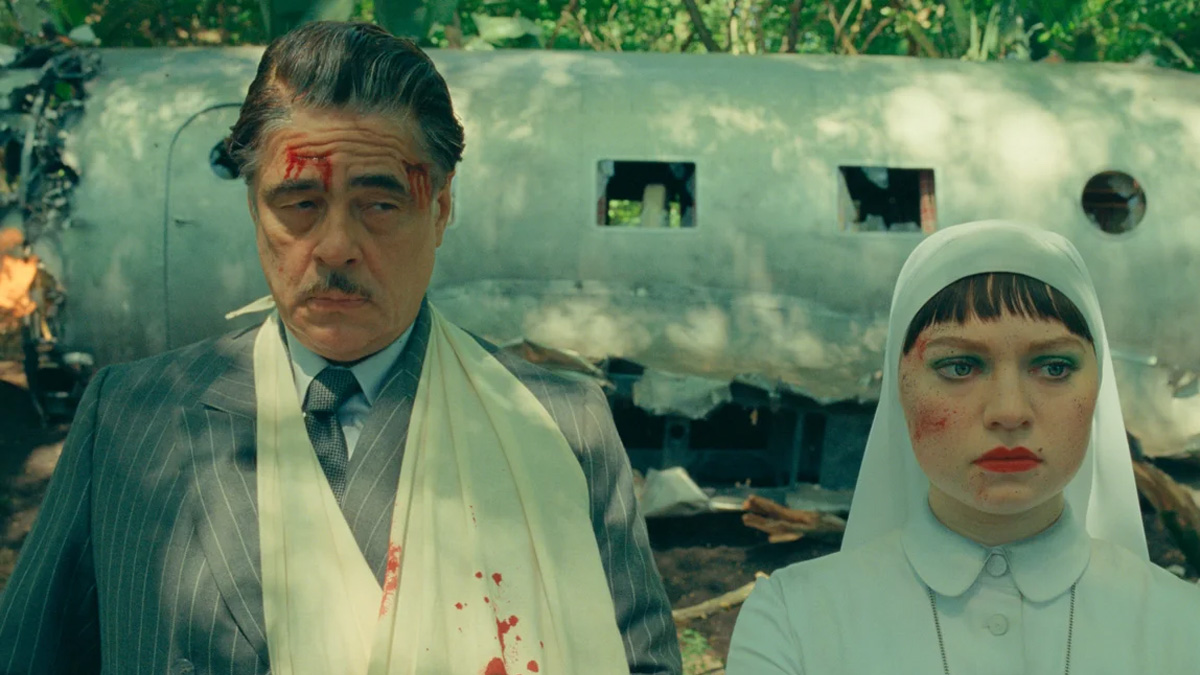
Quirky humor, ironic melancholy, and offbeat mannerisms. A vintage-tinged visual aesthetic with precise color schemes and costume designs. Stories of families in turmoil played out as characters in a Balzac story by way of Jaques Tati with a dash of early Woody Allen. These are the recognizable traits that make Wes Anderson the very definition of an auteur. Each new Anderson work carries his unmistakable cinematic stamp. The tales may differ, but the style is ever present in every frame. His latest, The Phoenician Scheme, is a graceful and novelistic tale of family, morality, and legacy that is one of the more interesting films of 2025, thus far.
Doing fine, nomination-worthy work, Benicio Del Toro is Zsa Zsa Korda, a billionaire industrialist who is forced to evaluate what is important in his life, what matters in his heart, and a man who will come to embody the words of William Shakespeare when he wrote, “No legacy is so rich as honesty.”
A lifelong schemer devoted to keeping his fortune flowing, Korda has amassed a great deal of wealth and an even larger group of enemies who want him dead. As The Phoenician Scheme opens, we find Korda surviving his sixth assassination attempt, as he is forced to land a plane after the shots meant for him take out the pilot. This latest attempt on his life causes him to realize it is time to make a clearer plan and path for his future. Everyone’s luck eventually runs out.
Korda gets the idea to fund an infrastructure project in the fictional country of Phoenicia called the “Korda Land and Sea Phoenician Infrastructure Scheme”. Through his elaborate plan, his businesses will take in 5% of the profits. As the title reminds us, this is a scheme and Korda must snake through a number of wealthy donors around the world. This is to be an investment that will leave something for his daughter Liesl (Mia Threapleton), who is on her way to becoming a nun. Korda feels his daughter should leave her “calling” and take over his company. Though he also has nine adopted sons, none are suited to be his heir.
Liesl is taken aback, as she has no relationship to her father and believes he murdered her mother. It is later hinted that Korda’s brother Nabor (Benedict Cumberbatch, looking like a Russian czar in a terrifically funny cameo) might be the one to have committed the deed.
As his enemies, the U.S. Government, and his own hubris are out to stop him from achieving his goal, he must travel the globe to collect (swindle) his advanced percentage from his investors. The rub being that Zsa Zsa has been “fiddling” with the contracts, which becomes apparent to everyone.
Written by Anderson and Roman Coppola, The Phoenician Scheme is a film about what matters in life. Be it religion, family, or what we leave behind, life’s truths await us all.
As Korda’s eyes are ever-so-slowly opened, he has profound mystic visions where he experiences Godly tribunals where his life is examined. These sequences are exquisitely designed in black-and-white (by cinematographer Bruno Delbonnell) and achieve the type of quiet profundity found in the films of directors such as Theodorus Angeloppoulis and Luis Buñuel. Charlotte Gainsbourg, Willem Dafoe, F. Murray Abraham, and Bill Murray (playing God) populate these moments, with each actor staying within the Anderson boundaries of understated performance.
To help tell his tale, Anderson fills his cast with regulars from his stock company along with a few new faces. Tom Hanks and Bryan Cranston have a quick (almost inconsequential) cameo, but make the most of their screen time. Scarlett Johansson is deadpan seductive as Korda’s cousin. Mathieu Amalric shows a good sense of comic timing as one of Korda’s screwed-over investors. Riz Ahmed, Jeffery Wright, Hope Davis, and Rupert Friend all make a memorable mark in this ensemble piece.
Complimenting the great work from Benicio Del Toro and Mia Threapleton, Michael Cera is a standout. The actor plays Bjorn, a nebbish Scandinavian expert on insects. The character is the funniest in the film thanks to Cera’s perfect comic timing and his ability to easily make the leap from nervously timid to steadfast do-gooder when the screenplay reveals a twist in Bjorn’s design. With his patented inexpressive style of humor, Michael Cera was born to be in the films of Wes Anderson.
Planimetric composition is a filmmaking technique where a camera is placed perpendicular to the scene, causing the backgrounds to seem flat and two-dimensional in contrast to central figures in the foreground of the frame. Anderson has long made this style one of his main trademarks. The director works with his cinematographers and production designers to design each set frame by frame. Such a meticulous aesthetic helps to create a cinematic tableau where each shot feels like a painting. For this film, Anderson keeps his visual style, but adds a sometimes darker tone to his shots.
Every precisely designed frame has purpose. Amongst the quirkiness, the filmmaker is searching for something real regarding Korda’s soul and such underlying seriousness warrants the occasional darker palette. Add Alexandre Desplat’s adventurous, old-school, score, and there is method behind the madness and genuine emotion under the askew surface.
Since his first feature (1996’s Bottle Rocket), Anderson has always focused on families and their shortcomings. Now father to a seven-year-old daughter, his story of a man learning to need the bond with his child is imbued with an effective sentimentality that may exist on the most personal level of any Anderson piece.
So “help yourself to a hand grenade” and immerse yourself in one of the year’s best films. Breezy, intricate, funny, and undeniably Wes Anderson, The Phoenician Scheme finds the filmmaker at the top of his game.
The Phoenician Scheme
Written by Roman Coppola & Wes Anderson
Directed by Wes Anderson
Starring Benicio Del Toro, Mia Threapleton, Michael Cera, Mathieu Amalric, Tom Hanks, Bryan Cranston, Scarlett Johansson, Jeffery Wright, Riz Ahmed, Hope Davis, Rupert Friend, Willem Dafoe, Charlotte Gainsbourg, F. Murray Abraham, Bill Murray
PG-13, 101 Minutes, Focus Features, Indian Paintbrush
Publisher: Source link




A Flame The Colour of Air – Film Threat
SLAMDANCE FILM FESTIVAL 2026 REVIEW! You will shimmer and shake, like you’re riding the snake while being wowed by the dynamite animated short A Flame The Colour of Air, written and directed by talented Canadian filmmaker Emily Pelstring. Jessica Mensch’s…
Mar 3, 2026

‘9-1-1’ Can’t Decide What It Wants To Focus On in a Lackluster Season 9
Editor's Note: The following contains spoilers for 9-1-1 Season 9, Episode 11.I was hoping that 9-1-1 would take advantage of its month-long hiatus and course-correct after its most recent episode, but while this week is certainly an improvement from last…
Mar 3, 2026
Good Luck, Have Fun, Don’t Die Review
Mercy was a film about AI that AI could’ve written. Good Luck, Have Fun, Don’t Die also tackles AI, although it could only come from the mind of Gore Verbinski. As he did with his Pirates of the Caribbean trilogy…
Mar 1, 2026
Investigative Screenplay Review: Suspenseful but Weak Antagonist
Vadh 2 (2026): When Murder Is Justified — Starring Sanjay Mishra as prison guard Shambhunath Mishra When evil tries to take control, its destruction becomes necessary. With this theme, Bollywood brings you a spiritual sequel to its 2022 crime-thriller “Vadh”.…
Mar 1, 2026