the Real Relationship and Desperate Alliance
Aug 4, 2023
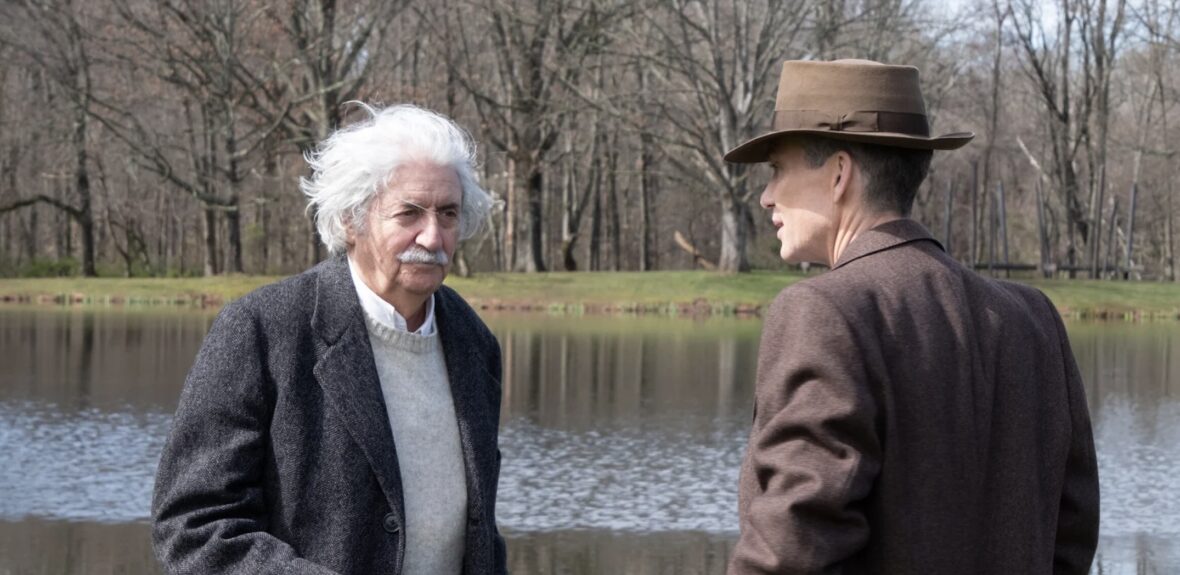
Oppenheimer shows from its earliest scenes that Albert Einstein and J. Robert Oppenheimer sometimes kept each other at arm’s length: Oppenheimer did not invite Einstein, for example, to work on the atomic bomb. In the film, they have a respectful if not necessarily warm relationship.
In real life, Oppenheimer wrote of Einstein, best known for his theory of relativity: “We were close colleagues and something of friends,” according to American Prometheus, the Pulitzer Prize winning 2005 book upon which Oppenheimer is based. As the film notes, Einstein was a longtime resident of the Institute for Advanced Study, which Oppenheimer led from 1947 to 1966.
Did Einstein Respect Oppenheimer? Did Oppenheimer Respect Einstein?
American Prometheus, by Kai Bird and Martin J. Sherwin, notes that the two scientists initially had some ambivalence toward one another: When Oppenheimer was suggested in 1945 as a candidate for a permanent professorship at the Institute, Einstein instead suggested physicist Wolfgang Pauli for the role. At the time, he knew Pauli well, and Oppenheimer “only in passing,” according to the book.
But when Oppenheimer became director of the institute, its most famous resident developed “a grudging respect” for him, and later called him an “unusually capable man of many-sided education.” (Oppenheimer’s embrace of the humanities as well as science gets a nod in a scene in the film when Cillian Murphy, in the lead role, is seen reading T.S. Eliot’s The Wasteland; in real life, he eventually welcomed Eliot at the institute, though Eliot had been invited by his predecessor as director.)
Also Read: Did Truman Really Call Oppenheimer a ‘Cry Baby’?
Oppenheimer, meanwhile, admired Einstein, played in the film by Tom Conti, for his “extraordinary originality,” but believed that he brought “deep elements of tradition” to this work, and that his embrace of tradition held him back.
The elder scientist spent years trying to poke holes in his own theory of relativity, Oppenheimer once noted: “He fought with the theory which he had fathered and but which he hated. It was not the first time that this had happened in science.”
This sounds like a very wry joke on Oppenheimer’s part: Though credited as the father of the atomic bomb, he also lamented and advocated against its use. He was so concerned about the “blood on his hands,” in fact, that President Harry S. Truman once belittled him as a “cry baby” — a moment elegantly dramatized in Oppenheimer in a scene between Murphy and Gary Oldman, who plays Truman.
‘Something of Friends’
American Prometheus includes several anecdotes suggesting warmth between Oppenheimer and Einstein, recounting an evening in 1948, soon after Oppenheimer took over as director of the Intitute, when he chatted about neutrinos and “the beauties of physics” as Einstein watched — “gravely and intently, and at times with a chuckle and wrinkles around his eyes,” in the words of David Lilienthal, who was the head of the U.S. Atomic Energy Commission at the time.
Also Read: Why Oppenheimer Was Called the ‘American Prometheus’
In the same paragraph, the book recounts a time when Oppenheimer, knowing how the older physicist loved classical music, “arranged to have an antenna installed on the roof of Einstein’s modest home” so that he could hear broadcasts of concerts from Carnegie Hall in New York City, more than 50 miles from the Institute’s headquarters in Princeton, New Jersey.
Allies
They were aligned in at least one crucial area: their opposition to nuclear proliferation. American Prometheus notes that the elder scientist respected Oppenheimer for trying to “use his influence to put the breaks on the arms race,” though he sometimes found Oppenheimer to be too cautious.
“The older man clearly didn’t understand why Oppenheimer seemed to care so much about maintaining his access to the Washington establishment. Einstein didn’t play that game.”
Of course, Oppenheimer’s attempts to maintain his influence — and use it to slow down the use of a weapon that could destroy the world — were for naught. Those who supported nuclear proliferation managed to strip him of his influence when in 1953 the Atomic Energy Commission took away his security clearance and refused, the next year, to reinstate it.
Main image: Tom Conti as Albert Einstein and Cillian Murphy as J Robert Oppenheimer in Oppenheimer.
Publisher: Source link








Born Again’ Showrunners Detail How the Media Ties into Season 2
Marvel is fast approaching the release of Daredevil: Born Again Season 2, marking its second live-action Disney+ show of 2026. Bringing back Charlie Cox's Matt Murdock and Vincent D'Onofrio's Wilson Fisk, this season picks up where Season 1 left off,…
Mar 23, 2026

New ‘Wheel of Time’ Animated and Video Game Adaptations Are in the Works
Amazon might be finished with The Wheel of Time, but we haven't seen the end of the story when it comes to adaptations of Robert Jordan's bestselling high fantasy saga. Fans were left blindsided when Amazon abruptly pulled the plug…
Mar 22, 2026

‘Off Campus’ Teaser and Release Date Revealed by Prime Video
No one expected a love story between rival hockey players to become one of the most talked-about TV shows of 2025, but there's a lot more where Heated Rivalry came from, as a new teaser for Prime Video's foray into…
Mar 21, 2026

Sarah Michelle Gellar Urges ‘Buffy’ Fans to Avoid Reading Leaked Reboot Scripts
Buffy the Vampire Slayer fans have had a rough few days after Hulu officially pulled the plug on a revival of the series, which would have brought star Sarah Michelle Gellar back as the titular heroine. Described as a continuation…
Mar 20, 2026