‘The Shrouds’ Review: David Cronenberg’s Sexy Sci-Fi Confounds
May 21, 2024
The Big Picture
David Cronberg’s
The Shrouds
is a chilly, alienating, and darkly comedic sci-fi film.
Vincent Cassel and Diane Kruger each bring their own weirdness, exploring grief, technology, and intimacy.
Cronenberg’s personal film delves into themes of mourning, loss, and how the emotional toll of grief casts a long shadow.
You aren’t prepared for how chilly and strange David Cronenberg’s The Shrouds is. Yes, even for him, this is a weird one. More science fiction than outright horror, it’s a film that is almost intentionally cold and alienating from the ground up where all its many bodies are buried. Just as his previous film, Crimes of the Future, was both misunderstood and misappreciated by many, audiences being confounded yet again feels like a likely destination for this one as well. This isn’t just because it is once again more metaphysical than it is as macabre as his past work, but because the whole thing almost feels like a joke. Not only it is darkly comedic to the point of being playfully provocative (with that word being thrown out a couple of different times with pointedly ironic detachment), but it also seems like it is purposely uninterested in what you think of it. It’s a film that feels as though nearly all the life has been sucked out of it.
The Shrouds (2024) An innovative inventor creates a device that lets the living interact with the dead via technologically enhanced shrouds.Release Date September 25, 2024 Runtime 119 Minutes Budget Prospero Pictures, SBS International Studio(s) Pyramide Distribution
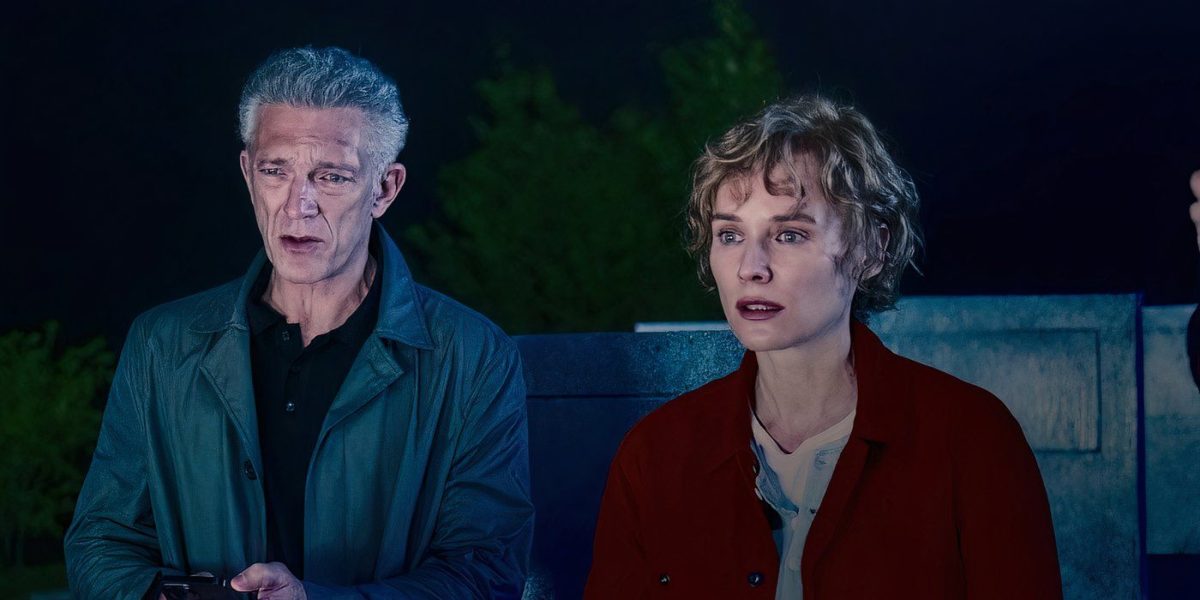
Some of this comes down to the performances, with both Vincent Cassel and Diane Kruger bringing their own weird energy to the whole thing, but it is also that Cronenberg just seems to not give a single thought to sanding down his unique disposition for an audience. It’s a conspiracy movie where the answers are almost secondary as it instead flirts with being an erotic thriller and a meditation on the way grief becomes altered by our relationship with technology. It zigs when you expect it to zag, leaving dangling loose threads on fundamental parts while dancing into elements that are then revealed to be meaningless. It’s far from his best, as that was and will likely always be the fantastic 1986 film The Fly, though The Shrouds still shows he’s got plenty of sly stories to tell that defy easy categorization. It lacks the electricity of his past works but, as we come to see, the lifelessness of it all, is, in many regards, the point of the whole thing. It’s about carrying on when nothing makes sense.
What Is The Shrouds’ About?
This all gets filtered through the melancholic and neurotic life of the troubled widower Karsh (Cassel) who we first see yelling while observing the body of his wife Becca (Kruger), who is held in some sort of suspended state of peaceful sleep. Though this is already far from a literal opening, his cries being heard by nobody else but himself serves as the first indication of Cronenberg’s thematic interest in grief. It’s like shouting into the void, a terrifying prospect all its own, and the terror that may come when something from the recesses of your mind shouts back. When we get into the real world, we come to learn about how Karsh has made a company that allows you to continue to see the body of your loved one even when they are buried beneath the ground. Is this a bold new way of processing loss or just a way for yet another predatory tech company to sell us things that degrade our quality of life?
There is no easy answer to this question, as Karsh is both buyer and seller, using the technology to see his wife even when it doesn’t seem to bring him that much comfort. Instead, it seems like an obsession. As Karsh demonstrates this process via a handy app on his phone on a date, we see in her eyes the discomfort that he has long since stopped even noticing. In fact, the man often seems to hardly feel anything at all. He will meet with Becca’s sister Terry or talk to his AI assistant (both of whom are also played by Kruger) without much investment in any of it. This is what it means to grieve for Cronenberg. There is no catharsis coming as life is now a series of odd moments.
That Karsh is made to look quite like the director is only one part of how this feels like one of his most personal films. Cronenberg has spoken openly about how losing his wife was what drove him to make the film, and you can feel this specificity in every frame. The darkly comic nature of it all is only part of the picture, but it works incredibly well with what he’s getting at. Losing the person you love more than anything in the world, including even life itself, is like a sick joke whose punchline you’ll have to deal with for the rest of your days. When Karsh speaks of how he wanted to throw himself in with his wife while she was being buried, the agonizing pain in this sentiment is complicated by how coldly Cassel delivers it. Of course, that is what it is to lose someone. You almost become numb to it, desperate to feel something once the pain has just settled into a dull ache that you can’t escape.
Cronenberg Wrestles With Sex and Conspiracies in ‘The Shrouds’
Image via Cannes
As The Shrouds goes down the conspiratorial rabbit hole a bit, with vandalism of Karsh’s tech graves disrupting his business and preventing him from looking closer at something strange he noticed on his wife’s bones, this all feels like a way of coping. It’s easy to create a narrative that’s neat and tidy, no matter how outrageous it may be, when life itself is more banally painful. Sure, the film brings in tech hacker Maury (Guy Pearce) to poke around with what’s going on, but right from the jump, this feels like a fool’s errand. Karsh is certainly bothered by what has happened, but is this just because he has been locked out of catching glimpses of his wife’s bones again? That he begins to form a strained relationship with the similarly grieving Soo-Min (Sandrine Holt), who is on the cusp of her own loss seems to indicate there was something more to life that he was holding himself back from experiencing.
Notably, this is frequently discussed in terms of sex. No, it doesn’t have anything to do with surgery this time around, and is instead about how Karsh’s relationship to such intimacy was poisoned by how he could no longer touch his wife as she was ailing without hurting her. This is where the film goes closest to body horror, with recurring scenes of her coming into the bedroom in shadow before we see the toll her treatment is taking on her. It’s all a little bizarre, but it feels like Cronenberg channeling the anxieties of those who have been present through the later stages of a partner’s degeneration. It leaves an impact on you even as Karsh rarely speaks about it, instead dryly saying how he is essentially celibate at this point.
When he then does begin having sex again, the way he and others get aroused is deeply strange by design. After all, once you’ve lost someone, all the things that used to provide pleasure or get you in the mood just may not cut it any longer. As Karsh goes on this strange journey of sexual re-discovery, the conspiracies floating about become intertwined with this. It serves as a fittingly fraught development that makes explicit how these plots, even when possibly validated in some tangential twists, were more about the emotional than the intellectual. We desire meaning and conspiracies are a way to get there.
‘The Shrouds’ Is About the Long Shadow of Grief
Image via Pyramide Films
If this all sounds a little impenetrable, it very much is. This is often to its detriment, with some character developments feeling a little sudden and forced. However, with this in mind, grief is itself not always legible to those not caught in its grasp. People do random, even potentially harmful, things when trying to work through the all-consuming pain. They carry guilt, shame, sadness, and dread with them every day. So, when we see Karsh just acting bizarrely in a way that is hard to pin down, this is Cronenberg working through his own alienation from the world. Once you have lost, there is no looking at life or other people the same way again.
This builds to an abrupt ending that undercuts the film’s path to healing, where the director brings it all back to the bedroom, the place where Karsh was living in the shadow of his wife who has now gone. Much can be frustratingly obscured, both in the film and in life, and yet, that is where people must do what they can to grow tolerant of the unimaginably intolerable feeling of grief. Just as someone else is lost, this is forever a part of yourself as well. Even if you reinvent your life, redesign your apartment, or attempt to travel far away, it’s like a phantom limb, waiting for you to notice it’s gone once again.
The Shrouds (2024) REVIEWDavid Cronenberg’s The Shrouds is not his best film by any means, but it is an effective sci-fi exploration of grief with all the strangeness that entails.ProsThe film is both darkly comedic and playfully provocative, capturing the alienating experience of losing someone.Both Vincent Cassel and Diane Kruger bring their own weird energy to the whole thing.The ending, while abrupt, brings everything back to loss and lingers like a phantom limb. ConsMuch of the film can feel frustratingly obscured.
The Shrouds had its World Premiere at the 2024 Cannes Film Festival.
Publisher: Source link



Ron Perlman Explains How His Role as Super Mutant in ‘Fallout’ Came to Be
Ron Perlman has a long list of impressive credits on his resume, including his fan-favorite portrayal of Hellboy in a pair of movies from 2004 and 2008. He also has a long history in video games, thanks to his work…
Mar 30, 2026
Netflix’s ‘Jo Nesbo’s Detective Hole’ Debuts With Perfect Rotten Tomatoes Score
Anyone currently on the hunt for a new crime thriller to binge-watch may want to divert their attention to Jo Nesbo's Detective Hole, which is currently streaming on Netflix. The nine-part drama, adapting the fifth book in Jo Nesbø's bestselling…
Mar 29, 2026
Prime Video’s ‘God of War’ Casts ‘Lost’ Star Sonya Walger as Freya
Amazon's upcoming God of War series that is currently in production is also one of the most anticipated of the next couple of years. Film and television adaptations of popular video games have been on the rise, with creative teams…
Mar 28, 2026
Paramount+ Renews ‘Criminal Minds: Evolution’ for Season 19
The start of its new season is still weeks away, but fans of Criminal Minds: Evolution won't have to wait that long to learn the fate of the long-running hit crime procedural. Execs at Paramount+ have already decided what the…
Mar 27, 2026