To Really Appreciate Adrien Brody’s Performance in ‘The Brutalist,’ You Need to See His First Oscar-Winning Role
Mar 7, 2025
On March 2, 2025, the 97th Academy Awards took place with its share of upsets, surprises, and breakthrough moments. But there was one category and one actor whose performance was never in doubt from the moment he came on screen with his broken nose, the pain, the moral certitude, and the rage bubbling just below the surface.
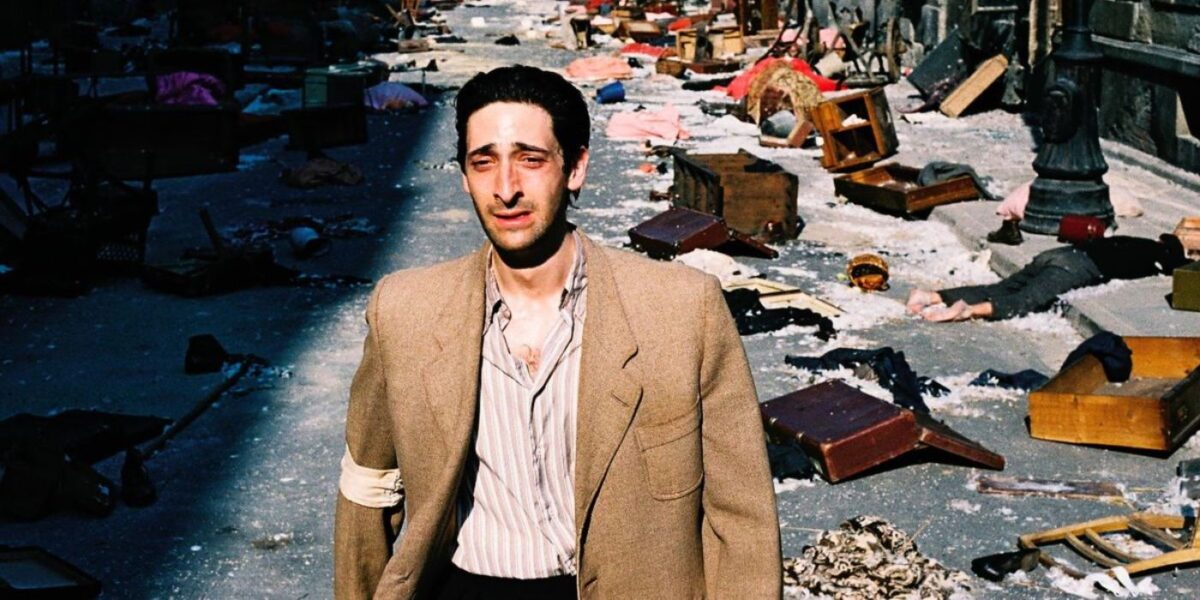
While much of the credit for The Brutalist goes to Brady Corbet for his vision, there aren’t many actors who could’ve played the part of Lazlo Toth, a Hungarian-born Holocaust survivor with an undercurrent of angst and fire better than Adrien Brody. In fact, to truly appreciate the beauty of Brody’s Oscar-winning performance in The Brutalist, we have to go back 22 years to another movie about a Holocaust survivor, The Pianist, that landed Brody his first Oscar, and also gave him insight into playing a man haunted by survivor’s guilt and the weight of loved ones lost.
What Is the Story of ‘The Pianist’?
The Pianist (2002) is based on the memoirs of Władysław Szpilman, a Polish-Jewish pianist who survived the Holocaust in Warsaw. The film chronicles Szpilman’s life from the outbreak of World War II through the Nazi occupation, culminating in his desperate struggle to stay alive amid the ruins of the city. As Szpilman, Brody gets to the heart of what it takes to survive and how the ordeal transforms one. Through subtle physical transformation, precise emotional restraint, and an unwavering focus on Szpilman’s internal turmoil, Brody captures both the everyday nature of survival and its terrifying precariousness.
Related
The 10 Saddest Biopics, Ranked
Reality is often far more heartbreaking than fiction.
The film opens with a scene of Szpilman playing Chopin at a Warsaw radio station. When the first German bombs fall, Szpilman, born into a prosperous and cultured family and conscious of his place in society, brushes off the impending threat like dust off his shoulder. We are witness to his faith in normalcy being chiseled away bit by bit as Nazi forces seal off the Warsaw ghetto. Every day, through Szpilman’s eyes, we see the Nazis enact brutal policies that strip Jewish citizens of their possessions, their dignity, and ultimately their lives. Through each indignity, we also see the helplessness and vulnerability creep into Szpilman’s once-confident facade.
Szpilman’s family is eventually taken away to the trains bound for extermination camps, and he escapes that fate at the last moment thanks to a friend in the Jewish police. From there, the film traces Szpilman’s harrowing survival: moving among hideouts provided by members of the Polish resistance, living in bombed-out buildings without food or water, and witnessing from a distance the doomed Warsaw ghetto uprising. His story culminates with an encounter in the war’s final stages with a German officer named Wilm Hosenfeld, who helps him by allowing him to remain in hiding—and by asking him to play the piano, a moment that underscores how arbitrary, bizarre, and paradoxical survival could be.
‘The Pianist’ Shows Us Brody’s Full Range as He Goes From Cocky Dandy to Stoic Survivor
Image via Focus Features
Early in the film, Brody portrays Szpilman as a self-assured, almost carefree young man who is confident in his musical abilities and his charm. There is a clear sense of smugness in his demeanor, as if he assumes that no great calamity can truly affect someone with his talent and status. Thus, when others begin to panic about the German invasion, Szpilman, sure that normal life will resume soon, is more focused on seducing Dorota (Emilia Fox) and continuing his radio performances. This arrogance and single-minded dedication to his craft is again on display when the radio building is bombed while he is mid-performance. While others around him are petrified, he momentarily ducks, brushes off the falling plaster, and returns to playing. These early moments aim to give us an idea of Szpilman’s confidence in his place in society. In an almost sadistic manner, the rest of the movie peels away those beliefs of power and untouchability.
As Nazi oppression intensifies, we see Szpilman’s confident smile being wiped away. The transformation is gradual yet relentless. Each humiliating Nazi decree and every personal loss chip away at Szpilman’s initial bravado as his posture tightens. His eyes reflect growing horror as his family loses their possessions and freedom. In one of the most wrenching sequences, Szpilman is separated from his loved ones at the last minute. Brody conveys profound shock and guilt in his haunted expression, as though he can scarcely register what is happening—only that he has survived while they have not.
‘The Pianist’ Shatters the Myth of Heroic Survival
Image via Focus Features
Brody’s portrayal is marked by an almost paradoxical detachment. He does not play Szpilman as a hero actively outsmarting the Nazis. Instead, he emphasizes the bewildered passivity that was the reality for most trapped in these circumstances. Szpilman does not fight in any armed resistance. He is saved by happenstance, fleeting connections, and others’ empathy. Brody’s subdued portrayal underscores how mere fortune—rather than grand heroics—often determines who lives and who dies. The movie acknowledges trauma and guilt. In the quieter, reflective moments—Brody’s cheeks sunken in from malnutrition, hiding in cramped, barely livable conditions, staring out of a window as he hears gunshots or trembling in a dark apartment—speak volumes about survivor’s guilt. His almost feral eyes reveal a haunting awareness that surviving was, in itself, an accident of history rather than a personal triumph.
Long stretches of The Pianist show Szpilman confined to dusty rooms, waiting in silence. Brody uses stillness and body language to convey Szpilman’s fear and despair—moments in which he is so tense he can barely breathe for fear of being discovered. He seems imprisoned not only physically but also psychologically. The Pianist captures Szpilman’s near-animalistic state by the end. Even finding a can of pickles becomes a momentous victory. Brody’s performance in these scenes is understated but powerful: he staggers through bombed-out streets, frantically searching for shelter or scraps of food, all dignity stripped away.
Adrien Brody’s Oscar-winning performances as Władysław Szpilman in The Pianist and Lazlo Toth in The Brutalist are two sides of the same coin. We cannot understand the fury, rage and angst behind Toth’s eyes until we see the naïveté, optimism, and confidence being stripped away peel by peel from Szpilman.
The Pianist
Release Date
March 28, 2003
Runtime
150 Minutes
Director
Roman Polanski
Writers
Ronald Harwood, Wladyslaw Szpilman
Publisher: Source link





Rebecca Ferguson’s Near-Perfect Sci-Fi Thriller Is Officially a 600-Day Streaming Smash Hit
While it was the Mission: Impossible franchise that put Rebecca Ferguson on everyone's radar, it was her appearance as Rose the Hat in Doctor Sleep that cemented her as a superstar. It led to movies like Dune, Netflix's A House…
Oct 25, 2026
‘The Gentlemen’ Loses 2 Original Stars, Reunites ‘Lord of the Rings’ Icons in Big Season 3 Shake-Up
Guy Ritchie's signature blend of aristocratic elegance and gritty underworld chaos has officially solidified its place as a Netflix powerhouse. Originally launched as a television spin-off of his hit 2019 feature film, The Gentlemen captivated global audiences across its first…
Oct 24, 2026

Taylor Sheridan’s ‘Yellowstone’ Sequel Hits Major Milestone Ahead of Streaming Return
The Yellowstone universe has grown so fast since the main series ended that it’s fair to wonder whether the franchise might be stretching itself a bit thin. That’s part of why Dutton Ranch came as something of a surprise. Beth…
Oct 23, 2026

Taylor Sheridan’s 5-Part Western Sensation Returns to Streaming as New Spin-Off Battles for #1 Spot
Taylor Sheridan's seminal five-season western is officially one of the biggest shows on streaming, once again, all while its latest spin-off fights for the #1 spot on the charts. Taylor Sheridan keeps going from success to success. After his hit…
Oct 22, 2026