Was Albert Einstein Really Homeless? Einstein and the Bomb Fact Chec
Mar 10, 2024
If you’ve seen Netflix’s docudrama Einstein and the Bomb, you may be wondering if renowned physicist Albert Einstein was really homeless for a period in 1933.
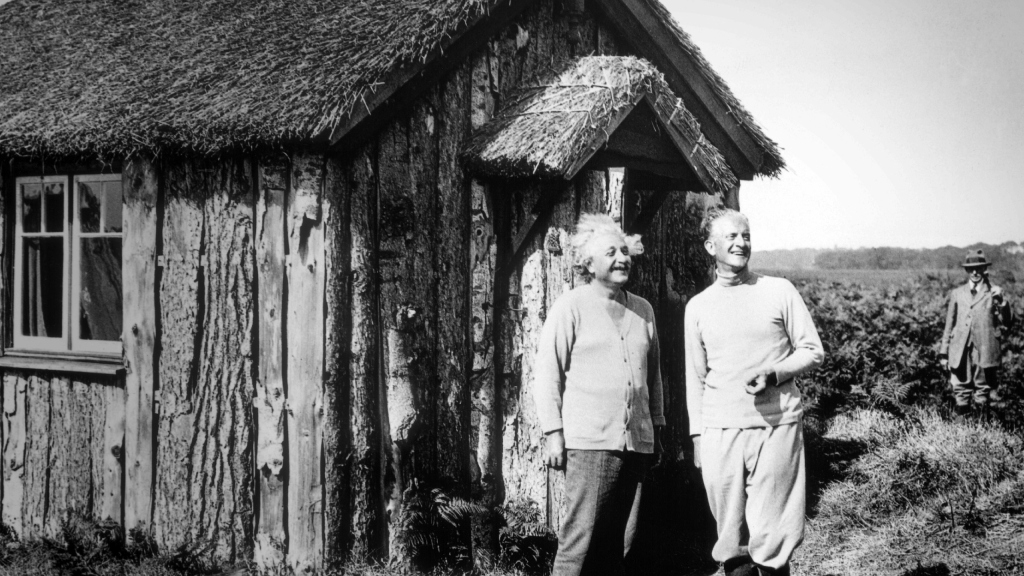
It’s true that Einstein fled his home in Berlin, Germany that year out of fear of a possible assassination attempt being planned by the Nazis, and was very briefly homeless before being taken in by the English, according to Time. He stayed temporarily in a thatched hut in rural Norfolk, England as the guest of Commander Oliver Locker-Lampson, a Conservative member of the English Parliament.
Was Einstein Really Homeless?
“Today, Einstein is without a home,” Commander Locker-Lampson, played by The Crown‘s Andrew Havill, says in Einstein and the Bomb in a dramatization of a real speech Locker-Lampson gave to Parliament in presentation of a bill that would have given British citizenship to Jewish refugees fleeing the Nazis if it had made it into law.
“I am not personally a Jew, but I hope that I do not require to be a Jew to hate tyranny anywhere in the world. Germany has selected the cream of her culture and suppressed it. She has even turned on her most glorious citizen, Einstein,” he said. “The road-hog and racketeer of Europe have plundered his palce. They have even taken away his violin. He had to write his name in a visitor’s book in England, and when he came to write his address, he put, ‘Without any.’”
Also Read: Einstein and Oppenheimer: Their Real Relationship and Desperate Alliance
Indeed, the full speech from July 26, 1933 can be read on the official UK Parliament website.
Another snippet that didn’t make it into the docudrama reads: “A man who more than any other approximated to a citizen of the world without a house! How proud we must be that we have afforded him a shelter temporarily at Oxford to work, and long may the tides of tyranny beat in vain against these shores.”
According to Time, it’s true that the Nazis confiscated Einstein and his wife Elsa’s German bank accounts and raided their summer home for arms. They Nazis targeted Einstein not only because he was Jewish, but because he had publicly spoken out against them shortly after Hitler rose to power. In response, Einstein was maligned in the German press, his theory of relativity was called a hoax, and his books were burned in Berlin.
Another moment shown in Einstein and the Bomb in which Einstein reads a particularly horrifying sentence in a German propaganda book describing him as “not yet hanged” is also true.
According to Time, the anti-Semetic German publication was approved by Nazi propagandist Josef Goebbels himself, presenting a photograph of Einstein with the caption “BIS JETZT UNGEHAENGT,” which indeed translates to “not yet hanged.”
As Einstein and the Bomb describes, Einstein would leave England for a new home in America, never again return to his native Germany.
Einstein and the Bomb is now streaming on Netflix.
Main Image: Albert Einstein and Commander Locker-Lampson in 1933 courtesy of Netflix
Publisher: Source link








Paramount+ Renews ‘Criminal Minds: Evolution’ for Season 19
The start of its new season is still weeks away, but fans of Criminal Minds: Evolution won't have to wait that long to learn the fate of the long-running hit crime procedural. Execs at Paramount+ have already decided what the…
Mar 27, 2026

‘A Tale of Two Cities’ First Look Reveals Kit Harington in MGM+ Series
The BBC and MGM+ are teaming up with a new four-part limited series adaptation of Charles Dickens' classic 1859 novel A Tale of Two Cities. Game of Thrones veteran Kit Harington will play Sydney Carton, a cynical English lawyer who…
Mar 26, 2026

HBO ‘Harry Potter’ Series Image Reveals Dominic McLaughlin in Title Role
The first official look at HBO's upcoming reboot of Harry Potter has finally arrived, and it is already teasing a magical trailer release. As we inch closer to the show's expected 2027 release, the network has begun to reveal more…
Mar 25, 2026
‘Dutton Ranch’ Trailer Reveals ‘Yellowstone’ Sequel Release Date
Rip Wheeler and Beth Dutton gamble everything on a new life in South Texas in the first trailer for the Yellowstone spin-off, Dutton Ranch. The footage reveals all manner of gun fights, fist fights, explosions, galloping horses, and even mysterious…
Mar 24, 2026