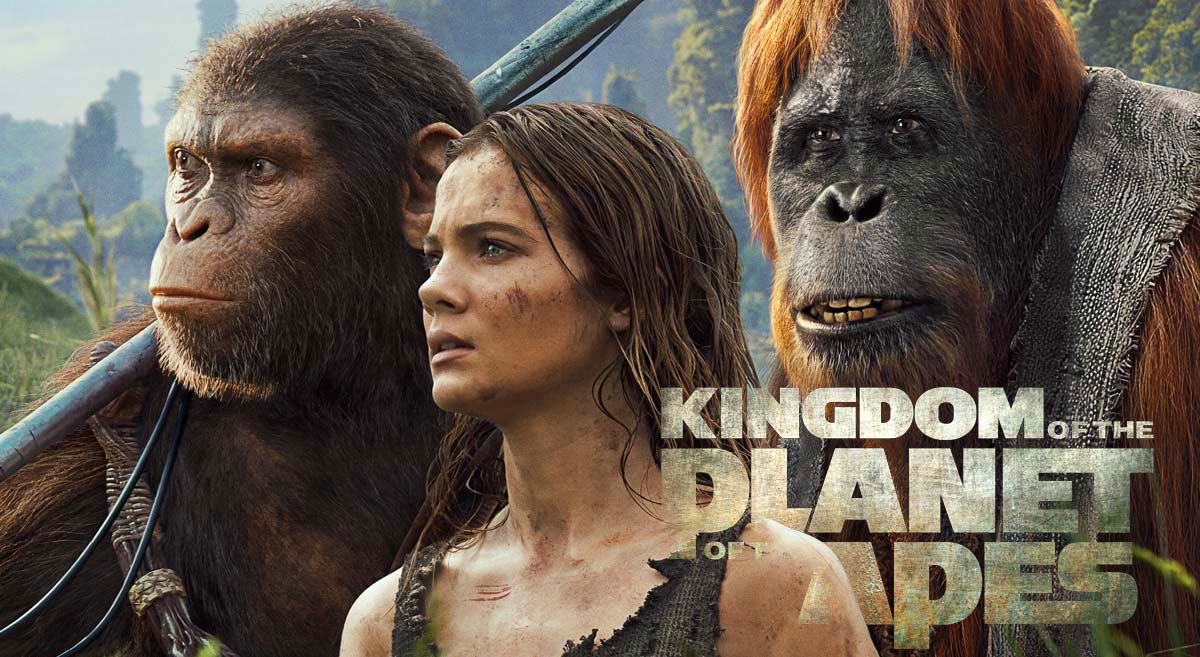
Wes Ball Delivers A Bold, Engaging Vision & Solid Future For The Franchise
May 9, 2024
It has been 56 years since “Planet of the Apes,” arguably one of the greatest science fiction films of all time. To see the franchise display such promising growth and evolution almost six decades later is phenomenal and deeply heartening. That’s especially so at a time when Hollywood is enduring one of its most challenging eras. The fourth installment in the franchise reboot, “Kingdom Of The Planet Of The Apes,” takes place 300 years after the events of 2017’s “War For The Planet of the Apes.”
At the center of this story is a young chimpanzee named Noa, played by Owen Teague, forced to make a perilous journey after his village is destroyed and his family and community are either slaughtered or abducted by the army of Kevin Durand’s megalomaniacal Proximus Caesar. That army is led by the terrifying Sylva, a Kong-esque silverback gorilla who is bad to the bone. Eka Darville’s winning performance is chilling.
READ MORE: Summer Movie Preview: 50 Must-See Films To Watch
En route, Noa joins forces with mysterious human woman Mae, played by “The Witcher star Freya Allan, and Peter Macon’s wise ape scholar Raka, who protects and follows the teachings and ideology of Caesar. The expedition ultimately leads to Proximus Caesar’s oceanside kingdom, built around a bunker of human technology he is desperate to get his hands on. While he claims it’s to aid his thirst for knowledge, it’s abundantly clear it’s more about power, control, and oppression. Not all of Proximus Caesar’s subjects are apes. William H. Macy plays Trevathan, a turncoat human who sees an opportunity to enjoy the best life he can, with an element of influence, in return for teaching Proximus Caesar about history.
Whereas previous films in the series have leaned into the interactions between humans and apes, “Kingdom of the Planet of the Apes” has very few humans other than Mae and Trevathan. For the vast majority of the movie, it is every inch the apes’ tale, which is a significant change in itself.
Out of the gate, director Wes Ball makes bold creative choices, marking this tenth film in the franchise as his own, like a wild animal. His first, driven by the narrative constructed by ‘Kingdom’ franchise writer Josh Friedman, is to show a dead Caesar from the most recent films, lying on a funeral pyre, surrounded by mourning apes. Clear and swift underlining of the plan creates a sandpit of three centuries of space for storytelling and world-building to explore with all new characters.
Whereas “Rise of the Planet of the Apes,” “Dawn of the Planet of the Apes,” and “War for the Planet of the Apes” leaned into action as much as drama, “Kingdom of the Planet of the Apes,” while not short on pulse-racing set pieces, it’s a journey that builds and almost savors laying out the road map while never neglecting the lore and the legacy. It’s not often that you can enter a series this many movies deep and potentially not have seen any of the other films that came before, but you instantly feel engaged and connected with the world. However, the deftly curated Apes exposition enables that, and at a time when it is harder to get butts in seats, that level of accessibility is invaluable.
Ball is a director who often doesn’t get enough credit or respect for his ability to excel in delivering both drama and action. His controlled and balanced execution of both, previously evidenced in his “The Maze Runner” trilogy, is something many may have previously overlooked. However, “Kingdom of the Planet of the Apes” allows him to showcase his skills perfectly. Where the film requires intimacy and contemplative introspection, Ball delivers. Where it involves tension and excitement, Ball provides thrills. And where the film requires epic scale that at times feels so engaging to the degree that the film envelopes the audience, Ball, you’ve guessed it, achieves it all. Part of that credit should also go to cinematographer Gyula Pados, who previously shot the second and third “Maze Runner” movies with the director, who does stellar work that displays a level of nuance “Kingdom” didn’t need to have yet benefits from. Also, John Paesano, another Ball collaborator from the “Maze Runner” era, does a beautiful job of scoring “Kingdom of the Planet of the Apes,” echoing elements of the original Apes movies but still feeling unique and contemporary.
Dylan Jury and Debra Zane’s casting decisions are fresh and original, and it’s another eagle feather in Kingdom’s cap. Owen Teague’s performance as Noa seemingly effortlessly blends naivety with a thirst for knowledge as the young adult tries to find himself and his role in this world. As Mae, Freya Allan flourishes in the second half of the film as her story unfolds, revealing her struggle to do the right thing and questioning what that is in the first place. Kevin Durand’s tyrannical Proximus Caesar is a villain who almost instantly becomes one of the franchise’s best, and Eka Darville’s ferocious Sylva is a revelation. There are no loose links in the chain.
“Kingdom of the Planet of the Apes” works as a movie in its own right and as a reset on the rebooted franchise. It seamlessly sets up a sequel or sequels that you are left wanting to see. See this in theaters, and we might just get them. [B+]
20th Century Studios release “Kingdom Of The Planet Of The Apes” on Friday, May 10.
Publisher: Source link





Ron Perlman Explains How His Role as Super Mutant in ‘Fallout’ Came to Be
Ron Perlman has a long list of impressive credits on his resume, including his fan-favorite portrayal of Hellboy in a pair of movies from 2004 and 2008. He also has a long history in video games, thanks to his work…
Mar 30, 2026
Netflix’s ‘Jo Nesbo’s Detective Hole’ Debuts With Perfect Rotten Tomatoes Score
Anyone currently on the hunt for a new crime thriller to binge-watch may want to divert their attention to Jo Nesbo's Detective Hole, which is currently streaming on Netflix. The nine-part drama, adapting the fifth book in Jo Nesbø's bestselling…
Mar 29, 2026
Prime Video’s ‘God of War’ Casts ‘Lost’ Star Sonya Walger as Freya
Amazon's upcoming God of War series that is currently in production is also one of the most anticipated of the next couple of years. Film and television adaptations of popular video games have been on the rise, with creative teams…
Mar 28, 2026
Paramount+ Renews ‘Criminal Minds: Evolution’ for Season 19
The start of its new season is still weeks away, but fans of Criminal Minds: Evolution won't have to wait that long to learn the fate of the long-running hit crime procedural. Execs at Paramount+ have already decided what the…
Mar 27, 2026