Whispers of Fire and Water Featured, Reviews Film Threat
Aug 24, 2023
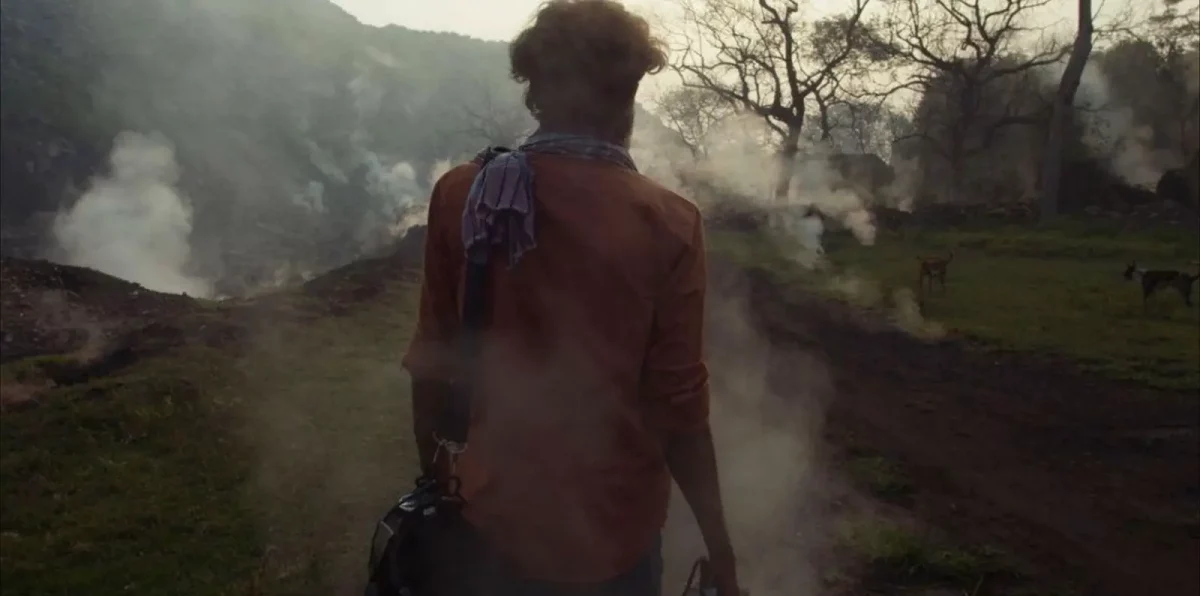
LORCARNO FILM FESTIVAL 2023 REVIEW! Sab Khokla Hai Yahan (Translation: Everything is lifeless here. Hollow). Beyond the mining laborers, the water trucks, the torn-down one-room houses, and the landscape scenery, the land of Jharia is indeed hollow and lifeless – slowly and gradually burning down with the coal extracted from there for a century now. Shiva (Sagnik Mukherjee), an audio-installation artist, is visiting Jharia, India’s most significant coal field that has employed most of the local population forever. Recording and discovering various sounds from mining operations, Shiva finds himself amidst the complexity of coal mining’s impact on local life, which pushes him to unravel an understanding of the natural and industrial mysteries of the town.
Lubdhak Chatterjee’s screenplay and direction on Whispers of Fire & Water is an experiential telling where nature’s mystics contrast heavy machinery; locale contrast urbanization; black coal contrast lush-green landscapes; the chirping birds contrast dynamite explosions; and fire contrast water. Everything about the film takes precedence in these two rivaling elements and their traits that have forever shaped the locals’ lives, for better or worse.
Whispers of Fire & Water begins with Shiva traversing the coalfield of Jharia and witnessing never halting mining and dumping operations with a workforce practically living amid the smoke. But Chatterjee halfway breaks the narrative and shifts directly to Shiva’s experience in the forest that serves as the native land for all who earn a living mining coal. While the coalfield has subjected these people to suffocation and breathlessness, their native, which they call home, has helped them cope and provided them with a freedom of life and short-lived peace. Juxtaposing Shiva’s two drastically distinct experiences through an impeccable combination of sight and sound eventually layer up all the allegory, thematic interpretations, and ambitious voices of Jharia, which Lubdhak so creatively and strikingly calls – Whispers.
“…narrates a juxtaposing commentary about the gradual decay and destruction of Jharia under industrial urbanization.”
When in the coalfield, Shiva is surprised by the destructive progression of life there. Though his job dictates he collects audio samples, he can’t help but witness the emptiness in the vast and widened layers of coal. Repeated oxidation has caused several piles of coal to burn throughout the day constantly. These fires, burning tonnes of coal to waste, have never been put entirely to rest for over a century. That’s a hundred years of uncontrolled air pollution, water contamination, and ground subsistence. And while the laborers continue to come under mining employment, they slowly lose their sustainable health and living. Through Siva’s stay near the field, Chatterjee indirectly takes us through workers’ plights which Shiva is subconsciously submitting himself. It’s a commentary on the nearly-dying cause of natural depletion and conservationism.
Yaha ka toh aapko pata hi hai (Translation: You know how it is here), remarks a local police officer, indicating rampant crime, systematic corruption, and authoritative loopholes in administration. A visiting journalist (Rohini Chatterjee) struggles to get officials’ comments on degrading climate conditions and workers’ lives, further stressing the concerns being downplayed in the region.
The sound of crackling coal, the invisible fires in the day, the explosions, and cranes engross the coalfields – echoing silent chaos in the life of workers. And as Shiva walks through the now-visible fires at night, we see workers inhaling toxic fumes and gases without gear and protection from piles of burning coal – resembling a crowd gathered around a pyre. By this time, the film has indeed captured what it hinted at in the beginning, which is the hollowness in the lives of Jharia. This is the whisper of Fire.
Chatterjee inspires a lot by Lav Diaz and slow cinema’s impactful traits and artistic ideologies. In several sequences, we see a stand-in camera just capturing the engulfing smoke, the burning pyres of coal, the mining explosions, and water trucks unsuccessfully trying to subdue the fires across several square miles of land. It feels like watching a two-dimensional frame from far away long enough to take in its true intent. Chatterjee also pushes us to watch Shiva closely in these stands-in frames, trying to get the best out of his expressions that resonate with the psychological implications of his experiences in the town.
Publisher: Source link








Earth’ Season 2 Casts Peter Dinklage as Series Regular
While screenwriter, television showrunner, and director Noah Hawley is already lining up his next feature film project, that seemingly hasn't stopped developments on the second season of Alien: Earth. The series, which premiered on FX last year, was a project…
Apr 10, 2026
‘Foundation’s Lee Pace Teases Even “Bigger” Story in Season 4
The return of Apple TV’s critically acclaimed, yet somehow still sorely underrated, three-part science fiction epic has just been given the perfect hype, with a returning star not only offering a production update but also calling the next outing “bigger”…
Apr 9, 2026
![‘Star Wars: Maul – Shadow Lord’ Is the Perfect Jumping-on Point for Newcomers [Exclusive]](https://www.filmibee.com/wp-content/uploads/2026/04/Star-Wars-Maul-Shadow-Lord-Is-the-Perfect-Jumping-on-1200x675.jpg)
‘Star Wars: Maul – Shadow Lord’ Is the Perfect Jumping-on Point for Newcomers [Exclusive]
Lucasfilm and Disney are jumping back into the animated Star Wars universe with the release of Star Wars: Maul — Shadow Lord, centered on Sam Witwer's iconic animated Sith villain. Spinning off from Star Wars: The Clone Wars, Shadow Lord…
Apr 8, 2026

Netflix’s ‘Detective Hole’ Is Now a Global Streaming Sensation
Netflix is no stranger to great crime thrillers, and its newest series is no exception. While the streaming service is already home to such modern classics as Mindhunter, Ozark, and The Stranger, its new show can easily be counted among…
Apr 7, 2026