Why Judy Blume Finally OK’d the Movie
Apr 27, 2023
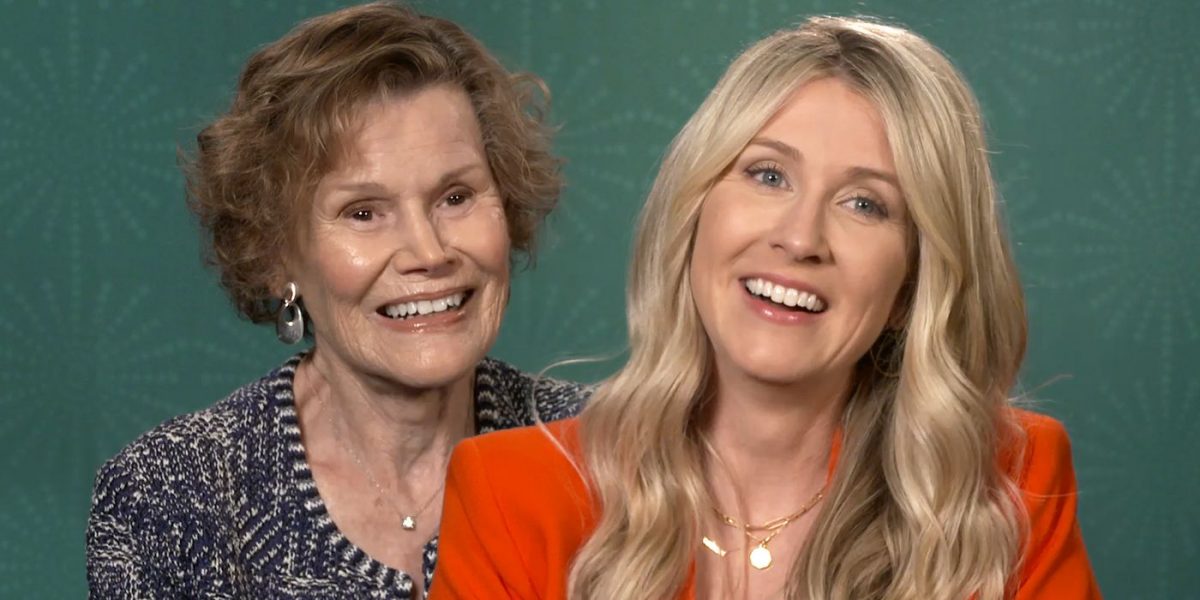
Over 50 years since her novel Are You There, God? It’s Me, Margaret was published, author Judy Blume is now serving as a producer on the feature film adaptation. In an interview with Collider’s Perri Nemiroff, Blume opens up about why writer-director Kelly Fremon Craig was the creative that inspired her to finally say yes to Margaret’s silver screen debut.
Are You There, God? It’s Me, Margaret is a coming-of-age story about Margaret Simon played by Abby Ryder Fortson. With the support of her mother (Rachel McAdams) and grandmother (Kathy Bates), who are on coming-of-age journeys of their own, Margaret tackles scary pre-teen challenges like getting her first bra, exploring religion, and putting on her very first maxi pad.
COLLIDER VIDEO OF THE DAYSCROLL TO CONTINUE WITH CONTENT
What’s the key to capturing such an iconic book’s spirit on film? That’s exactly what Blume and Fremon Craig discuss with Perri in their interview. Check it out in the video above or read the transcript below to find out what gave Blume the confidence that Fremon Craig was the right person to helm the adaptation and what she thinks Fremon Craig improved on from the source material.
For all of that and much more, watch or read on, and be sure to catch Are You There God? It’s Me, Margaret on the big screen on April 28th!
Image via Prime Video
PERRI NEMIROFF: Judy, I was reading a lot about how you passed on many pitches to adapt this book to screen. What was it about Kelly’s take on the material that set it apart from all the pitches you’d heard in the past?
JUDY BLUME: Well, it was Kelly’s incredible letter that she wrote to me. In that email, she told me that she had – by the end, she saved it for the end, I think – “and by the way, I wrote and directed a movie called The Edge of Seventeen,” and I’m like, “Wait. What? I’ve seen that movie! I love that movie.” So this is the first time that someone came to me with these credentials, something that I could actually see and say, “I love this.” This is a good person, and she came with James L. Brooks. They came to visit me and it was wonderful, and knew we were gonna work together.
Edge of Seventeen is a pretty good calling card there.
BLUME: I’ll say, it was a great calling card! It was the calling card.
Kelly for you, I was reading a little bit about how you had been working on the script for this for about a year. What would you say is the biggest difference between draft one and what we see on screen in the finished film?
KELLY FREMON CRAIG: That’s a good question.
BLUME: A lot. I would say a lot because I remember it, all the different drafts.
FREMON CRAIG: Yeah, because you find it and you wrestle with it. I think the first draft, you sort of put everything including the kitchen sink in and then you start to take pieces out and shape it. The process is really — I don’t know, one way you find it. You find the movie over the course of each process, casting, editing, all of it.
Was there any particular game-changing moment in terms of finding it that you can share with us?
FREMON CRAIG: Gosh, you know, I just have to say there were certain moments that we filmed on set that just felt like, “Oh, this is so exciting. That’s the spirit of the movie.” One of them was actually when Margaret goes into her room and puts on a pad for the first time. There’s just something about seeing that intimate moment. That should be something we’ve seen before, but I, as a 42-year-old woman, have actually never seen another human being put a pad in their underwear and walk around. So there’s something about that that just felt – I don’t know, there was something electrifying about it, and that felt like, “Okay, we’re doing Judy Blume,” you know?
BLUME: For me, it was a moment with Laura Danker, and Margaret realizes that she hasn’t been fair to this girl, and she chases her, and says, “Laura, wait, wait!” And Laura goes into a church and Margaret follows her into the church, and Margaret goes into a confessional to see what it’s like. And it’s almost like she’s saying, “Are you there, God?” She doesn’t know what’s gonna happen and the priest says, “Yes, my child.” [Laughs] And it’s like, oh, this is so wonderful.
Image via Lionsgate
Judy, even having written this book yourself, was there any part of the story that became stronger than you ever could have imagined when you saw it on screen? Something that gave even you a greater appreciation for an element of your own book?
BLUME: Completely, completely, because Kelly wrote the mother. Kelly wrote Barbara Simon, and then Rachel McAdams plays her in such a way that is so wonderful that I say I want to come back in my next life and be a mother like the mother that Kelly wrote and Rachel plays in this movie. So there’s so much about that because a movie is different than a book, even if it’s the whole book, and it is. But you get to see these characters. You get to see them as real people.
With that in mind, Kelly, you’ve now explored a coming-of-age scenario in the pre-teen years and also in high school. In the future, are there any other stages of life you’d be most eager to explore the coming-of-age experience in a film? You kind of do it here in addition to Margaret with her mother and her grandmother. I feel like we box the idea of a coming-of-age story into kids and kids only, which is not the case.
FREMON CRAIG: Yes. I think that you’re so right. I feel like you can come of age at any age, and I feel like I’m constantly on that journey, you know what I mean? Every time I have to step up and embody some new role or do something that’s uncomfortable, I feel like an awkward 12-year-old all over again. So, yeah, I don’t know. I don’t know, but I definitely – there’s something about this particular period of life that always is fascinating to me. [To Blume] I wonder, why do you write about it? Do you know?
BLUME: Because it’s what came naturally, and it was right there. I scratched the surface and the 12-year-old was there, maybe still is. Maybe you have to go a little deeper right now. [Laughs] I think writing is that way. It’s what comes naturally, what you want to do, what you’re most attracted to. You can never do too much because each one is so different. Coming of age is coming of age at any age.
I’m here for it no matter what age you explore next!
Image via Lionsgate
Kelly, I’ve got a question based on a quote that I read of Judy’s in our production notes that really stood out to me. Judy, you were talking about the idea of becoming an author and how your New York Times book review influenced you. I think the quote was something like, it was the first time that you allowed yourself to think, “Maybe I can do this. Maybe I could become an author.” So Kelly, for you, is there anything you experienced that finally made you think, “Maybe I can do this?”
FREMON CRAIG: Oh gosh, that’s such a good question. You know, I have to say, jumping into the director’s chair is such a daunting thing that you actually kind of don’t know until you get there, and then it’s just sink or swim. But I knew that I cared desperately about all the details, and I knew that that was the job of the director, was to make sure that all of those were right, and I’m definitely obsessive about those, so I knew at the very least I could bring an obsessiveness. [Laughs]
Are You There God? It’s Me, Margaret is in theaters on April 28th. Check out Perri’s interview with stars Abby Ryder Fortson and Rachel McAdams below:
Publisher: Source link



‘Off Campus’ Teaser and Release Date Revealed by Prime Video
No one expected a love story between rival hockey players to become one of the most talked-about TV shows of 2025, but there's a lot more where Heated Rivalry came from, as a new teaser for Prime Video's foray into…
Mar 21, 2026

Sarah Michelle Gellar Urges ‘Buffy’ Fans to Avoid Reading Leaked Reboot Scripts
Buffy the Vampire Slayer fans have had a rough few days after Hulu officially pulled the plug on a revival of the series, which would have brought star Sarah Michelle Gellar back as the titular heroine. Described as a continuation…
Mar 20, 2026
![Born Again’ Stars Explain Why Bullseye Is So Dangerous in Season 2 [Exclusive]](https://www.filmibee.com/wp-content/uploads/2026/03/Born-Again-Stars-Explain-Why-Bullseye-Is-So-Dangerous-in-1200x675.jpg)
Born Again’ Stars Explain Why Bullseye Is So Dangerous in Season 2 [Exclusive]
Along with Charlie Cox's Matt Murdock and Vincent D'Ofnorio's Wilson Fisk, Daredevil: Born Again Season 1 brought back one of The Man Without Fear's most notorious villains: Wilson Bethel's Benjamin Poindexter, better known as Bullseye. Not only was he back…
Mar 19, 2026
Born Again’ Showrunner Confirms ‘Avengers’ Character Is Key to Street Level MCU [Exclusive]
Ahead of the Avengers' return to the big screen later this year, Marvel Studios will return to street-level storytelling with the second season of Daredevil: Born Again on Disney+. Along with making the show canon to everything that happened in…
Mar 18, 2026