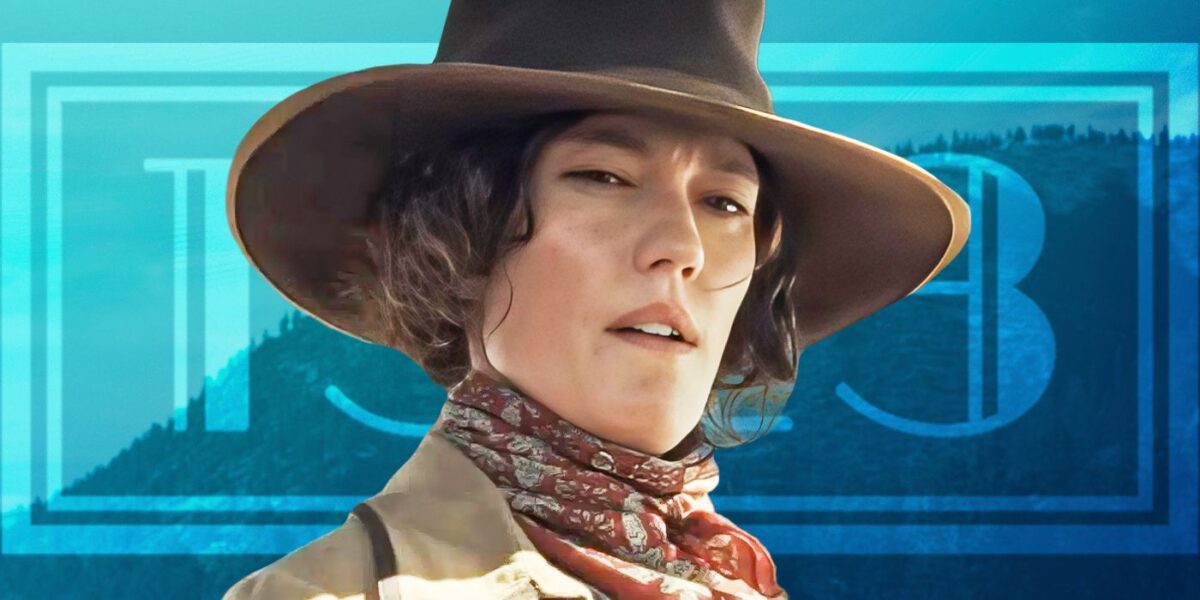
‘1923’s Jennifer Carpenter on Crossing Paths With Duttons and Why Playing Mamie “Reinvigorated” Her as an Actor
Mar 23, 2025
Editor’s note: The below interview contains spoilers for 1923 Season 2 Episode 5.
Even though many of the characters in Taylor Sheridan’s Dutton prequel series 1923 are currently split up from each other, we’re slowly starting to see these storylines begin to cross over as the second season continues. More than halfway into Season 2, this week’s episode, “Only Gunshots to Guide Us,” begins to see the hunt for Teonna Rainwater (Aminah Nieves) spill over into other character journeys, as U.S. Marshal Mamie Fossett’s (Jennifer Carpenter) investigation of events leads her to cross paths with none other than Spencer Dutton (Brandon Sklenar), who’s just trying to make his way to back to the Yellowstone Ranch in Montana.
Ahead of the premiere of “Only Gunshots to Guide Us,” Collider had the opportunity to speak with Carpenter about how Mamie’s storyline reaches an unexpected turning point this week. Over the course of the interview, which you can read below, Carpenter discusses her road to joining 1923, the physical process of training to ride horses and becoming comfortable in the saddle, how the role of Mamie Fossett “reinvigorated” her as an actor, why she was most afraid to share a scene with Jamie McShane, who plays Marshal Kent, and more.
COLLIDER: I would love to hear the story of how you became linked up with 1923. Did you get a call from Taylor [Sheridan]? What was the whole process that led to you joining the show?
JENNIFER CARPENTER: The very first scene where you see Mamie in the show showed up in my inbox, and I made a tape for it. Then, maybe weeks later, one note came about one moment—one word, actually. “Can you just do something different with that one word?” I resent the tape back, didn’t hear anything for quite some time, and all of a sudden, I was called to Texas to do a test. Honestly, Genesis Rodriguez, who was going in for Lioness, was also there, and she and I were just cheerleading each other on that day, and we started a friendship. We’ve been in touch ever since.
The consensus in the Taylor community is that it’s a family, and you really feel it. Even on a day where it’s so stressful, you’ve really grown to want to be a part of something. It’s so supportive and gives you all the room to make yourself vulnerable so that the work can be present and the nerves can wait in the hall. That was a nice taste of what that world could be like. I also let them know once we were all on set, I am up for adoption, that this is a family. I can sign my papers whenever you’re ready. That’s how it all started.
Jennifer Carpenter Fell in Love With Horseback Riding While Training for ‘1923’
Image via Paramount+
In terms of the Sheridanverse, you really are being thrust into this world — especially in this show, because it’s a period drama. It’s a change from doing something more contemporary, including horseback riding. Other actors I’ve spoken to for this show have mentioned “cowboy camp.” Was that something that you had to jump into and learn how to do, in terms of the more physical elements of this role?
CARPENTER: Even before I got to the horse element and the cowboy thing of it, I was doing everything I could. I consider myself a sleuth on the internet when it comes to researching for parts, and I could find so little — so little, in fact, that I was sure it couldn’t possibly be enough about the actual Mamie. It turns out it was. There was, honestly, an advantage, to having such spare information because it became the skeletal system, and then I spent all these weeks and months just adding thought, which just gave it tissue and breath and blood flow. All of that was happening naturally.
Then I thought, “Uh oh, I have to also know how to ride a horse.” I didn’t want to be thinking about, “Am I doing it correctly? Are my feet in the right spot?” I knew that cowboy camp had already been established for the first year, so they probably weren’t gonna be coming back, so I just put a phone call out to Taylor, and I said, “I want to be a know-it-all on the day.” So he said, “Come out.” So I went out solo for a week, and I rode with Danica, who runs one of his barns there. She was an excellent teacher, very patient, and I was terrible. I probably didn’t get into the rhythm for the first three days, so you feel like you’ve been in a car accident for three days in a row. Then, I asked to come out a week early before shooting, and I worked with two separate trainers, Bobby and Diane. There was one day, one moment, one note when [Diane] decided I was ready. She gave it to me, I did what she told me to do, and it all just clicked. Then, we were off and running, no pun intended.
But I realized how green I was. There was one scene where I had to run full out, and I looked at Diane, and right as the cameras were setting up, I said, “I’ve never done that. What do I do?” She goes, “Just squeeze him like a tube of toothpaste!” [Laughs] I did with everything I had, and we were off. Now I can see why people dedicate their spare change to riding horses, and more, because it is so thrilling and spiritual to be connected with an animal and to trust an animal like that—and trust them with you! It was incredible. Wild.
You just mentioned that there’s not a lot of information about the real Mamie Fossett, and I think a lot of that is in part due to the fact that she was a woman at that time. When it came to your process of figuring out who this woman was, and the version that you wanted to play, did it come through the costume, finding the accent, [or] some other little detail that really helped you latch onto her?
CARPENTER: It came in small increments, and there wasn’t a big enough moment to go, “Now I feel safe. Now I feel ready. Now I feel armored.” Of course, the costumes were incredible to put on. They felt foreign to me, too, at first. I thought, “This is not how I pictured it at all.” It felt too adorned, but the more I moved through it, I realized, “Oh, everything carries a function.” Also, [costume designer] Janie [Bryant] did a couple of things for me that I was carrying that no one else would know about. So, it was learning the scenes, meeting the other actors, all of that good stuff. But, to be honest, Texas was my friend—just the weight of the air, the heat, just computing the most minor breeze, sitting in proper form on the horse.
I needed to know a couple of pieces of information. One was that I was protected. I don’t think that a woman moves through that territory and puts her life on the line every day without having some connection to God — or a Creator, as Aminah [Nieves] puts it. I think that [Mamie] pictured herself as a soldier for God’s creation in all forms. Being saddled with the law, which was paper thin at the time, knowing that it was her charge to add weight to it and to add validity to it, that’s where it started. Then it was the real-life elements that really turned everything on, because you are there thinking the thoughts, and you are there suffering the elements, and you do feel your horse’s lungs expanding and contracting over and over. There’s no distraction like we have with all of our devices. It was truly like time travel. I didn’t see a camera — there were seven at the time. You don’t know if you’re on or not. So, I was as in the moment as I’ve been since I’ve been on stage. That’s why I feel so reinvigorated as an actor. I feel like I’m Tom Brady in his prime. Let’s go! [Laughs] I’ve never had that thought or said that out loud, but I guess it’s true because it’s coming out now.
Related
“I Can’t Think of Anything More Dire”: ‘1923’s Brandon Sklenar Previews What’s Ahead for Spencer Dutton in Season 2
Sklenar also discusses the biggest difference for him in filming the first and second seasons of Taylor Sheridan’s Dutton prequel series.
Jennifer Carpenter Explains How She Figured Out Who ‘1923’s Mamie Fossett Really Is
Image via Paramount+
The moment that we’re introduced to Mamie while she’s in her office, she always feels like she’s in control, despite the fact that she’s a woman in this field. At various points, there’s that echoing refrain of, “I didn’t even know there were female marshals.” Was part of the appeal of the character the fact that she just owns who she is and doesn’t apologize for it, even if there are men who are sometimes questioning her authority?
CARPENTER: That was the part that terrifies me, Jennifer, playing it, like, “Do I have the stuff?” I remember in the press, maybe on the news or in a clipping in the paper at my dad’s house, seeing they had done a study where they put a man and a woman in identical rooms for a certain amount of time. They called them out, and then they had them list all the things they could remember that were in the room, and the women always won. From then on, I was like, “We are the noticers. We are always taking inventory.” So, I endowed her with that. She is someone who is always calculating—it’s not even calculating, just putting the numbers down.
I imagined her being one of many children watching her brothers have freedoms that maybe she envied, watching her father until he passed or they were no longer connected, and I just thought she must understand that power is not how you treat people; power is how people treat you. So, what do you do? You get them to treat you first so then, they can experience your response. If you don’t give them a ton of information in the response, then you aren’t leading them. They will expose themselves.
Ben [Richardson], our director, was very helpful [in] talking to me about very, very subtle one-word notes that would make you realize that you don’t have to have your hands hovering over your weapons at all times. As long as you have concentration, then that’s as good as having your finger on a trigger. That’s where it all started. Then you look at someone like Jamie [McShane] across the table, who is, I think, a powerhouse. Even in his most subtle moments, he is explosive. He was the person that I was most afraid to be on-screen with, but I did not want him to win. [Laughs] I just think he’s incredible.
[In] that first scene when you meet her, I went to my office on that set very early, and I spent maybe an hour and a half in there because I didn’t want it to look like the first time I’d ever been in there. I went through every book. I actually have all of her credentials here, framed. They let me have them! There was nothing in the room—book, trophy, nothing—that was after 1923. It was all up to 1923. It was all authentic. They have this book of wildflowers from the 1800s. You weren’t taking photographs. If you wanted to remember a meadow or a state line, you would take a flower and then write in it. And all of that was right there in front of me. It was just the same way that the exteriors felt so full and so alive. A lot of the interiors did, too, because it felt like the best of every department was putting their everything into it.
You are getting to bounce off of more and more of the cast, especially in this episode. We’re seeing these storylines start to converge with the Teonna storyline and the search for her, but Mamie’s also running into Spencer. When did you have the realization that your character’s storyline isn’t really isolated, and you’re actually getting to be a part of this larger narrative?
CARPENTER: One thing I appreciated is that it doesn’t matter who she runs into, her target is clear. There’s not a secondary character, even Spencer, that can come in and move her sights. It’s all about these men that came and said that this is what was happening. “Well, let me find out what these men are up to after they’ve clearly created a crime of their own.” It was just about the clarity of the charge.
In the scene where Mamie’s having the phone call with the sheriff, she’s trying to get more information on who Spencer is, but there’s also something that Mamie says that really seems to distill her philosophy as a marshal down into a single line, and it’s when you say, “You can’t arrest a man for what he might do.” It just says so much about who Mamie is and the type of lawman she is. What can you tease about her goals and her drive, and how that’s going to carry through the remainder of Season 2?
CARPENTER: I think that the flip side of that line is, “You have to have faith in a man and what they might do.” [Spencer’s] heard me say it: I’m not his parent. I work for him as much as I work for the man sitting across the desk. So, I think that there’s a sense of sober clarity about her, and it brings her closer to herself. It’s almost like she doesn’t have a mono mind. She has one charge. She has one aim and one mission. She’s so multifaceted in my mind—maybe the viewer would see her as a little flatter than this. Every second felt so alive and so real and true; if I can keep order and faith about myself, then I can give it to my fellow man authentically. That is the grace that she lives in, even with all of the grit that she wears and has stuck in her teeth and the corners of her eyes when she’s out there doing her job.
New episodes of 1923 Season 2 premiere Sundays on Paramount+.
1923
Release Date
2022 – 2024
Network
Paramount+
Directors
Guy Ferland
Publisher: Source link




Mason Gooding & James Van Der Beek’s Bad Night Is Aggressively Dull
Ever since the Scream franchise helped put him on the map, Mason Gooding has been a great talent to watch. The genre-bending slasher Heart Eyes is still his best non-franchise role yet, but he's also branched outside of horror in…
Mar 15, 2026
A Grumpy Nick Offerman Keeps This Fish Tale Swimming Along
Animated fish films have been done. Finding Nemo. Shark Tale. Ponyo. So to hear about another doesn't feel like anything new. However, The Pout-Pout Fish, starring Nick Offerman as a grumpy ocean pout named Mr. Fish, is a little different.…
Mar 15, 2026
‘The Rookie’s Best Season 8 Episode Goes Completely Different With Full Zombie Horror
Editor's Note: The following contains spoilers for The Rookie Season 8, Episode 10.It's crucial for procedurals to come up with a winning formula that entices viewers to tune in every week. But it's just as important for these types of…
Mar 13, 2026

Sidney Prescott Leads a Brutal Throwback
Walking into Scream 7, I wasn’t sure if this entry would be a new reinvention. I know I wanted tension. I know I wanted that uneasy calm before the snap. And most of all, I wanted to see why Sidney…
Mar 13, 2026