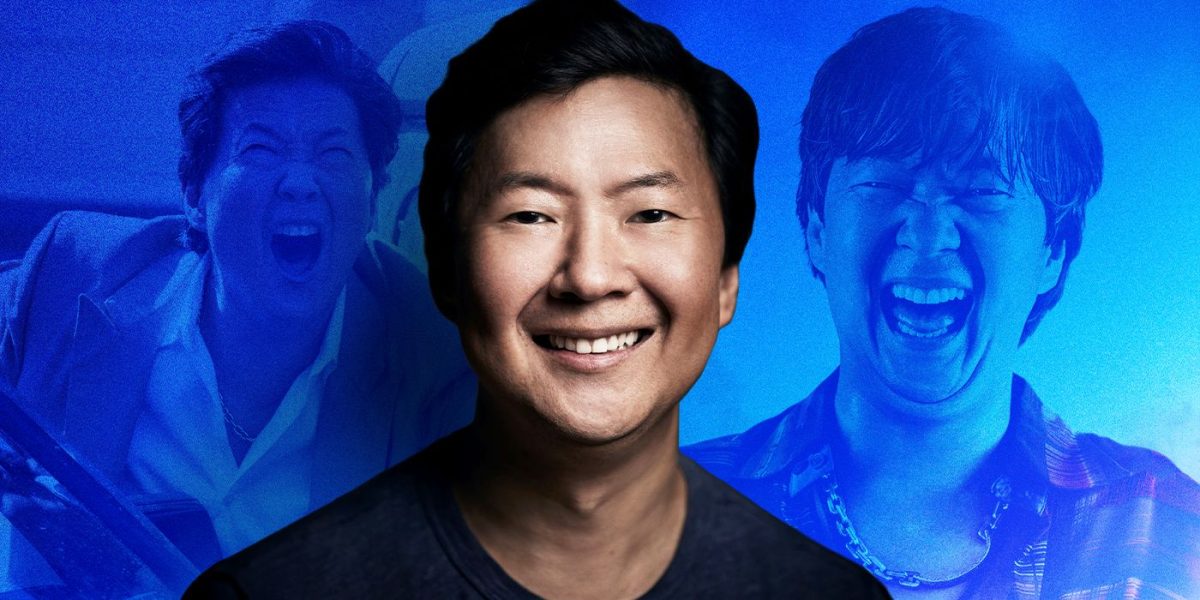
The “Worst Period” of Ken Jeong’s Life Changed Absolutely Everything
Sep 13, 2024
For anyone who thinks Ken Jeong is America’s busiest actor, you would be absolutely correct. Since 2009, the comedian has been stepping into some of the funniest projects across film and television. To be more exact, you might remember this time 15 years ago, the Detroit native was coming off the mega success of his R-rated blockbuster comedy The Hangover and just days away from the premiere of what would become one of TV’s best comedies of the 2000s, Community. While the 55-year-old humbly admits the Dan Harmon series made him a “better actor,” one can see Jeong has always been deeply layered behind those outrageous, emotional undertones. It’ll be no different when he’s filming Season 2 of the Accused for FOX in Toronto this month, a crime anthology series from Homeland’s Howard Gordon.
During a Zoom call with the actor from his bright, humble abode on the West Coast, Jeong is laid back and chill. Sporting a crisp black T-shirt and sharp thick, black-rimmed glasses, he could double for a cool, very Asian James Dean. But in the hour we shared talking about his career and its impact on him today, he’s clearly the kind of person to wear his heart on his sleeve and genuinely cares about the difference he makes. Admitting that even with his upcoming role in the FOX series with Michael Chiklis being his first dramatic lead in a drama, it has him feeling a lot of emotions. “I’m really excited and probably nervous, and wanting to just do a good job in it,” Jeong says, adding how it’s all very surreal even saying out loud. “It’s nothing I’ve ever done before. I’ve had supporting roles in dramas but never the lead, so I’m honored that Howard would even think of me for this because I so love his work.”
Despite not being able to share anything more without veering into spoilers for the series’ sophomore season, Jeong calls working with Chiklis a “full-circle” moment, having first starred with the actor on Season 6 of The Shield as Skip Osaka. “I had, like, one line. It wasn’t with him, but it was just in the background as a crime photographer,” he chuckles. But while Jeong was once an up-and-coming actor, it would be only two years later that his life would dramatically change following the release of what is now one of the highest-grossing R-rated comedies ever in the United States, beating a record formerly held by Eddie Murphy’s Beverly Hills Cop for 25 years.
Fans Don’t Know the Truth About ‘The Hangover,’ According to Ken Jeong
By this time in Jeong’s career, everyone knows the deeply personal context behind the role that brought him to one of film’s most superstar baddies, Leslie Chow. But the Duke University graduate reveals it almost never happened at all because of his wife, Tran Ho’s cancer diagnosis. Fifteen years later, she is now, thankfully, cancer-free. But at the time, when the new parents had just welcomed their twins, Jeong admits he wanted to be there for his wife during treatment despite Ho having other ideas. “My wife was going through chemotherapy for breast cancer at that time, and I, in fact, almost didn’t do the movie,” he says somberly. “At that time, because I’m a physician and my wife’s a physician, we really approached her situation very clinically, and with knowledge, and knowledge is power. We knew that after her first dose of chemo, her tumor markers had gone down, so we knew there was a really, really good chance that we could beat this thing, and that was before even discussing The Hangover.”
Jeong discloses with his wife’s blessing and even his mother-in-law’s (“shoutout to her for taking care of her and our kids at that time”), he took on the role. But he adds that audiences don’t actually know the whole truth behind his now iconic appearance in the Bradley Cooper, Zach Galifianakis, and Ed Helms-starring film. “I was only there in Vegas for three days for the movie. I was not there the whole time filming,” he says. “So for the first movie, I was only there filming for three days. Luckily for me, because of Todd Phillips, the director and writer, it seemed I was in the movie a lot more on the first movie. They were in Vegas for many months, and I give Todd a lot of credit, and Warner Bros. They flew me back and forth from filming. As soon as I was done, I’d go back to LA to be with Tran.”
Thinking about it now, Jeong tells me how there’s so much more meaning behind The Hangover to him than to fans of the film. “It really got me through the worst period of my life,” he says before taking a pause. “As time goes by, the more I appreciate the behind-the-scenes love that everyone had. I wasn’t public with it. At that time, only Bradley and Todd knew because I’d done a movie with Bradley a year prior, so we had known each other.”
Thinking about it now especially, there’s so much more meaning behind ‘The Hangover’ than it is to the public because it really got me through the worst period of my life.
Jeong says he didn’t want to tell “too many people,” otherwise he would “break down crying every day.” It helped the actor a great deal to have that much support, especially from Phillips and Cooper, who made it a point to help every step of the way. “There’s a lot of behind-the-scenes love that was there. Even if The Hangover wasn’t The Hangover, I don’t think I would have gotten through that time if it wasn’t for doing that movie, because it was very therapeutic. I think that’s probably why I played it so hard and literally balls to the wall,” he laughs out loud.
Adding how it was the best distraction for him, “artistically,” Jeong approached the film in a way that he’s never approached anything before, nor since. “I just approached it as therapy as opposed to, ‘Oh, we’re gonna make this a great movie.’ I wasn’t even thinking about that, to be really honest.” It’s also a big reason why Jeong admits he never knew the movie would take off and spawn two sequels like it did. “I remember telling my wife while we were filming it, I said, ‘I think this is the funniest movie I’ve ever done, I just don’t know if the world will see that.’ Because sometimes, when you’re making movies and making TV, you don’t really know what’s going to work or not,” he says, adding how there has been a slew of projects over the years he’s done and “personally love” that he felt would make an impact, but never quite took off.
But even then, the actor admits it’s “still a great experience” to have. Thankfully, The Hangover was that for him, “but with the caveat that it became the biggest thing” Jeong has ever been a part of. “It just gave me a career. I wouldn’t be here talking to you if it wasn’t for The Hangover. I’m very, still, 15 years later, eternally grateful for that movie because it just opened a whole new world that I never knew existed for me, to be honest.”
While Jeong humbly states that The Hangover “changed” him as an actor and an artist, he goes on to share how the experience reminds him that “life is short and to just maybe go opposite” of those usual instincts he holds as a performer. “I was thinking about my approach to the role because I was just known for Knocked Up at that time, basically, and that was where I played a doctor because I was a doctor. Those were the kinds of roles I was getting at that time,” he says. “I really didn’t, by nature, like to do that kind of role prior to that. But then after [playing Chow], everything just changed. I really keep telling myself, ‘Just always go for it and be fearless.’ I’m not always like that. I wasn’t always like that, necessarily.”
‘The 4:30 Movie’ Has Ken Jeong Pulling From Older Roles
Since The Hangover, Jeong has starred in more than 40 films and TV shows and even directed a short in The Seven Faces of Jane alongside real-life best friends, Joel McHale and Gillian Jacobs. But it’s his latest with director Kevin Smith in The 4:30 Movie that finds the comedian taking on another kind of role — an adult bully. In the entirety of our conversation and sharing stories about our own families, it’s hard to believe Jeong can be intentionally mean to children. Yet it’s a scene-stealing performance that sets the film up for some hearty laughs. In the sincere, cinematic endeavor by Smith that finds three teenagers sneaking into films at the local cineplex, the award-winning actor brings out a striking, focused depth to him that is more than meets the eye.
“I think [Mike’s] just a frustrated producer-director,” Jeong says. “There’s something in him, but he kind of feels stuck in his town, so he just projects everything out in a negative way and in a narcissistic way onto his employees and to the patrons.” Jeong admits he thought of another role he played years ago that weaved similar threads in the comedy, Role Models with Paul Rudd. “I did think a little bit of my own character, self-referencing, a little bit of King Argotron in Role Models. Someone brought that up at [The 4:30 Movie] Q&A,” he says. “I didn’t think about that consciously, but looking back, I think subconsciously, I referenced that. In a way, the character I play is almost a throwback to the characters I played early on in my career in ‘07 and ‘08. So there was a nostalgia even for what I do in the characters that I play.”
But it’s not just Jeong bringing nostalgia to the comedy. The Smith production is a love letter to ‘80s cinema in every way, channeling John Hughes and the most elevated of yesteryear fashion. Having watched the film with audiences at Smodcastle Cinemas in Atlantic Highlands, New Jersey last month, Jeong says all his scenes were done at the cinema Smith frequented as a teenager. “He now owns [it], so it was full circle to come back and watch the premiere there with a full, sold-out audience, and all my scenes were filmed there. It was crazy. It was beautiful. And to see how full circle it was for Kevin, I was just incredibly happy for him and the cast.”
Revealing how he “loved it even more watching it the second time around,” Jeong says portraying Mike was more exciting than he imagined. Coming off the heels of My Spy: The Eternal City with Dave Bautista where Jeong plays a very responsible parent, he plays the total opposite in The 4:30 Movie. “Manager Mike was more fun to play in terms of just the ‘07 Ken version of it, where it was almost like a throwback for me to the roles I’ve done in yesteryear,” he says.
I was not rebellious at all. I was kind of a model kid who would try to do everything the right way.
With the movie delving into themes of rebellion and being bold — traits brimming to the surface of Chow’s being in The Hangover — Jeong admits that is not a characteristic he had him in early on. Much like the kids in The 4:30 Movie sneak into movies at their local Cineplex all day, the father-of-two admits he was always “too afraid” to do something like that. “I was not rebellious at all. I was kind of a model kid who would try to do everything the right way. But I did grow up in ‘86 when people would go theater hop and I just thought that was the most insane thing ever. I remember friends of mine were like, ‘Hey, let’s just…’ I’m the other guy that was just like, ‘Hey, instead of theater hopping, like… No, I don’t want to get into trouble. I’m going to college. I don’t want that on my record.’ I was always paranoid about stuff like that,” he laughs.
With all this talk about Smith’s auto-biographical feature in theaters on September 13, there’s a curiosity that piques interest in what part of Jeong’s life he would ever segment off into a biopic. Forty minutes into our conversation, it’s already evident, but it bears repeating that it’s The Hangover experience that would be the focus of his own big-screen life story. It’s the fastest response he shoots my way this afternoon, but it will come with a twist: “I think it’d be more of a drama of what I went through behind the scenes. I think that would at least be the inspiration for a narrative.”
Adding how it wouldn’t be “beat for beat,” Jeong says he feels it would portray the balance of life and death and “the real-life stakes of how we live our lives and how art was an escape” for him. “That interests me just as a person, as an appreciator of art and film. I’d be interested in any tale of that ilk of what inspires you in your art. And for me, it was Tran and what she went through and how that changed my life and changed my art, of how I approach things. It’d be interesting to try to balance the drama of my real life with literally the dirtiest comedy ever made and how there’s something very sweet and wholesome to such a dirty movie,” he chuckles wholeheartedly.
With Jeong putting so much of his “anger and frustration” about Ho’s situation into Chow and the duality of that character flipping on and off at the flip of a switch, it’s this precise juncture in time that one could say, cosmically redirected things for him. As a testament to his heart and the Universe paying it back in some way, the role changed him in more ways than one. “Not only my career, obviously, but it changed me in how I approach everything. That spilled over into Community, where Chang is kind of a version of that; where he was insane. It was right off the heels of The Hangover where I was still maybe in that kind of Chow mode of fearlessness that I applied to Community, except that one was on broadcast TV, so I was able to kind of transfer that energy for six more seasons. So, it definitely changed because had I filmed Community prior to The Hangover, I think you would have seen a very different version of Chang had I gotten offered that role. And who knows? Maybe I wouldn’t have.”
It’s hard to think of Community without Chang. As one of the show’s most eccentric and unpredictable characters, the quirky and slightly unhinged Spanish teacher at Greendale Community College undergoes several bizarre transformations throughout the series. After losing his teaching job due to not having the proper credentials, Chang’s role became increasingly erratic, proving Jeong was a comedy powerhouse. “There are so many moments on Community that made me a better actor,” he says. “There are just too many to mention. Just the boundaries that were pushed and the genres that were given homage to, that was all the brainchild of Dan Harmon.” Jeong goes on to call merely reading the scripts at the table reads such an honor because they were like short stories. “That’s such a special time of watching everybody in that cast. Now everybody’s a superstar — except Joel McHale, of course.”
Joking, of course, Jeong takes me on a cul-de-sac for some “real talk” about his former co-star (who he notes was just actually just a “great guest star”). Leaning into the camera to speak to me as if it’s a secret, he admits the two are not only BFFs but that McHale is also someone he can sincerely confide in. “Joel and I were always good friends during the show, but after the show, he’s one of my best friends. It’s amazing, it’s kind of having a college buddy that I got to know even more afterward. It is just amazing how our lives keep intertwining, and it’s just a beautiful thing. Please cut all these great things I’m saying about Joel in the interview,” he laughs.
Image by NBC Universal, Sony Pictures Television
As we spin back onto the road sans McHale praise, Jeong recalls a moment during Season 5 when Chang was at his “certifiably crazy” best. “It wasn’t really about a genre-pushing episode at the time… [my character] was doing so many insane things that I was worried that my overacting had kind of put the writers in a corner where I’m just doing so many crazy things that I couldn’t get myself out of.” Jeong admits it’s “every actor’s lament” once you hit the fifth season of a popular, groundbreaking series. “‘Oh, I can do more!’ That’s such a natural instinct, and I knew I was kind of falling into that trap a little bit, and that’s every actor on a series,” he says, revealing through laughs that the thought occurred during the “Ass Crack Bandit” episode (better known as “Basic Intergluteal Numismatics”) where Chang was walking backward with a churro up his butt.
“I remember at that point, I had emailed Dan Harmon and said, ‘I would love to do something more grounded. I feel like this is my fault for maybe playing the character so hard and too over-the-top that possibly I’ve backed the writers into the corner, and this is all I do.’ And I said, ‘I’m not asking for a bigger part,’ because actors, when they want something, sometimes that means they want to be [a bigger part]. I said, ‘I do not want a bigger role in the show at all, but I just would love to try to play something more grounded because I know I’m capable of it.’”
Taking a minute to recall the moment, Jeong adds how Harmon sent him the “nicest email” and explained what was going on at that point in the writers’ room. “‘We just needed two guaranteed laugh-out-loud moments in that episode, so the pinecone sandwich and the churro up your butt were just good bookmarks, well-placed in the first and third acts of the episode,’” Jeong recalls Harmon sharing.
With the episode paying homage to David Fincher movies and shot like Se7en, Jeong reveals it was on the eve of co-star Donald Glover’s exit from the series, so a lot was on Harmon’s mind, particularly when it came to the future and survival of the show. “I was honored that he would share that with me as to why he placed those scenes and why he did those scenes,” Jeong says. “It really made me understand the amount of stakes. I know writers are constantly under a crunch of stress, but really, the artistic stress that the show was going through, that he was going through, and then not thinking of just myself selfishly. I really understood the conundrum and the stakes involved in the future of the show.”
Those were my real tears. I just couldn’t stop crying, even in between takes.
Throughout our chat, it’s evident Jeong is not only humble with a big heart for those around him, but is also extremely modest. While he’s sharing details of an email he wrote to Harmon about something he wanted to see for Chang, Jeong is like everyone else, experiencing fears and insecurities. Except, one of the most transparent things about him is how all these fears pushed his career growth. With the promise of something much more dramatic from Harmon after the “Basic Intergluteal Numismatics” episode, Jeong admits he doubted he could pull it off. “I said to myself, ‘I’m not that good an actor, and I can’t do that. I can’t do a dramatic monologue,’” he laughs, sharing that Harmon is a wordplay genius who writes like a musician.
“There’s a musical flow, and I feel like his words are lyrics in many ways. So by the time I got next week’s scripts, he wrote me a monologue that was actually, verbatim, what I wrote in the email to him — how my character has sacrificed, has paid his dues, has done his time, and he is craving more respect. What drove me to tears in that scene, and it still gets me choked up now, the monologue was my email to him, and he couched it in such a way that gave my character depth. I’d never cried in a scene before, like real tears, and it’s in the ‘Bear Down for Midterms’ episode [titled “Analysis of Cork-Based Networking”]. Those were my real tears. I just couldn’t stop crying, even in between takes.”
Ken Jeong Is Expanding His Range Outside Comedy
Image via Apple TV+
Admitting he still thinks about it, Jeong considers that moment the “best introduction to the beginning of a dramatic” despite him being very clear that he doesn’t do much of the genre. But it is something he wants to tackle. “It’s, in many ways, one of my favorite moments of my acting career, because I got to cry on camera, like every actor’s dream, and to really feel it and mean it,” he says, sharing how it helped when he filmed A Great Divide, a film about a Korean family encountering hostility and xenophobia in their new Wyoming community. “I actually think about what Dan did for me in that email. Instantly, sense memory will get me misty-eyed and drive me to tears. It’s so surreal that when I have to be dramatic and really feel what I say even more than I usually do, I think about that monologue that Dan did for me.”
While Jeong admits he never “really envisioned” he’d be a permanent part of Community, especially coming off of The Hangover, the whole thing feels like a blessing. “It was a dream on a dream on a dream come true,” he smiles. He adds that Chang was never intended to be Señor Chang, the Spanish teacher. “It wasn’t by design that he was gonna be a teacher, student, dictator, and then by the sixth season, he was wanting to be an actor for some reason. What I loved about the show, and what I like about television in general, is all the characters suddenly had changes throughout. Mine was more pronounced, but it was no different from the evolution of a character on television.”
With the performance helping him expand his range, Jeong says he was just “happy” to be a part of the show in any capacity. Sharing how he firmly believes the series has “endured the test of time,” he praises Harmon’s knack for real moments and authenticity that helps explain the comedy. “Community is not about the comedy, it’s about the heart of Greendale, and really through the heart of Dan Harmon, there’s so much of his emotion. I look at Community as a very emotional series. I don’t see, ‘Oh, it’s a funny show.’ I never think about Community that way, even as a fan. It’s a very emotional series. He’s taking the viewer on an emotional journey.”
Proving he is more than just Ben Chang or even Manager Mike, Jeong is well on his way to shifting his career a bit more through these dramatic twists and turns. In the case of the Accused, the actor admits he is thrilled to be joining Season 2 of the series and happy fans will see another, very nuanced side to him. “I’m very excited about my dramatic lead debut. To me, I feel like everything in my life has now been a wonderful bonus. I’ve accomplished everything I’ve wanted to accomplish.”
Ken Jeong can be seen in The 4:30 Movie, now playing in theaters.
Get Your Tickets
Publisher: Source link





‘Tracker’ Season 4 Officially Puts Its Biggest Mystery on Hold Despite Major Cast Comeback
Our fictional missing persons expert, Colter Shaw (Justin Hartley), has kept audiences happily on the edge of their seats ever since Tracker debuted two years ago, and Season 3 in particular left audiences with quite a major cliffhanger — all…
Sep 19, 2026
‘Reacher’s Action Thriller Spin-Off Gets Major Season 2 Update Following Premiere
For four seasons, Reacher has been one of the biggest TV shows on Prime Video. Based on the novels by Lee Child, the series follows former military police officer Jack Reacher (Alan Ritchson) as he wanders from place to place,…
Sep 18, 2026

One of CBS’ Longest-Running & Highest Rated TV Shows Is Coming To End After 30 Years
Along with countless scripted dramas, comedies, and action shows, CBS is well known for its impressive run of unscripted programs over the last 50 years. More recent years have included major competition shows like Survivor and The Amazing Race, along…
Sep 17, 2026

Prime Video Officially Launches New Deal That Changes the Streaming Game Forever
It seems like streamers raise their prices every day. At the end of August, Apple TV raised the subscription service price by $2, bringing it to $14.99 a month. Netflix, Disney+, HBO Max, Paramount+, and Peacock have all raised prices…
Sep 16, 2026