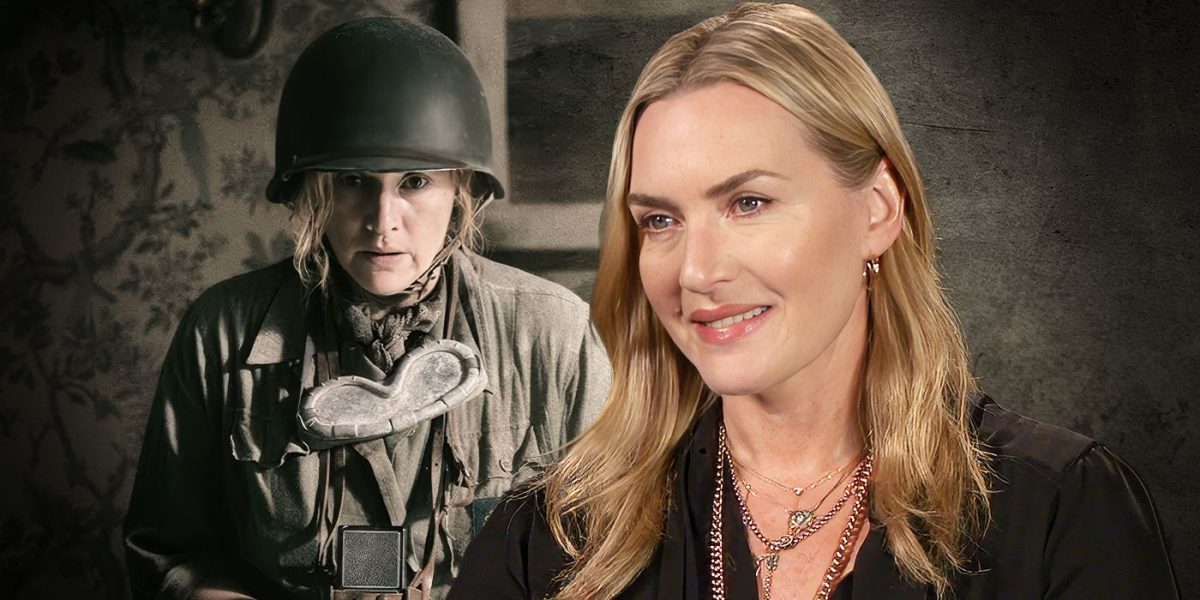
Kate Winslet Reveals Why Her Latest Movie Almost Fell Apart the Day Before Filming Began
Sep 29, 2024
The Big Picture
Collider’s Steve Weintraub talks with Kate Winslet about the Ellen Kuras biopic
Lee
.
In the film, Winslet plays Lee Miller a female photojournalist during WWII that also stars Andy Samberg and Andrea Riseborough.
During this interview, Winslet discusses her role and the challenges faced during filming, including a back injury.
Academy Award-winning actress Kate Winslet is a worldwide icon, creating memorable performances for massive audiences in collaboration with filmmakers like James Cameron, Peter Jackson, and Ang Lee. Lately, she’s conquered the limited series with smashes like Mare of Easttown and The Regime. Now, Winslet is pulling double duty as star and producer in longtime cinematographer and first-time director Ellen Kuras’ biopic Lee.
In the film, Winslet plays real-life photojournalist Lee Miller. After a career as a model and living as an artist’s muse, Miller enlists as a photographer to chronicle the events of World War II and capture the atrocities of the Holocaust for history’s sake. The movie also stars Andy Samberg and Andrea Riseborough. Ahead of the movie’s release, Winslet spoke with Collider’s Steve Weintraub. During their time together, Winslet spoke about the importance of keeping the biopic female-led, female-centric, and genuinely from Lee Miller’s point of view. You can watch the full conversation in the video above or read the transcript below.
Kate Winslet Unintentionally Goes Method for ‘Lee’
“I was in excruciating agony, but ironically, Lee Miller went through the war with unbearable back pain.”
COLLIDER: I watched this yesterday. I have so much to say, but first of all, you’re fantastic in this role.
KATE WINSLET: Thank you very much. Thank you.
I really want to start with a thank you for your work. I’ve really enjoyed your stuff over the years. I’ve learned so much about acting and what it really takes. Thanks for your work.
WINSLET: Thank you. I appreciate that. I really appreciate that.
Before jumping into the film, I’m always curious with actors, what is the most nervous you’ve been prior to the first day of filming something?
WINSLET: The most nervous I have been, I think, was probably prior to the first day of filming Lee. So much rested on it for me because I had spent seven years developing it up to that point, really working with the writers and getting the script right, contributing even at points to the financing, putting the financing together, which was a very complicated process; hiring the crew, bringing in all those wonderful actors. I wanted it to be not only a great experience for everybody, I, of course, wanted to make the best possible film that we could. I actually vividly remember I did not sleep a wink the night before.
You’ve spent all this time developing this movie, you’re finally shooting with cameras, you’re on the first day of filming, and boom , you get hurt.
WINSLET: I hurt myself the day before we started shooting. It was when we were rehearsing the San Malo sequence, the Battle of San Malo, and I’m running through that street as it’s being bombed. The costume designer came to me before rehearsal, and he said, “Just quickly, can you slip these boots on? I want to make sure that they’re comfy and we don’t need to break them down anymore.” I said, “Oh, yeah, sure.” The sole of the shoe had not been scored enough, or scuffed up enough, so there was no grip. I went running through that town. I ran into the entryway of our bombed-out hotel set, which was covered in sand, and I just went like an ice rink and bang! I landed right on my coccyx on a hard marble floor.
I really thought I had broken my back. Somehow I hadn’t. But I had two vertebrae that had come out, two that had gone in, and four hematomas on my spine. I didn’t even know that that was a thing that could happen. I was in excruciating agony. But ironically, Lee Miller went through the war with unbearable back pain, so I was like, “Okay, great. Thanks.” That’s another thing. I was in a lot of pain. I just kept going. You just keep going. What are you gonna do? Stop? It’s an independent movie. No. So we just kept going.
I can’t imagine. It is weird that she had back pain, and then she’s like, “Yeah, you’re gonna get it, too.”
WINSLET: Oh, yeah. There were lots of things that Lee threw at me, but that’s okay. That’s okay. She was just testing me all the time.
The Visual Voice of Ellen Kuras Was Perfect For ‘Lee’
Image via Sky Cinema
How is this Ellen [Kuras]’s first movie?
WINSLET: Isn’t it extraordinary?
Seriously.
WINSLET: When I was developing the film. I knew there was no way I could talk to a male director about directing this piece. It morally wouldn’t have felt like the right thing to do. And because it was so important to me to really capture what Lee did in being that visual voice for the victims of conflict with that Rolleiflex camera, I had to learn how to use that thing like it was an extension of my arms. It just had to be second nature. Ellen, with her visual storytelling skills, I knew she was going to be able to visually convey the narrative and the film that I was hoping to make. I just knew she could do it.
This is a fantastic movie. How did you decide on it as a movie versus a six or eight-episode TV miniseries? Because her story is so incredible, and there’s so much you can pull out of her story. That’s great dramatic material.
WINSLET: That was part of the challenge. Most of the challenge in really getting the screenplay right was how much do we keep in? Because she lived so many lives in her lifetime. I mean, truly. In her later years, post-war, she became a Cordon Bleu chef. Honestly. She was just extraordinary. But for me, this decade of Lee’s life was the decade when Lee became Lee. This was the period of her life that most defined her. It also was the period in her life that, I believe, is how she would most wish to be remembered. We wanted to lift her out of the male gaze. She had been often described as the “former muse of Manray,” the “ex-cover girl,” “former Vogue model — these infantilizing labels that had been placed upon her — and that was a tiny section of her life. Her real life, her truth that she fought for, really happened during that decade of her life when she went to war, and paid a huge emotional price herself for bearing witness. As soon as we settled on that decade, we were able to really condense and pack our story.
How Andy Samberg Was Cast In ‘Lee’
Image via Kimberley French
Was it Ellen who said, “Let’s get the guy from Brooklyn Nine-Nine to play David?”
WINSLET: It was actually Marion Hume, one of our co-writers, who’s a very old friend of mine. I’ve actually known her since I was 16 years old, and this was also her first screenplay. We had lots of first-timers, actually, and that was very important to me as well. But Marion called me one day, and she went, “Have you actually seen how much Andy Samberg looks like the real Davy Sherman?” And I said, “Hang on. Let me just think about this.” I had never put the two faces together, and, of course, the second I did, my god, all the light bulbs went on. I just thought, “Wow!” And she said, “Go and ask him.” I said, “Well, first of all, I don’t know him, and secondly, I don’t know if he would feel this was something he wanted to do.” And to my amazement and delight, he took a phone call, and he was really excited to be asked. He read and he became part of a process of trying to figure out how he would feel comfortable in doing this. He was just absolutely brilliant. I’m a big believer in comedic actors 100% being able to play serious roles. We were very, very fortunate to have him, and he was very happy to have been asked.
I’m a huge fan of his, and you should, of course, cast people that were in Pop Star . I’m joking around, obviously.
What Set Lee Miller Apart From Her Male Counterparts
”Lee was photographing the women, the children, the victims of the atrocities.”
Image via Roadside Attractions
Being completely serious, in the third act, you deal with a very serious subject matter. With the train sequence, with the concentration camps, there’s so much there that is very powerful. Can you talk about the importance of those scenes and what it was like on set trying to capture those historical moments?
WINSLET: When we were shooting those scenes, we actually had a really scary moment where it suddenly started to properly rain, and we knew that it had not been raining when Lee had taken some of those images. The “waiting for the rain to stop” part became ever so slightly nerve-wracking because we obviously had so much we needed to shoot during our day. Anyway, the gods were on our side — if you believe in God — and the rain lifted.
All I can tell you is that it was incredibly hard. Incredibly hard and detailed. There have been so many wonderful films that have been made by brilliant filmmakers that include scenes from the Holocaust, or even about the Holocaust entirely, beginning to end, that are wonderful, wonderful films. We knew that we didn’t want to do that because we had Lee’s images, and we had to only be guided by them. But when you look at Lee’s real images and what she did, it really sets her apart from other male photographers at the time. Men who were standing back and photographing what they could see or photographing the soldiers, and the fighting, or the bloodshed.
Lee was photographing the women, the children, the victims of the atrocities of the Nazi regime. Not just photographing it, but because she had a Rolleiflex camera that she did not need to bring up to her face — she was able to truly bear witness, truly stand in amongst the destruction, the devastation, and the death to reveal to the world the stories of those victims. The people left behind. The missing whose stories may otherwise not have been told. That did feel like a pressure, but it didn’t make us panic. We just stuck to the truth and let the facts carry us through those sequences. It was very hard.
Lee is in theaters now.
Buy Tickets
Publisher: Source link




‘Tracker’ Season 4 Officially Puts Its Biggest Mystery on Hold Despite Major Cast Comeback
Our fictional missing persons expert, Colter Shaw (Justin Hartley), has kept audiences happily on the edge of their seats ever since Tracker debuted two years ago, and Season 3 in particular left audiences with quite a major cliffhanger — all…
Sep 19, 2026
‘Reacher’s Action Thriller Spin-Off Gets Major Season 2 Update Following Premiere
For four seasons, Reacher has been one of the biggest TV shows on Prime Video. Based on the novels by Lee Child, the series follows former military police officer Jack Reacher (Alan Ritchson) as he wanders from place to place,…
Sep 18, 2026

One of CBS’ Longest-Running & Highest Rated TV Shows Is Coming To End After 30 Years
Along with countless scripted dramas, comedies, and action shows, CBS is well known for its impressive run of unscripted programs over the last 50 years. More recent years have included major competition shows like Survivor and The Amazing Race, along…
Sep 17, 2026

Prime Video Officially Launches New Deal That Changes the Streaming Game Forever
It seems like streamers raise their prices every day. At the end of August, Apple TV raised the subscription service price by $2, bringing it to $14.99 a month. Netflix, Disney+, HBO Max, Paramount+, and Peacock have all raised prices…
Sep 16, 2026