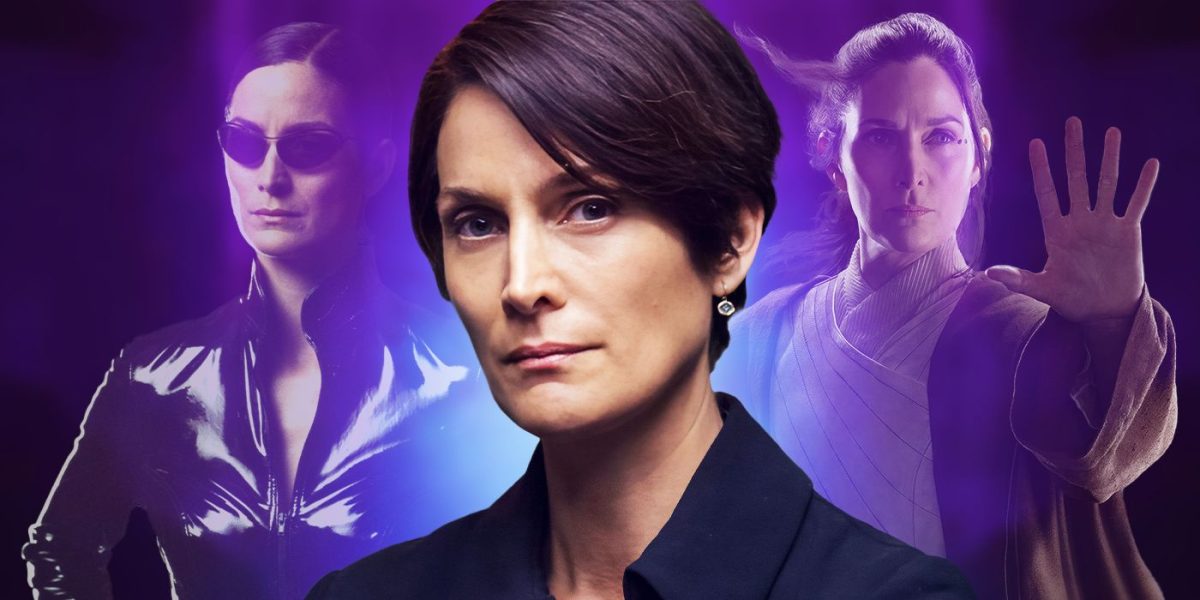
From ‘The Matrix’ to ‘Die Alone,’ Carrie-Ann Moss Has Cracked Hollywood’s Code
Nov 3, 2024
Who do you think of when you hear the name Carrie-Anne Moss? Is it the enigmatic Jedi Master Indara from The Acolyte? Is it the cutthroat lawyer Jeri Hogarth from the Netflix Marvel Defenders universe? Is it the subtly manipulative bartender Natalie from Memento? Or is it Trinity from The Matrix? I think if you asked most people, they’d likely tell you that Carrie-Anne Moss is as synonymous with Trinity as the hacker is with the influential sci-fi film. After over 30 years in the business, the career-defining role of Moss’ life remains a massive part of the actor’s legacy. But, if you think Moss is anything like the stoic and restrained Trinity, then you’d be wrong. Neither is she like the rugged Mae in her newest indie horror feature, Die Alone. Instead, when sitting with her on a Zoom call, Moss is down-to-earth, with a very matter-of-fact approach when it comes to talking about her life and career. She shares the wisdom she earned from being a part of Hollywood, emphasizing that her priorities lay with her family — specifically her kids — and the importance of keeping yourself grounded when it comes to the glitzy business.
When I first met Moss, it was only in passing at The Matrix Resurrections premiere in San Francisco. There, she stood alongside her Matrix co-stars and director Lana Wachowski in an elegant and gauzy black dress and looked every inch the superstar she is. While that version of Moss felt unapproachable and far too glamorous, the Moss who sat down with me for a chat a few weeks ago is different. Still clad in black, she’s now in a mock-neck long-sleeve shirt, her short Trinity-cut hair now grown out to long dark brown locks. She looks relaxed and comfy, sitting in front of a wood-paneled wall with a giant window to one side of the frame showing off an autumnal scene complete with color-changing leaves. The 57-year-old Canadian actor is thoughtful in her replies to my questions that dive into both Die Alone and the various corners of her past. At the end of it all, she has convinced me that she’s got (at least part of) life figured out, and we’d all do better to think a little bit more like Carrie-Anne Moss.
Carrie-Anne Moss Reveals the Best Lesson She’s Learned From Her Years in Hollywood
One thing that immediately becomes apparent to me is how genuine Moss is. Unlike how some actors might expound on lofty ideals of the craft, Moss is straightforward. Nothing is colored with purple prose or fanciful language. She humbly confesses, “Never did I think I would ever be in action movies,” when I ask how she feels about being known as an action movie legend. She acknowledges easily that acting is part of the larger entertainment business and while she might not have come by that lesson easily, Moss’ logic and approach are clearly what keep her from getting lost in the fantasy of Hollywood.
Moss is often hesitant to linger on past regrets and could-have-been moments or speculate about the future. When I prodded a little about potentially seeing her Marvel character Jeri Hogarth come back on screen — especially with Daredevil: Born Again on the horizon in 2025 — she praises the role but doesn’t linger on any maybes. “I love that character too. She was so much fun to play. That was a really, really fun three years. I don’t know. I have no idea,” she says. But would Moss be open to the prospect? “I don’t know. I have to see… I mean, I don’t know. I just don’t. I don’t go there with anything that’s hypothetical. I’ve learned, like, who knows?” she explains with a shrug. It’s not the kind of denial that feels like perhaps she’s hiding a big cameo secret in her future; it’s an unbothered one. “It’s just not worth it, sitting around imagining what could be. Yeah, we do that sometimes, but I don’t really do that with my career.”
I commend her healthy approach to the job, and it surprises me. It’s a common enough question for anyone in the industry who has been a part of a large franchise project: Would they like to play the character again? It’s used by me and many others to bait an answer that might lead to a great headline, perhaps even leading to a slip-up exclusive. But rather than giving me a scoop on a story, the question opens up a whole philosophy for Moss about how she approaches the job. “I say this all the time, but how I’ve navigated Hollywood is really understanding that it’s business. I love the business; it’s filled with really amazing people, and it’s also a business that really doesn’t care about me or anybody really in the end,” she explains. “To ever want to get anything or thinking that you’re gonna get something from the business — like it’s gonna care about you, it’s gonna take care of you, it’s gonna love you or anything like that. I just don’t allow that energy. That can be really toxic for people when they’re looking for their validation through all of that. I learned pretty early on not to look for my self-worth through the lens of the business that I’ve chosen to be in. To really be clear that I love it and I love my part in it, but then at the end of the day, it’s business.”
I learned pretty early on not to look for my self-worth through the lens of the business that I’ve chosen to be in.
Moss easily admits that while she understands business, she’s not savvy at it; she’s the creative. She defines herself as an actor and a mom. “I don’t have a degree in business. I don’t broker big deals. I’m of service to the collective in a weird way in that the roles that I play are things that I do truly from a place of wanting to be a part of storytelling, and I’ve always wanted that since I was very young. And I love it. I don’t take it for granted, and I don’t vilify it, and I don’t put it on a pedestal. I get it, you know, I get it. And I’m not naive.” And while the actor has felt some of the pressures from Hollywood as she’s gotten older, she also acknowledges that in this period of her life, she has played some of her favorite roles so far. What she’s doing is still fun for her, and it’s significant; she’s grateful to still have this passion for her career after 30 years. She’s still in love with her job, and it’s advice she passes on to her kids as they go into college: pursue something you love.
I don’t think anyone listening to Moss speak today would call her naive, but she admits that these sage lessons about acting come from when she was still a new, burgeoning actor who first arrived in Los Angeles. The lessons learned became a part of a protection mechanism, as she calls it. “I think it’s understanding how difficult the industry was moving to LA when I was like, 24 or 25, being pretty naive, not having any money, not knowing anyone, not having a green card.” While it was a big deal for her to begin cashing checks as an actor, she realized quickly that there was a lot of time she wasn’t working. To maintain her mental health, she began to look at life differently. “In a way, the difficultness of what I do for work propelled me into developing my own way of navigating it,” she says. While some people might have different names for it — like self-help or “woo-woo,” as she jokes — it was simple for her. “It was just for self-preservation, to preserve myself.”
“I remember sitting on my couch not having a job, wondering, ‘Am I going to get another job?’ And I’m probably 27 or something and thinking, ‘Wow, I spend a lot of time without a job.’ It’s more time not having a job than having a job. If the only time I feel good about myself is when I’m on a set, then most of the time I’m not going to feel good about myself. So I better figure out how to crack that code, and I did. And I continue to do that,” Moss concludes, giving her advice on how to navigate the highs and lows of a very unpredictable industry while pointing to the struggle of rejection and how the industry has forced her to grow.
It’s a highly realistic look at Hollywood, and one might even call it a bit cynical, but Moss quickly points out how fragile the attention gotten from stardom can be. “It ends real quick,” she states plainly. “You can be at the top of all the news, all the ads, the media. You have a movie coming out, and it’s just you, you, you. Then, in a minute, it’s onto somebody else, and then it’s onto somebody else, and it’s always like that.” The actor points out, “It’s not real. It’s a system that is just churning out and trying to sell. And it’s good, it’s part of what we do, but it’s not real.” She snaps her fingers to emphasize that few keep that level of attention, “Very, very, very few.”
What Exactly Draws Carrie-Anne Moss to These Projects?
But lest that conversation make you think that Moss has become too practical or distanced from her love of storytelling, it hasn’t at all. Though some actors dream of directing or embarking on other aspects of storytelling, the actor is comfortable where she is. “It would have to be the right story. I do have stories that I want to tell and want to be a part of, but I’d like to have that idea and share it with someone that could bring it to life.” It’s clear Moss views filmmaking and storytelling as purely collaborative art. She describes having a burning desire to be a part of storytelling and loves playing her part in it, but she clarifies, “It’s not like anyone’s an island unto themselves.”
That love for storytelling brought her to stories like The Matrix and, when she mentions it, Christopher Nolan’s Memento. With no idea of the cult status it would achieve, Moss was still eager to be a part of Nolan’s Sophomore feature that earned him international acclaim and recognition. “That script was really amazing. And then meeting Christopher Nolan, and it was just a no-brainer. I was so excited to do that film,” she says. “But I never think like, ‘Oh, this is going to be huge.’ You can’t imagine, right? Like The Matrix, I didn’t know it would be like that.” The draw for her always lies in the soul of the project. So it’s not too surprising when I ask what drew her to her most recent film, Die Alone, and she answers, “I pick movies; movies pick me.” She describes falling in love with her character, Mae, after being sent the script by her manager. “I love the idea of this really rugged woman surviving, and she’s so capable and witty and she’s quite funny. And at the same time, of course, the story is so tragic in many ways, too. But I felt like I wanted to step into those shoes and play her. It was really actually a very strong reaction that I had right away where I was like, ‘Yeah, I want to play Mae.'”
Related ‘Memento’ Remains Christopher Nolan’s Best Movie About Lying to Yourself “I have to believe in a world outside my own mind.”
Die Alone feels like the perfect movie to add to Moss’ repertoire. The indie film, directed and written by Lowell Dean, is set in a post-apocalyptic world where a virus has ravaged the world. The virus in question is plant-based, and when it infects the body, it slowly turns people into plant-like zombies. Douglas Smith, probably best known as Ben in the HBO series Big Love, plays Ethan, a young man who struggles with memory loss. He’s desperately trying to find his girlfriend, Emma (Kimberly-Sue Murray), in a world that is being reclaimed by nature. At a glance, the film’s aesthetic might remind you of The Walking Dead or The Last of Us, but Die Alone is far less concerned with the conflicts between humans or between humans versus the zombies and more focused on the love story at the center of the film.
Much of the film revolves around Mae and Ethan. Moss’ character, Mae, is a survivalist, protecting Ethan as he tries to put his life back together, though her own mysterious origins soon play a larger part in Ethan’s story. Having worked with Smith previously on The Bye Bye Man and Treading Water, Moss was happy to sing the praises of her co-star. “I loved working with him. I loved having scenes with him. I think he does a really fantastic job. In the movie, what he does is very difficult to balance that line of not knowing what’s going on. But it’s so important that he’s able to do what he does in order to take us on the journey because we’re seeing it through him. We’re following him and all these different people that he meets and all the different things that he goes through.”
It’s a surprisingly emotional story — one that is more likely to bring a tear to your eye rather than make you jump back in fear. I point this out and ask what Moss hopes audiences will take away from the film, and once again, she approaches it from an unexpected point of view. “I try never to impose what I hope people get out of anything because everyone’s coming to a story and a movie from their own lens and from their own experience,” she replies. “But I hope that they enjoyed the journey and that they’re surprised by some of the little twists and turns that happened through it. I hope they feel the humanity in it and the love story that’s underneath it. But again, I really try not to impose what I want people to get. Just, you know, watching a movie is such a personal experience.”
I try never to impose what I hope people get out of anything because everyone’s coming to a story and a movie from their own lens and from their own experience.
She admits she’s not into the science-fiction genre, nor is she a big horror fan, and certainly not into zombies. But it was director Lowell Dean and his story that made her sign on to Die Alone. Moss recollects that the film was shot for around four weeks in Saskatchewan, which was a breeze compared to the three months that she took to film The Acolyte. Likening her experience on Die Alone to Memento, she highlights how, in these films, she was given freedom as an actor. “I think I shot 10 days on Memento. Memento was such a small independent film,” she explains. “You don’t have so many people overlooking the project with their voices coming in.” Compared to the experience of establishing a Jedi for a Disney and Lucasfilm project like The Acolyte, Die Alone offered her something she was missing from the larger production. “It’s coming out of Lowell’s mind, and he’s got all these relationships with people that he already has worked on. So, he has it in his mind how he wants it to be, and you just feel less hands in it, I guess. You feel a little bit more free.”
Carrie-Anne Moss Looks Back at ‘The Matrix’ Training in Contrast to ‘The Acolyte’
Image via Disney
So we know the story is what draws Moss in, but what is an ultimate deciding factor is a different thing altogether. Clearly, for the pieces to come together for a job, her family needs to take priority. “I’ve raised three children in the last 21/22 years. It’s often like, ‘Oh, I can’t work right then, my kids have a break, and I need to be home with them,’ or I don’t have any childcare that month that they’re shooting.” In fact, the three-month period it took for her to shoot The Acolyte in London presented its challenges, even if the experience was ultimately enjoyable. The period included not only her time on camera but also the prep work. And to play Indara, Moss was only given two to three weeks to prepare.
“The Matrix team was much larger, much more time to learn fights,” Moss explains, comparing the two experiences. “The Matrix was my first experience in true action.” And The Matrix’s action was unlike most action in Hollywood at the time. The Wachowskis brought in Hong Kong stunt teams, giving the action film roots in Hong Kong cinema and wirework. “That was my first experience of what that looks like, and I don’t know if other people were doing it like that, in America anyway,” Moss says. “I think we were really being led by the great masters like Woo-Ping, and his team showed us how to do it. They were leading the training, and it was months every day, hours and hours, every day.”
In comparison, The Acolyte feels like a speed run. Although the time constraints were initially daunting to Moss, it ultimately worked out. The bigger burden was the time it took away from her family. Due to the filming schedule and London’s distance from home, it wasn’t easy to fly home during her days off. “It’s kind of like ‘all in’ when I was there for the three months. I mean, I did come home for Christmas. Don’t get me wrong. I did have a break, but that’s pretty unusual for me to leave for that long.” Family is a large part of Moss’ life, especially her children. When talking about her legacy, I wonder what her kids think about the reputation she has from being in these iconic movies.
“It was a long time ago that I watched [The Matrix] with them. I think they were pretty shocked,” Moss remembers with a smile on her face. “My kids really didn’t watch any TV growing up when they were little. And so when I think they were 12 or 13, they had a few friends over and made popcorn, they’re like, ‘We’re gonna watch my mom’s movie!’ And, you know, their friends are there, they’ve all known me since they were babies.” Moss points out that as a mom, she was very clear no one was playing with guns. But then introducing her kids and their friends to Trinity was quite a surprise for them. “It was quite fun,” Moss laughs, “when you show your kids a part of you that they have no idea about. I mean, kids don’t really think about their parents that much as they’re growing up. They’re the center of the universe for them. So, to kind of be like, ‘Oh, wow.’ I think it was pretty special. It was pretty fun to show that.”
Escaping The Matrix and Then Resurrecting It 18 Years Later
Image via Warner Bros.
It’s impossible to talk to Moss without mentioning The Matrix, and it was surprising to me how easily she brought up her role in the film. Often, actors and other creatives don’t reminisce on their most well-known roles without a bit of nudging, but it feels like a touchstone to Moss. Before getting the part of Trinity, she had built up a steady career as a television actor. She had a job as a regular in F/X: The Series, a Canadian series based on the 1986 action thriller F/X, and had a spot in the main cast of Models Inc., a soap opera that spun off from Melrose Place that followed an LA modeling agency. Sprinkle in a few guest starring roles in shows like L.A. Law and Baywatch, and Moss was a working actor. Although she was grateful to have a job, she also admits this was a difficult time for her. “I was sort of starting to feel a little bit discouraged. You know, when I tell you that I do all that work on myself, it’s not like I feel great all the time either. You have your moments, right? Where you’re just like, ‘Oh, really? Am I really doing the right thing?’ And I knew I was, I knew I wanted to be an actor, but I was like, ‘Oh, maybe I’ll never have the success that I was kind of hoping I would have to be in a good movie or something like that.'”
Of course, before the days of the streaming wars and Netflix and prestige television, the difference between being a television actor and a film actor was wide. “The hierarchy was very different,” Moss admits. And it’s no secret. Film actors were afforded a level of prestige that television actors just weren’t. And just when Moss was ready to settle into a career on the small screen, she got the audition for The Matrix. “I certainly didn’t think I would get the part, and I was 29 during that process, because I actually screen-tested with Keanu on my 30th birthday. So I was young, but, you know, in Hollywood, I was not that young. It was like the world opened up to me,” Moss recalls, walking into the audition without knowing much about the project other than the fact that Keanu Reeves was in it and the Wachowskis were helming the project. The Wachowski sisters at that time only had one feature out, Bound, and Moss hadn’t even seen it yet. “I think I had six or seven auditions for that, and every audition that I would get, I would just be like, ‘Wow, this is so amazing that they want to see me again, and I’m just going to celebrate that,’ because I didn’t really ever think I would get it. I could imagine there were a lot of movie stars who were wanting it and up for it, and I just kept working hard and showing up and giving my all, but I was pretty surprised when I got it.”
Once Moss nailed down the role, she admits that while she struggles to remember her exact first impression of the story, she didn’t analyze The Matrix from an intellectual level. Anyone who has dug deeper into its philosophy and the Wachowskis’ fictionalized world will know there are many theories and concepts to explore. Everything from the fundamentals, like Plato’s Allegory of the Cave to references to Jean Baudrillard’s Simulacra and Simulation, the text is dense, to put it lightly. “I understood it from a feeling place; it was a love story,” Moss says. “You know, we would have dinners with everybody, the directors, the actors, and they’d all talk about all these really highly intellectual books that everyone was reading, and it was way over my head at that point. ‘Cause I felt it, I didn’t have it up here,” she points to her head, “It was kind of more here,” she pats her chest, “which I think Trinity really is the heart of the film in a way and especially that first film so that was perfectly fine.”
I really just didn’t want to play characters like [Trinity] because I didn’t want to give her to anybody else. I felt like the Wachowskis created her and that it would be kind of disloyal for me to take that vibe and give it [to someone else].
And with the gamble played by the Wachowskis ultimately paying off, Trinity, Neo, and Morpheus were launched into the stratosphere. Two years after release, the gang got back together for The Matrix Reloaded, which also shot back-to-back with The Matrix Revolutions, both later debuting in 2003. In between, Moss took roles in films like Memento, Red Planet, and Chocolat, a vast divergence from the cyberpunk dystopia setting of The Matrix. Questioning the choice of roles, I ask after the monumental success of Matrix if there was ever a fear of being typecast. “No, it was never a concern for me,” Moss says simply. “I really just didn’t want to play characters like her because I didn’t want to give her to anybody else. I felt like the Wachowskis created her and that it would be kind of disloyal for me to take that vibe and give it [to someone else].” This instantly brings to mind The Acolyte, Moss mentions that showrunner Leslye Headland compared Indara to Trinity at one point. “Now, she never said that to me,” Moss says. “If she had said that to me, I would never have done it. And I didn’t see it that way at all. I mean, she’s a strong woman, and she fights but it’s so different.”
Of course, as someone who had the joy of watching The Acolyte trailer with a group of fans, the first reaction to the sighting of Moss was, “Oh my god, Trinity?!” in that crowd. But, once again, Moss is right. Aside from their impressive martial skills, Indara and Trinity couldn’t be more different. So, maybe her protective instincts are right about this beloved character. But the actor also admits that she’s had enough time since The Matrix not to be so precious about it either. “I was fiercely protective of her for those first, I’d say, 20 years,” Moss says with a little smile.
Related It’s Time to Go Down the Rabbit Hole and Accept ‘The Matrix Resurrections’ Is Great Lana Wachowski’s 2021 sequel ‘The Matrix Resurrections’ was an ambitious legacy sequel that emphasized the themes of the first film.
But when 2020 rolled around, and Lana Wachowski decided to introduce the fourth movie, The Matrix Resurrections, to the world, it seemed like it was time to dust off the black patent leather and get plugged back into the matrix. Although it was initially hindered by the COVID pandemic when filming first started in February, it soon picked back up in August. “Yeah, I was really shocked and surprised. I didn’t see that coming,” Moss nods, but then quickly adds, “Again, but I don’t really leave myself open to those things either. I don’t ponder those kinds of things at all. So, I was super thrilled.” It shouldn’t be surprising now that Moss doesn’t live her life hoping to go back to these projects that put her in the limelight, but that doesn’t lessen her excitement for the story at all. “We got together, did a read-through at [Lana’s] home in San Francisco. And from then on, it was like there’d never been a break, like it was crazy. So, yeah, I didn’t see that coming, and I was thrilled, of course, to be a part of it.”
While Resurrections didn’t see the same kind of success that the first movie did, the film’s lore did establish Trinity as part of the One alongside Neo, which surely ruffled some feathers of fans who had grown attached to the idea of Trinity remaining a love interest. If you’re in the Matrix circles (as yours truly is), you’ll know that this is not exactly a completely new theory. It’s one that’s been floated around for a while. But did Moss have a part in shaping how Trinity’s arc fell in that fourth movie? “No, I didn’t really ever have any input, only because they have all of it in their minds,” she explains to me after I ramble at her about the fan theories. “I’m really a conduit of just bringing to life something that they created.” But it’s not because she’s not interested in those ideas or concepts. “When you work with a filmmaker that is very clear and lives and breathes it. You just trust them. That’s number one. You trust them. Then you just become a vessel in a way, like it’s a co-creation, of course, but any of that kind of stuff, I just trusted her.”
How Carrie-Anne Moss Overcame the Pressures of the Job To Elevate Her Performance
Image via Filmoption
It fascinates me that Moss could go through so many different transformations of character, moving through different major franchises, while still maintaining such a grounded approach to her life. When poking around for some advice or insight into the greatest lesson she’s picked up from all of these major projects, Moss doesn’t try to pinpoint one moment. Of course, that’s the most realistic answer, and I’ve gotten used to that from her. She’s not one to editorialize her life. Instead, she takes us back to the first Matrix and her first time tackling some of the daunting physical challenges she never had to face before. The pressure not only of the martial arts, but the enormous weight of making sure the scene was right, even if it’s only one shot, it was her first time dealing with it. Moss remembers shooting on set for the first film. “I feel like the ADs on that and the directors really protected me. I didn’t really understand that until I was done,” Moss says. “It’s [about] trying to feel the pressure and continue to move forward and elevate, which is challenging.”
Surprisingly, despite Trinity’s badassery, Moss is not a daredevil at all — no pun intended. She doesn’t like heights, she doesn’t want to jump out of airplanes, she’s not a thrill seeker, admitting happily that she’s best in front of a cozy fire. But it’s not about the physical challenge that gets her. Referencing a scene in Resurrections where Moss and Reeves had to jump off a building, she calls it a highlight for her. But not because of the stunt itself, “it was the leading up to it and all of the mental stuff I had to go through to actually be able to do it,” she says. “I love a good challenge, and I especially love a good mental challenge. And even though that was a physical challenge, like I had to physically do it, it all happened here in my mind.”
I love a good challenge, and I especially love a good mental challenge.
It’s hardly a small feat to me, and Moss admits that although there was very little possibility, the fear was still there. “I think it’s a major mental challenge,” she reiterates. “Like, am I gonna die? That’s what it feels like.” Even if the reality is that she’s safe, Moss still has to overcome the mental obstacle. As someone who neither jumps off buildings nor pretends to jump off buildings, this specific mentality actually makes a lot of sense to me. I empathize with her, joking that it might be morbid, but I think every day that I could die at any moment. Life is too short not to grab life by the horns. And while the normal reaction I get from someone when I say that is a very strong side-eye and an “oookay,” Moss shakes her head and reassures me with her now-familiar direct manner. “I don’t think it’s morbid. I think it’s actually really using life as a catalyst for growth. Not having to come up against death to understand, to live each moment. I think it’s actually not morbid in any way. I think it’s a very evolved and wonderful way to live.” On top of the compliment she’s paid me, that’s what cements, for me, how Moss approaches both her wild and larger-than-life job and also everything else.
It’s not about looking back on the past, trying to correct mistakes that have been made, or undoing regrets that weigh you down. It’s also not about worrying about the future or trying to predict success. It’s about embracing the now and living in the moment without being pushed to do so. Yes, it might sound a bit like self-help or “woo-woo,” but Moss gets it. It’s not about basing your worth on just one thing, it’s not about living in hypotheticals, it’s not about making someone see things how you see it. It’s about overcoming that obstacle in your brain that says you can’t, the fears that keep you from pushing past the pressure. It’s not easy, but Moss has cracked that code.
At the end of our talk, I ask what she would be doing in the multiverse where she never got the part for The Matrix and maybe even quit acting. Her answer is no longer the surprise it might have been for me at the beginning of our chat: “Maybe a thousand different things.” She doesn’t pin herself down on what might have been, even in this thought exercise. There are no fantasies of could-have-beens or would-have-beens. “I put all my eggs in one basket,” she says. And what if she failed? “I never had any doubt that I was gonna do well, and I also didn’t have any doubt that if I didn’t, I’d figure it out.” If the Wachowskis are somehow right, and we are all trapped in the matrix, then I think Carrie-Anne Moss has already broken free from the machines.
Die Alone is now in theaters and available on VOD.
Die Alone In a dystopian future, a pandemic has ravaged society, leaving behind a landscape overrun by zombie-like creatures. A young man with amnesia teams up with a tough survivalist to track down his missing girlfriend. Along the way, they encounter a mysterious figure whose presence may unlock the secrets of the past.Release Date October 18, 2024 Director Lowell Dean Cast Douglas Smith , Carrie-Anne Moss , Frank Grillo , Steven Roy , Kimberly-Sue Murray , Harlan Blayne Kytwayhat , Jonathan Cherry , Amy Matysio , Sari Mercer , Leo Fafard , Laura Abramsen , Ryland Alexander , Jason Truong , Palmer Tastad , George Grassick , Greyson Dubois Runtime 91 Minutes Writers Lowell Dean Expand
Watch on Amazon Prime
Publisher: Source link


‘Reacher’s Action Thriller Spin-Off Gets Major Season 2 Update Following Premiere
For four seasons, Reacher has been one of the biggest TV shows on Prime Video. Based on the novels by Lee Child, the series follows former military police officer Jack Reacher (Alan Ritchson) as he wanders from place to place,…
Sep 18, 2026

One of CBS’ Longest-Running & Highest Rated TV Shows Is Coming To End After 30 Years
Along with countless scripted dramas, comedies, and action shows, CBS is well known for its impressive run of unscripted programs over the last 50 years. More recent years have included major competition shows like Survivor and The Amazing Race, along…
Sep 17, 2026
Prime Video Officially Launches New Deal That Changes the Streaming Game Forever
It seems like streamers raise their prices every day. At the end of August, Apple TV raised the subscription service price by $2, bringing it to $14.99 a month. Netflix, Disney+, HBO Max, Paramount+, and Peacock have all raised prices…
Sep 16, 2026
Netflix’s 10/10 Thriller Series Returns After 3 Year Absence With Explosive New Trailer
Over the last five years, Netflix has expanded heavily into non-English content, with international series taking an even bigger focus for the streaming giant. One of the biggest driving forces in that effort is the French thriller series Lupin, led…
Sep 15, 2026