‘Small Things Like These’ Screenwriter Reveals Why He and Cillian Murphy Are the Perfect Pair
Nov 9, 2024
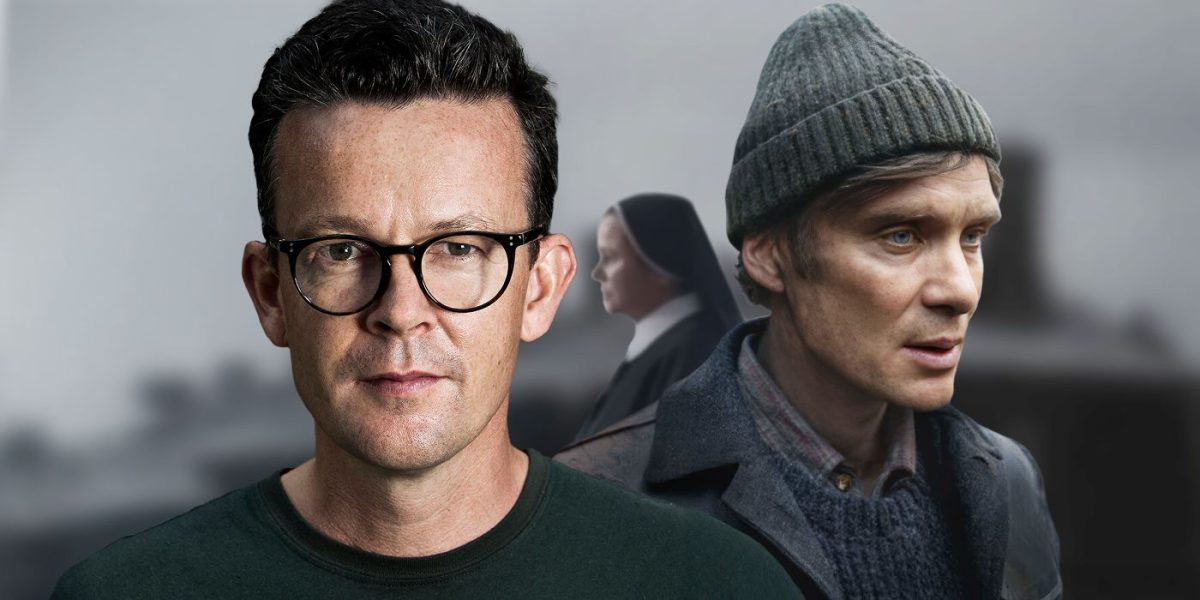
Enda Walsh may not be a household name, but he should be. He’s one of Ireland’s most prolific and celebrated living playwrights, with original productions including Ballyturk, The Walworth Farce, and Mistermam. Movie buffs may know him for adapting the Irish films Once and Sing Street for the stage. He co-wrote the Irish historical drama Hunger with Oscar-winning director Steve McQueen. What some people may not know is that Walsh was instrumental in the launch of Cillian Murphy’s career. Walsh wrote the play Disco Pigs, which Murphy starred in on a world tour in the late ‘90s. This gave way to one of Murphy’s earliest screen performances in the film adaptation of the play in 2001. Since then, the actor and writer have reunited several times for the stage and have become close friends and creative partners.
With Murphy starring and producing Small Things Like These, it was a no-brainer to bring in Walsh to adapt the masterful novella from Claire Keegan. The story may seem small at first — a working-class family in ‘80s rural Ireland doesn’t exactly say “scope” — however, as the plot unfolds, decades of trauma, abuse, and the crimes committed by the Catholic Church are packed into this impactful story. As Walsh says himself, Small Things Like These isn’t so much about the Church, but about how a society became complicit in a horrifying system of abuse, torture, and the illegal separation of mothers from their babies.
Walsh speaks to Collider about reuniting with Murphy, how to adapt a story with so much historical context, and his next project, Lynne Ramsey’s Die, My Love, which stars Jennifer Lawrence and Robert Pattinson, with Martin Scorsese as a producer.
What Was Enda Walsh’s First Reaction to Claire Keegan’s ‘Small Things Like These’?
COLLIDER: Did you read the book of Small Things Like These before signing onto the project? What was your first introduction to the novel?
ENDA WALSH: Yeah, I did. My memory of — it’s probably completely wrong — is that I think this was before the book was reviewed properly, so maybe even before it was published or was just about to be published. I got a copy of it via Cillian, and he said, “Oh my God, the rights are available miraculously.” And I’d read all [Claire Keegan’s] previous stuff, and I was, like a lot of Irish people, a huge fan then. I think I got it before it came out properly and read it and found it as strong as Foster. I was like, “Oh my God. Bloody hell. It’s just like another absolute masterpiece.”
It really is. And so then how do you approach a type of story like this that seems like quite a small story on the surface, but has decades of really intense history behind it and lots of sensitive feelings? Was that scary?
WALSH: I think, as an Irish person, all that history is sort in you already, with all those thoughts and images of people standing outside the central court crying because their lives have been ruined by the Catholic Church. We know it culturally, we know it historically, so it’s all in there. I really went at it. My sense of it was that I just really needed to lean into the book more and more, and I love the tone and the pace of it and the way it unfolds.
I really took it on because, first of all, I’m a playwright and I turned my back on film a long time ago because I was like, “It’s no place for a writer.” It feels like a really boring, dangerous, brutal place to be in. And it’s very literal. But all the sorts of films I like are quite minimalist, although I’m a maximalist when it comes to my own stage work. I like the quietness. And I’d made a play and made it an opera back to back, and I was really quite tired. I was at the stage where I thought, “Oh God, maybe I’ll actually stop writing for a year or maybe for a good while.”
And then, when he gave me the book, I thought, actually, this is going to be really good for my soul. It’s going to teach me, it’s going to reconnect me with the time of 1985, which I grew up in. It’s going to reconnect me with those stories, but in a different way, with those Magdalene Laundry stories, in the way that she writes that story, in that quiet way. I thought she would be able to teach me a lot about storytelling, a lot about tone and atmosphere, and for that reason, I took it on because I knew that it was going to be so beautiful to be around something to write so quietly. And it was true. It was a really lovely writing experience. Also, I’ve known Cillian since he was 19, so everything is very easy with us.
When you were adapting, did you have much contact with Claire Keegan and get her insights, or was it very separate?
WALSH: Yeah, we had two meetings. Anyone who’s met Claire [knows] she’s an incredibly impressive, brilliant person. I think she understands people. Many writers can spend their whole life writing, but they don’t really know people, and they spend their whole lives writing characters, but they don’t really get them. I think she gets them in a really deep, deep way. But I think she also understands men, and certainly that type of man, that country tough man, in a really deep way — much more than what I do. So, I really leaned into all her feeling about him as a character, Bill Furlong.
I’ve been in this situation myself. When you write something, and you pass it on, your work is done. You’ve had your relationship with the piece, and then you give it to someone else. For me, she’s up there with Richard Ford. She’s such an absolute master, and I thought, “I better not fuck this up because it’d be so embarrassing.” It’d be really embarrassing, as a writer and a lover of writers, that I would sort of row in there and just mess it up.
What Scene Is the Most Impactful in Small Things Like These’?
You didn’t at all. A scene that I thought was scripted so well, that to me is the core of the film, is the conversation in bed between Bill and Eileen. She says something that I feel represents the entire story, “If you want to get by in this life, you have to ignore certain things.” Was there a certain scene when you were reading the book that you couldn’t wait to unpack in the script?
WALSH: You think about your own parents, and I come from a family of six, so I know that both my parents were really busy just keeping us together. But I can remember as a boy listening in, not being able to hear in their bedroom, not being able to hear the conversation they were having, but being so surprised that they were having a conversation. So, I was really looking forward to that scene. And I agree, I think that is central. Because they begin to look at one another really for the first time. It’s such a delicate conversation that they’re trying to have, and they’re saying so much about, of course, their world of view, and yet they’re doing it in that incredibly understated sort of subtextual way, but still, they begin to talk as clearly as they ever get with one another.
Because the rest of it is about unwriting, it’s about just charging the subtext. But then you have to be really careful with choosing the words that they do actually talk to one another. And I think an audience is aware of it. Also, you’re ready for him to talk. I know he talks before then, but he says that really strange, obtuse line, “Do you think we’re all right?” I mean, that’s so huge. It feels like just the most enormous thing. So, we’re ready for that conversation. Structurally, she did that in the book. You are aware that, actually, things need to happen now as a reader or, in our case, a viewer. A lot of the time, drama is sort of the denial of information and the denial of stimulus, and when you are going to deliver something. That is the perfect scene for that. We’re ready for some sort of direct connection at that point.
Related
‘Peaky Blinders’ Director Reveals Who Reunited Him and Cillian Murphy For ‘Small Things Like These’
Tim Mielants also discuses adapting such a sensitive and important story.
Enda Walsh and Cillian Murphy Have Worked Together For Over 20 Years
Image via Lionsgate
You’ve done several projects with Cillian Murphy. Why do you think you work so well with him?
WALSH: Sense of humor — we just laugh at the same things. And we’re both music freaks. Also, men don’t really sit around talking about stuff like that, but you do in the rehearsal room [of their early theater productions]. As much as we’re good friends, we became really close in the rehearsal room together because you were able to share things about yourself in the way that you just wouldn’t do with other male friends.
I’ve known him since he was a kid, so I’ve watched him. He’s nine years younger than me, and to me, he’s like a little brother. So, I’ve watched him and know when he’s on form and when he isn’t on form.
This isn’t your first time developing a story about Irish history. You penned Hunger with Steve McQueen about Bobby Sands. What is your approach when you’re dealing with very heavy historical context? Like with Bobby Sands, did you do much research with the Magdalene Laundries? I know you grew up with it, but what’s the first step?
WALSH: Yeah, I think you do a lot of the research, and you read as much as you can. I put this massive Pinterest board together of loads and loads of images. I also create Spotify song lists. It feels like really artistic procrastination, but I only ever do it for a week. I lay everything out for a week and read, and then I’m ready to start thinking about writing it. Then, I eventually get around to writing it.
The thing about the research is it puts you in a position whereby, as we talked before, culturally, you know it, historically, you know it. But it’s important to know the facts of it. Even with Bobby Sands, it’s always about walking in the shoes of the character, that these are people just like us. And trying to eke out how they are feeling and coping and what they’re trying to do. And what they’re not saying, and then definitely what they are sort of saying.
What I love, and I think it’s very, very beautiful, is in this book and in this story is this relationship that you have with your past. This sense that, actually, you are always carrying around your 10-year-old self. She or he is always there with you, and I love that. I love the ghosts of all the past yous that you have to carry around all the way through your life. I think all those sorts of characters do that. I can see them as little children. And certainly Bill, this poor guy who doesn’t know who he belongs to, really.
And he feels like he has the weight of the world on his shoulders, and he can’t talk to anyone about it.
WALSH: Yeah, exactly. And he doesn’t have a parent. He’s this orphaned man, which is really beautiful for the act that he does and what he takes on. Because in that period, and I remember it well, in 1985, the influence of the church was coming to an end for sure because of various scandals. Ireland was a lot more urban, trying to be cool, but also it was very, very poor. And it was still yet to have grown up. It wasn’t a modern country even then. It was still stained by our relationship with the church, our relationship with ourselves.
She got that so correct — the quiet oppressiveness in those environments, in those small towns. I think that was our job to do that filmically. How do you allow space? If you create space around a story so that the anxiety will develop in an audience, an audience who are so much more rooted to being told at every second what they’re looking at. It creates its own anxiety, I think.
Enda Walsh’s Next Project Is the Jennifer Lawrence and Robert Pattinson Movie ‘Die, My Love’
Image via Magnolia Pictures
I think it’s so strange that you just said, “I’m turning my back on film,” because you’ve done such brilliant work with this. And then you have a project with Lynne Ramsay coming up, one of the greatest filmmakers ever. How excited are you for that? Is there anything you can tell us about Die, My Love?
WALSH: I came out of the pandemic, as a person who’s worked so much on stage, a little bit like, “Well, stages don’t exist, so I better fall back in love with film.” And I did something for Netflix [2020’s The House], which is great animation, which is really fun. But working on this, I realized that what I need to do is choose the right people to work with. And as soon as I put it out there that maybe I was up for doing some film, people haven’t forgotten that, actually, I can write it, which I’m very, very thankful for.
So, now I’m ending up doing quite a few films, and one of them is Die, My Love. This book came to me via Lynne Ramsay. I think, initially, Scorsese gave it to her, and then she said, “Would you write a first draft of this?” It’s an extraordinary book. You should read that book. It is the most amazing book. My deal with it was very simple. I’m a big fan of Lynne’s, and I said, “I’ll write the first draft, you write the second draft. Good luck.” And that’s all I wanted. So, my involvement in it was that. I wrote the first draft, and they were about to shoot it, but then the strike happened. And so, acting was postponed, and now they’ve shot it. It’s done. It’s being edited.
It was a gift to me to write it, but also it was a gift to Lynne Ramsay. I was like, “I think you’re an amazing filmmaker. Here’s a script. Now, do what you want to do with it.” And so I’m excited to see it. It’s such a weird project. So I’m excited to see what the hell she’s going to do. And you’re right — when she gets it right, she’s an absolute auteur. She’s like a genius.
You’re becoming the go-to guy for adapting Irish stories, and we’ve gotten some great Irish books in the past few years. The Bee Sting and Prophet Song for example. I also read The Heart’s Invisible Furies recently, and it’s not too far from Small Things Like These. Is that something you’d be interested in?
WALSH: I do get offered quite a few, but you have to choose your projects really carefully. And you have to choose your producers. That’s the thing. Cillian is a good friend of mine, and he produced this with Catherine McGee and Alan Maloney just so brilliantly. And the two guys in America [I assume he’s referring to Ben Affleck and Matt Damon], just when they came in, everything was really steered so easily.
Now, you do have to look ahead as a writer and go, “Okay, what can I control, and what can’t I control? And who are the people around me?” Otherwise, it gets really complicated. It can be terribly heartbreaking that you can work on something and go, “Oh my God, I’m with the wrong people. They’ll never get it over the line no matter what.” Then, they’ll sit on the rights of something. I think a lot of the time, like anything in work, it’s just how to steer things and who to work with.
You obviously had the perfect team with Small Things Like These and you see it in the final result. I was talking to a friend of mine about the film. He just summed it up. “I’m just so glad a film like this exists for women in Ireland.”
WALSH: I think as much as people bang on about the church — and I get it, I’m one of those people who also bangs on about the horribleness of religion — it’s the complicity of the whole society. That’s the larger question. So, it’s always timely. Whether it’s in America or wherever the hell it is, it’s always a timely thing, that sense of when the mass of the population is turning on a smaller number of people, whether they be transgender or Black, or in this context, of young Irish women who’ve always got a fucking wrong deal — a really bad deal from Ireland for decades and decades and decades. Thank God the ones that are changing society in Ireland are the young women.
Small Things Like These is in theaters now.
Release Date
November 8, 2024
Director
Tim Mielants
Cast
Cillian Murphy
, Michelle Fairley
, Emily Watson
, Clare Dunne
, Joanne Crawford
, Mark McKenna
, Amy De Bhrún
, Agnes O’Casey
, Eileen Walsh
, Abby Fitz
, Ian O’Reilly
, Helen Behan
, Tom Leavey
, Cillian O’Gairbhi
, Aidan O’Hare
, Zara Devlin
, Aoife Gaffney
, Liadan Dunlea
, Ella Cannon
, Louis Kirwan
, Sarah Morris
, Faye Brazil
, John McCarthy
, Ciarán Hinds
Runtime
96 Minutes
Main Genre
Drama
Writers
Claire Keegan
, Enda Walsh
Expand
Get Tickets
Publisher: Source link




‘Reacher’s Action Thriller Spin-Off Gets Major Season 2 Update Following Premiere
For four seasons, Reacher has been one of the biggest TV shows on Prime Video. Based on the novels by Lee Child, the series follows former military police officer Jack Reacher (Alan Ritchson) as he wanders from place to place,…
Sep 18, 2026

One of CBS’ Longest-Running & Highest Rated TV Shows Is Coming To End After 30 Years
Along with countless scripted dramas, comedies, and action shows, CBS is well known for its impressive run of unscripted programs over the last 50 years. More recent years have included major competition shows like Survivor and The Amazing Race, along…
Sep 17, 2026

Prime Video Officially Launches New Deal That Changes the Streaming Game Forever
It seems like streamers raise their prices every day. At the end of August, Apple TV raised the subscription service price by $2, bringing it to $14.99 a month. Netflix, Disney+, HBO Max, Paramount+, and Peacock have all raised prices…
Sep 16, 2026
Netflix’s 10/10 Thriller Series Returns After 3 Year Absence With Explosive New Trailer
Over the last five years, Netflix has expanded heavily into non-English content, with international series taking an even bigger focus for the streaming giant. One of the biggest driving forces in that effort is the French thriller series Lupin, led…
Sep 15, 2026