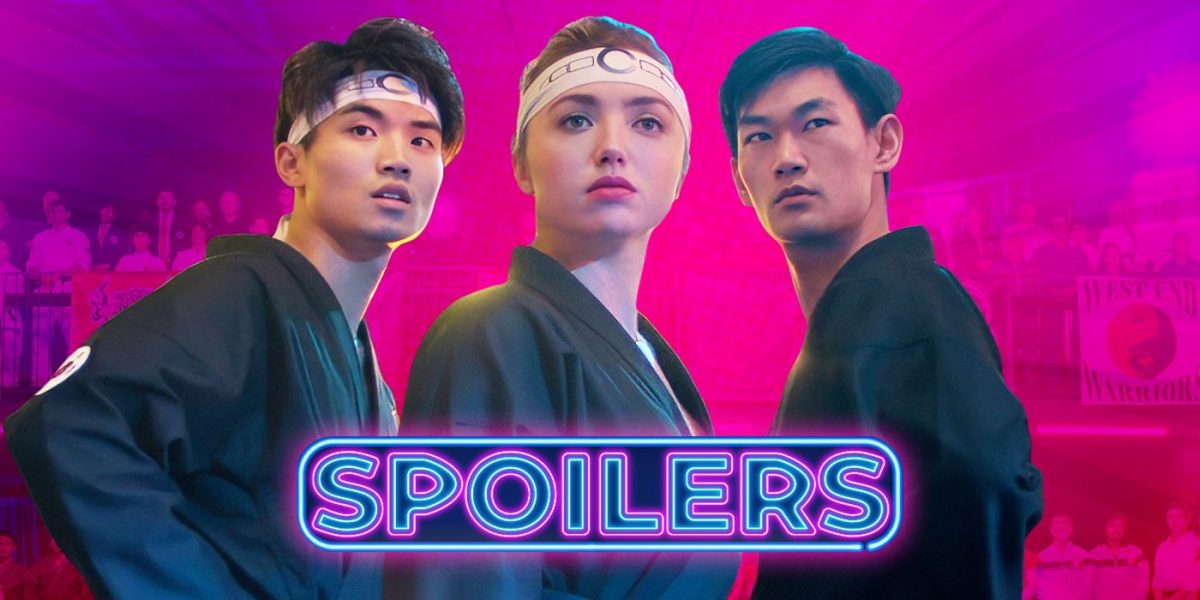
‘Cobra Kai’ Creators on Why THAT Character Had to Die
Nov 15, 2024
The Big Picture
Collider’s Perri Nemiroff talks
Cobra Kai
Season 6 with series creators Josh Heald, Jon Hurwitz and Hayden Schlossberg.
During their spoiler-filled conversation, they discuss Part 2’s biggest fights, that devastating ending, and more.
Heald, Hurwitz and Schlossberg also take a moment to tease what to expect from the series’ big finish, Season 6 Part 3.
Editor’s Note: The following contains spoilers for Cobra Kai Season 6 Part 2 The sixth and final season of Cobra Kai continues with the recent release of Part 2 arriving on Netflix this week. The five new episodes send the Miyagi-do crew away from the Valley and to Barcelona, as they compete in the high-stakes Sekai Taikai Tournament.
Cobra Kai has seen some radical fights throughout its run, but this new setting allows creators Jon Hurwitz, Hayden Schlossberg, and Josh Heald to create some of the most complex fights of the entire franchise. Collider’s Perri Nemiroff was able to sit down with the creators of Cobra Kai and talk about some of the biggest reveals in the latest batch of episodes, including the return of Thomas Ian Griffith’s Terry Silver, Mr. Miyagi’s tragic connection to the Sekai Taikai, and that shockingly deadly cliffhanger.
All Three Parts of ‘Cobra Kai’ Season 6 Tell Their Own Distinct Storyline
PERRI NEMIROFF: Before I start to dig into Part 2 specifics here, I wanted to ask you a broader question about releasing a season in three parts. Thus far, having released Part 1 and being about a week away from the release of Part 2, what would you say is the most surprising thing about releasing a single season of TV in three parts?
JON HURWITZ: I don’t know if it should have been that surprising or not, but early on, every season was 10 episodes, and we were always sort of hesitant to switch that up, that pattern. When doing this final season, we knew that we had more story to tell than 10 episodes, and 15 felt like the right number, so we landed on that. It had been a while between seasons, so the initial thought was, “Okay, well, let’s divide this up into three parts within the season.” Each one is its own distinct part, as people who’ve seen [Parts] 1 and 2 will definitely feel, and you’ll feel that in the third.
We’re excited about all of that. By dividing it up and dropping five, just the ravenousness of fans to get those next five was at a level even more intense than we could have even imagined, which was a good thing in the sense that people were excited and desperate for more, and also, we felt bad for the fans because the thought was, “Okay, well, we’re getting them episodes earlier. If we give them all 15, then they’ll have to wait a full year or more, and they’ve been all over us to get some episodes out.” So, we got five episodes out, and it wasn’t enough! So, we’re excited that people get to see these next five. Hopefully, that’ll give them their fix for a while. But we think that this one is action-packed and a lot of fun.
You have made an incredibly bingeable show. I just can’t believe how quickly I always fly through all of the new episodes. I want to follow up on one thing you mentioned briefly, that each part is going to feel distinct. Can you now tease how Part 3 is going to feel distinct from 1 and 2?
JOSH HEALD: Part 3 has to answer for everything that happened in Part 2, particularly what happens at the end of Part 2. We pull a giant rug. It’s something we haven’t done to this level before, and hopefully, it upends any audience expectation about what’s going to happen and where we’re going because what we want is for people to come in not saying, “Here are the three things yet to happen, and I’m just waiting for them to happen.” We wanted to get to that in the middle, and we like being in a place where you have an anxiousness of, “Well, where do you go after that? How does the show respond? How does the world respond?” We have to wrap up this series in the way that we’ve always planned to wrap it up, so we painted ourselves into an intentional corner knowing how we were going to get out. But I’ll say that the last five should have an expectation of the great unknown and the hope for explosiveness.
I’ll ask one more question about Part 3 before I backtrack to certain beats I want to hit in Part 2. Is there going to be a time jump between Part 2 and Part 3, or is Part 3 going to kick off in Barcelona?
HAYDEN SCHLOSSBERG: Anything is possible, Perri. I will say, you know we’re going to be covering the span of time that our students on the show graduate high school. So, you know, we’re going to leave the series with you knowing where their childhoods ended up and as they go off into adulthood. So, I can’t say exactly what happens in episode 611, and whether we’re still on the mat with Kwon’s blood or if we’re years later in Nantucket at Miguel’s Crab Shack, but you’ll find out the fate of our characters.
Terry Silver’s Return Was Planned All Along
“When we ended Season 5, we knew that we would want to bring Terry Silver back.”
Backtracking a little bit, one of the first big things that I have to ask you about is incorporating Terry Silver into Season 6. At what point during the writing phase did you know that he would return and play such a big role in the final season? Was it while writing Season 6, or is this something that came to mind well before that?
HURWITZ: This was the plan all along. When we ended Season 5, we knew that we would want to bring Terry Silver back. When you have 15 episodes, part of the fun — and this is something we’ve done over the years — is have characters sort of disappear for a while. You forget about them for a little bit, and then they return on the show. We knew that as we’re going to be landing the ship at the very end, that we want Terry Silver to be part of that. He’s been the biggest bad that we’ve had on the show, the most unpredictable, so we purposefully did not have him in the first five episodes. We knew that he would be lurking in the shadows and working behind the scenes in the middle five, and we knew that we were going to bring him back in that iconic hot tub. So, that was where we were. But this was all part of the intention as we were designing the season, was that there would be this other dojo that is the biggest threat to both Cobra Kai and Miyagi-do, and then we’d reveal that Terry Silver was behind it.
Talking Terry Silver tees this question up quite nicely for you, Hayden, because you get to share the screen with him in Part 2. How did that cameo come about, and then also, are there any new qualities that you saw in Thomas [Ian Griffith] by acting opposite him versus all the other ways you’ve worked together in the past?
SCHLOSSBERG: When we were shooting Season 5 and we knew that Terry was going to end up in jail, and we knew that we wanted to bring him back, in my mind I thought about his lawyer, his legal team. He’s such a villainous guy that you’d figure he’d have that kind of top-notch lawyer that could get him out of a jam. I love this Terry Silver character as Jon and Josh have, as well, and I love always kind of defending him online, so I thought that would be a fun part. I’ve always wanted to act, but it’s got to make sense and be the right thing, and being Terry Silver’s lawyer is in the zone of something I felt would come naturally.
Shooting it was fun. It was the first time I’m acting, so I’m focused on myself, but I have Thomas Ian Griffith giving me one of those full-throated yells. And at first, I just cracked up. I’m like, “I can’t believe I’m caught up in in this world.” But it was so fun. He’s not a method actor, he’s Thomas Ian Griffith when we say cut, but right in those seconds before we say action, you just see him go into character, and it’s so fun.
Creating the Sekai Taikai Was Unlike Anything the Creators Had Done Before
“We wanted it to feel like Sekai Taikai has an endless bag of tricks with old events and brand-new events.”
7:31 Related Peyton List Reveals Tory Isn’t Leaving EVERYTHING Behind for Cobra Kai in Season 6 Part 2 Xolo Maridueña also teases Miyagi-do’s “special advantage” going into the Sekai Taikai.
Veering into the fights now, I want to highlight one that you were all quite excited about when we were talking in June, and now I can see why. It was the ballet-like fights, the tag team fights, which I was so impressed by. What are some unique challenges that that kind of fighting style poses for you in the writing and development phase?
HEALD: Every fight we set out to shoot in these five episodes was a challenge unlike we’ve had before. We had to reach into our bag of tricks of what we could just come up with out of thin air in a writers’ room, and then try to marry that with some sort of reality, talking with martial artists who have taken part in tournaments all over the world and different events that are unlike three points and you win that has been what the Karate Kid franchise was until now. So, we started looking at things like tag team tournaments and whole teams on the mat, Royal Rumbles-type of events, things with elevated platforms and balance beams. We wanted it to feel like Sekai Taikai has an endless bag of tricks with old events and brand-new events that they could pull out at any moment, like, “Oh, we haven’t done this one since 1973,” and, “Oh, this one is premiering this year,” and just to feel like that’s the great equalizer for the event. It’s not like American Ninja Warrior where you kind of know what that course is going to look like. It’s, at any given moment, they could pull out something that could be a gift for an underdog team or just could be something that could demolish everybody.
Our stunt team, in these five episodes especially, rise to an occasion that we needed them to and they went above and beyond. It’s not just Ken Barefield and Don Lee, it’s everybody who they’ve worked with, who’ve we’ve worked with now for multiple seasons, if not six seasons, and it’s a lot of people you don’t even see on camera. There are people running a full dojo on set at all times, training actors at lunch and early before call and after call, and working with utility players who are not only choreographing but teaching them actually how to do some of this stuff that is now brand-new to the franchise. There’s that, and then there’s also the mechanics of now you have people fighting up in the air on an elevated platform and trying to keep them safe, but also trying to make it look dangerous. So, everything just called upon everybody a set of skills to make sure that the story doesn’t get lost in the spectacle, and to make sure that the spectacle feels brand new and fresh.
Before jumping into Episode 10, there is one very specific dialogue-driven scene that I wanted to make sure to highlight. It’s the locker room scene. What is the key to writing a scene like that that serves the characters in this moment, in this competition, but also is something that kind of reflects their whole journey of coming together throughout the series?
HURWITZ: It was interesting. We were talking about how this was the final fight before the individual fights, the captain fights, that happen in this tournament. We were realizing, as our characters do, that this is the last time that they’re kind of all fighting together, so we wanted it to be heartfelt and emotional. We wanted it to also be something that came from the kids themselves. We’ve seen so many pump-up speeches from the senseis, and those are always awesome and you always find a new flavor of them, but we felt like in this moment, this was sort of the coming-of-age for all of them who have been on this karate journey together, whether they’ve been rivals at times. But right now, here and now, it’s them against the world and them against Cobra Kai. So, it was making sure that in the episodes leading up to this moment we built them to a place where they each had some unique and strong point of view, and try to build it in a way that would be fun and unexpected and unlike any of the other pump-ups we’ve had on the show.
HEALD: I’ll just say, multiple of us were standing just off camera in that tight little locker room, and it was hard for the performers. There were times when tears made sense, but the tears were very free-flowing because it kind of was like the end of karate summer camp that we’ve been at for seven years, and they could feel it. This is the last of the team competing together. You felt the performer and the character melding more than ever before.
Now it’s time to make the big leap to the Episode 10 brawl. The first question I have for you is a little more of a theory question, but it did cross my mind. What do you think would have happened if the disqualified dojo wasn’t a factor at all? Would that brawl still have happened because Kwon hit Robby during his match? Was that enough?
SCHLOSSBERG: This is like what happens if Archduke Franz Ferdinand was not assassinated? Would there have been a World War II if there wasn’t a World War I? Sometimes there are these matches that kind of set the whole thing ablaze. We’ll never know what the alternate reality was, but all the kerosene and gasoline and dynamite and TNT and nuclear material is all there at its most volatile in that final match. Sometimes all it takes is an irate Russian sensei to smack an official to just let all hell break loose.
HEALD: I can almost assure that Sensei Ivanhoff is not allowed back in the Sekai Taikai. [Laughs] I don’t know if that’s too much of a spoiler, but I don’t think he’s coming back.
SCHLOSSBERG: The other thing is, I’ll just say, the way that he’s acting there, I really feel like he believes he was cheated, which makes me wonder, was there some sort of foul play to eliminate them? We don’t know all the deal with their rivalries.
In all honesty, that kind of crossed my mind because Terry Silver is very clearly aligned with the Iron Dragons and I think he wants them to do well because he wants to own the best dojo in the world to an extent, and he wants to embarrass the other two dojos. But I also never trust what he’s capable of behind the scenes, if he planted something that then kind of sparked all of this.
HURWITZ: We may never know.
SCHLOSSBERG: It could be it could be Devon.
There is a lot going on during that brawl, so what is the key to making sure that a really big set piece like that doesn’t feel like a blur of fighting, but rather each beat has a real purpose and some meaning to it?
HURWITZ: It’s all about the writers’ room. It’s all about being in that room and bringing each character to a journey so that they have some element of stakes in that moment. We knew that we wanted to have a melee that was bigger than anything we’ve done on the show before. We had the school fight, which was amazing, we had that fight at the LaRusso house. This was something where we were at a tournament where everyone knows karate, the students know karate, the senseis know karate, and we wanted there to be enough heightened conflict between a million different parties, all that has built throughout the tournament. Even little things like a match between Miyagi-do and the Dublin Thunder. Little moments like that that we’re building throughout so that anytime a character is throwing punches or kicks there’s some juice behind it. So, it was carefully crafting all of the different stories that were going to get us to that point.
It’s really one satisfying beat after the next. And I’ll just emphasize, because we don’t have time to dig into this part of it, the music from Leo [Birenberg] and Zach [Robinson] there is just so on point, and hearing it evolve every step of the way is really something else. It elevates everything that we’re seeing on screen big time.
HEALD: Our favorite thing is showing the locked cut to Zach and Leo because they’re such fans of the show that they try to stay out of the scripts and they try to stay out of everything until we all watch it together. So, as they’re watching the show, we’re just watching them. We know that something’s about to happen that’s going to make one of them excited, and that’s one of the best parts of post-production is when we get to that point.
The Parallels Between Kreese and Miyagi
Image via Netflix
Now, looking at the end of the big brawl, we learn that Mr. Miyagi killed someone during his Sekai Taikai tournament many years ago, and now we have Kwon’s death in this modern-day one. Why did it feel right to you to connect these two generations via death at this tournament?
HEALD: There are a lot of parallels between Kreese and Miyagi in terms of they both fought in wars, they both have faced tragedy romantically, they both believed in their own type of drive in terms of what’s right, and they both saw the world as right and wrong. They just happened to be on completely different islands. There was a little bit of poetic justice of, “What’s it going to take for Kreese to see something and finally, possibly, see that black is not black and white is not white in terms of, is there an endgame to what “no mercy” means?” If somebody fully drinks the Kool-Aid, what are the pitfalls? We dealt with that a little bit with the school fight with Miguel going so far as to pay the price, but this was obviously a major degree more.
We wanted to bring the whole martial arts community to this place where we’ve set up this tournament as a place where there have been injuries, there have been deaths — Mike Barnes tells us that in Episode 4. We start to unravel some truths about Mr. Miyagi. When this happens, it should come out of thin air, kind of out of the blue, and at the same time, it’s been set up the entire time that something like this was probably going to happen.
I know I have to let you all go soon, so I’ll end with this question, because it’s a particular moment that really stuck with me. From Episode 10, it’s the conversation between Tory and Kim Da-Eun, where they’re talking about whether it was all worth it, whether focusing so hardcore on karate is worth it. How can you tease how that might reverberate through Part 3 of Season 6? Will that be an idea that you continue to play with?
SCHLOSSBERG: All I could really say about the third part is that all these character journeys are going to come to an end. That doesn’t necessarily mean karate is over for them, but this is the stage in their karate lives where their high school existence kind of reaches the conclusion, and they’ll always look back on their past. Right now, the kids are still kind of putting the finishing touches on what will someday become their past. So, you have your adult characters like Kim Da-Eun, who you know is who she is because of her upbringing, and all these characters are going to be confronting their ultimate challenges in life, whether it’s something that’s present-day or something that haunts them from the past. That’ll all come to a head in the final five.
I can’t wait. I assume you don’t have a locked release date yet that we can countdown to?
HURWITZ: Not that we’re able to talk about.
Cobra Kai Season 6, Part 2 is now streaming on Netflix.
Thirty-four years after events of the 1984 All Valley Karate Tournament, a down-and-out Johnny Lawrence seeks redemption by reopening the infamous Cobra Kai dojo, reigniting his rivalry with a now successful Daniel LaRusso.Release Date Creator Rating Seasons 6 Story By josh heald Writers Josh Heald , Jon Hurwitz , Hayden Schlossberg , Michael Jonathan , Mattea Greene , Bill Posley , Stacey Harman , Joe Piarulli , Bob Dearden Directors Jon Hurwitz Showrunner Jon Hurwitz Expand
Watch on Netflix
Publisher: Source link


‘Reacher’s Action Thriller Spin-Off Gets Major Season 2 Update Following Premiere
For four seasons, Reacher has been one of the biggest TV shows on Prime Video. Based on the novels by Lee Child, the series follows former military police officer Jack Reacher (Alan Ritchson) as he wanders from place to place,…
Sep 18, 2026

One of CBS’ Longest-Running & Highest Rated TV Shows Is Coming To End After 30 Years
Along with countless scripted dramas, comedies, and action shows, CBS is well known for its impressive run of unscripted programs over the last 50 years. More recent years have included major competition shows like Survivor and The Amazing Race, along…
Sep 17, 2026

Prime Video Officially Launches New Deal That Changes the Streaming Game Forever
It seems like streamers raise their prices every day. At the end of August, Apple TV raised the subscription service price by $2, bringing it to $14.99 a month. Netflix, Disney+, HBO Max, Paramount+, and Peacock have all raised prices…
Sep 16, 2026
Netflix’s 10/10 Thriller Series Returns After 3 Year Absence With Explosive New Trailer
Over the last five years, Netflix has expanded heavily into non-English content, with international series taking an even bigger focus for the streaming giant. One of the biggest driving forces in that effort is the French thriller series Lupin, led…
Sep 15, 2026