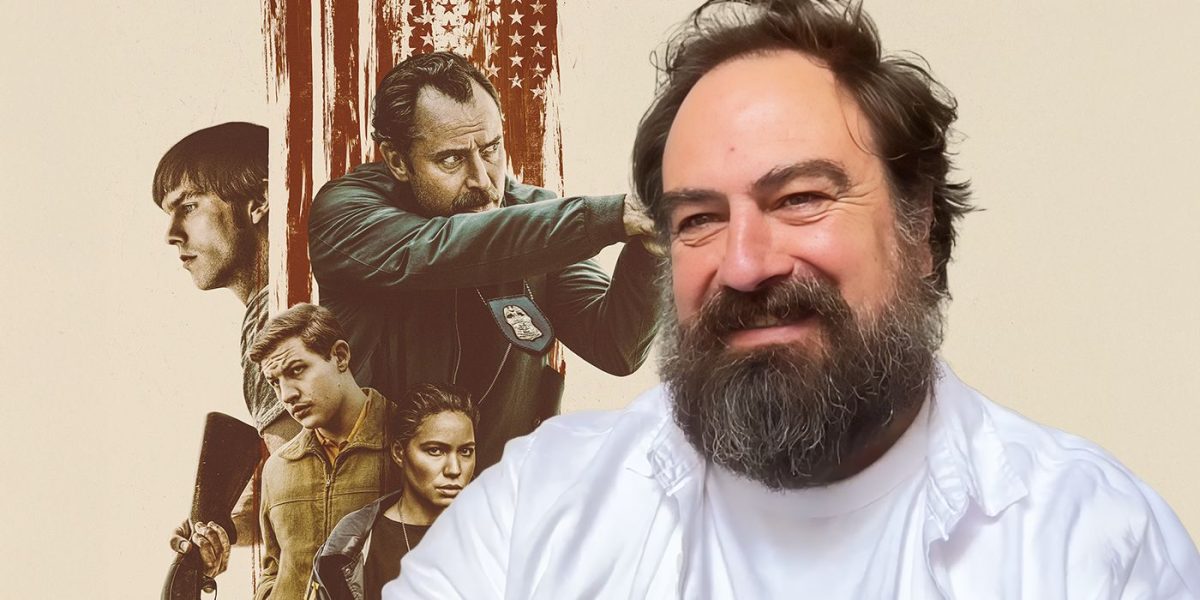
“It’s Starting to Become Really Hard Making These Sorts of Films” ‘The Order’s Justin Kurzel Explains How the Industry Has Changed
Dec 7, 2024
[Editor’s Note: The following contains spoilers for ‘The Order’]
The Big Picture
Collider’s Steve Weintraub talks with
The Order
director Justin Kurzel.
The Order features an ensemble cast led by Jude Law and is an adaptation of the true-crime bestseller
The Silent Brotherhood
about Robert Jay Mathews.
In this interview, Kurzel discusses the challenges their crew faced with limited time while filming the movie, working with Jude Law and his upcoming projects with Jacob Elordi and Nicole Kidman.
Writer, producer, director, and Palme d’Or nominee Justin Kurzel has left an unmistakable mark on Hollywood, who made his name with his feature directorial debut, The Snowtown Murders. He’s since worked with some of the most talented names in the business on epic adaptations, but clearly favors moving true stories of real people and real events. In The Order, which World Premiered at the Venice International Film Festival this year, Kurzel returns to form with writer Zach Baylin, based on the Gary Gerhardt and Kevin Flynn bestseller, The Silent Brotherhood.
Like his other films, The Order is brought to life by an ensemble cast, this time led by Academy Award-nominee Jude Law, who plays the fictional FBI Agent Terry Husk. In the movie, Husk and his fellow agents Jamie Bowen (Tye Sheridan) and Joanne Carney (Jurnee Smollett) are investigating a series of bank robberies and car heists they believe to be the domestic terrorism of a neo-Nazi white supremacist group led by Robert Jay Mathews (Nicholas Hoult).
In this interview, Kurzel talks with Collider’s Steve Weintraub about the cinematography and casting of The Order, as well as the challenges their team faced throughout their whirlwind filming schedule. Kurzel also reveals the dream project he’d love to helm (after a conversation with George Miller), his upcoming war drama series The Narrow Road to the Deep North with Jacob Elordi, and his original horror he’s developing with Nicole Kidman.
‘The Order’s Nicholas Hoult Originally Didn’t Show Up Until 30 Minutes Into the Movie
Image via Amazon MGM Studios
COLLIDER: I’ve got a ton of questions for you, and I have a few curveballs to start things up. When will I get to see Ellis Park ? When is that being released in America?
JUSTIN KURZEL: Well, we’re still yet to find a distributor. It’s got one overseas and in Europe and in Australia, but we’re still searching. So, it’s still kind of journeying along. But I’m hoping very, very soon. It’s one of my favorite films I’ve made. It’s really beautiful about an incredible wildlife park and this beautiful man, Warren Ellis, who helped establish it. But it’ll be very soon.
Which of your films changed the most in the editing room in ways you didn’t expect?
KURZEL: Oh, wow. That’s a really good question. I went down a road with The Order because of the dual characters in the film, where we tried introducing Bob Mathews really late, a good 30 minutes in, and followed Jude [Law]’s story through the whole beginning of the film and his point of view. When you’ve got these multi protagonist characters, you can play around with how you unpeel the story. So, for a while there, it sort of had a singular point of view, and Nic [Hoult] came into it much later, but it didn’t have the same resonance and power and anticipation that it needed, that we ended up with. So, I reckon The Order, actually. I went down the rabbit hole with that one a couple of times.
I would love to see alt cuts, and I never will.
We Absolutely Need Justin Kurzel’s ‘Mad Max’ Prequel
George Miller, do you have time for a Zoom?
Image via Warner Bros.
If you get the financing to make anything you want as your next project, what would you make and why?
KURZEL: I’ll tell you what, maybe because it was such a big influence, but I’ve always been curious about what happened before the first Mad Max — what was that world with the Nightrider, pre-Mad Max? I’ve always been very curious about that and very tempted to talk to George [Miller] about the possibility of a world that is pre-Mad Max 1 and what that is. That’s been one that I’ve always been really curious about because it was such an influential film in my time.
What do I need to do to get you to call George and say, “Let’s talk?”
KURZEL: Yeah, I’d love to have a chat with him about it.
Oh, I’m dead serious with you. I think that you should absolutely be doing this.
KURZEL: It’s an amazing franchise, but I’ve always been curious about those moments before that first one because it’s set up so richly. And it’s such a great time in Australia, too, that period.
‘The Order’s Ending Was Almost Snuffed Out Due to Fire Bans
At TIFF, you and Jude told me that you really didn’t have a lot of time to make this movie, The Order . Which shot or sequence was the one that came close to not being able to get made because of the limited schedule or budget, or was that not an issue?
KURZEL: I think the ending, the burning of the house, we had these incredible fires at the time and fire bans everywhere. There was a moment there where we literally had to start thinking of a different ending, and that was really challenging because, in the real story, Bob Mathews did burn alive in this house. So, there were some really interesting conversations about, “How else can we end this if we can’t burn this house in any way possible because of the fire bans?” That was one that we started to have conversations about, perhaps a different way of concluding our film.
I really enjoy the way you and your DP, Adam Arkapaw, collaborate. How much are you guys, before stepping on set, storyboarding, blocking, figuring out how you wanna handle everything, and how much are you finding everything in the moment when you’re stepping on set?
KURZEL: No, this one was really planned. Adam has a very classic way of approaching his work, which was really exciting for me, of, “Where does the camera want to be?” And it was never off the dolly or off sticks. We never went handheld with it. That means you have to be very deliberate and, in a sense, organized. He’s a huge asset to me. He has a great mind, especially to do with coverage, and was a huge part of how we imagined the world and how much footage we needed, and where the point of view was cinematically for the film. Then you always leave a little bit open for the day, especially in the way that I work with actors, which is always our really interesting sort of tussle of, like, “Should an actor hit a mark?” I want them to feel quite free with something, but Adam’s also like, “Look, the camera needs to be respected, as well,” in terms of what that point of view is. So, there’s always a really interesting tension there that comes from when we actually do start filming. But it’s a bit of both — it’s leaving a little bit there for the day, but at the same time, knowing the film that we’re trying to make.
Image via Amazon MGM Studios
I’ve spoken to so many directors and cinematographers, and it’s so interesting. Like Ridley Scott likes to shoot with eight or 12 cameras, and Roger Deakins uses one camera, and that’s it. How do you guys typically like to work and do you do a lot of coverage on set, or do you minimize that as much as you can?
KURZEL: No, I try to work with one camera. Point of view for me gets really lost when you suddenly have four or five cameras. For me, it starts to feel like I’m picking up coverage and finding the film in the edit a little bit more; whereas, with the deliberateness of a single camera and everyone focused on it, you can feel the actors focusing on it, as well. I really do two cameras for one performance. I usually really focus and concentrate on one actor’s performance and then turn the camera around. I find that it just focuses the film up in a way that you can really tell when you get into the edit.
‘The Order’s Cast Was Meant to Be
From establishing the on-set tone to fulfilling Kurzel’s vision, this cast showed up and out.
You put together this great cast for this movie. When you cast Jude Law in something, is it almost like entering a cheat code in a video game because he’s so good in everything he does?
KURZEL: Yeah, he really is. He’s one of the bravest actors I’ve worked with, but also, he just loves the craft of acting, so you’ve got an actor coming on set with a big smile on his face every day, of like, “Wow, what am I gonna get to discover and find today?” He’s endlessly curious, so it’s just an energy that he brings that, as a director, it gets me very excited about being on set, but also gets the other actors really, really pumped. He’s very giving in that way. He’s had an amazing career and done such varied roles, and what was interesting about this was it felt like a role that was fresh to him. He felt like he hadn’t walked in these shoes before, and that excited him. That, I think, was a great bonus to the film and to his interpretation of Husk.
Which role ended up being the toughest to cast and why?
KURZEL: Well, I was very fortunate with a lot of the actors in that they were the first actors that I went to, and they saw something. I gotta say, casting Marc Maron was really important because Alan Berg was so specific and had such a particular kind of style. There’s something very similar. Marc kind of looks a lot like Alan Berg — tall, has a similar voice — and I just knew from the start, as soon as I read this thing, that I desperately wanted Marc to be in it. I was a massive fan of his podcast, so I felt his voice was really needed in this. Even though Alan Berg doesn’t play throughout the whole film, his presence and his visibility are really important to the film. So, probably him. I just had my fingers crossed every day that he would see something similar in it to what I saw.
16:29 Related Jude Law, Nicholas Hoult, Tye Sheridan, and Jurnee Smollett Star in This New True-Story American Crime Thriller The cast and creatives discuss their shockingly short film schedule, embodying difficult characters, and more at TIFF.
You told me at TIFF that you had less than 40 days to make this but didn’t get specific. Do you want to tell me how many days you had or do you wanna just avoid that one?
KURZEL: I’d rather not be specific, but it was under 40 days by quite a bit. It’s really hard. It’s starting to become really hard making these sorts of films. I think we made them more in the past, and you were given 60, 70 days to make them, and probably triple the budget that you get this time. So, a lot of those high sequences we’re doing in a day, and it’s unfortunate in a way because you need every bit of craftsmanship and expertise to pull them off because they’re highly difficult, and a lot of it’s in camera, and you’ve got stunt drivers and so forth. So, you’ve got to be really clever about how you do them, and get that ambition on screen. It’s just the way of the world at the moment that I hope changes. These films that weren’t independent before and had the resources are now being made in much more trying ways. But hopefully that’ll improve.
What I do hope is that it doesn’t go down further because it’s,, I don’t know how you do them. You’re not the only one to tell me these things, and I don’t know how you did it in 20-something days because it sounds like that’s what you had.
Justin Kurzel Teases His Five-Part War Series With Jacob Elordi
Image via Sony Pictures Television
What is the status of The Siege ?
KURZEL: Oh, that’s a film I was attached to way, way back that, for some strange reason, is still in my own IMDb. It was a film I was attached to that didn’t come to fruition. I won’t be doing that.
Something you are doing is The Narrow Road to the Deep North .
KURZEL: Yeah, I filmed that in Australia with Jacob Elordi, and that will be out next year with Amazon in Australia. It’s a five-part series based on an absolutely beautiful book, one of my favorite books in Australia, written by Richard Flanagan. I’m really excited about that. Jacob’s really wonderful in it. It’s got an amazing cast — Odessa Young and Ciarán Hinds, and a really, really good group of people that have made it. So, yeah, I’m doing that.
There’s a horror film I’m developing at the moment as, as well, and also an amazing true story called Burning Rainbow Farm that I hope to make in the future, as well. There are a couple of others, too, that have been part of my life for a long time that I’d really love to make, as well, but it’s just finding the right time and when those films want to get made.
Did you direct all five parts of Deep North ?
KURZEL: I did. I was an executive producer on it and directed all the episodes, and they were all written by Shaun Grant, who wrote Nitram and True History of the Kelly Gang and The Snowtown [Murders] with me. He’s been a long collaborator with me.
Needless to say, I’m excited to see it.
Nicole Kidman Is Taking on an Original Horror In Justin Kurzel’s ‘Mice’
Image via Warner Bros.
I have to touch on the horror thing you mentioned. What can you tease about it? Horror is one of the few things that seems to always perform at the box office. It’s a very popular genre.
KURZEL: I’ve been really fascinated by it. It’s a horror film called Mice that Shaun Grant is also writing and that Nicole Kidman’s producing and also going to be in. We’re just developing it and writing it at the moment. I’ve always flirted around it a little bit with certain projects in the past, but being a big fan of the genre, I think you can do some really interesting stuff with it. It’s become something I’ve started to focus more on in terms of just finding the right thing that I could do for the first time.
Also, it might be easier to get financing if you have her and horror because, generally, horror films don’t have a crazy budget.
KURZEL: Yeah, but in some sense, the genre is the star in a way. It’s so interesting how that genre just seems to capture. Like my daughter’s really fascinated and interested in horror, and I’ve been watching a lot of horror films through them — not only present ones but also ones from the past. It’s really interesting how it captivates an audience like no other genre.
The Order is now playing in theaters.
The Order is a historical crime thriller directed by Justin Kurzel. Set in 1983, the film follows FBI agent Terry Husk, who investigates a series of violent crimes in the Pacific Northwest. He suspects these are not the actions of a regular criminal gang but rather a white supremacist group led by the charismatic Bob Mathews. As he digs deeper, the investigation uncovers a radical underground network.Runtime 120 Minutes Writers Zach Baylin , Kevin Flynn , Gary Gerhardt
Get Tickets
Publisher: Source link



‘Reacher’s Action Thriller Spin-Off Gets Major Season 2 Update Following Premiere
For four seasons, Reacher has been one of the biggest TV shows on Prime Video. Based on the novels by Lee Child, the series follows former military police officer Jack Reacher (Alan Ritchson) as he wanders from place to place,…
Sep 18, 2026

One of CBS’ Longest-Running & Highest Rated TV Shows Is Coming To End After 30 Years
Along with countless scripted dramas, comedies, and action shows, CBS is well known for its impressive run of unscripted programs over the last 50 years. More recent years have included major competition shows like Survivor and The Amazing Race, along…
Sep 17, 2026

Prime Video Officially Launches New Deal That Changes the Streaming Game Forever
It seems like streamers raise their prices every day. At the end of August, Apple TV raised the subscription service price by $2, bringing it to $14.99 a month. Netflix, Disney+, HBO Max, Paramount+, and Peacock have all raised prices…
Sep 16, 2026
Netflix’s 10/10 Thriller Series Returns After 3 Year Absence With Explosive New Trailer
Over the last five years, Netflix has expanded heavily into non-English content, with international series taking an even bigger focus for the streaming giant. One of the biggest driving forces in that effort is the French thriller series Lupin, led…
Sep 15, 2026