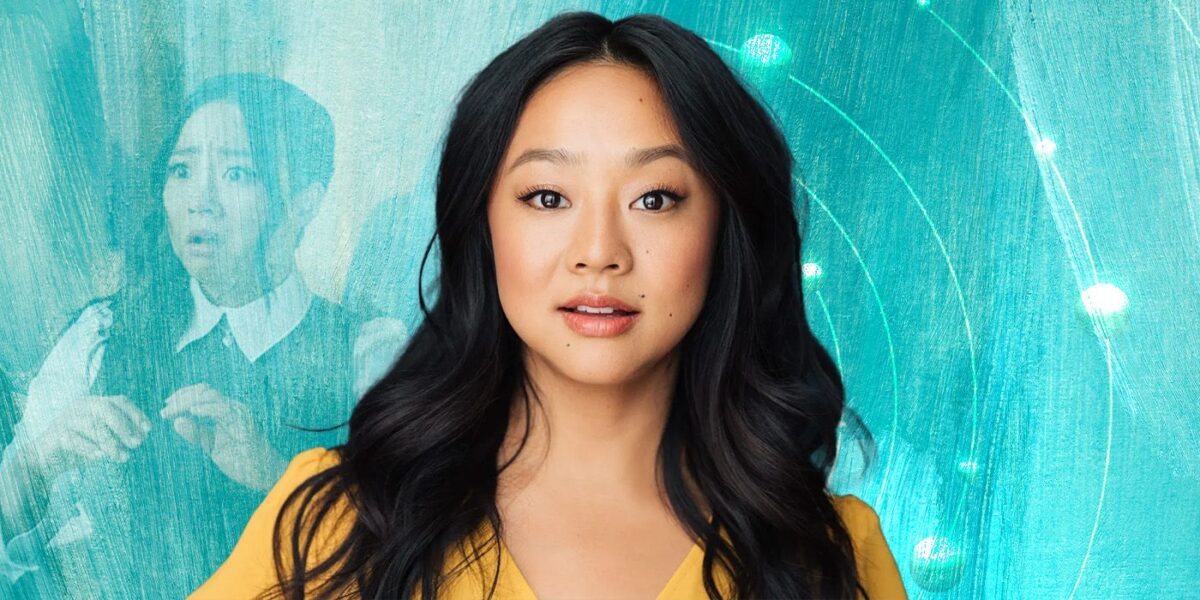
Stephanie Hsu Is Embracing the Renegade and Outsider Within
Feb 7, 2025
There aren’t many young actresses these days who are constantly breaking the mold made for them with every role they take, but Stephanie Hsu is one of them. Best known for her performance as Jobu Tapaki and Joy Wang in the Best Picture winner Everything Everywhere All at Once, there’s much more to Hsu than just that iconic role. With supporting roles in shows like The Marvelous Mrs. Maisel, starring alongside fellow comedians in movies like Joyride, and taking to the stage for The SpongeBob Musical, there doesn’t seem to be much that Hsu can’t do. Her newest joint, Peacock’s Laid, a comedy series about a woman whose past sexual partners are all dying, makes her a rom-com lead. Whichever role she takes, you can be sure that Hsu is always thinking outside the box and challenging the preconceived notions that might come with the character. It’s quietly become one of her best skills.
Stephanie Hsu Was Inspired by the Unconventional
Image via Walt Disney Studios
For every creative in Hollywood, the road to stardom and their craft can look different. For Hsu, it was The Practice that caught her eye. The legal drama starring Dylan McDermott spanned eight seasons, earned two Emmys for Outstanding Drama Series, and led a five-season spin-off. It also came as the first touchpoint for Hsu, who declared that she wanted to be a lawyer because she loved the show. However, Hsu immediately rejected the call of the screen, saying that she knew she needed to do something more “practical” with her life. “I really fought being an actor for a very long time,” she tells us via Zoom earlier this winter. “It wasn’t until high school, when people started inviting me to do the school play or audition for the school musical, that I really had my interest in performing, and people started to tell me what was possible in a way that I had not known about before then.”
“I really fought being an actor for a very long time.”
And for many actors, there is one movie that inspires and changes you and how you look at film. For some, it’s The Godfather or maybe Citizen Kane, classic cinema that’s lauded by the masses and has become a part of many an origin story. Hsu, however, has an unconventional flick that immediately catches my attention. “In terms of first formative movies, it’s definitely a tie between Flubber and Space Jam,” she declares, much to my surprise. Of course, Space Jam is a classic when it comes to comedies from the ’90s, especially considering that Hsu herself was in her formative years at the time.
But Flubber holds a special place in my heart as well, as it was a movie I would watch when movie hopping with my grandma as a kid, and I was delighted to hear that someone else in the world also seemed to connect with it. Pointing out that I am also Asian American, Hsu says, “I think it’s because there’s a huge physical comedy component to Flubber, acted by the Flubs, obviously, and Robin Williams and I have been thinking about this recently of the type of things that I thought were funny growing up.” As a big fan of “physical comedy,” she admits part of the reason she loves it so much is because of how she can relate to it. “I grew up really understanding it and resonating with it… because I didn’t understand most of the cultural references that were happening on most of TV and film. I didn’t know who was what, like who the people were that people were making jokes about or doing impressions of, but I did understand a pratfall, you know?”
There’s a distinct understanding there, not only about what makes physical comedy so universal — which is hardly surprising — but an understanding of the cultural limitations that come with comedy and how to move past them. It’s an experience that is likely familiar to most children who grow up with immigrant parents or family members whose first language is not English. Comedy can so often rely only on language and pop culture references or wordplay, limiting its accessibility. You’ll spend more time explaining the joke to someone than laughing at it. You might not get a joke about The Beatles, but you can’t deny the humor attached to Flubs bounding around on the screen. It’s a bizarrely inclusive form of comedy, and while it can feel like an oddly hollow descriptor, Hsu’s approach to the industry and her choice of roles project a sort of inclusivity that is surprisingly unique.
Stephanie Hsu Balanced the Stage and Joining ‘The Marvelous Mrs. Maisel’
Image via Prime Video
If one of Hsu’s main influences as a child was The Practice, then the other was Gilmore Girls. At the time, a teen Hsu did not know who Amy Sherman-Palladino or Dan Palladino was, but she notes, “I didn’t know how much their dialogue and pace of dialogue was already stamped into a very formative experience of entertainment.” She got to experience that dialogue in person when she was cast as a supporting character in The Marvelous Mrs. Maisel. Citing the old theater adage, “Louder, faster, funnier,” Hsu pointed out the theatricality of Maisel and the heightened nature of the show that made it such an incredible experience.
At the time, Hsu was on Broadway performing in a musical called Be More Chill, where she played one of the main characters, Christine. It was a role that Hsu played from its 2015 world premiere until the Broadway show in 2019. “I was doing eight shows a week, and then on Mondays, we would shoot Maisel; they worked it out with my contract that way,” Hsu explains. Despite the grueling schedule, Hsu has nothing but praise for the project. “They built such an incredible world that it’s so easy for an actor to just step in and fill it. I miss that show so much. I miss working on that show.”
Related
Stephanie Hsu’s 10 Best Roles, Ranked According to IMDb
Stephanie Hsu’s first Oscar nomination is a sign of a promising career.
In Maisel, Hsu played the character Mei Lin. Now, on paper, Mei Lin feels a bit like a stereotype. She is a Chinese-American woman who is a doctor and the daughter of the landlord who owns the club that Joel (Michael Zegen) owns. While the series is not completely free of some of the sticky Asian stereotypes that it globs onto Joel’s scenes in Chinatown, Hsu infuses life and freshness into Mei Lin in a way that goes far beyond the cookie-cutter character that Mei Lin feels like on the page. Hsu describes the character as a “huge shakeup” for the show that would lead to a cultural shift as Joel’s life became more involved in Chinatown and his club.
“When I was first pitched the role, before I knew it was for Maisel, I just heard, ‘There’s this character — she’s this Chinese woman in Chinatown in New York in the late 1950s, early ‘60s. Cindy Tolan, the casting director, thinks it’s you. Everybody thinks it’s you,'” Hsu remembers. At the time, Hsu was in tech for Broadway, and the concept of Mei Lin made her understandably wary. “I was like, ‘I don’t know if I can shoot a show right now. Also, I’m scared to read the script because I can’t imagine a world in which that character is going to be not offensive.'”
Stephanie Hsu Looks Back on Stereotypes and Breaking Them
Image via Warner Bros
Of course, reading the actual script and finding out the role was for The Marvelous Mrs. Maisel changed things. “She was unlike any character I had ever seen for someone who looks like me in that time period, ever. I thought it was just so badass that she’s a doctor, but not in the way that it’s a stereotype that Asian people are doctors; she was a doctor in the way that it is incredibly badass and feminist for a woman to be a doctor in the 1950s, to be ambitious enough to study that, and that she was fluent in both Mandarin and English, you know what I mean?” And much of Mei Lin’s uniqueness is more thanks to Hsu’s performance than just the words on the page. Hsu plays her as slightly sarcastic, definitely sassy, and extremely confident. Importantly, Mei Lin embodies a typical Asian American who has grown up in America, speaking English without an accent and able to fluidly move between two communities and codeswitch with ease.
Mei Lin’s character introduction, around Season 3 of the show, came right after a huge Asian wave had hit Hollywood. A little sensation known as Crazy Rich Asians became a worldwide hit and launched a whole cast of AAPI actors into the stratosphere. When asked whether Hsu believed that her worry about portraying an Asian stereotype colored her choice of gigs, Hsu referenced Crazy Rich Asians as a watershed moment. She says, before Crazy Rich Asians, “we were not having the conversations that we’re having now about Asians and representation in Hollywood and media.”
I was just hardline, ‘No, I will not do things that are going to make my people feel humiliated.’
And while she was not consciously avoiding stereotypes, she says, “I think I was just hardline, ‘No, I will not do things that are going to make my people feel humiliated.’ I want to tell stories that I understand the humanity of the characters. Yes, sometimes it can be racially centered, but also, we’re human. So, I just want to continue to challenge all the ways in which we’ve been represented through the mere act of being human and being these characters, and if it is going to feel stereotyped, then it’s just not right for me.”
Hsu might have just missed the window to be cast in Crazy Rich Asians, but she does recall the impact of watching that movie for the first time. Between the matinee and the evening show for The Spongebob Musical, Hsu took her Tupperware full of lunch to the movies at the AMC in Union Square and sat down to enjoy the film. “I immediately started projectile crying in the intro credits because I could tell. I was like, ‘This is huge for us. Everyone is so hot!'” she explains effusively. “It’s hard for us because there’s so much that’s happened since then in terms of like, whatever Oscars, whatever, everything. So, it’s hard to remember that that was definitely less than 10 years ago, and that was, like, the first time that we were deemed as just universally hot. You know what I mean?”
Stephanie Hsu Goes ‘Everything Everywhere All at Once’
Image via A24
While Maisel might have launched her small-screen career, Everything Everywhere All at Once ultimately put Hsu on the map officially. Directed by Daniel Scheinert and Daniel Kwan (collectively known as the Daniels), Everything Everywhere follows Evelyn Wang (Michelle Yeoh) as she faces parallel universes and takes on a powerful being set on destroying the multiverse. That powerful being? Jobu Tapaki also known as an alternate version of her daughter Joy Wang, played by Hsu. The film also starred Ke Huy Quan (for his return to acting), James Hong, and Jamie Lee Curtis and not only did it become A24’s highest-grossing film, but it also won seven of the 11 awards it was nominated for at the Oscars, including Best Picture.
For Hsu, though, the largest change in her life between pre and post-Everything Everywhere was deeply internal. “For all my life up until then, I think I had been like, ‘Am I going to pursue a life as an actor? Am I going to be in this industry, or am I not? Maybe this is not for me.’ Not in the sense of, like, I didn’t love to do it, but I think I just always felt a little bit like an outsider or a renegade. Maybe I was a renegade because I felt like an outsider.” Part of the appeal of the Daniels’ story, Hsu notes, was its quirkiness but also the fact that the story was, ultimately, a simple one.
“I think that Everything Everywhere, that project was so close to me in terms of the type of art that I want to make, which is big-hearted, a little strange, large philosophical questions, but actually, at the end of the story, a very intimate, simple story. As a lover of hard comedy, but also Eternal Sunshine of the Spotless Mind and philosophy and all sorts of different types of sciences, metaphysics, etc., I was like, ‘This is the closest thing to my wheelhouse that I could possibly ever make.'”
And it’s true that, in the beginning, Everything Everywhere was the little engine that could. Made on a $14.3 million budget, the movie earned 10 times that at the box office and quickly lifted out of the indie sphere and into the mainstream. As a bizarre hodge-podge of different genres, Everything Everywhere didn’t look like a classic Best Picture winner. Not only was the entire cast predominantly Asian, but it was a science-fiction story full of multiverses, butt plugs, bagel black holes, and a raccoon hiding under a chef’s hat. At that point, none of the cast had an Oscar or a nomination. “Yes, of course, legends on set, but it wasn’t what it now has become, and so there was a really pure innocence to it,” she admits. “That’s also a testament to [Daniel Kwan and Daniel Scheinert] and the set that they built.”
In many ways, this career found me, and I want to honor that.
Hsu praises the collaborative atmosphere of the set. “It really felt playful and open and creative in a way that I think the biggest lesson that I learned from Michelle [Yeoh] is watching someone like her, such a legend, surrender into process every single day and really fully trusting her directors. I think watching her be able to do that at her stage in her career was a really important witnessing that I take with every project that I’m on. We’re there to surrender and to play, and you can have your ideas, but you have to trust the process and trust your eyes, which are not your eyes, but the eyes of the director.”
But then the film did make millions, and it did win Oscars. Hsu herself scored a nomination before losing to co-star Jamie Lee Curtis. But life after Everything Everywhere changed Hsu’s outlook. She notes that the film’s success was, “an affirmation that whatever weirdness is floating through my brain and in my creativity and my expression, there is a space for it, and in fact, people are really hungry for it and want more of it.” Ultimately, Everything Everywhere’s success helped Hsu gain the confidence she needed to stop questioning herself.
But, lest you think that the success of this film has changed Hsu as a person, it has only strengthened her understanding of her role as an actor and honoring the gift she’s been given. “I do feel, in many ways, this career found me, and I want to honor that. I want to honor whatever this calling is in this lifetime, and I have to honor it because so many people are on the other side of the door waiting to get in and need more space to be made for them.”
‘Laid’ Put the Producer’s Hat on Stephanie Hsu
In her latest project, once again, Hsu is taking on a quirky and unconventional concept that has, within it, a very simple story. In Laid, Hsu plays Ruby Yao, a woman in her 30s trying to get through life while playing the dating game. As it goes with any adult her age, she’s had a handful of past lovers, but when it turns out that these past lovers are dying in the order she slept with them, Ruby embarks on a journey to try and figure out the source of her curse. Based on an Australian series by the same name, Hsu injects her signature charm and heart into Ruby’s character, as the story boils down to not only her dilemma about finding someone she can genuinely connect with, but also focuses on her bond with her best friend AJ (Zosia Mamet) after Ruby sleeps with her boyfriend.
For Laid, Hsu not only took on the role of the lead character, but she also put on the executive producer hat. The biggest gift that hat gave her, as Hsu explains, was “having enough of a say that you could create an environment on set that you want or value, and so I definitely wanted to bring so much of what the Daniels taught me in terms of how to run the spirit of a set. Sometimes, you don’t always get a say in that. But that, I think, was the thing that felt most special to be able to bring in.” She credits showrunners, Nahnatchka Khan and Sally Bradford McKenna, along with producer Jen Carreras, for embracing that collaborative spirit.
“Similar to what I was saying earlier about surrendering into process, when we were in writers’ rooms or when we were giving notes on scripts, I would be in the producer hat, but then I’d have to learn to take that off, and then be an actor and surrender on set and just play — take big swings, take random swings, just surrender into the process and trust,” Hsu says when having to juggle the two roles she had in this production. Hsu admits it was a lot to wear multiple hats, but it’s clear her dedication to telling Ruby’s story panned out.
Take big swings, take random swings, just surrender into the process and trust.
Hsu emphasizes the importance of casting and bringing in exciting people, specifically getting a say about who Ruby had relationships with in the past. It was important to Hsu that Ruby’s “sex timeline” was full of “people from all different walks of life in a way that someone in their 30s might have many partners from all different walks of life, and making it not cookie cutter.” Moreover, with the series created by women, there was never any shame that came with examining Ruby’s prolific love life. Ruby’s struggles should be understandable for anyone trying to find a life partner and having reached a crossroads in their 30s where it feels like it’s impossible to find a partner.
“I think dating is really hard, and people are on the apps. There are more Ruby’s roaming around us than I think we even realize, who I think are about to be exposed,” says Hsu with a laugh. Coming from the era of Nora Ephron rom-coms, she notes that the changing of the dating scene has also altered what a rom-com can look like. “I still love those movies, but there are no new rom-coms that I watch to teach me about what love might look like, and I think that that is a lot of why we made Laid. This girl, Ruby, doesn’t know, and I think a lot of people are asking that same question of, like, ‘How do you know when you know? Am I missing something?'”
As someone still in the bloom of her career, with many years and many more projects ahead, speaking with Hsu offered a surprising insight into what a new generation of actors can look like. Growing up, I always wondered how Hollywood might change and evolve with time. Would I ever get to see someone like me on the screen? Would that person ever have the nuances and weirdness that felt so unique to just me? Hsu represents that in many ways, and without putting all of the pressure on her shoulders, she is one in a movement of young actors who are embracing a new angle and approach to taking part in this industry. Not only as an Asian American, but also in playing and creating roles that feel uniquely designed to reach out and touch that most personal part of us in a way that only storytelling can.
Laid is streaming now on Peacock.
Laid
Release Date
December 19, 2024
Publisher: Source link




One of CBS’ Longest-Running & Highest Rated TV Shows Is Coming To End After 30 Years
Along with countless scripted dramas, comedies, and action shows, CBS is well known for its impressive run of unscripted programs over the last 50 years. More recent years have included major competition shows like Survivor and The Amazing Race, along…
Sep 17, 2026

Prime Video Officially Launches New Deal That Changes the Streaming Game Forever
It seems like streamers raise their prices every day. At the end of August, Apple TV raised the subscription service price by $2, bringing it to $14.99 a month. Netflix, Disney+, HBO Max, Paramount+, and Peacock have all raised prices…
Sep 16, 2026
Netflix’s 10/10 Thriller Series Returns After 3 Year Absence With Explosive New Trailer
Over the last five years, Netflix has expanded heavily into non-English content, with international series taking an even bigger focus for the streaming giant. One of the biggest driving forces in that effort is the French thriller series Lupin, led…
Sep 15, 2026
Original ‘Yellowstone’ Dutton Favorite Officially Confirms ‘Marshals’ Return Interest
Yellowstone jump-started a generation-spanning story that has so far spawned four spin-offs that are all interconnected by the Dutton bloodline. While creator Taylor Sheridan has since branched outside that saga with Tulsa King, Landman, Mayor of Kingstown, The Madison, and…
Sep 14, 2026