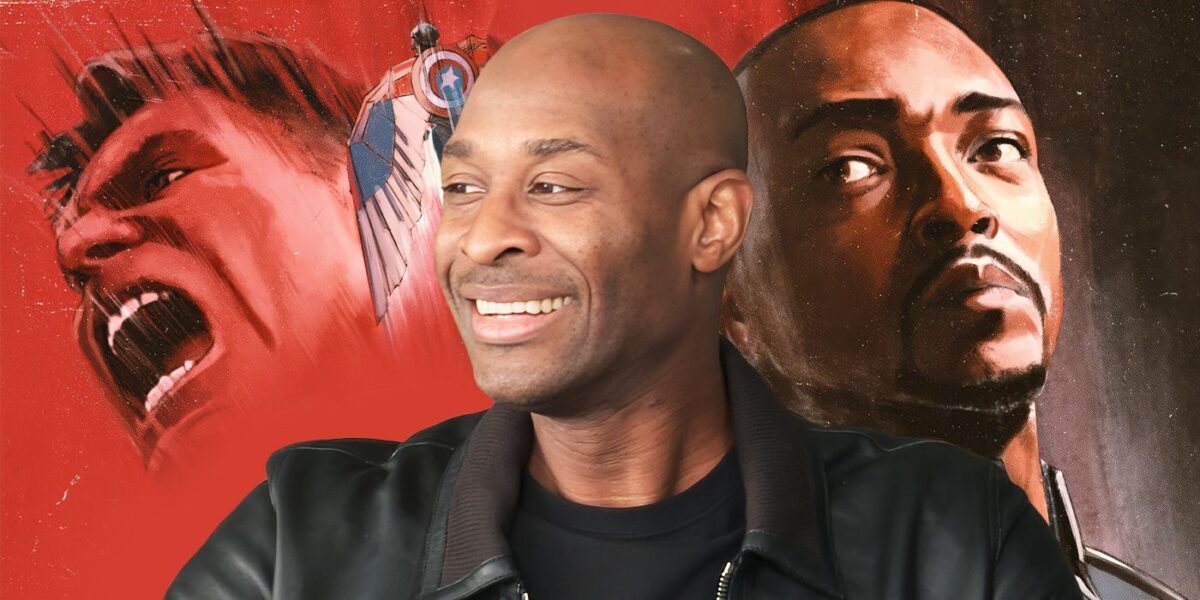
Brave New World’s Director Sets the Record Straight in This Spoiler-Filled Interview
Feb 22, 2025
[Editor’s Note: The following contains spoilers for Captain America: Brave New World]
Summary
Collider’s Steve Weintraub speaks with Captain America: Brave New World director Julius Onah for a spoiler-filled breakdown.
In this interview, Onah discusses character cameos, bringing legacy characters back into the fold, and character designs.
The filmmaker also shares insight into cut characters, like Seth Rollins and Rosa Salazar, their approach to Red Hulk, and so much more.
As Captain America: Brave New World continues to top the box office, Anthony Mackie’s Sam Wilson has now officially taken up the mantle. Marvel Studios is ushering in a new era of the MCU, and Brave New World is not only cementing Wilson’s title, but it’s bridging the gap between 2008’s The Incredible Hulk and bringing on all-new characters.
A Marvel movie is never standalone fare. Of course, as director Julius Onah tells Collider’s Steve Weintraub, one goal is to always ensure “anybody could just sit down and enjoy this movie as a movie,” but there’s also a duty to connect the dots from phase to phase. In this case, Onah’s feature is packed full of surprising familiar faces in a more grounded, spy thriller-esque entry to the ever-expanding Multiverse.
The road to Brave New World was paved with rumored cameos, leaked images, and fan theories, and in this exclusive interview, Onah addresses our most burning questions after those credits rolled. He discusses the Bucky Barnes (Sebastian Stan) cameo, bringing back Betty Ross’ (Liv Tyler), and the dedication to keeping this movie as grounded as possible, and how that altered the Serpent Society (or rather Serpent)’s presence in the story. The director also reveals the conversations had about Red Hulk (Harrison Ford), Tim Blake Nelson’s final look as the Leader, characters cut from the narrative, Giancarlo Esposito’s Sidewinder design, and plenty more. Check out the full conversation in the video above, or you can read the transcript below.
What Were the Storyline Challenges for ‘Brave New World’?
How do you bring so many projects together for a new audience?
COLLIDER: I’ve got a ton of questions and a lot of spoiler questions, but first, this film had a working title of Rochelle, Rochelle—who is a Seinfeld fan?
JULIUS ONAH: I have to give all the credit to Kyana Davidson, one of our producers on the movie, who is a massive Seinfeld fan. That working title came from her.
I love it. I believe you were hired around July of 2022 on this. What were those first few months like? This was your first time working on a project of this size and scale, part of the Marvel machine. When you came on, how much was the script close to done? How much was it a work in progress? What were those first few months like?
ONAH: Those first few months were mind-blowing. Stepping into those offices and seeing all the costumes and toys and everything, as somebody who grew up a geek loving anime and comics and pop culture, to be amongst that and know that you had the opportunity to contribute is mind-blowing. So, just on a human level, I was like, “Whoa, this is crazy.”
But specifically, the main pieces were in play. They were not fully shaped. We always knew this was going to be a Sam Wilson story. We always knew Sterns was going to be an adversary, and Ross, and that key dramatic triangle was going to be a part of the film. At that point, Serpent Society was ready on the table, but it was will-we-won’t-we? So, that was an ongoing conversation that evolved. The real challenge was figuring out how to make it move into a very specific genre lane and tonally how to do the things I think people love so much about the MCU—these characters, the heart, the humor—but not to tip over or out of the genre that the movie was trying to operate within as an action thriller with paranoid and political undertones to it. So that was in the scripting process, something that was really, really important.
Then I think the other thing was to make sure that as much as this was nodding back to The Incredible Hulk, as much as this was taking characters from The Falcon and the Winter Soldier and bringing them into the cinematic space, how do you do it in a way that an audience can come in, watch this movie, and just go for the ride? So that was the other thing that took a little bit of time to figure out where to meet the audience and make sure that anybody could just sit down and enjoy this movie as a movie.
When Does Kevin Feige Get Involved With Marvel Projects?
The Marvel Studios President is a very busy man.
So you get there. It’s those first few months. Who is in the room with you when you’re figuring things out? A lot of people wonder, is Kevin Feige in all these meetings? Which leadership is there? Who are you working with? Ultimately, it’s part of the Marvel machine, so where is the approval coming from?
ONAH: There’s a great team I was working with led by Nate Moore, who’s a producer on the film, as well as Kevin, and then Kyana Davidson, who I had mentioned, a co-producer on the film. Those were my day-to-day interactions in addition to, at that time, the writing team of Malcolm Spellman and Dalan Musson. As we work things out as a unit, then Kevin and Louis D’Esposito join us, and then we dig in even deeper. We’re always moving along, moving along, and then looping in Kevin and then having a wider conversation about what the implications are specifically for that movie and then for the larger universe. So, the team is always on top of everything. Obviously, Kevin’s a busy man, and there are a lot of projects to oversee, but Nate Moore, who’s been at Marvel for such a long time at that point, and has been so critical in shepherding Black Panther and previous Cap movies, was a great, great collaborator and partner to have as we were developing the movie.
Liv Tyler Was Involved Early in Development
“It takes time to make a deal and prep.”
Image via Marvel Studios
When did you know Liv Tyler was willing to come back?
ONAH: We knew Liv was willing to come back when I had a Zoom with her. [Laughs] You dream these things, you work these things out, but then you just have to actually go talk to the human being. She had taken a bit of a step back from acting, focusing on other things in her life, and she’s such an incredible human being. But I just went and did a Zoom and had a very honest conversation with her, like I did with every other actor who was going to become involved, as to emotionally and thematically what this movie was trying to accomplish and why I thought it would be worth their time and their talents. Luckily, she responded.
When in the process did you ask her? Was it towards the beginning when you guys were figuring things out? She didn’t have to be in the movie, but she has an important role.
ONAH: It was right during the development process. I think I had the Zoom with her probably in early 2023 because it takes time to make a deal and prep and all that other stuff. So, it had to be well in advance so that if for some reason it wasn’t going to work out, whether scheduling or whatnot, we would have the opportunity to make another choice or decision.
“Bucky Was Always a Part of It”: Sebastian Stan’s Cameo Was Never an Option
“It was just a matter of when.”
Image via Marvel Studios
Sebastian Stan as Bucky is in the movie for a small bit. When did you realize he was a part of it, or how did that get figured out that Bucky would be meeting Sam in the hospital?
ONAH: Bucky was always a part of it. There are so many great characters that Sam has had relationships with, and from the very beginning, we knew that Bucky would feature in some way in the story. Obviously, we weren’t going to tip our hand to the entire world. It was just a question of when. There were versions where he was at the beginning of the movie, there were versions where he was at the very end of the movie, but it became clear that putting him at a point where Sam is dealing with one of his emotional lows would be very, very potent, and also offer a surprise. I don’t think the audience is ever expecting that that’s the moment he’s going to show up in the movie, and I love that kind of surprise. So, he was there and in the orbit of the movie.
These things organically develop, and I think that’s something that people forget sometimes; these movies, just like any movie, you have to explore, you have to be open. You have to let the characters tell you where they want to go. Sometimes when you just try to jam it in or shoehorn it in, it’s just never going to be the result you want. I think we found the right place. It was so gratifying to hear some reactions when that scene played for the first time with audiences.
That scene is pretty serious, and then at the very end, there’s some humor. When I saw it with the audience, everyone was laughing. Was that last bit of that scene improvised, or was that scripted?
ONAH: It was scripted, and then, for me, and I think that’s the case with any great scene, you have to allow the actors to bring something to it. So, in the very beginning, we shoot the scripted version and then I’ll go over and say, “Have fun with it.” So, the shape of the scene and even some of the words there are what is scripted. It’s just them having a little bit of fun with some behavior or throwing in a line here or there. I think that gets you the best organic result.
Julius Onah Fought to Avoid This With Red Hulk
“You’re moving away from the pure id.”
Image via Marvel Studios
What is something that you fought for that a lot of people debated?
ONAH: I would say whether or not Red Hulk should talk. That was something that came up quite a bit. My feeling was that he shouldn’t, which is what is the case in the movie. The transformation that Ross is dealing with and the struggle that Ross is dealing with emotionally in this film is trying to move away from what he’s been known as as Thunderbolt Ross. He doesn’t want to backslide. He doesn’t want to be seen as this figure of rage and anger, and I just felt the moment you gave him language as a Hulk, then people can talk to each other, and you’re moving away from pure id to a more rational being. It was the same way Harrison felt. So I think the combination of Harrison and I both saying what was best for this character is to have him be pulled back into the very thing he’s running away from, not just as a Hulk, but emotionally and psychologically, and allow that to be a tension that Sam then has to resolve. That speaks to a guy and how great of collaborators everybody at Marvel is. They respected that, and that’s what we got in the movie.
What’s funny is I was wondering that when I was watching the movie, “Would he or would he not?” I’m very much on your side. I think that if he was able to talk, that’s something that the Hulk sort of worked towards to be able to do. I agree with your decision. Was there anyone who really was like, “We’ve got to get him to talk?”
ONAH: Let’s just say it was a debate and we talked about every single angle of it, the benefits and the demerits. But I’m really thrilled. As you said, I think it takes a while for a Hulk to work to that, and it’s also something we’ve kind of seen a version of before, certainly in Hulk and Betty moments. So, to allow this to be its own thing, but also just to be consistent with the character, that’s where I’m always coming from. How do you make the character feel consistent and coherent? It felt like the best way to do that was to allow him to be a rage Hulk.
I completely agree.
What Really Happened to Seth Rollins’ Serpent Society Character?
“The movie takes a very grounded approach.”
Image via Seth Rollins/Twitter
I have a bunch of questions I’m about to get into, but I just want to clarify that I believe that no matter what is done during the production of a movie, all that matters is what people are going to see when it comes out on opening day. A lot of movies go through changes and stuff, and I know you did a bunch of additional photography. There have been some characters that were cut out, and I want to actually talk about that. Seth Rollins was originally part of the Serpent Society, and there are a lot of people who are WWE fans, and they want to know more. Was he just in a scene or two scenes, or was he a bigger part of the movie? What can you say about what he was going to do in the film?
ONAH: There’s been a lot of misinformation about the process of a film. Every single one of these Marvel films and every movie of this scope plans an additional photography process, even just for simple things as we want to get some inserts or there are things that we want to clarify from a story standpoint. You know when you’ve got so many moving pieces that that’s going to be necessary. So we had planned from the very beginning, and we only had one additional photography process. Part of that was in the back of our heads, also thinking through, “We are taking a swing with Serpent Society, a group of characters that, in publishing, dress up in snake costumes and have some pretty bizarre snake-adjacent powers. How is that going to work in the tone of this Captain America movie?” So we always knew that we were going to be coming back to potentially refine that.
In terms of the Seth Rollins of it all, he was a character that was just going to feature in the opening of the movie. Seth is amazing. Incredible. I would work with him again in a heartbeat, but as we were iterating on the movie, it was very clear that some of the tonal things that we were playing with with the original iteration of Serpent Society had to fit even more closely in the mold with the rest of the movie. The movie takes a very grounded approach to its characters, even down to the choice of locations. We were shooting a lot more things practically. Sam is not a guy who’s got serum, so even our Captain America, despite his wings when he’s not in that suit, is a much more grounded version of this character.
So when our additional photography period came, we just thought through what helps us ground this character and still nod towards things that feel a bit heightened, and Giancarlo is so good about walking that fine line between larger than life but still feeling human. So, it became—I’ve said this over and over—something of a no-brainer. Then I also just had personal history and connections with him through Spike Lee, who had mentored me and helped me produce my first feature, and I’ve been his intern. I was a student of his in film school at NYU. He had a history with Mackie, so it just felt so organic. And when you have Giancarlo in the movie, well, let’s have as much of him as we can, you know? So, I’m literally telling you how organic it is in terms of the process, but that said, Seth is amazing. I know I’m going to want to work with him and hopefully will work with him again. He’s just such a phenomenal guy and obviously an incredible performer.
I read that originally the movie opened with Serpent Society before additional. My question is, with that version, was it not as grounded as you ended up making the movie, and that’s another reason why with Seth and the way you originally had it, it just wouldn’t work?
ONAH: Yeah, exactly. The movie still starts with Serpent Society, so the movie didn’t change in terms of story and plot and theme, and all those other things. You’re just turning dials to make sure that, tonally, everything feels coherent. That’s all that happened with Seth. As you see, Serpent Society still serves a similar function in the story and dovetails into the larger geopolitical conspiracy, much like we always planned.
I spoke to someone who may or may not have worked on the movie, and they said that the movie is basically exactly the same as what was originally made. The only difference is there are different action set pieces.
ONAH: With all of these movies, and again, I will reference every other movie made in the MCU, the action is always being refined and enhanced. That’s what the post-production process is. I think sometimes there’s this idea that the making of a movie is input data, press enter… But if you look at the chronology of so many things that we love in pop culture, I say this all the time, from The Wizard of Oz to Jaws and Star Wars, the filmmaking process is an iterative and exploratory process, and so many things that we know and love were made that way. Without that, we wouldn’t have these things. We have to, as creatives, discover and experiment and try things to create the things that I think end up standing the test of time, or just things that ultimately end up working in a way that tells the best story, and that’s what we did here. I’m really excited about everybody being able to see it.
Listen, I want to just say so everyone hears me on camera, I am fully supportive of additional photography, and I know the Marvel process. I’m fully on board.
Why Was Rosa Salazar’s Character Cut?
“It just became the cleanest and simplest way to do it.”
Image via Netflix
So Rosa Salazar was originally in the movie, and she even got a McDonald’s Happy Meal toy. Was she just in the opening, or was she more in the movie?
ONAH: Again, Serpent Society is serving the exact same function in the story as what you saw. In that iteration of it, playing with the Seth Rollins and the Rosa of it—Rosa is another person I love, she’s a brilliant actress and another person I can’t wait to work with again in the future—the same structure of the movie exists right now. It’s just that when we pivoted, it didn’t make sense to have these two Serpent Society characters. It made sense to have one character. And again, also with timing, I believe Rosa was shooting another movie in Australia. I don’t even think she was available during our dates. I’m giving you the nuts and bolts of how movies get made. You’re working with all these different factors: schedule, tone, etc., etc. When it became clear that Giancarlo was available and that was going to serve the function that we needed to tell the best story, it just became the cleanest and simplest way to do it, both in terms of the practical of making a movie and then also what was really right just story-wise and thematically and action-wise.
A lot of people don’t realize how messed up scheduling is with movies. In some of those Avengers movies, those actors were never in the room together performing scenes. It’s crazy. What is it actually like as a director picking up the phone and having to call someone and say, “You were great, but you’re not going to be in the final cut?”
ONAH: Fortunately, I’ve known Rosa for a very, very long time. We’d almost worked together on a previous film 10 years ago. I consider her a friend and she’s an actress I have so much respect for. Seth was somebody I became friends with when we were making that film, and I got to meet his wife and his kids. He’s an incredible human being. These are all people who I have the utmost respect for, and they also have great ties with the Marvel community. So, you’re talking to people who you have respect for, affection with, and for, and you just have an honest conversation. These are all people who understand what the filmmaking process is, understand what it means when they’re halfway across the world at a time when you have a very specific window to shoot something. So, in the same way as you get to know anybody better, you’re honest, you’re collaborative, and you know that in this crazy world we live in, our paths will cross again in ways that we least expect.
“Multiple Iterations” of Tim Blake Nelson’s Leader Were Discussed
In the end, it all came down to tone.
Image via Universal Pictures
With Tim Blake Nelson, I saw a picture of him more like the comics, where his head was up and he had hair, and it wasn’t the prosthetics. I’m just curious, was that part of the movie and then there was a change made? I’ve seen two versions of the Leader if you will.
ONAH: When you’re trying to do something, again, in a certain tonal lane and do it as practically as possible, we always knew that we were going to have a practical look on set for Sterns, and then potentially evolve that. I think maybe in some of the photos you saw there were orange dots on him, as well. I can’t speak to everything that leaked online, but what I can say is we always knew that what we had on set wasn’t going to be the final iteration of it, that we were going to be working with the great visual effects team we had on the film. We had different renderings that the visual development team had created at Marvel, and we knew that we wanted to refine that in post. So, I don’t know exactly what image you saw, but what I will say is the whole plan was to always finalize that look as we were finishing the film.
Yeah, I really like the way he looks in the final film, but how much did you debate having more of the comics look with the forehead?
ONAH: If you go through the history of this character in publishing, there have been more human-like versions of him, there have been incredibly grotesque versions where his head opens. There are so many iterations of it, and we had discussions about multiple iterations. We explored renderings of it, we explored makeup tests. It’s the same thing as with our Serpent Society—as you are dealing in the movie and trying to make sure that this fits into a film that also is operating in a more grounded lane in terms of its genre, you turn the dials, and we turned the dials in a way that I think really leans into what is grotesque about the transformation of Sterns, but at the same time doesn’t feel like all of a sudden you’re in a completely different movie. So, it was really exciting to find that and to work with Tim on finding that.
One of the things about this film is it’s a mystery, and you have to figure out where and when you want to give the audience information. What was it like trying to figure that out in the scripting process, and how did it change in the edit when you started showing it and you want the audience to be following along, but not ahead and not behind?
ONAH: I love that. I love turning those dials, in specific. The great thing about a thriller, as you said, is it’s all about information. When does the audience need to know what they need to know to move the story forward? I think the key thing that was really important for me is to not let the audience get ahead of Sam, that Sam drives us through the story so that when he makes a discovery, we make a discovery. The first time we hear the name Samuel Sterns is with Sam. There’s another point where there’s a key plot turn in the story that has to come with Sam first, and we start to feel some of the ramifications of that geopolitically, but it’s Sam who makes the discovery with Sidewinder, and then that throws us into the next major sequence of the movie. So, the key thing was making sure that Sam was working as our investigator in the procedural component of the story and driving us forward.
I don’t know if this is true, so I want to preface this, but I read that Logan Kim was originally in the movie as Amadeus Cho. Is that true, or was that a BS online rumor?
ONAH: I think there’s been a lot of BS and online speculation. I’m not going to speak to that because I don’t indulge in that kind of stuff, really, just because there’s so much stuff out there. This has always been a story about Sam and Ross and Sterns, and that’s what we got in the finished movie.
Designing the Look of Sidewinder for ‘Brave New World’
“We’re always looking for little details that connect you to publishing.”
Custom Image by Zanda Rice
So, Giancarlo has blue eyes in the movie, which is a comic reference, but the rest of the costume is more for the movie. Can you talk about how much you guys debated the look of the character, why the blue eyes, and why the costume that he ended up with?
ONAH: Well, the costume because it was really important that it felt like he could be a mercenary that existed in the real world. When you think about a lot of real private military companies, obviously we’ve heard of things like the Wagner Group in Russia, there’s always the uniform of camouflage and real military, but we wanted to put a little twist on that, so we made it gray and black and white. The other thing that Giancarlo and I talked about was thinking of real warlords, warlords from Congo and other parts of Africa. So we sort of combine the look of a warlord, somebody who has this sort of powerful aura that commands the respect and loyalty of his followers while at the same time feeling like, “Well, how would they operate as a real power military or a real private military company?” So, it was the merging of those two things that I felt would help us create something specific for Serpent Society and how they would potentially work. And in fact, we called them just Serpent in the movie.
Then, the blue eyes were something that Giancarlo contributed, which I thought was awesome, just thinking about Seth and the character to give you a little bit of a throwback to him. Even just the orange lapel on his coat throws back to the orange of Sidewinder. So, we’re always looking for little details that connect you to publishing in subtle ways so fans can appreciate that, but it’s not the kind of thing that would distract an audience who just wants to go along on the journey of the film. I thought it was a great way to differentiate Giancarlo, and he very much so felt it was a great way to differentiate him from other characters he played.
One of the things about making movies is that as you start to show the movie, you start to learn what’s working, what’s not working, and what to tweak. Talk a little bit about those early friends and family screenings, or the early Marvel screenings and what you learned, what made you feel great, and what made you think, “We need to adjust this.”
ONAH: The things that made us feel great, first and foremost, were the characters. There was a real great love for Sam, Sam and Joaquin, Isaiah, and Ross’s journey. So those were all things that, again, the character work that we had done from the very beginning of the process on the page. Also, I had a rehearsal process with these actors. All that was shining through. So, we’ve kind of talked about this already, but really just turning the dials on tone and making sure that tonally, everything was living in the same world. Those were the adjustments that we iterated on, both in terms of Serpent Society and, to a certain degree, also in terms of Sterns.
Here’s What You Can Expect for ‘Brave New World’ Deleted Scenes
Sorry, no five-minute deleted scenes.
Image via Marvel Studios
Every movie has a lot of deleted scenes, especially at Marvel. Do you know what deleted scenes you’re planning on releasing on either the Blu-ray or Disney+? Or have you not thought about it yet?
ONAH: I have. We have gone through and we’ve made our selects. That doesn’t mean those are the ones that are going to end up out in the world, so I don’t want to say too much about it, but there’s a handful of really cool scenes that I think are really fun that I’m really excited about. When the digital release eventually happens, those will come out. We were obviously really focused on getting the movie done and out, so that’s a decision that’s still yet to come.
Are any of the scenes five minutes? Are they all, like, a minute?
ONAH: I would say some of them are a couple of minutes long. In general with a movie like this, because there’s a certain degree of propulsion and it’s a thriller, you don’t want to have too many. Five minutes is a long scene, and there’s no scene that ever wants to stick around for that long.
How close did you come to having a member of the Eternals in the movie? Was that ever discussed?
ONAH: That was never on the table. No.
I had to ask.
The “Sam-Centric” Post-Credits Scene Was Strategically Chosen
The sequence was shot during additional photography.
Custom Image by Zanda Rice
You have a post-credits scene but not a mid-credits scene. How much did you guys debate having a mid-credits scene?
ONAH: Not at all. It was always the case that what felt organic for this movie was just leaning into a post-credits sequence that could tease what’s coming next. We wanted to tease it in a way that didn’t become too explicit. This is about introducing Sam as our new Captain America. That was the overarching focus of this movie, so to start throwing in too many post-credit sequences just felt like it was going to stray away from that. Even the tease we have is still very Sam-centric.
With that post-credits scene that you do have, how early on did you know it would be that scene? I’ve spoken to other Marvel directors, and sometimes there are multiple options, and you’re debating what it’s going to ultimately be.
ONAH: Again, that was shot during our additional photography. That’s what I mean about all this is planned ahead of time. We didn’t know what our post-credit scene was going to be just yet. As you know, there was a massive writers’ strike, so that meant it was pencils down not just on this movie, but pencils down on everything in film and TV. Nothing was happening. So, who knew what Thunderbolts* was going to look like necessarily? Or the next Avengers was going to look like? So when we got out of that strike, and we were actually able to put pen to paper for wrap, and everybody else was able to put pen to paper for their movies, then that’s when you can actually start to have a real conversation as to where things are going and what post-credits sequence is the appropriate one to tease. So, that’s how it evolved.
No, Steve Rogers Didn’t Know About Isaiah Bradley
Do you think Steve Rogers knew about Isaiah Bradley?
ONAH: I don’t think Steve Rogers knew about Isaiah Bradley, otherwise he would have done something about it. Steve is an incredibly honorable human being.
I agree with you 100%.
A Break-Down of Sam Wilson’s Abilities
“This is a guy at peak human performance.”
Image via Marvel Studios
What Sam Wilson can do when he’s in costume with the shield kind of defies the laws of physics. It’s movie magic. How much did you guys debate behind the scenes about what Sam can actually do when you’re doing these action set pieces? How much is it like comic logic? How much is it real? What’s that debate like as a director and working with the crew in terms of figuring it out?
ONAH: It starts early on in the process of previs and storyboarding, and stunt-vising these sequences, as well. Obviously, Sam does have enhancements. That suit gives him enhanced strength and enhanced speed and Wakandan energy that he can release when he absorbs kinetic energy through his wings. Sam is also trained. This is a guy at peak human performance. He’s been a PJ in the Air Force. You’re not dealing with just your average Joe. You’re dealing with somebody who’s at peak human performance, and then you’re giving him even more enhancements, both in terms of his suit and his technology. So, with that in mind, it means you have some really fun action that you can orchestrate.
But that said, he doesn’t have serum, so he can’t do some of the things that Steve does. But that’s why I’ve also really loved leaning into the tactical and emotional intelligence, him picking up on a little clue from something Ross says during a conversation and then realizing that’s something that he can utilize to break through to him later on. Those are the things that become really fun to figure out, when you put yourself in the POV of the character and lean into his emotional superpower.
Related
How Does ‘Captain America: Brave New World’ Set Up the Future of Captain America and the MCU?
Sam Wilson has some assembling to do.
One of the things about VFX is that every shot costs a lot of money. What did you learn about VFX making this movie that you want to take with you to a future project? Like maybe you learned a certain shot costs way more money than another? I’m just curious what you took away.
ONAH: I delved a little bit into visual effects before, so this was an opportunity to dive in even a little bit more deeply into that. I think if anything, when you are iterating on a movie like this and certain things evolve and certain things change, you don’t always necessarily have the ability to plan everything to the detail that you want to. I’m a preparation junkie. I love to storyboard. I love to previs. Now, really knowing, to your point, how long something takes, I feel I can be much more specific about, “Let’s start this at this time because it’s going to take that much time to get a result that I want.” So it’s really as boring as it sounds—a scheduling thing. And that’s something that I think you learn from experience. Every filmmaker learns from experience how to allocate time, to achieve a certain thing. So, that was probably my biggest take away from the VFX of it all.
Captain America: Brave New World is in theaters now.
Publisher: Source link



One of CBS’ Longest-Running & Highest Rated TV Shows Is Coming To End After 30 Years
Along with countless scripted dramas, comedies, and action shows, CBS is well known for its impressive run of unscripted programs over the last 50 years. More recent years have included major competition shows like Survivor and The Amazing Race, along…
Sep 17, 2026

Prime Video Officially Launches New Deal That Changes the Streaming Game Forever
It seems like streamers raise their prices every day. At the end of August, Apple TV raised the subscription service price by $2, bringing it to $14.99 a month. Netflix, Disney+, HBO Max, Paramount+, and Peacock have all raised prices…
Sep 16, 2026
Netflix’s 10/10 Thriller Series Returns After 3 Year Absence With Explosive New Trailer
Over the last five years, Netflix has expanded heavily into non-English content, with international series taking an even bigger focus for the streaming giant. One of the biggest driving forces in that effort is the French thriller series Lupin, led…
Sep 15, 2026
Original ‘Yellowstone’ Dutton Favorite Officially Confirms ‘Marshals’ Return Interest
Yellowstone jump-started a generation-spanning story that has so far spawned four spin-offs that are all interconnected by the Dutton bloodline. While creator Taylor Sheridan has since branched outside that saga with Tulsa King, Landman, Mayor of Kingstown, The Madison, and…
Sep 14, 2026