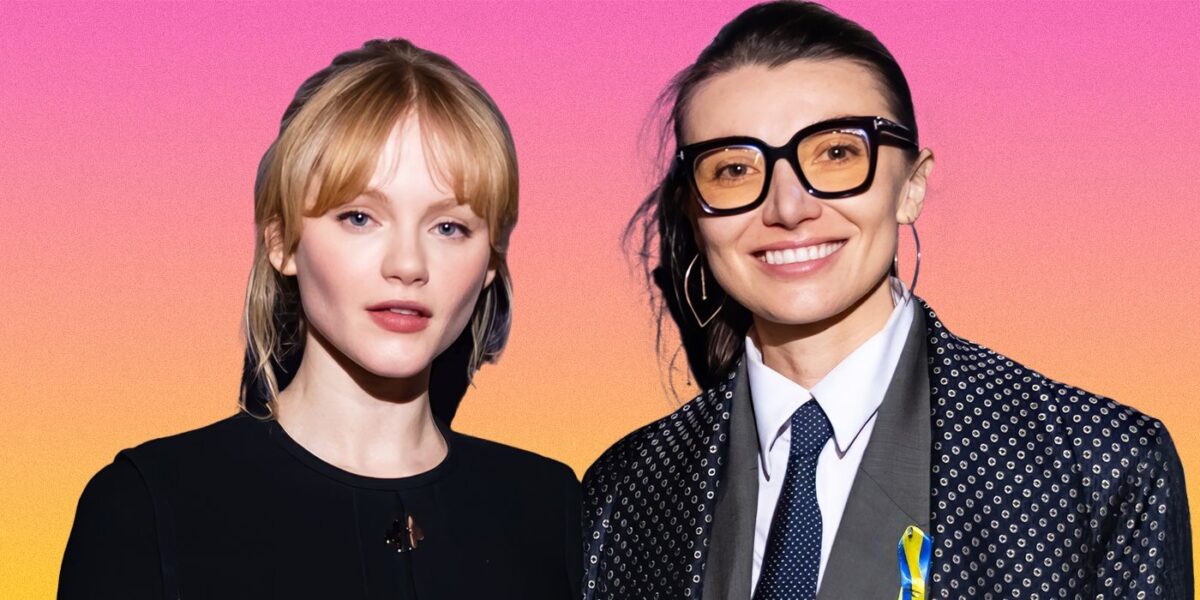
Satisfaction’s Emma Laird Reveals How the Most Difficult Scene Was “Designed to Be Uncomfortable”
Mar 25, 2025
Summary
Collider’s Steve Weintraub talks to Satisfaction writer-director Alex Burunova and star Emma Laird at SXSW 2025.
Satisfaction is a psychological drama about two British composers struggling to communicate.
Burunova and Laird talk about the intense prep work, how co-stars Laird and Fionn Whitehead lived in an Airbnb together, improv on set, and Laird’s upcoming roles in 28 Years Later, Blood on Snow, and more.
At SXSW 2025, rising star Emma Laird (Mayor of Kingstown, The Brutalist) and writer-director Alex Burunova (Enter the Anime) dropped by the Collider Media Studio at the Cinema Center to sit down with our own Steve Weintraub to discuss their new drama, Satisfaction.
In the movie, Laird plays Lola, a young composer who lives with fellow artist Philip (Fionn Whitehead) on a Greek island in the off-season. Burunova’s slow-burn sophomore feature reveals bits and pieces of Lola’s story at its own pace as tensions build between the two musicians and others are pulled into the fold. Satisfaction also stars Adwoa Aboah (Ghost in the Shell) and Zar Amir Ebrahimi (Tatami).
Check out the video above or the full transcript below, where Burunova and Laird share the extensive prep work they put into this film, how the original screenplay changed over eight years, and how Laird and Whitehead developed their characters’ relationship off-screen. Laird also shares teases for Danny Boyle’s 28 Years Later, as well as Nia DaCosta’s addition to the franchise, working with Aaron Taylor-Johnson, and more.
‘Satisfaction’ Has Been in the Works for Eight Years
The romantic drama stars Emma Laird and Fionn Whitehead.
Image via SXSW
COLLIDER: I love this festival. I’m super happy to be here and be able to talk about cool movies. No one watching this right now will have seen the film yet, so how have you been describing it?
ALEX BURUNOVA: Satisfaction is a psychological drama about two British composers who can’t seem to address something. They have a really hard time communicating as they vacation on the Greek island off-season, and things begin to escalate when Lola meets a local woman on a nudist beach and brings her into the fold.
That’s very good at not giving away everything. It’s almost like you’ve done that before. [Emma], I’m sure you’ve read a lot of scripts. What was it about this one that said, “Yes, I’m doing this?”
EMMA LAIRD: It was more a feeling than it was a plot. My manager called me, and she was like, “Listen, I know you don’t want to tell this kind of story again or be in that mindset again,” which I’d been in before, but she was like, “Just read the script.” I read it, and I was like, “Okay, this is cool. This is interesting.” Then, we get to a certain point in the script, and I just kind of bawled my eyes out and cried for the rest of the script and finished it, knowing that I had to do it. That’s usually how I take projects. First and foremost, before—no offense—filmmakers, before producers, actors attached, or anything else, it’s the character, and then it’s the script for me. It’s this feeling that I get whether I want to do it or not. I usually know in the first, like, 20 pages. So, yeah, it was just kind of a feeling as opposed to anything else, really.
One of the things about this film is that it weaves two different storylines. You’re two years in the past, and then you’re in the present. Talk a little bit about why you wanted to do that. It could have been more time or less time. How did you discover for two years and the way you wanted to tell the story?
BURUNOVA: I knew I wanted to set the story in two opposite timelines, before that pivotal event and after, and I knew that I wanted to go back and forth between the two timelines to really feel the juxtaposition and feel the difference between the main character, Lola, before something happened and after this traumatic event happened. So, I scripted it this way. I’ve been writing this project for over eight years, and two of those years I spent moving scenes around and figuring out, “How much time do I need to spend in the past, and how much time do I need to spend in the present? Which scenes tell the story and the emotional journey of the character the best?” And that’s how it came together.
It’s two completely different headspaces for you. How much did you film all of the stuff from the two years in the past together? How much were you trying to do that for the emotional stability of your cast?
BURUNOVA: We shot two timelines separately. At first, we shot the present. We tried to go as chronological as we could, schedule and budget permitting. Then we shot all of the past scenes together. I think that really helped Emma and the cast to separate the two timelines because she had to step into basically two different characters.
LAIRD: It definitely helps us as an actor, too. It’s the same as when you’re kind of in and out of a job. It’s hard to click back in. You do it, but it’s much easier to live in the headspace and the environment and then to go and play basically a different character. I was very fortunate that we got to do that.
What was it like for you when you were inhabiting a character like this where it’s two completely different mindsets? It’s almost two different people.
LAIRD: In some ways, it didn’t feel like two people just because Alex made it so that I was as much like Lola as possible in terms of my own accent, maybe more androgynous than maybe I am, but it felt very lived in with the prep, as well. We made all these memories. I lived with Fionn [Whitehead] and we had a rapport that made it feel very real. So, when we got to the past stuff, it was kind of just me and Fionn messing around and chopping onions and improvising. It didn’t feel like a massive stretch because it just felt like a different version of myself that I just had to step into.
The final scene that we shot of the film was like the big scene in the film, so I think that was a bit still on our minds. Throughout the entire production, we were like, “Until we’ve shot that scene…” It was like the thing that we kind of dreaded. So, that was the only thing that we kind of had to get through. But other than that, it was easy. It was easy going into the past self because it was actually quite fun after all the heavy stuff.
BURUNOVA: She makes it look easy.
Well, I mean, good actors.
LAIRD: Thank you.
Emma Laird and Fionn Whitehead Shared an Airbnb in Prep
The two co-stars created a past full of memories in character.
Image by Photagonist
So, I read this, and you mentioned that you and Fionn shared an Airbnb, which is not things I’ve heard of with a lot of people. This is not the norm.
LAIRD: You really do have to give over to this process and to your director and trust them. It was definitely a new experience for me of lots of, like, “I don’t want to do that.” It’s not that I didn’t want to live with him, but sometimes you just want to go home and have your own space. In retrospect, I’m really grateful for all of this stuff that Alex suggested we do in prep. She set up meetings, she was in contact with composers in London to go to really wonderful schools and have these people make time to meet people like Fionn and me, set up the Airbnb, and all of this unique, weird prep that we got to do. I’m really grateful for that because I think it made for a very special outcome.
Why was it important that you wanted them to spend time in the Airbnb?
BURUNOVA: I come from theater, and I’m a big fan of immersive prep and intensive prep. I wanted to shoot the film chronologically, but then, for budgetary reasons and schedule, we just couldn’t do it, so we had to shoot present first and past later. But I wanted them to have that shared history together because we would be able to feel it. So, in prep, they stayed together in the Airbnb and created shared memories in character. They cooked, and they hung out, and they welcomed guests and improvised different scenes, building those memories together so when they got to Greece to shoot the present, the past [and] those memories were already created.
‘Satisfaction’s Most Difficult Scene Is “Designed to Be Uncomfortable”
“I knew the weight that I was carrying.”
Image by Photagonist
I don’t want to talk specifically about what happens in the movie, but I do want to talk about how you shot a very important scene because it’s shot very powerfully. There’s no way you’re not going to feel it. What do you want to say about the way you wanted to shoot that sequence?
BURUNOVA: There is a pivotal scene that happens in the film, before which Lola’s character is an absolutely different person. This scene was scripted eight years before we shot, and it never changed. It’s one of those scenes I never rewrote, never touched because it just felt right. It’s a traumatic scene, and when I talked to my cinematographer, my production designer, and everyone on the team, I wanted to make sure it was not too stylized, it doesn’t have any frills on it, that we light it like a documentary film and the camera doesn’t move, and we don’t have anything going on with the production design. We stripped it from sound design so it doesn’t have any sound design, and we mixed it in mono. The whole film is mixed in stereo and 5.1, of course, and that scene is mixed in mono, the way you would listen to a video, so it feels more real. And it’s just a shot of Lola’s face. So, I storyboarded it five years prior before it was shot; it was that shot of Lola’s face, and that’s how we shot it.
It was a really, for me, a tough watch, and I think it’s because of the way you shot it. Again, I don’t want to talk about specifics, but when you are going to be performing such a real honest and no-bullshit scene, what is it like for you in the days leading up to it, getting into that mental headspace? What was it like for you knowing this was a really important moment?
LAIRD: I knew the weight that I was carrying with that because Alex and I had spoken so much about this thing, and we built this relationship where we knew the significance of what we were making. It was all really about this thing and how it affects her afterward. But, I mean, there are always nerves going into something like that. I remember we cut on one of the takes, and I just wanted to make you proud in that moment because that was the whole thing that we’d created together was in that moment. But I had no real anxiety because I had that relationship with Alex, and we had so many chats about the topic and experiences and being a woman and all of that stuff. So, I felt very, very comfortable on that set. Alex very much gave me the opportunity to keep going if I wanted to and not if I didn’t.
Of course, it’s never fun to end a shoot with that scene because no one’s like, “Oh my god, we did it!” Everyone was super respectful, and it was kind of like, “Oh my gosh…”
BURUNOVA: “We did it.”
LAIRD: Yeah. But I’m proud, and I agree with you. That was in the script, and I love that there are no frills. You’re uncomfortable. It’s designed to be uncomfortable, and you’re seeing the whole wave of emotions in this, and we’re not cutting to different angles, there are no fancy camera things going on. The camera is still. All we’re seeing is that whole scene on one continuous thing, and I think that’s so powerful.
100%.
I like talking to directors about editing because it’s where it all comes together. Talk a little bit about how you have all your footage; you’re in the editing room, you have an assembly cut, and you’re showing it to people, friends, and family. Are you jumping out the window because you’re like, “Oh, fuck,” or are you like, “I have it, I just need to make a few tweaks?”
BURUNOVA: No, I was so fortunate. When I saw the first assembly cut, I was like, “It’s going to work. It needs a lot of work, but it’s working. The back and forth is working, and it’s doing what it needs to be doing.” So, the rest was much easier. It was just balancing it out because, as you said, there are past scenes and present, and it’s finding the balance between how long each one should run and the rhythm between the past and present.
Were there any big notes that you got from friends and family where you’re like, “Oh yeah, I do have to fix this?”
BURUNOVA: You’re asking such good questions. It’s a slow burn where you don’t quite know why this character is the way she is and why there’s such a big juxtaposition between her now and her in the past. At some point, you see what happened. The note was, “We want to see it sooner because we want to be with her.” The story really gets not just interesting but gets heartfelt once you are with her on that journey, so we ended up moving it up a little bit sooner.
I did some research prepping for this and read you had 110 drafts over eight years. That’s a lot. I am curious: how radical of a change did this story go through from beginning to when people are gonna see it, or were certain events always there?
BURUNOVA: It changed drastically. There was a completely different ending and completely different way Lola was behaving towards her partner, but as I was working on this personal story and working through it, I also changed the way I feel about my past and so the script changed.
I also read you workshopped it as a play, and you spent five years painting storyboards and keyframes.
LAIRD: Wow, you’ve really done your research. I just found that out earlier, and I’m like, “I want a painting!”
BURUNOVA: I will give you a painting. I don’t usually talk about that, but yeah, I come from a painting background. I went to art school, and so once I had the story down, I started painting keyframes because I really wanted to dial in on the visual style of the film because I wanted it to be very specific. So, that’s the painting. As far as workshopping, I come from theater, so I workshopped the screenplay as a theater play with four different sets of actors. So, there were four different Lolas before this Lola because I wanted to dial in the rhythm and the pacing, and I didn’t want to tell a very simple story. I knew it was complicated. I knew it had to be nuanced, and I really wanted to dial it in.
“Keep the cats.”
Image by Photagonist
So, I wrote down cats because I love cats, and Perri does too. Let’s talk about cats and their impact or part in this movie.
BURUNOVA: I’d like to talk about cats.
Let’s do it! I’m here for this.
BURUNOVA: So, the main hero’s house where we shot in Greece had these homeless cats, but they weren’t homeless; they thought it was their home, except they couldn’t go inside. They lived around that house, and they would show up on set.
I love animals, but I love cats, and so if I can bring up cats during an interview…
LAIRD: I actually really love this.
BURUNOVA: They would wander on set, and we would keep them there because I love that they added to the [scene]. The scene would be completely improvised, and then there would be this cat, and I’d be like, “Keep the cat.”
LAIRD: It’s so Greek. There are cats everywhere in Greece.
BURUNOVA: They’re everywhere. So I’d be like, “Keep the cats!” There was no cat continuity whatsoever. It was one take with a cat, one without, then cat again, but we cut around the cats, and they cut around beautifully.
LAIRD: I made, like, a whole fake movie poster with a donkey. [Laughs] Because I think there was just one day that you were trying to get a shot of a donkey or something, and it just became this weird [thing]. I don’t really know what the story is, but every time I just think of this donkey in Greece that never made it into the film.
BURUNOVA: I was trying to cover this Greek island, and I was shooting everything that was interesting, and then I saw this donkey.
LAIRD: She was like, “I need to get the footage of the donkey,” going crazy with the producers, like, “We must get the shot!”
BURUNOVA: So, she takes a photo of a donkey, and she puts the word “satisfaction” underneath it and sends it to everyone. She’s like, “That’s out movie poster.”
LAIRD: I’ve still got it somewhere on the chat.
BURUNOVA: You have the donkey exclusive.
Thank you.
After Years of Prep, Alex Burunova Embraced Improv on Set
She compares it to oil paints versus watercolors.
Image by Photagonist
Again, I read that after months of prep, you set the script aside and embraced improv and unexpected choices. You’ve spent so much time preparing everything, years and years working on this, and yet you are willing to let it go on set and let them make choices. A lot of directors wouldn’t do that. What was your motivation?
BURUNOVA: As a painter, I was working with oils for the longest time, which is a lot; it’s very precise. Then I took on the watercolors, which they flow the way they flow. I wanted to have that experience with this film, and so we’ve prepared a lot for Emma and Fionn and Zar find their characters and to embrace them. We worked on childhood memories. Emma is an incredibly prepared actress. Her script was this thick with notes and annotations. Same with Fionn. Their scripts were insane. We did so much prep so that they can set them aside on set and speak from the heart because having those words come from the heart, if you’re completely immersed and fully in character, I trusted them to do that, and I think what we got was something very special.
What is it like for you with all that prep, and you have your notes and you have the script, and then all of a sudden she’s like, “Just go do it?”
LAIRD: It’s liberating. You need to do that prep. You really do because you have to have as many options, or possible options for a scene so that if something isn’t going right on set, you have something to fall back on, and you can go back to your script, and you can be like, “Okay, maybe it means this.” But it was scary for me. I just worked with the director, and I was like, “I don’t like improv. It’s not my thing.” But I will. Part of my prep is, the lines are the last thing of importance for me. I learn lines so easily because I’m thinking about everything around it, about what she’s thinking, and so I do improv in a way, slightly, around the dialogue, but whole scenes are something that I’m not comfortable with. But in doing it in prep, it was really a great learning opportunity for me and a lot of the scenes that you see in the film are from what we improvised beforehand.
I will say I preferred improvising in rehearsal instead of just being like, “Okay, roll.” Because I talk for days, and that’s what I’m scared. If you roll the cameras, it’s just gonna be nonsensical. But we did it in rehearsal so that we had a more refined road map to work from, so it wasn’t just like whole scenes that we improvised, but we felt like we had freedom, which is rare to work with a director like Alex.
BURUNOVA: Yeah, the scenes stayed the same, but the words changed.
I totally get it. You’re still capturing what you’re looking for in the moment.
’28 Years Later’ “Couldn’t Be More Different” From Nia DaCosta’s Film
“Nia’s film is gonna be quite insane.”
I do have some individual questions for you, if you don’t mind. You’ve done a few things that I’m really excited about and curious about. For example, Danny Boyle and shooting a movie on an iPhone.
LAIRD: I don’t know if I should say this, but they had lenses on those phones.
Oh, 100%. Ralph Fiennes told me about it.
LAIRD: There was a whole tent. We’d be walking down to set, and there’s just a tent full of iPhones charging, and I was like, “What’s going on?” They’re like, “We’re shooting this on iPhone.” I’m like, “What? No, we’re not!” Because you get to set and it looks like the same kind of setup, but I think Danny was trying to do something like what he did with 28 Days Later. It was such an indie film, and now it’s not quite the indie film that one was, but trying to kind of have that same feel to it. He’s amazing.
No spoilers, but what can you say about your character? Are you involved in more than one of them?
LAIRD: I come in at the end of Danny’s film, so I didn’t get to work with him that much. You’re introduced to me. What I will say is I’m not a likable character, and it’s absolute insanity. What Danny has set up for Nia DaCosta’s film, those two films couldn’t be more different in a way. Nia’s film is gonna be quite insane. I don’t even know how to describe it. Both are wonderfully unique and both very different.
I really can’t wait. I don’t want to get you in trouble, so I’ll stop there.
Apple’s ‘Neuromancer’ “Captures What Is in the Source Material Really Well”
The series was filmed on location in Tokyo, Japan.
Image via Apple TV+
Also, I’m a big fan of Apple TV, and I read that you’re doing Neuromancer.
LAIRD: I am. I just wrapped on Friday. Well, wrapped for a while. I maybe have to go in for a couple more days. But yes, I am.
That’s something that’s been trying to get off the ground for years and years and years.
LAIRD: Have you read the book?
I haven’t read the book, but I know the material. What is it about those scripts that excited you? What can you tell people? It’s something a lot of people love.
LAIRD: I’m just completely contradicting what I said earlier, but I was sold by the showrunner, Graham [Roland], and J.D. [Dillard], the director, and the character. I didn’t get the scripts until we shot in Tokyo in January. I landed in Tokyo, and I was like, “Guys, I only have Episode 1. Can you help me out?” But the character’s really cool, and I read half the book, and they’ve managed to capture what is in the source material really, really well. There are a lot of characters. It’s very complex. It’s a very confusing book, but I think somehow bringing that onto the screen helps tell that story maybe a bit more clearly.
The costume is insane. The hair and makeup is crazy. It was real character [acting], as was Danny Boyle’s film. What we’ve made is really grounded and a drama; these other ones are just a bit more mad and very much character acting for those two projects.
One of the things that excites me is the Tokyo aspect. Tokyo Vice was fantastic on Max, and that city is just a completely neat place, unlike anything else on this planet. What did that city bring to production?
LAIRD: Just on the crew side, people were so welcoming and wonderful there. We had a whole ceremony to commence the shoot. The lights and the language and the food, the culture in Japan, it was one of my most memorable experiences because it is just a culture like no other. That is a huge theme and a huge part of Neuromancer in the books, as well. So, yeah, it’s a very important part of it. I don’t think it would have quite been the same if we’d done it all on a stage in London, so it’s great that Apple had the money to send everyone there.
Cary Fukunaga’s ‘Blood on Snow’ Is “Amazing”
Laird says Aaron Taylor-Johnson’s performance proves his “still so underrated.”
Image via Sony Pictures
I’m really excited for Blood on Snow. You’ve clearly won the actor’s lottery. These are really, really big deal projects, so congratulations. I really mean that sincerely. Blood on Snow is another huge one. For people who don’t realize, who’s involved with this project?
LAIRD: Cary Fukunaga, who did True Detective and did the last Bond film. Wonderful director. It’s his next thing. It’s a Jo Nesbø adaptation of the book, same title. Aaron Taylor-Johnson, myself, Eva Green, and Ben Mendelsohn. It’s amazing. He’s shooting it on film, and it’s set in the ‘70s. I don’t know what I can say. It’s just wonderful. I can say, as well, Aaron Taylor-Johnson is maybe one of my favorite actors I’ve ever worked with. The way he shows up on set is so enthusiastic and so talented. I feel like he is, in some way, still so underrated. He supported me through sometimes I’d have creative blocks, and he was the most generous co-star I could ask for. I have high hopes for it. But yeah, all very exciting. I feel really grateful. Thank you for saying that.
Special thanks to our 2025 partners at SXSW, including presenting partner Rendezvous Films and supporting partners Bloom, Peroni, Hendrick’s Gin, and Roxstar Entertainment.
Satisfaction
Release Date
March 7, 2025
Director
Alex Burunova
Writers
Alex Burunova
Publisher: Source link




Prime Video Officially Launches New Deal That Changes the Streaming Game Forever
It seems like streamers raise their prices every day. At the end of August, Apple TV raised the subscription service price by $2, bringing it to $14.99 a month. Netflix, Disney+, HBO Max, Paramount+, and Peacock have all raised prices…
Sep 16, 2026
Netflix’s 10/10 Thriller Series Returns After 3 Year Absence With Explosive New Trailer
Over the last five years, Netflix has expanded heavily into non-English content, with international series taking an even bigger focus for the streaming giant. One of the biggest driving forces in that effort is the French thriller series Lupin, led…
Sep 15, 2026
Original ‘Yellowstone’ Dutton Favorite Officially Confirms ‘Marshals’ Return Interest
Yellowstone jump-started a generation-spanning story that has so far spawned four spin-offs that are all interconnected by the Dutton bloodline. While creator Taylor Sheridan has since branched outside that saga with Tulsa King, Landman, Mayor of Kingstown, The Madison, and…
Sep 14, 2026
Netflix Officially Cancels Its 2-Part Taylor Sheridan Replacement Western
Netflix Published Sep 12, 2026, 10:30 AM EDT Omar is an experienced editor and writer who sees life and storytelling as one and the same — there’s always a story to tell. He’s helped shape features, headlines, and coverage across movies,…
Sep 13, 2026