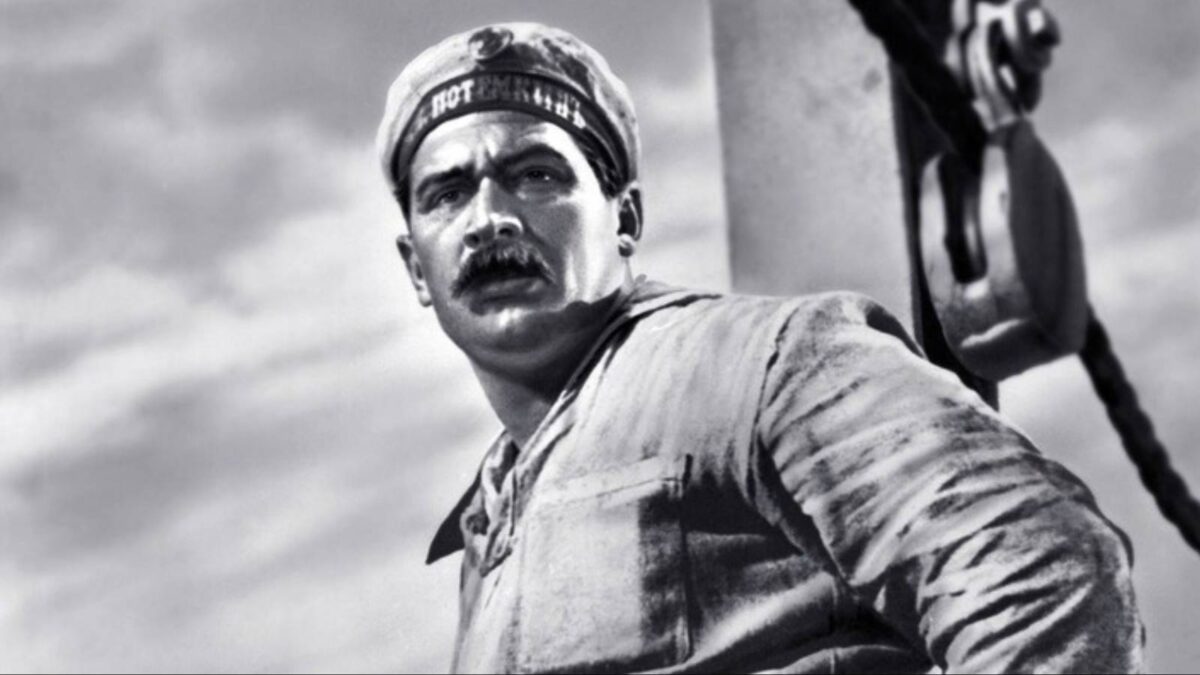
Battleship Potemkin is a Hundred-Year-Old Masterpiece of Revolution, Montage, and Ideological Cinema
Dec 25, 2025
Depending on who you ask, Battleship Potemkin is either among the greatest films ever made or an unseen cinematic relic. One century later, the language of silent, black-and-white cinema utilized in Battleship Potemkin can feel almost as archaic as the political ideologies that defined the era. But to dismiss the film on those grounds is to misunderstand the truism that art reflects its era. By that measure, Battleship Potemkin rises from significant to foundational – especially because that same cinematic language is still ubiquitious. A film celebrating a 20-year-old Russian revolution, Eisenstein’s 1925 magnum opus reshaped filmmaking through experimental montage editing that conveys meaning and evokes emotion rather than merely suggesting. Equally vital was its unapologetic political intent, so potent that governments banned or censored the film for fear it might incite unrest. One hundred years is a long time; technology has since cloaked the ingenuity of filmmaking’s infancy. A watch or re-watch (whatever the case may be) of Battleship Potemkin, however, reminds viewers of how bold cinema once was. The film is uncommonly confrontational about collective oppression and the resistance against the powers that be.
Battleship Potemkin Tells A Singular Event In One of the Darkest Moments of Russian History
A dying nurse in Battleship Potemkin
A proto-historical epic by modern standards, Battleship Potemkin recounts the 1905 mutiny aboard the Battleship Potemkin Tavrichesky of the Imperial Russian Navy’s Black Sea Fleet, unfolding across a 75-minute, five-act structure. While the drama unfolds off the coast of Odesa, its roots lie in St. Petersburg, where revolutionary sentiment was already fermenting against the Tsardom of Nicholas II. The humble rank and file of the roughly 12,900-ton battleship refuse to be mere bystanders in the unfolding unrest. Audiences familiar with history immediately understand why; for those who don’t, the film makes it clear within minutes. Treated like cannon fodder by their superiors, the crew is one serving of maggot-infested meat and one outspoken sailor away from overturning the command hierarchy, which they eventually do, quite literally. A declaration that “Russian prisoners in Japan are better fed than we are” from a nearby disgruntled sailor suggests that the wounds from Russia’s humiliating defeat in the Russo-Japanese War are still fresh. Indeed, it’s a mutiny that wins unprecedented support once news of it reaches Odesa’s shores, but which unsurprisingly angers the higher-ups. In what would come to be appreciated as one of the greatest scenes in editing history, a Cossack host brutally stamps out rioters in the streets as a squadron sets underway to put the Potemkin to order.
Sergei Eisenstein’s Montage Editing in Battleship Potemkin Provokes Propaganda
The soldiers’ boots on the Odessa Steps in Battleship Potemkin
While watching Battleship Potemkin, it’s nearly impossible to ignore the Soviet-era aesthetics embedded throughout, especially Eisenstein’s landmark montage editing technique. Rapid cuts between contrasting emotions, settings, and events clearly guide the audience to favor one side emotionally over the other. Close-up shots of maggot-ridden meat are quickly juxtaposed with the disgusted faces of its would-be eaters; shots of sailors arming themselves are intercut with senior officers running helter-skelter as the mutiny crescendos; and serene images of calm seas and then rough seas alternate with sleeping sailors and the restless wandering of the crew, building tension as they await visual news of the Tsar’s approaching fleet. Eisenstein’s brilliance in this technique shines not on but off the Potemkin, specifically in the now-famous Odesa Steps sequence. In this pièce de résistance (which, as many might not know, never actually happened in real life), the collision of wide shots of fleeing civilians with close-ups of terrified faces, falling bodies, and the merciless soldiers’ boots — a pair of which crushes a dead child’s hand — creates a rhythm of terror and urgency. This is no accident; it exemplifies the Soviet ideological approach to filmmaking, which treated juxtaposition and contrasting imagery as the engine of storytelling. Every cut is carefully designed to provoke a reaction. It’s easy to imagine a 1925 domestic audience watching this film, coming off a successful Bolshevik revolution, with patriotic hearts and even more revulsion towards oppression. Little wonder the Soviet government itself commissioned the film, and governments abroad banned or restricted it.
Battleship Potemkin Intentionally Forgoes Individualism Yet Unintentionally Favors It
Staying true to the collectivism of Soviet ideology, Battleship Potemkin is, on the surface, almost entirely devoid of individualism. In other words, the characters behave, move, and are shot like pieces in a grand mechanism, marching toward or fleeing a shared goal. It’s not coincidental that there’s no central character in this film; Grigory Vakulinchuk (Aleksander Antonov), the only figure that comes close to being one, doesn’t survive the second act. Men move en masse, in unison, with no individualism. Thus, lines like “Oh, my baby” hardly make it into the title card dialogues, even when everyone expects them to. That was Eisenstein’s and the commissioners’ intention, and it achieves the desired result. However, there’s an irony — deliberate or not — that belies that purpose. In attempting to depict the community as an indivisible unit, Eisenstein paradoxically relies on intimate close-ups that momentarily pull individual personalities into focus, conjuring a sudden, almost magical sense of personal identity amid the mass. From the grieving mother whose child is gunned down, to the frantic grandmother watching her infant’s carriage dangerously hurtle down the Odesa Steps, and the terror-stricken face of a man witnessing the carnage, Battleship Potemkin uses exemplary poignant moments to draw and unnerve viewers into the chaotic mess of violence wielded upon the citizenry.
Pacing Hurts Battleship Potemkin Worse Than Technology Does
It goes without saying that, unlike in the 1920s, when black-and-white, silent films were the order of the day, today’s cinema would balk at a movie where the only color comes from a red flag on the ship’s mast (originally white but edited to red). That, however, is the least aspect of Battleship Potemkin that would worry moviegoers.
Nothing tests an audience’s patience more than pacing, and Battleship Potemkin occasionally slows to a crawl, particularly in its lingering shots of ship mechanics. Regardless, making an excuse or two for Eisenstein in this regard is viable. These shots in question speak to the age of industry and labor, values that the Soviet state kept close to heart, and may also serve to flaunt the prowess of the state’s marine engineering on the face of all who dare look. Sonically, the film stands its ground. Eisenstein famously favored rhythm-based scores, which couldn’t be more perfect when this one ship enters the lion’s den. And every version has largely kept to that vision. Anyone looking to have Battleship Potemkin on their menu should be sure to enlighten themselves about the era’s socio-political awareness. Stripped of this, it still packs enough punch to be a unique watch, but it risks being dismissed as an antique film rather than the ideology-shaping machine it was designed to be.
Release Date
December 24, 1925
Runtime
66 Minutes
Director
Sergei Eisenstein
Writers
Nina Agadzhanova, Sergei Eisenstein, Grigoriy Aleksandrov
Publisher: Source link









‘Reacher’s Action Thriller Spin-Off Gets Major Season 2 Update Following Premiere
For four seasons, Reacher has been one of the biggest TV shows on Prime Video. Based on the novels by Lee Child, the series follows former military police officer Jack Reacher (Alan Ritchson) as he wanders from place to place,…
Sep 18, 2026

One of CBS’ Longest-Running & Highest Rated TV Shows Is Coming To End After 30 Years
Along with countless scripted dramas, comedies, and action shows, CBS is well known for its impressive run of unscripted programs over the last 50 years. More recent years have included major competition shows like Survivor and The Amazing Race, along…
Sep 17, 2026

Prime Video Officially Launches New Deal That Changes the Streaming Game Forever
It seems like streamers raise their prices every day. At the end of August, Apple TV raised the subscription service price by $2, bringing it to $14.99 a month. Netflix, Disney+, HBO Max, Paramount+, and Peacock have all raised prices…
Sep 16, 2026

Netflix’s 10/10 Thriller Series Returns After 3 Year Absence With Explosive New Trailer
Over the last five years, Netflix has expanded heavily into non-English content, with international series taking an even bigger focus for the streaming giant. One of the biggest driving forces in that effort is the French thriller series Lupin, led…
Sep 15, 2026