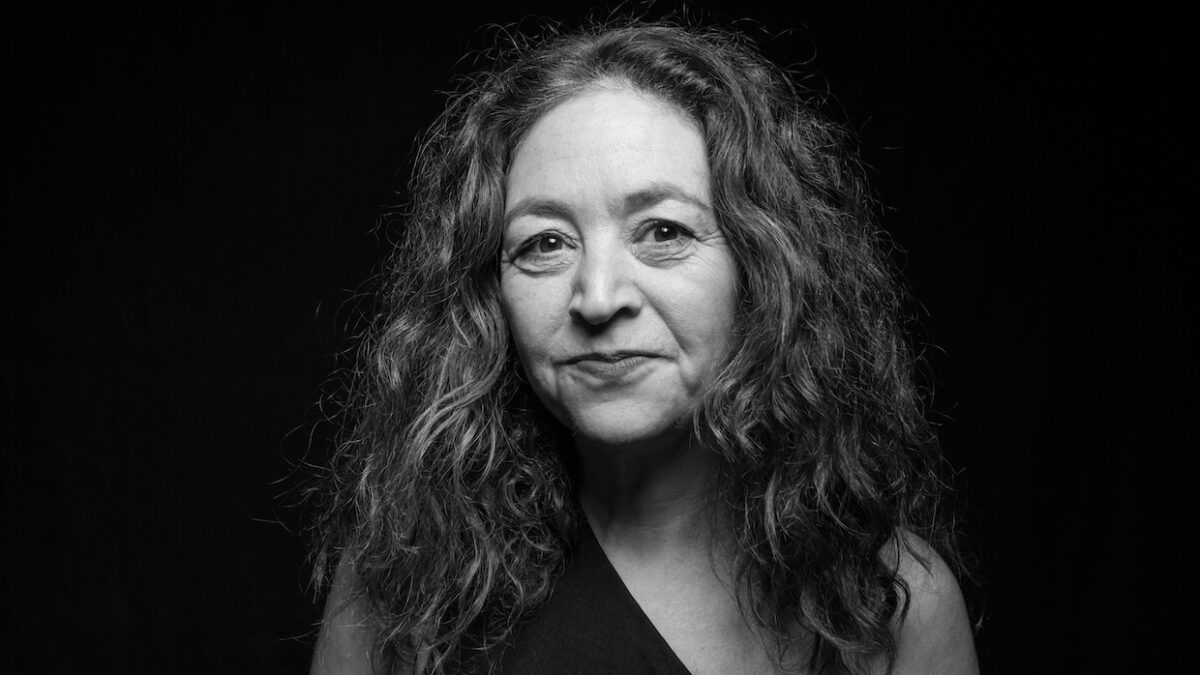
Liz Garbus on Non-Fiction Filmmaking
Jan 4, 2026
Liz Garbus
Liz Garbus broke into documentary features with The Farm: Angola, USA, an unnerving portrait of the notorious Louisiana prison. Made when Garbus was 24, it looks eerily prescient today.
Garbus has since directed a string of influential works covering the spectrum of the documentary genre. Gone Girls: The Long Island Serial Killer used the Gilgo Beach serial killings to uncover police corruption in Suffolk Country. What Happened, Miss Simone?, a wide-ranging look at Nina Simone, won Emmy and Peabody awards. All In: The Fight for Democracy tackled voter suppression. She’s explored shorts, features and series for every available platform, from theatrical to PBS, HBO, Netflix, Amazon Prime and Showtime. She’s also worked in narrative film, directing episodes of The Handmaid’s Tale and Yellowjackets, among others, and produces documentaries as well, like Marshall Curry’s Street Fight.
This year EnergaCAMERIMAGE gave Garbus its Award for Outstanding Achievements in Documentary Filmmaking, screening five of her works. I spoke with her in the Muzeum Etnograficzne before a screening of What Happened, Miss Simone?
Filmmaker: I watched The Farm: Angola, USA again here. I can’t believe the access you got to the prisoners.
Garbus: I heard a cinematographer here say he feels 90% of his films are failures and he can’t sit through any of them. I don’t feel quite that bleak, but I certainly subscribe to the notion that films are never finished, only abandoned. Watching The Farm, I appreciated its patience, and pacing, but I chafe at the narration. I was such a baby when I made that film.Most days we spent six or seven hours just waiting to get into the place. We maybe got two or three hours a day of filming.
I was 24 years old at the time and didn’t have a family to support or a company to run. We had, I think, $100,000 from Channel 4 in the UK and maybe $150,000 from A&E. We worked on it for three and a half years. It was shot on a variety of formats, depending on the cameraperson we could wrangle: Beta[cam] SP, MiniDV, Digi Beta [Digital Betacam] for when we were going big. That material held up great. The funeral at the end was Digi Beta.
Filmmaker: You speak to individual inmates who, to a certain extent, are performing to the camera.
Garbus: I wouldn’t put it that way. They’re certainly advocating for themselves, taking advantage of an opportunity to tell their stories. All documentary is performance in some ways. Our job as filmmakers is to discern what is a performance of truth. When you feel a performance is false, you don’t use it. When you feel that it’s naturalistic, even if it’s performative, hen it is useful.
Filmmaker: Did you select the films for the festival?
Garbus: Yes, I’m proud of them to varying degrees. Some I’m more at peace with than others in terms sitting through them. They all had various struggles. Maybe that’s what I feel proud of.
They also represent how my films have evolved as my life as evolved. For The Farm, Girlhood, The Execution of Wanda Jean, I didn’t have children. I was able to live a totally chaotic life, be completely at the beck and call of the film, which is necessary for verité. Moving on to Bobby Fischer Against the World and What Happened, Miss Simone?, I had a lot more control of my schedule. The later films came from my passion and curiosity, but also represent a different part of my life.
Filmmaker: Can you describe the difference between shooting live, in person, and working archivally?
Garbus: I’m not sure there is that much difference. The only film of mine that’s purely archival is Becoming Costeau. The Simone and Bobby Fischer docs are structured around master interviews. With Simone we uncovered so much of her own voice narrating her life.
Just like with verité, with archival you don’t know at the beginning what you will end up with. It’s an equally exciting process of discovery. With both, the footage is a mound of wet clay in a workshop. You shape and massage it, leave stuff aside and finally, hopefully, maybe you manifest it in the shape of a beautiful vase to share with the world.
Filmmaker: Did you feel that way with Simone?
Garbus: There was this kind of holy grail, a memoir or autobiography with a ghost writer who taped her for days and days when she was quite on in years. It took us forever to find those tapes. We were already months into the edit. When we got them, they restructured the way we told the film.
Filmmaker: Do you have to restructure with each project?
Garbus: Of course you always try a million things. For instance, we start the Simone doc with a concert in Montreux, which is really the middle of the story. We’re always moving things around, restructuring and reshaping, seeing how switching a piece to the front affects the entire puzzle, seeing what the trade-offs are. That’s actually my favorite part of filmmaking.
Filmmaker: How has producing and funding documentaries changed since you started?
Garbus: “Documentary” is a really broad term at this point. It ranges from things that are journalistic and deeply reported, like Frontline, to docuseries that resemble reality TV, to someone like Fred Wiseman. The way films are made today, they’ll say, “When will we get your script?” And I’m like, there is no script. “Well then, the outline for your three-act structure.” And I have to tell them that I could give them something, but it’s not going to reflect the final film at all. If the film accurately reflected that treatment or script, then I have made no discoveries throughout the process.
Filmmaker: Films seem to be increasingly staged to me, until I’m not sure they’re really documentaries.
Garbus: I would say many documentarians “stage” to some degree, and of course our very presence interferes with reality. We try to minimize it. But we are there, and while we ultimately aim to disappear, you’re fooling yourself if you believe your presence doesn’t have some effect.
Filmmaker: But you’re not telling your subjects what to say.
Garbus: I might ask an inmate to call his mother because I’d like to film him doing that. Or, “Please move so there’s better light.” I don’t have a script, but I do interfere with their day.
Filmmaker: As a viewer, we can’t really tell.
Garbus: Right. You need to trust the filmmaker. When The Farm was at Sundance, we shared the grand jury prize with Frat House. It came out later that those filmmakers were staging things. There was a consensus that they crossed a line — that things were happening that would not have otherwise occurred. But if I say, “I’m showing up at four, can you wait until then to do something?,” I’m also intervening. We all have to find our red lines. Mine is that I am presenting something that represents truth.
Filmmaker: What makes me uncomfortable is how some filmmakers recreate material.
Garbus: I think there’s a pact with the audience. Maybe that’s why there was a controversy about using AI to reconstruct some of Anthony Bourdain’s words in Roadrunner—a very good film, by the way. The problem wasn’t that the filmmaker did it, but that the audience didn’t know it had been done.
You have a pact when you’re making documentary. You are not presenting an illusion. You are presenting something that has truth, or at least truthiness. If something is a recreation, or made with AI, you should share that information. Audiences will accept that if they know the rules of the road.
“True crime” is a broad topic, one that’s become derogatory among many doc makers. We need to rethink it as a category. Perfect Neighbor, an extraordinary film, is for many viewers “true crime.” It found huge audiences. That’s a good thing. I think there are films like this, and some I have worked on, that explore the criminal/legal system in a way that is analytical rather than salacious. These can be films about transgression, humanity, power, subjugation. To call them “true crime” feels reductive.
Filmmaker: Everybody wants an umbrella.
Garbus: Celebrity docs, sports docs …
Filmmaker: You haven’t done sports, have you?
Garbus: I consider chess a sport. I have a film I’m really excited to premiere at Sundance about Billie Jean King, Give Me the Ball!, built around a master interview with her. I thought I knew her story, but over time I fell so deeply in love with her spirit. Billie’s positivity and relentlessness is like manna for me in this moment.
Filmmaker: When we spoke in New York you said you were going to explore your family history in Poland.
Garbus: I was vaguely aware that my grandparents came from Russia/Poland, not specifically where. I learned a lot about them, even before I accepted the invitation to Toruń. With my grandfather on my paternal side, he had papers listing him as being from Russia and from Poland. When he came to America, he didn’t speak English. He said he came from a town in Poland called Pinsk. People didn’t understand him, and wrote “Minsk” instead. But he wasn’t Russian. He never lived in Minsk. Pinsk is a small town, I think 80% Jewish. He was a woodcutter in a shtetl in the forest. In 1919, there were pogroms in Pinsk, caused by Poles suspecting that Jews were collaborating with the Bolsheviks in Russia. This was near the border with Russia, so the Bolsheviks would be coming any moment. Somehow he got out to America. He had one other brother who escaped, but nine siblings who were killed in the Holocaust. Three out of my four grandparents left Poland in 1920 right as pogroms were starting.
Traveling through Poland with my daughter, I’ve felt what a miracle it is that my family even exists. Being here I can appreciate that miracle, and also feel the tragedy of Polish history. We were at Auschwitz two days ago. They display photos of prisoners on the wall. When the Jews arrived, they were in mass deportations, so they didn’t get photographed. The Poles were treated more as typical prisoners, so they were photographed.
On the wall I noticed these four women of different ages who had the same last name. I asked my guide, he gave me their names, and we started to research them. I fell in love with this Polish family who were largely women. In one photo, a young woman listed as a student, Anna Smoleńska, had a very defiant look on her face. She had been studying graphic design. She designed the symbol for the Polish underground resistance movement, the Kotwica, a P with a double-pronged anchor. It appeared in an underground newspaper. The Nazis tried to arrest the publisher, but couldn’t find him. They arrested her and her family instead. One had a Ph.D. in philosophy, one was a chemical engineer intern, another had a crazily impressive advanced degree. Four intelligent, defiant women. They all died in Auschwitz. I never considered doing this kind of a story before, but this experience made me think about it.
Filmmaker: Would you have trouble funding a project like that?
Garbus: I don’t know. Most funding comes from the US, where the climate now is one of fear—not just in terms of politics, but in terms of any creative risk.
Publisher: Source link



Netflix’s 10/10 Thriller Series Returns After 3 Year Absence With Explosive New Trailer
Over the last five years, Netflix has expanded heavily into non-English content, with international series taking an even bigger focus for the streaming giant. One of the biggest driving forces in that effort is the French thriller series Lupin, led…
Sep 15, 2026
Original ‘Yellowstone’ Dutton Favorite Officially Confirms ‘Marshals’ Return Interest
Yellowstone jump-started a generation-spanning story that has so far spawned four spin-offs that are all interconnected by the Dutton bloodline. While creator Taylor Sheridan has since branched outside that saga with Tulsa King, Landman, Mayor of Kingstown, The Madison, and…
Sep 14, 2026
Netflix Officially Cancels Its 2-Part Taylor Sheridan Replacement Western
Netflix Published Sep 12, 2026, 10:30 AM EDT Omar is an experienced editor and writer who sees life and storytelling as one and the same — there’s always a story to tell. He’s helped shape features, headlines, and coverage across movies,…
Sep 13, 2026
Jason Momoa’s Epic Historical Action Thriller Officially Getting New Release
Apple TV has established itself as a rising force in streaming entertainment. From Silo and Dark Matter to Pluribus and Ted Lasso, there is something for everyone, and not only that, but a ton of huge star power at the…
Sep 12, 2026