An Imbalanced Yet Effective Follow-Up to ‘The Handmaid’s Tale’
May 4, 2026
When “The Handmaid’s Tale,” based on the novel of the same name by Margaret Atwood, first premiered in 2017, it felt like a bleak calling card of our time. Now, nearly ten years later, “The Testaments,” also based on Atwood’s follow-up novel and a continuation of the original series, feels depressingly similar. A story about women stripped of their autonomy, mentally wrestling with a world in which they’re subservient. In an era where changing your name might restrict your ability to vote, it doesn’t take much for the series to force us to reckon with the evils of our time. However, even with that undeniable impact and the can’t-look-away nature of the series, it begs the question: Does the power come from the story, or from the strife of the times we live in?
READ MORE: The 75 Most Anticipated TV Shows & Mini-Series Of 2026
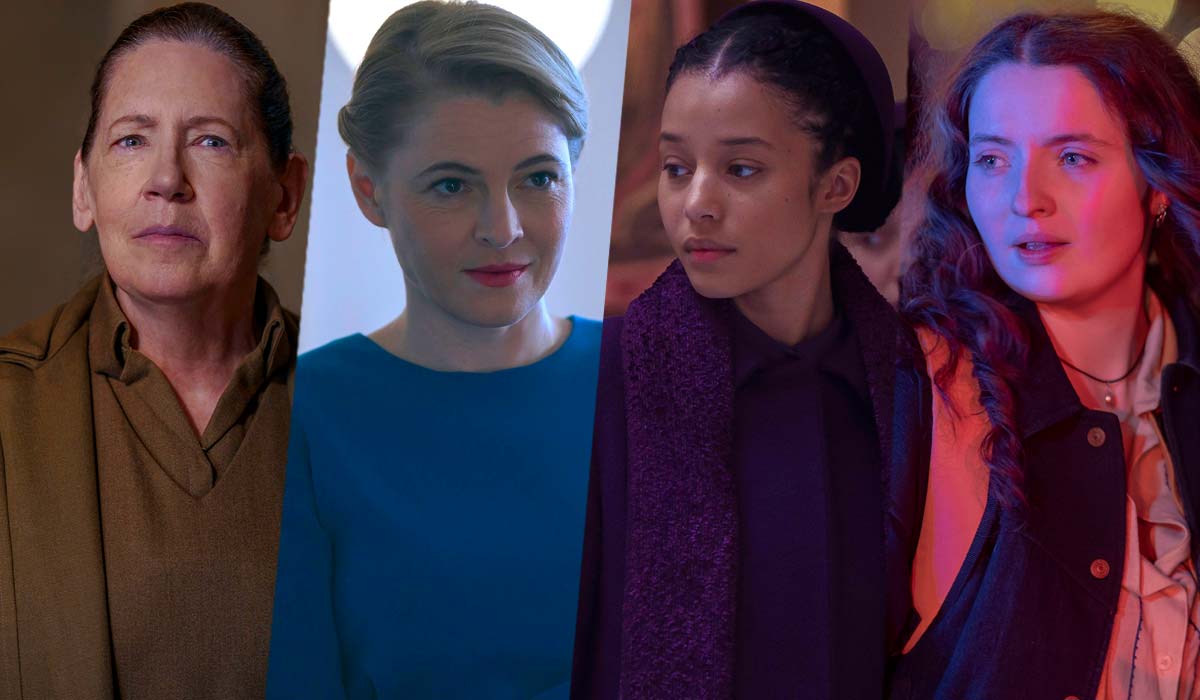
Based on the novel of the same name, which shared the Booker prize alongside “Girl, Woman, Other,” the series, created by Bruce Miller, takes place years after the events of “The Handmaid’s Tale.” But now, we’re getting a look at the world under the rule of Gilead through the gilded, stifling cages of the elite. And “The Testaments” wastes little time in making the series’ thematic core abundantly clear, as our protagonist, Agnes (“One Battle After Another” breakout, Chase Infinity), peers through the windows of an extravagant dollhouse.
She, at this point, is not so different from the dolls she holds. And, in a voice-over, as she tells the story of her life in Gilead, it’s through this dollhouse that she’s able to mark time. In one of the many ways women were deprived of autonomy, they weren’t allowed calendars. She doesn’t remember the date when things began to change for her, just that it aligned with the ownership of a childhood fantasy built aloft, and the moment she became eligible for marriage.
It’s that striking tone of childhood innocence and the ugly, pervasive truths of her world that create the most intriguing and nauseating threads of the series. Agnes is a member of Aunt Lydia’s (a returning Ann Dowd) elite preparatory school, whose members are often the daughters of elite commanders of Gilead. Agnes attends the school where the Aunts (the teachers) drive home the idea of divine justice and the expectations placed on women in a world disinterested in their thoughts, feelings, or individuality. They’re meant to appear as God’s will, but also to serve it, which means whatever men deem appropriate or just.
Agnes, despite harboring a crush on her handler, Garth (Brad Alexander), and poorly concealing her dislike of her step-mother, Paula (a wonderfully tight-lipped Amy Seimetz), is the perfect image of the pious young woman the Aunts look to mold. However, the arrival of Daisy (Lucy Halliday) threatens to change that. Daisy is an outsider, having arrived from beyond Gilead’s borders. While Agnes is a Plum, decked in purple to signify being of marriageable age – as the series once again uses color to assign status to women – Daisy is in white, a Pearl Girl. A Pearl Girl signifies someone who has come from beyond Gilead, destined to become an Aunt. This outsider status offers an eye-opening perspective on the world beyond their borders.
On the surface, the way in which “The Testaments” views Atwood’s dystopian, theocratic universe offers an engaging shift from the ground-level despair of “The Handmaid’s Tale.” In the original series, all of the characters knew about the world before the rise of Gilead. Women knew how to read and write and held jobs all before having it violently stolen from them, forced from hard-won independence to being seen as little more than cattle. “The Testaments,” meanwhile, shows us the view from those who know little more than the world they were born into.
These girls fear the hell their Aunts have warned them of, and embrace the brutal, tangible hell of their system of justice. They pass by the hung, mutilated bodies of members of Mayday (a resistance group) and are unaffected by it. This is the will of the world they’ve been indoctrinated into. Daisy, meanwhile, having existed in the outside world, can see the reach of poison that the Aunts and Gilead wield with expert, insidious precision.
This perspective makes the girls’ mounting internal battles all the more fascinating because they don’t know any other way. They believe that a man who has his hand sawed off for behaving inappropriately around them is an act of justice. But they also believe that they are at fault for having tempted him. So when characters like Agnes, her best friend Becka (Mattea Conforti), the observant but biting Shunammite (Rowan Blanchard), or the sweet and stumbling Huldah (Isolde Ardies) begin to realize the severity of their existence feels off, the realization strikes with greater impact because they have no reality in which they might understand why their simmering desire for independence is acceptable and immensely brave.
The foundation of their world slowly rips apart, tearing away their understanding of safety. At the same time, any man they’ve even seen as a protector shows their hand through either small cruelties, dismissals, or outright violence. No one who works for Gilead is good.
They have only known Gilead, and they’ve known it through the watchful eye of Aunt Lydia and other Aunts, such as Aunt Vidala (Mabel Li), who know exactly what type of world they’re repressing them from. The dive into certain backstories that show the Gilead uprising examines why the Aunts would so readily assume any role of power offered to them, even if that power is more of a ploy to keep them under control.
But for all the interesting ideas and the ways the narrative overlaps with and engages the original series, it often feels emotionally hollow, perhaps because we’ve had a decade of this type of story. Or perhaps because despite the cruelty of the story that shows young women – girls – picked through by men decades older to become their future, obedient wives, the dialogue is so trite, so on the nose (like the dollhouse imagery) that it makes us wonder who the series is for.
Some of this comes down to how the series paints itself as, essentially, a YA version of “The Handmaid’s Tale.” And not just because of the younger characters. From the dialogue that forces the distinction between Daisy and Agnes through excessive, unnatural swearing, to needle drops inspired by the many ruminations of girlhood in Sofia Coppola films, to even the bright-eyed hope of the protagonists who believe friendship can and will save the day, the effect feels disingenuous to the tone. The point might be to highlight how girlhood persists under a regime or to demonstrate their mental disconnect with the horrors they’re facing, as “Dreams” by The Cranberries begins to play, but it doesn’t land.
What’s better and more interesting is when the series shows the proclivity for rage that each girl harbors. When a character faces punishment, the girls are all encouraged to yell and point to demean whoever is receiving it. It’s a moment where the veil of blank stared innocence lifts, as they’re able to engage in the release of fury without having to examine where it’s coming from. Because it very likely isn’t the classmate who gossiped or swore.
While the series grapples with the tone, the performances are, for the most part, solid. Having delivered a formidable turn in “One Battle After Another,” it’s little surprise that Infiniti is charismatic here as well, even if the series doesn’t utilize her dynamic abilities to the same extent. She’s excellent at conveying what her character withholds, with longing looks and a steely gaze that signal major internal revelations. Unfortunately, her main counterpoint, Daisy, struggles both as a character and a performer. While an obvious foil to Agnes’s character, the construction leaves us wanting. She’s a draft of a character rather than a fully realized one. Halliday, who delivers a stiff performance, doesn’t help the issue. Granted, she isn’t helped by having to bear the bulk of the worst dialogue and exposition dumps.
Conforti, as Becka, delivers the most heartbreaking performance; however, as the first girl to truly realize how suffocating their lives are, her smile slowly wanes episode by episode. There’s a naturalism to her performance that allows the character to become the emotional center of the series, her plight inspiring the greatest tension because her slowly surfacing misery makes her all the harder to predict. Her story is an example of when “The Testaments” works. Despite the failure to maintain a consistent tone, the show steadies as it progresses and the characters develop.
Support independent movie journalism to keep it alive. Sign up for The Playlist Newsletter. All the content you want and, oh, right, it’s free.
“The Testaments” works in pieces. There’s a strong narrative pull and an engaging group of actors who convince us of the characters’ slow unraveling as they awaken to the true horrors of their chaste, curated world, where glass-doll men strive to beat, break, and remake. But by shifting the story to mimic the pulse of a coming-of-age narrative, it falters in its delivery, struggling to marry the tones. And the result is whiplash. As visually polished as the interior of the characters’ opulent houses, the series needed to probe further and embrace and wield the rightful, blossoming rage of the characters as they realize the lives they’ve been born into are, in many, varying regards, a death sentence. There’s power to the story being told, but the showrunners don’t seem to understand how to wield it. [C+/B-]
“The Testaments” premieres April 8 on Hulu.
Publisher: Source link


‘Reacher’s Action Thriller Spin-Off Gets Major Season 2 Update Following Premiere
For four seasons, Reacher has been one of the biggest TV shows on Prime Video. Based on the novels by Lee Child, the series follows former military police officer Jack Reacher (Alan Ritchson) as he wanders from place to place,…
Sep 18, 2026

One of CBS’ Longest-Running & Highest Rated TV Shows Is Coming To End After 30 Years
Along with countless scripted dramas, comedies, and action shows, CBS is well known for its impressive run of unscripted programs over the last 50 years. More recent years have included major competition shows like Survivor and The Amazing Race, along…
Sep 17, 2026

Prime Video Officially Launches New Deal That Changes the Streaming Game Forever
It seems like streamers raise their prices every day. At the end of August, Apple TV raised the subscription service price by $2, bringing it to $14.99 a month. Netflix, Disney+, HBO Max, Paramount+, and Peacock have all raised prices…
Sep 16, 2026
Netflix’s 10/10 Thriller Series Returns After 3 Year Absence With Explosive New Trailer
Over the last five years, Netflix has expanded heavily into non-English content, with international series taking an even bigger focus for the streaming giant. One of the biggest driving forces in that effort is the French thriller series Lupin, led…
Sep 15, 2026