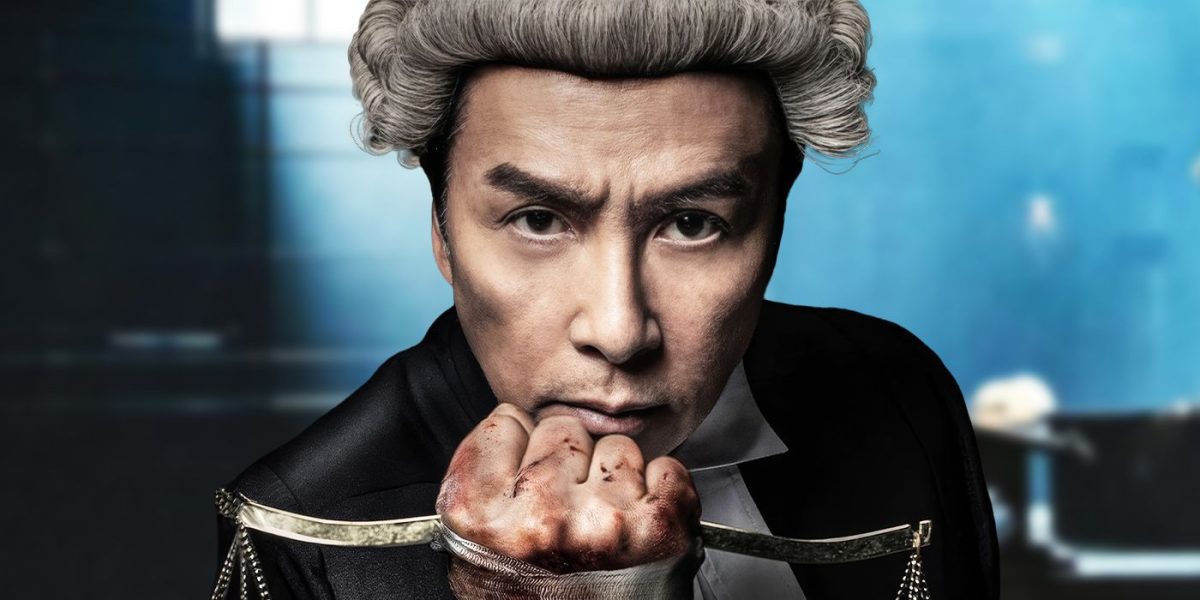
Donnie Yen Reveals How ‘The Prosecutor’ Is Both an Action Movie and a Courtroom Drama
Jan 12, 2025
Summary
Collider’s Steve Weintraub talks with director and star Donnie Yen for his legal drama action The Prosecutor.
In the movie, when a young man is wrongly charged for crimes he didn’t commit, an ex-prosecutor takes matters into his own hands.
In this interview, Yen discusses why he didn’t want to direct the film initially, what changed his mind, which elements were crucial for him to nail, reveals he’s in talks to direct his own John Wick spin-off, and more.
Donnie Yen has made his name synonymous with ass-kicking in the last four decades in the action sphere. In addition to dedicating his craft to Hong Kong’s cinema, he’s appeared in Hollywood blockbusters like the John Wick franchise, the Star Wars Universe, and Disney’s live-action realm. As with any profession, to have a well-rounded grasp on something, it helps tremendously to have an understanding of many different elements, and Yen is a multi-hyphenate to the highest degree. From hands-on stunt work in the height of the ’80s and ’90s kung fu films to writing, producing, and directing, he’s done it all. Still, his latest venture, The Prosecutor, a legal drama/action hybrid, gave even Yen pause.
Don’t let the powdered wig fool you. The Prosecutor may be considered a “legal drama,” of which “there are tons of these really great movies about,” but the filmmaker and actor wasn’t about to let down the “action world of Donnie Yen fans.” Every step of the way, Yen was conscious of the audience-appeal when helming this story of an ex-prosecutor taking the obstruction of justice into his own hands. The movie also features Francis Ng (Bullets Over Summer), Kent Cheng (Flash Point), Julian Cheung (The Grandmaster), and Philip Chan (Bloodsport).
In this one-on-one interview with Collider’s Steve Weintraub, Yen confesses that, at first, he didn’t want to direct The Prosecutor and explains what the hold-up was and how he ultimately made the decision to take on the job. He shares his approach to filmmaking and what he holds in the highest esteem when considering the scriptwriting and editing, which films he directed that went uncredited, and also reveals he’s in talks with Chad Stahelski to direct his own John Wick spin-off.
Donnie Yen Is In Talks to Direct His Own ‘John Wick’ Spin-Off
“I don’t want to bring down the expectations for all the fans.”
Image via Lionsgate
COLLIDER: So I’m friends with Chad Stahelski, and he told me that you guys are currently talking about still doing that Caine spin-off movie, but he let something slip when I spoke to him earlier today, and he told me I could ask it. He said that he wants you to direct it.
DONNIE YEN: It is true.
Do you think this is going to happen?
YEN: I think both the fans, as well as the studio, want this to happen, and we’ll see. I don’t know, Steve. I can only tell you that much. But yes, we are talking, and we are talking intimately. We’ll see what happens.
Image via Lionsgate
I was excited about the movie just because you were going to do it, but your directing it adds a whole other level to it for me. I need this to happen. This is going to be fantastic.
YEN: But at the same time, I hold responsibility as well as a pressure that I don’t want to ruin the franchise. I try to do my best to bring something fresh to the franchise itself. I don’t want to bring down the expectations for all the fans. I try to do my best. Like always, I try to do my best.
Listen, if this film ends up happening, I would imagine Chad would be there to help and support.
YEN: He better be there! [Laughs]
I would imagine a lot of people would want to be there for you for this particular film. I really hope it ends up happening.
Donnie Yen Didn’t Initially Want to Direct ‘The Prosecutor’
“I do action movies.”
Hopefully, you’ll find this fun. This is a true or false question about The Prosecutor. Is it true that you only made this movie so you could direct your dad in the film?
YEN: [Laughs] Of course not. I didn’t want to do this movie in the first place. It took me two months to really convince myself and then also finding an angle and how to present the story. My friends are the producers for the Ip Man series as well as Flash Point. We were developing Flash Point 2 and working on a story for Ip Man 5, as well, and then all of a sudden, they presented me with the story. I told them, “I don’t want to do this because I don’t know anything about this,” right? “I do action movies.” There are tons of these really great movies about court scenes — we watched them all — and I didn’t want to risk myself. But they were really convinced that in their minds, that character in the original script… They know me, and they think that I’m the perfect person to play that character.
So it took me two months to convince myself to say, “Okay, I think I found a way to combine the two,” which was quite challenging because, number one, you have this “action world” of Donnie Yen fans. They want to see action. Then, this subject of the story is inspired by a true case. How do you make a realistic, true story along with a superhero type of action film? So, I combined the two and made them work, and that was the hardest task for me. But of course, there are other aspects as a director, like bringing all the great actors together and having the audience engage with the story where you don’t want to over-bore them, you don’t want to lecture them. Sometimes, these kinds of stories can be very forceful. I didn’t want it to be forceful. I wanted it to be entertaining. But then, after you watch the movie, there’s a deeper message behind the film. That was my initial intention, and I just took the chances of, on a daily basis, shaping the film as I went along with the film and the process.
You mentioned this film has action and it’s also a courtroom drama. For you, what ended up being the actual toughest part of directing this particular film, mixing two genres together?
YEN: Absolutely. First of all, you have to create a world where people have to believe in the story first, right? Secondly, it’s the pacing of the story. To me, when we watch movies, you can’t please everybody. Everybody watches movies from different perspectives. Some people watch for a joyride, some people watch it for soul-searching, so you can’t have it all. You can’t say, “Oh no, I want to make a movie that pleases everybody.” You have the popcorn lover audiences and then you have film noir, right? I do know one thing, though: when you have the audience emotionally attached to a film, they will forget everything else. When they’re emotionally attached, a lot of logic can go out of the window — “Oh, that didn’t make sense,” — because you are emotionally attached.
So that was my first attempt, having the audience engage with what my character is facing, the challenges, and to keep predicting what’s going to happen. What is the reaction? From every scene to every single shot. When I do the shot, when I do the scenes, is my audience still with me? And how excited are they? There were a couple of moments where I was really sure that I could have them going. For example, from day one, the fighting scene at the end — I know that it’s going to work. Even in the very beginning, when I was revising the script — we revised the script many times — I didn’t want it to dive too deeply into this case and this and that because I thought you would take away the entertainment aspect, the pacing of the film. I just wanted to be like, “Okay, this is the case, but at the same time, I need to drive forward. I need to keep going with the tempo of the story.” So when I was writing the script, I knew by the end of the story, people were going to be so engaged that they’re going to care for me. They’re going to feel the same pressure as my character in the film that’s going to work. We showed the film in many territories and that’s one of the favorite scenes of audiences.
Donnie Yen Has Helmed a Lot More Action Movies Than You Think
“I just went on instinct and guts and courage.”
You’re very selective with your directing. You haven’t directed many films, and I’m curious, what is your favorite part of directing? Some filmmakers I’ve spoken to love the shoot and hate the editing, and others, vice versa.
YEN: That’s a very good question, Steve. I want to use this opportunity to clear a few things up for you, though, because IMDb got it wrong. There are certain films on IMDb that I didn’t direct those films, and there are films that I directed that didn’t give me the credit. So I basically directed two films back in 1997 — Ballistic Kiss and Legend of the Wolf — and they were shot for half a million in US [dollars], so I had nothing to work with, and at that time, I didn’t know too much about being a director. My experience and everything, I just went on instinct and guts and courage and, “Okay, I want to direct. I want to try it out,” because I’ve always been a very good action director and I love editing. So, right before, I took on the role as a director.
After that, I directed a few films. I did Enter the Fat Dragon, even though it was credited to my little brother and my good friend Kenji Tanigaki. But I basically was driving that vehicle, as well as Chasing the Dragon, when I worked with Jing Wong, my producer, with Andy Lau. I probably directed, like, 80 or 90% of the story. I did Sakra, and I did part of Raging Fire with my late friend, Benny Chan because we took on different roles. I helped him shape and shot the action scenes. He was sick, and I helped him do it. I helped him to actually edit most of the film in his last few months, unfortunately, before he passed away. Then, I went on to direct Sakra. It was also a very tough journey because when you shoot a movie with that kind of historical literature based on the novels, trying to condense them into two hours is always impossible. I don’t know why I took that job, but I did it anyway. [Laughs] We didn’t have a lot of money to work with, shooting a period film with all these great costumes and 50 characters in the film, but I did that.
Then, this is what I did — my latest work, The Prosecutor. I do feel that The Prosecutor is giving me a fair chance of showing what type of director I am and the potential of me being a director because although in comparison to the Hollywood standard, it’s not a huge budget — we shot it for under $25 million US — it’s still a lot more than my first movie when I shot for half a million. And I dedicated myself. I didn’t do anything else. I spent a whole year doing this movie. So, to be fair, I think this really represents what kind of director I am.
Related
10 Best Donnie Yen Movies to Watch After ‘John Wick: Chapter 4’
The ‘John Wick’ standout has shined in numerous international films for decades.
Which is why I said let’s have you direct that Caine movie.
YEN: [Laughs] I have to flesh it out. I have a couple of ideas in my mind of how I would like the story to go. But we’ll see. I don’t want to give away too much because I don’t know if I’m in that position to give that away. But they’ve been very persistent, and they’ve been very passionate about me taking on this project. We’ll see what happens, and I’ll do my best.
Like I said at the beginning, if it does come together, there’s going to be so many people in the action community that would want to work on this with you that it would be like an all-star rock concert, except your movie.
YEN: I want to make sure it’s going to be a lot of fun. My attempt is to try to make something that won’t disappoint the fans and the general audience.
Watch Donnie Yen’s Documentary, ‘The Prosecutor, Directing With Donnie Yen’
“There’s no holding punches.”
Before I got to talk to you, Mandarin Motion Pictures released this unbelievable EPK thing with you of the behind-the-scenes directing, and it really shows a lot. Did you enjoy pulling back the curtain and showing all that stuff on set and you directing?
YEN: I produced The Prosecutor with Mandarin Films. I actually produced this documentary. It was my giving permission for them to do that because I wanted to share how films are being made and how I make films. Unfortunately, the Western audience cannot understand the language barrier. I curse a lot, as well, and that is the culture of old-school, and still today, Hong Kong action cinema or any cinema. So there’s a lot of cursing around, but the cursing doesn’t define a person with no sophistication. It’s just a certain language of expressions on the set. There’s no holding punches. I want to let the audience see. But at the end of the day, that’s how I truly feel about the industry of Hong Kong today.
That’s how I truly feel about how I like to share my experience with the younger filmmakers, particularly with how Hong Kong action movies have been influencing the world, I believe, in the last few decades. In recent years, I do feel that there’s a certain disconnection or decline in the quality of these films, and I just wanted to use that opportunity to inspire younger filmmakers, like, “Look, you’ve got to work hard, you’ve got to dedicate to your art.” Ultimately, that is how I felt, and I wanted to share it with the world.
It’s really excellent. You can learn a lot about how you work.
Why Pacing Is Extremely Important for Donnie Yen as a Director
“If you’re watching a Donnie Yen action movie, I want to grasp them.”
So you finish the movie or you have a cut that you’re happy with and you start showing it to friends and family. What did you learn from those early screenings that impacted the finished film?
YEN: I’ve cut this film probably about a dozen times, and I showed the screening on the big screen within my own production crew and one or two friends. I think it was overall about how I pace the film. There are one or two scenes I took out, ultimately. I wanted to keep the scene between me and Kent Cheng — he’s the funny guy. So there was a scene where we were working and we were exchanging our backgrounds of what’s going on in our lives. I thought, “I really like this scene. It really shows a lot about these two characters,” but at the end of the day, I have to make the ultimate decision of pacing the story and getting the audience to engage with the story and not lose track of the side characters, the main subjects’ storytelling, as well as the emotional engagement that I emphasized. Ultimately, if you’re watching a Donnie Yen action movie, I want to grasp them. I don’t want them to be like, “I’m going to go to the toilet.” [Laughs]
So, you have to make these hard decisions on a daily basis. I spent three months in the editing room. I was changing the lines even during post-production because a lot of times when you do the ADR, you change lines as well because when you shoot action movies, especially in Hong Kong, you can’t use a lot of these dialogues because it’s just too noisy. It sounds unclean. So when you go to the editing room, you find another creative freedom in all of the possibilities of making that scene even better. That is the culture of Hong Kong filmmaking from day one; we improvise a lot. I changed the script about a dozen times. I reshot some of the scenes, but mainly, I edited probably a dozen times to finally come to our version where this should fit different types of audiences. Some people are looking into the finesse of these characters, and some people want the tempo of the story. So, I believe, ultimately, this is the final version. But having said that, I always say, just like in my BTS, I can continue to edit. There’s no end to it. You can always be fine-tuning and always find little things. You can perfect the film.
Listen, I know people who have edited for a year. With editing, all the directors I know say it’s not, “You finished the movie,” you’ve just run out of time.
YEN: Yeah, absolutely. I always wait until the last second. The producer, the film company is like, “Donnie, this week we’re going to shoot this.” I say, “Give me a couple more days. I need more days.” [Laughs]
The Prosecutor is in select theaters now.
Your changes have been saved
The Prosecutor
Cast
Michael Hui
, Yu Kang
, Adam Pak Tin-Nam
, Mark Cheng Ho-Nam
Runtime
117 minutes
Get Tickets
Publisher: Source link



‘The Rookie’s Best Season 8 Episode Goes Completely Different With Full Zombie Horror
Editor's Note: The following contains spoilers for The Rookie Season 8, Episode 10.It's crucial for procedurals to come up with a winning formula that entices viewers to tune in every week. But it's just as important for these types of…
Mar 13, 2026
Sidney Prescott Leads a Brutal Throwback
Walking into Scream 7, I wasn’t sure if this entry would be a new reinvention. I know I wanted tension. I know I wanted that uneasy calm before the snap. And most of all, I wanted to see why Sidney…
Mar 13, 2026

Eggs – Film Threat
In writer-director-star James Clair’s short drama Eggs, a man struggling to rebuild his life finds his quiet mornings turning into strange conversations with the very eggs he is meant to cook. I mean, they want him to eat them. So…
Mar 11, 2026
Ethan Hawke Elevates A Rugged, Predictable Gold-Run Survivalist Western[Sundance]
As far as one can tell, Murphy (Ethan Hawke), a father, WWI veteran, and avid car mechanic, has never encountered an insurmountable challenge. Living in Eugene, Oregon, in 1933, four years into the Great Depression, Murphy and his young daughter,…
Mar 11, 2026