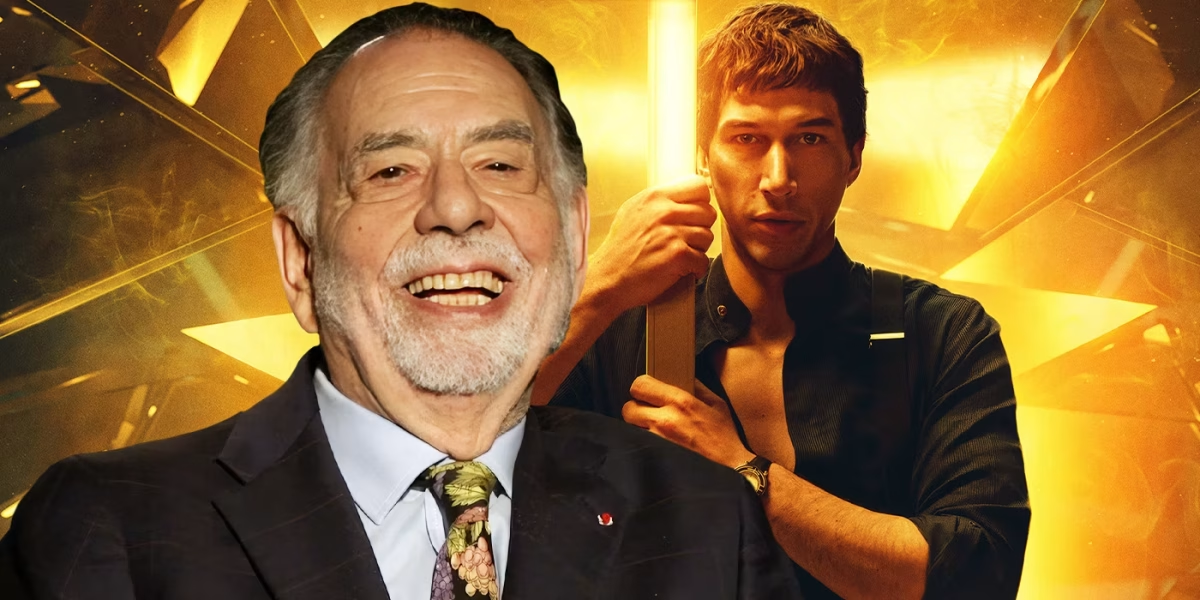
Francis Ford Coppola Reveals the Real Message Behind ‘Megalopolis’
Sep 26, 2024
The Big Picture
Collider’s Steve Weintraub speaks with
Megalopolis
director Francis Ford Coppola ahead of the film’s release.
Megalopolis
, explores a decaying metropolis with an ambitious architect, a corrupt mayor, and a conflicted socialite.
During this interview, Coppola emphasizes the importance of taking risks and creating films that illuminate life and his passion project 40 years in the making.
Without question, Francis Ford Coppola is on Mt. Rushmore of living American filmmaking legends. His work in the 1970s is arguably the hottest streak of films for any director in cinematic history. Winner of 14 Academy Awards (with 55 nominations!), two-time Palme d’Or winner at Cannes, and a litany of honors from festivals all around the world. Coppola has been teasing us for years now with his urban fantasy satire, Megalopolis. Due to the events of September 11, 2001, production collapsed, and the film was shelved. Now 23 years later, Coppola has finally chosen to share Megalopolis with audiences thirsty for a fresh moviegoing experience and primed for an exceptionally rare story.
Megalopolis is a brand-new cinematic vision depicting a decaying metropolis called New Rome. Within, idealist architect Cesar (Adam Driver) is granted license to demolish and rebuild the city. His nemesis, Mayor Cicero (Giancarlo Esposito), remains committed to keeping New Rome as it is. Torn between them is Julia (Nathalie Emmanuel), Franklyn’s socialite daughter and Cesar’s love interest, who, through the tumult, continues her search for life’s meaning.
Collider’s Steve Weintraub had the honor of speaking with Coppola to dive into Megalopolis. Coppola eloquently explains why he chooses to re-edit some of his films decades after release, the genuine optimism he feels towards this world, and how he filtered those feelings through his long-awaited epic fable.
“Movies Are Not Fast Food, Movies Are a Living Art Form”
COLLIDER: Sir, I just want to say for myself, for everyone at Collider, and for millions of people around the world: Thank you for your contributions to cinema.
FRANCIS FORD COPPOLA: Thank you so much. You’re very kind.
It’s a real privilege to speak with you. I really want to thank you for making Megalopolis , and for helping to show what cinema can be, and for pushing the art form forward.
COPPOLA: Thank you. I do believe that artists have to not be afraid of risk. Risk is part of the artistic formula. You have to sometimes leap into the unknown to express how you feel. You can’t be like the company that wants to make fast food that is habit-forming so that you know the people will eat the same thing. They’re trying to do that to movies. Movies are not fast food. Movies are a living art form that tries to illuminate life for people, that helps them see the world they live in as clearly as possible.
How ‘Megalopolis’ Was a Return to ‘Apocalypse Now’
“The film starts telling you how to make it.”
Image via American Zoetrope
I’m fascinated by the editing process because that’s where it all comes together. How did Megalopolis change in the editing room in ways you didn’t expect going in?
COPPOLA: It’s obvious that, like Apocalypse Now, I was making a film that I really didn’t know how to make. And when you make a film that you really don’t know how to make, the film starts telling you how to make it, and it happens in the editing process. When I shot the film, I did a lot of things with the actors that were unusual to help prepare them. One of my principal editors was Canadian, Cam McLauchlin, and when we would look at it all with the other team, we all would say, “Let’s do more like that and less like the more normal.” We would do these unusual takes at first to get the actors going, and then later on, we would do more the typical way movies are supposed to be done. But we kept saying, “Let’s do more like the unusual one. That’s more interesting. It seems to be telling us something.”
Editorially, as you follow the direction of the movie itself, it takes you to a place that you didn’t know you were going. That’s what happened with Apocalypse Now and that’s what happened with Megalopolis. We had wonderful, collaborative actors who were always trying, were always willing to do nutty things with me. We, as the editors, as we looked at it, we said, “Yeah, let’s do more of that. That’s more interesting than the more typical version.” So, the movie was telling us to make it as we were going along.
Why Does Francis Ford Coppola Re-Cut His Movies?
“There are a lot of movies I’ve never changed.”
Image via Orion Pictures
You’ve released different versions of some of your films. With Megalopolis, is the version that is ultimately being released the definitive version? Do you see yourself ever putting in certain deleted scenes? If you know what I mean.
COPPOLA: Yeah, I know what you mean. I feel pretty good about that. I like this version. There are other scenes that were cut out, but I like this version. That history I have of sometimes changing movies — there are a lot of movies I’ve never changed. For example, The Conversation. I sometimes change movies that I feel, in their time, the producer wanted, like The Cotton Club — the producers all said, “There are too many Black people and too much tap dancing.” I said, “But it’s the Cotton Club. It’s about Black people and tap dancing. How can you say it’s too much?” So, I went and recut it and made a version called The Cotton Club Encore. When I change a picture, it’s because of something that would happen that at its time that I felt was a mistake. But [The Godfather Part II] has never been changed, The Conversation has never been. I don’t think [Bram Stoker’s] Dracula has ever been changed. I don’t think that Megalopolis is gonna be changed, but who knows?
‘Megalopolis’ Has Been 40 Years In The Making
“There’s not a problem that we face that we do not have the ability to solve.”
Image via Lionsgate
You famously shot footage in 2001, when you thought the film was gonna get made prior to September 11. How much of the footage that you shot back then is actually in the finished film?
COPPOLA: There is some — a lot of establishing shots of New York. There was a great photographer named Ron Fricke who shot that. It’s beautiful footage, but I didn’t use much of the 9/11 shot because I felt so many people lost their families and their loved ones that it would be improper for me to use that footage. There’s a little bit, just for a poignant reason, because it hits our hearts when we see it. I felt more respectful to the people who lost family during that. But yes, there is a lot of the Ron Fricke footage in the film. It’s very beautiful.
You’ve been thinking about this film since, I believe, the ’80s. What has kept you so passionate about this story and this material for so long that it needed to be made?
COPPOLA: I famously work on something until I hate it, and then I abandon it, and then I start working on something else. Then I hate it and abandon it and say, “That one before wasn’t so bad. I’ll make that.” I was working on a different film which I abandoned in order to make Megalopolis. I’m always making one film late, in a way. [Laughs] But I felt the themes of this movie are so important to the world today. Do you have children?
I don’t, but I have a lot of cats.
COPPOLA: We are killing so many of our cousin human beings and so many of our children. We are a genius species. We can’t waste one another. We all have unique talent. There’s not a problem that we face that we do not have the ability to solve. Someone has to say that, I feel, and that’s what this film says.
Megalopolis releases in theaters and IMAX on September 26.
Buy Tickets
Publisher: Source link





Eggs – Film Threat
In writer-director-star James Clair’s short drama Eggs, a man struggling to rebuild his life finds his quiet mornings turning into strange conversations with the very eggs he is meant to cook. I mean, they want him to eat them. So…
Mar 11, 2026
Ethan Hawke Elevates A Rugged, Predictable Gold-Run Survivalist Western[Sundance]
As far as one can tell, Murphy (Ethan Hawke), a father, WWI veteran, and avid car mechanic, has never encountered an insurmountable challenge. Living in Eugene, Oregon, in 1933, four years into the Great Depression, Murphy and his young daughter,…
Mar 11, 2026
The Moment Review | Flickreel
Brat Summer was a cultural phenomenon that I didn’t understand at all. I knew that it was connected to an album that Charli XCX had released. Whenever I asked what Brat is, though, nobody could seem to give a straight…
Mar 9, 2026
Cillian Murphy’s Netflix Crime Hit Delivers a Brutal, Bleak Finale
It’s been four years since we last saw Cillian Murphy play Tommy Shelby, but seven have passed in the world of Peaky Blinders, with The Immortal Man taking place in 1940, in the middle of World War II. Tommy’s gone…
Mar 9, 2026