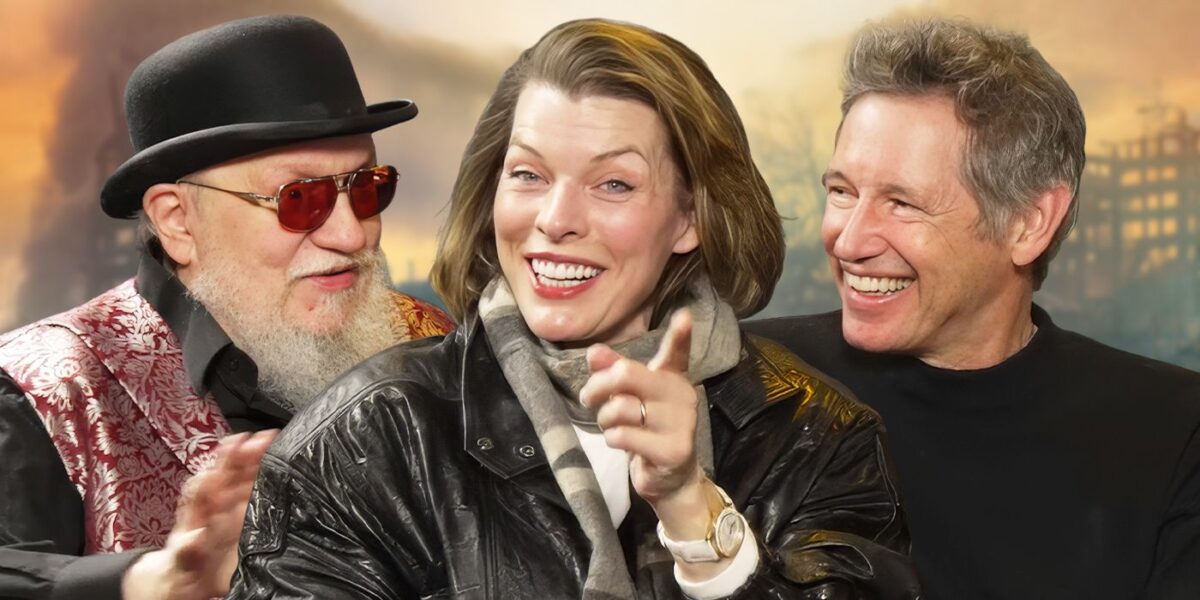
George R.R. Martin on Watching His Adaptations Come To Life and ‘In the Lost Lands’
Mar 8, 2025
Summary
Milla Jovovich and Paul W.S. Anderson collaborate to bring George R.R. Martin’s fantasy world to the big screen.
The film’s characters Gray Alys and hunter guide Boyce navigate a dangerous, mystical land to fulfill a Queen’s wish.
The adaptation process involved adding hope to the original tragic ending, aligning with Martin’s approval, and discussion of character development.
Milla Jovovich has commanded the big screen for years, capturing audiences with superstar performances in films like The Fifth Element, Ultraviolet, and Hellboy. Paul W.S. Anderson has directed incredible adaptations of world famous books, video games, and other treasured properties – Mortal Kombat and Alien Vs Predator (to name a select few). Together, they are the unmatchable creative force behind six(!) Resident Evil feature films. They’ve also teamed up to bring us Monster Hunter and The Three Musketeers. Now they come together once again to bring the enormous and imaginative fantasy worlds of Game of Thrones’ creator George R.R. Martin to the big screen with the epic adventure, In The Lost Lands.
Desperate to find love, Queen Melange (Amara Okereke) sends the mysterious witch, Gray Alys (Jovovich) into the desolate, dangerous wilds of the “Lost Lands” to fulfill her wish of becoming a werewolf. Cursed to fulfill every wish that is asked of her, Gray Alys travels with the hunter Boyce (Dave Bautista) and the two of them travel the post-apocalyptic land facing off against supernatural forces and the religious zealots that want to persecute her. But, as with all genie-like figures, every wish comes with a price and consequences that only Grey Alys knows. The film co-stars Arly Jover (Blade) and Fraser James (Terminator: Dark Fate)
Collider’s own Therese Lacson had the unbelievable pleasure of sitting down with Jovovich, Anderson, and Martin along with co-producer and screenwriter Constantin Werner for In The Lost Lands during an event hosted by Blancpain. Together they talked about the film’s intense and complicated stunts, the expansive origins of the project spanning many stories and worlds, and why an audience of 30 kids left Martin’s independent movie theater in tears.
The ‘In the Lost Lands’ Movie Has Been in the Works Long Before ‘Game of Thrones’
“Milla was very keen to do something based on George’s work”
Image via Vertical
COLLIDER: Paul, I went through the production notes, and I know that you optioned three stories from George long before Game of Thrones was even in the picture. What can you tell me about the other two stories that you optioned, and what was it about In the Lost Lands that you felt made it the most cinematic?
PAUL W.S. ANDERSON: Actually, it wasn’t myself who optioned the stories; it was my producing partner and the writer of the movie, Constantin Werner, who’s sitting over there. He originally optioned the stories from George, like, 17 years ago, so in 2008. He optioned three stories: Lost Lands, The Lonely Songs of Laren Dorr, and Bitterblooms. Originally, Milla was approached by Constantin with an idea to make a movie where the three stories were combined. Milla was a huge fan of George’s. Milla reads an immense amount of literature, and especially fantasy, so she was very keen to do something based on George’s work, but that iteration of the movie never took off, as often happens in the film world.
A couple of years later, I think the auction rights were about to lapse, and Constantin and Milla talked, and Milla suggested that Constantin talk to me about it. I became involved, and then, at the behest of Milla, we wrote a different screenplay, one that just concentrated on one of the stories, which was In The Lost Lands, because we felt like that, out of the three, should be the first one we did.
MILLA JOVOVICH: Especially for a vehicle for me, specifically, it felt like the strongest story to begin your entrance into The Lost Lands’ universe. It felt like the easiest story to adapt because, intrinsically, it’s a love story. It’s a very simple story, but not at all simple.
GEORGE R.R. MARTIN: It’s got its twists and turns.
JOVOVICH: It’s got its twists and turns in it, but in the end, it is a beautiful love story. That’s what really drew me to it.
MARTIN: The three stories that Constantin optioned were all written by me, but they really have nothing to do with each other. They’re in different universes. Bitterbloom’s a science fiction story set in my science fiction future history that I call the Thousand Worlds. The other two are fantasy stories — both, actually, supposedly the first of the series when I thought of them. I never wrote the second story in either series, but I had in the back of my head that the Gray Alys could have a whole series of adventures with people coming to her and buying things, and it not turning out necessarily well for them.
JOVOVICH: It also feels like, in some sense, Bitterblooms and those three stories had no connection, but somehow, they all fit into your universe because you do have such an incredible ability to build these worlds. Who knows if it’s the same time period, or maybe it’s far-flung in the future, or far-flung into the past?
MARTIN: In multiple worlds, I think they were. I wrote all these stories in the ‘70s and ‘80s, so forgive me if I don’t remember clearly, but they all feature women in the leading roles.
CONSTANTIN WERNER: They all have star-crossed lovers.
MARTIN: That’s right.
WERNER: Every single one is a man and a woman who meet, and then destiny pulls them apart.
MARTIN: I remember them vividly. Laren Dorr began with the sentence, “There is a girl who goes between the worlds” — one of my favorite opening sentences that I ever found. And she does. She goes between the worlds, searching for a lost lover who she doesn’t find in that first story.
Gray Alys Is So Much More Than Just a Witch, She’s a Mythical Creature
“The price of immortality, right? Be careful what you wish for.”
Image via Vertical
JOVOVICH: I have to say, for me, when I was preparing the character of Gray Alys, I was reading the other stories to kind of go, “Was that Gray Alys? Are these all the worlds that she went through to get here?” It was very inspiring.
She’s had a long life.
JOVOVICH: Well, she’s a mythical creature. It’s like when you read Greek mythology, and you go, “Oh, the spirit of the river,” and you go, “Wow, that poor spirit has been sitting in that river for millennia, and hardly anyone ever passes by. They must be pretty lonely.” It’s always very tragic. The price of immortality, right? Be careful what you wish for.
With Gray Alys, it’s described that she’s cursed with the curse of having to fulfill people’s wishes. When I was reading the short story, I felt like she was a very enigmatic character, and it was kind of hard to read some of her emotions, but in the film, through your performance, she is a very emotional character where I can definitely feel what’s in her soul. What was it like developing that character and getting into that aspect of her?
JOVOVICH: It was really interesting because, for me, there were so many questions about Gray Alys. Where did she come from? What is the motive? What is her motivation, really? What is this curse? When did it begin? Did she have a childhood? Does she remember her parents? There are all these logistical, normal things that I was trying to figure out how to answer. There was a part of me that felt like maybe the answers are sort of in the questions. You don’t ever expect mythology to make sense. You don’t read Greek myths or Grimm’s fairy tales and expect that it’s going to be like, “This is how things work technically.” It’s magic! It’s imagination. There has to be some faith going into it.
So, I feel like, funnily enough, after we made the movie, a lot of my questions were answered because I feel like, in some really strange way, Gray Alys managed to outsmart her curse. Everything, in the end, worked to her benefit more than other people. So, be careful what you wish for because Gray Alys might just take it! She might just be like, “Oh, this is going to help me.” [Laughs]
What Exactly Is the Key To Adapting George R.R. Martin’s Work?
“if it’s good and if it’s good in the way that you wrote it, it’s like your dreams have come alive”
Speaking about that faith that you have in the character, George, you’re no stranger to adaptations of your work. For you, what is a green flag and what is a red flag when it comes to working with people who want to adapt your stories? And what was it about Paul that made you say, “I trust you with this?”
JOVOVICH: Don’t make him cry.
MARTIN: It was actually Constantin who first contacted me and bought the three stories. He wrote a screenplay with all three of them in it. I remember meeting with him a couple times, and he would apprise me of the progress — he was taking it to film festivals and so forth. I don’t remember how many years passed before you got involved, and he told me that you wanted to only focus on one of the stories.
JOVOVICH: We tried to get it made for, like, a year. A good year, we tried to get it made a couple of years later.
WERNER: Since probably 2017.
MARTIN: You’ve asked a very big question, ones that I’ve been blogging about and getting in trouble for. The writer, in some ways, is the hardest one to say about this. I once wrote a story called Portraits of His Children, which was about a writer and being haunted by his fictional characters. But I don’t have any children, and I think [like] a lot of writers, these are my children, these stories that I create. You have two choices when you sell them for adaptations: you can try to get involved, or you can [say], “I wrote the book. They’re making a movie. It’s a different thing.” Sometimes it’s good to do one, and sometimes it’s good to do the other.
James M. Cain, a very famous writer of the ‘30s — he wrote The Postman Always Rings Twice, and all that — was very famously asked by a reporter, not unlike you, “What do you think of what Hollywood has done to your books?” And he answered, very famously, “Hollywood hasn’t done anything to my books. They’re right there. They’re on the shelf. Not a word’s been changed.” [Laughs] That is the answer that you give sometimes.
But there’s also something very special for a writer if you sell your book for a movie, and maybe you’re involved with the movie, maybe you’re not. Maybe you don’t see any of it until opening day, but when you see it on opening day, if it’s good and if it’s good in the way that you wrote it, it’s like your dreams have come alive. These children of yours, these fictional children, there they are on the screen, and I can’t describe how great a feeling that is, how exciting it is.
Related
How To Watch ‘In the Lost Lands’ — Tickets, Special Formats, and More
Dave Bautista brings George R. R. Martin’s short story to life on the silver screen.
JOVOVICH: I can relate to that so much because I have children of my own. It’s so interesting that you would compare it that way, because in a sense, you write the book of your children when they’re born, and you have this idea of how you’re going to parent, and you do your best to raise them up until they’re 18 or whatever, and then you have to let them go. The integrity that you’ve put into them all those years then comes back tenfold to you because, in a sense, the life they take on on their own gives you pride.
MARTIN: Hopefully.
JOVOVICH: Hopefully! [Laughs] If Paul didn’t give you pride, I’ll get him for you.
I respect that. I’ve listened to a lot of your interviews in the past few weeks, and I think that’s a very fair answer to give, especially because sometimes you can control things, and sometimes you can’t. I think at some point, you do have to go with the flow and say, “We’re going to let this be what it is.”
MARTIN: Yes, but of course, everything in this world has upsides and downsides. It’s also the downside where you watch the movie, and, God, it’s not your children. They’ve done something. There are many cases. I know writers who have gone to the premiere of their movie and got up and walked out. They just can’t take it because there’s such a strong personal relationship there. It’s also a very good feeling, of course, which, in my arrogance, I will say doesn’t happen that often, but when they make substantial changes, and it’s better, it’s better.
I did a whole blog on House of the Dragon, the first season, and the character of Viserys Targaryen is a very minor character in my book, but they got Paddy Considine to play him, and he was robbed, and he should have won an Emmy. It was amazing. Amazing. His Viserys is so much better than my Viserys. It made me want to go back and rewrite the book, but I didn’t. [Laughs] But that can happen, too. So, this is really a profession for gamblers, wouldn’t you say? You never know how it’s going to turn out.
It sounds like a roll of the dice.
Paul W.S. Anderson Breaks Down the Most Complicated Action Scene To Film ‘In the Lost Lands’
“It’s not something you do on the spur of the moment.”
Image via Vertical/Constantin Film
To switch a little bit and focus on some of these wild action scenes in this film, there’s one specifically, Paul, that I want to talk about, which is a school bus/cable car fight in the middle of the air. I want to talk about what it takes to film a spectacle like that, specifically since I know you guys used a lot of Unreal Engine in producing some of these special effects.
ANDERSON: That was a scene that we ended up shooting pretty much for the whole length of the movie, and we kept coming back to. Because the school bus, as you said, is hanging in the air. It starts in a railway station, then it goes out like a cable car on these cables, and it goes over this vast chasm, and then one cable gets cut, and the car swings through 90 degrees. So, we had to shoot everything in the railway station first, then everything over the chasm second, and then everything where the cable cars swung through 90 next. Then both cables get cut, and the car ends up hanging, so we had to keep rearranging the geography and the physics in the school bus. So, we ended up coming back. Every few weeks, we’d have the bus arranged in a different way, and now you’re climbing up the bus, and now the roof of the bus is the floor of the bus. It was a very complicated scene.
JOVOVICH: That’s where Paul comes super in handy because, I think for actors, you’re so much in the moment, and so I always depend on Paul, and I go, “Okay, what just happened? Where did we just come from, and where are we going? Because it’s been a few weeks since we shot this scene, and I can’t remember.” It’s so important. And by the way, you’d be surprised how many directors don’t keep track of this, and I think it’s so special Paul does this. There’s a handful of people I’ve worked with that are very, very organized with keeping track of where we are in the script, and Paul is always able to go, “Remember, a couple of weeks ago, this is what you did, boom, boom, boom. You fought here, and now the cable car has gone down. Now you’ve just caught it with your sides. Boom. That’s what we’re shooting.” I’m like, “Oh yeah!”
There’s a lot of sequences to remember.
JOVOVICH: It’s very scientific in that sense. It’s obviously a product of passion and expression and art, but then the logistics are really overwhelming.
ANDERSON: It’s not something you do on the spur of the moment. There was a lot of planning.
Milla Jovovich and Anderson on Working With Dave Bautista
“So sweet and so kind and so open to suggestion”
Image via Vertical
A lot of the time on screen is you and Dave [Bautista] working together. How is it formulating that relationship together on screen and building that rapport? As both of you are pretty fantastic action stars, I wondered if you guys traded any tips when it came to being on screen.
JOVOVICH: We felt so lucky to get Dave after seeing him in Blade Runner 2049. We were like, “We want Dave!” He’s just perfect for this. Paul had many talks with him, and they got along really well, and he finally signed on to the picture. The thing that really struck me when I met him was how relieved I was that this is a nice, normal human that we’re working with and isn’t some egotistical movie star who is going to bring a bunch of baggage and entourage and stuff on set that’s just going to complicate things. When you make a movie of this scale, and there are so many details, and it’s already so challenging, the last thing you need is a bunch of egos on set, making things more difficult.
So, the fact that Dave came in and really became part of a family and was so sweet and so kind and so open to suggestion, open to us trying new things, improvising, taking risks, he always made everyone feel like there was a safe space around him. That’s, for me, one of the most important elements of working with actors is feeling safe around them, feeling like you can take risks, feeling accepted, embraced and seen and heard and respected.
Definitely. I’ve interviewed Dave a couple of times before, and he’s such a delight to see. I can’t imagine being on set with him, having all that time.
ANDERSON: He’s wonderful to work with. Really, having both him and Milla on the same set was a dream for me as a director, especially when you’re doing logistically very complicated things like the school bus, where it can’t be just all about the actors. Some of it, unfortunately, has to be about the logistics of turning things upside down. There wasn’t enough dolly track in Poland for us to go all the way around the school bus.
Also, we’d have to make all the lights move, and so the director of photography, [Glen MacPherson], came up with the idea of, “Well, we’re supposed to be circling around the school bus, but what happens if the camera stays stationary and the school bus goes ‘round and ‘round?” And we’re like, “That would look exactly the same,” but it means all the actors have to be on board for everything changing, everything going around. It’s like, “Which way am I looking?” There was a big technical aspect to making this movie that Milla and Dave were really very helpful with and very accommodating. They really made it easy.
JOVOVICH: We’re like, “Whatever. Just tell us where we got to be and what we got to do and which way you’re turning, and we’ll be there.”
That’s good to hear. It doesn’t go like that all the time.
ANDERSON: I’m not getting on that school bus! [Laughs]
How the Filmmakers Expanded the World of ‘In the Lost Lands’
“I wish there were dragons.”
Paul, with expanding this world, it is a short story so there is a lot to bring into and extend. I noticed you included a map in the film and there are a lot of new elements. What was it like extending those elements, and did you work with George? Did you talk with Constantin? What was that process like?
ANDERSON: The process started, obviously, with Constantin Werner, who optioned the stories and talked to Milla. Milla introduced the two of us, and then when we decided to focus on just The Lost Lands, Constantin wrote a new screenplay, and I was very involved in that, as well. Then, Milla was very involved. So, we’d take Milla a draft of the screenplay, and she would give us her notes, and quite often the notes would be, Milla was very, very concerned that we stayed true to what George had written, stayed true to the characters that were at the heart of George’s story because George’s story is really about the relationship between Boyce and Gray Alys, and this wonderful twist at the end. But it’s about those two characters. Quite often, because we were building out the world, we’d go too far in one direction, and Milla would go, “Amazing action, but where are the characters? You’ve kind of lost sight of the characters and their story.”
JOVOVICH: “Why are we following these people?” The story’s about Boyce and Alys.
ANDERSON: She beat Constantin and I with the screenplay and said, “Go back!” So, we’d do another draft, and we’d get some more notes. Then we’d do another draft. Finally, Milla would go, “Now we need to show it to George. We need to get his opinion on it.” Because I was very aware, I’m building out a short story, but I wanted George to be happy with it. So, we sent him scripts, and George would make comments. We also met in LA, and I showed George the production design artwork…
MARTIN: Beautiful stuff.
ANDERSON: …so he was aware of the world that we were building because I’m very aware that Westeros is out there, and we don’t want to just be Westeros-adjacent. We want to really expand the George R.R. Martin’s universe in a very distinct way.
JOVOVICH: I wish there were dragons. That’s the one thing we didn’t have, is dragons.
ANDERSON: Well, maybe a dragon walks into your shop!
JOVOVICH: I always wanted to bond with a dragon.
MARTIN: Ah, you want to ride a dragon, do you?
JOVOVICH: I want to feel one with the dragon.
MARTIN: And burn your enemies. That’s good, too.
JOVOVICH: That helps. I don’t have many enemies, by the way. I’m a pretty chill person. I might have a couple of people, though. They don’t need to be burned by dragon fire. Not yet, anyway.
Applying George R.R. Martin’s Valuable Knowledge of the Original Material.
“It’s nice when they do involve you.“
Image via Vertical
MARTIN: The process as described is the process for many, many films. As the original author, my position, in regard to this, is not always involved. Sometimes, they’re just buying your book, and you give you your check, and, “See you at the premiere,” if you even get an invitation. But it’s nice when they do involve you, and even more when you have a feeling that they listen and have an understanding of the original material because, many times, they don’t. I’m not talking about anybody that I’m involved with here, so please don’t turn it around to some current project.
I’m a science fiction fan. I grew up reading science fiction and comic books — I’m a big comic book fan — and I love these characters. I love some of these stories. There weren’t many science fiction films that were adaptations being made back in the ‘50s and the ‘60s. There were films, but they were original films about giant spiders and other things that someone invented.
But you didn’t see Robert E. Heinlein stories, you didn’t see Isaac Asimov stories, the great writers who made me love science fiction. When they finally got around and they started making some of those, it was very hard because, yeah, it might have had Asimov’s name on it, but this wasn’t the way Isaac would have written it. It was not at all, and that was not good. When you’re adapting, if you respect the original material, you should try to stay as close to it as possible. If there’s a reason for change, and many times there are reasons for change — a lot of them are budgetary, or they’re practical concerns of what you can do, what you can’t do — make changes for good reasons.
I was just in England. I came back just yesterday. I visited the Charles Dickens house. I think Dickens probably has more of his work adapted to television and film than any other author that I can think of.
I mean A Christmas Carol alone…
MARTIN: Yeah, I think Christmas Carol has been adapted more times than any other work of English literature. Maybe I’m wrong.
JOVOVICH: The BBC has a lot of free content out there.
MARTIN: And, boy, they’re different. Some of them are great. The Alistair Sim Christmas Carol, I think, is the greatest. The George C. Scott Christmas Carol is good. The Bill Murray Scrooged is crazily different but oddly faithful at the same time. But there are also some that are like, “Eh, why did you make this if you didn’t like the story? Stop it! Stop it!”
JOVOVICH: But what, for Paul and I, was really impressive was that with working with you, you come from a background that has experience in Hollywood. You’ve been a showrunner. You’ve gone through the gamut of the system, so you came into it with an intrinsic understanding of how the system works. You work, sometimes, with book writers who have no concept of what a Hollywood movie or TV show needs, so they get very precious. They just don’t understand that there are certain things, like, we can’t read people’s minds — we have to show it visually. There are simple things where you have this understanding of what it takes, and that was so helpful for us to have someone on the team who understood what it is to be a filmmaker.
How Anderson Surprised Martin and Jovovich With a New Ending to the Story
“You don’t want to send the audience out unsatisfied.”
Image via Vertical
Paul, the end of this film doesn’t go that closely to the short story’s ending, which is, I would say, quite tragic and almost kind of depressing. What was the decision to change up the tone of that ending and give it something where you have a little bit more hope?
ANDERSON: Well, the movie does have the original ending of the story, but then it goes on a little bit further because I think sometimes what works on the written page, if you have that experience in the movie theater, that’s not going to be the best experience. It works in your home when you’re reading it by yourself. When you’re sitting watching it, and you’ve been through this emotional journey with these characters, and then it suddenly ends, you don’t want to send the audience out unsatisfied.
JOVOVICH: Everybody dies.
MARTIN: Wait, that’s how I always end it. [Laughs]
Related
‘In the Lost Lands’ Review: George R.R. Martin, Milla Jovovich, and Dave Bautista Deserve Better Than This Fantasy Mess
Even diehard George R.R. Martin fans won’t be impressed.
ANDERSON: We wanted to give an element of hope at the end, which for me, as Milla said, it’s almost like Gray Alys works the system a little bit. She’s finally found how to outwit her curse. And maybe for some people, they actually do get what they wish for. They have to pay a terrible price for it, of course — it’s George R.R. Martin, you’d expect no less — but the terrible price is paid, and some people get what they want. That is a new ending that we added, and to be honest, that was something that developed during the making of the movie.
Because George had read the earlier drafts, he hadn’t seen that ending. So, when I came to show George the movie a few months ago, I’m sitting in the theater with George in the very theater that we’re going to be in tonight, and I suddenly realized, “I haven’t told him that there’s a new ending.” I got really, really nervous. I have to say, it’s the most nervous I’ve ever been in a movie theater.
JOVOVICH: He didn’t tell me this. I would’ve been like, “You what? This is George R.R. Martin!”
ANDERSON: I should have told him. I was busy. I don’t know. I got distracted.
JOVOVICH: I thought I could trust you!
ANDERSON: So, the lights go up at the end, and I’m the most stressed I’ve ever been, and George turns around and he looks at me—and George has really, really good comic timing—and he stares at me, and there’s this long beat, and he goes, “I loved it.” I went from being the most stressed I’ve ever been in the theater to probably the happiest I’ve ever been.
The cold sweats came in.
JOVOVICH: He turned to you with the face of thunder, leaned over, took a pause, “I loved it.” [Laughs]
MARTIN: It’s an interesting question, larger than our little movie, about the endings of stories and how stories should end. I wrestle with some of that a lot in a lot of my stories. The Greeks and Romans love tragedies. I’m not sure Americans share that taste for it.
I love a tragedy.
JOVOVICH: Well, they’ve always been hopeful. It’s a young nation. They don’t have the experience of the Russians.
ANDERSON: Where everything will eventually go wrong. Even if it goes good for a while, it’s going to go wrong.
George R.R. Martin on Tragic Films and His Independent Movie Theater
Image via Buena Vista Distribution
MARTIN: When I bought this theater, the Jean Cocteau, it had been closed off for seven years. I bought it and reopened it. We refurbished it a little and all that, but then I’m trying to get movies to fill it, and, of course, this is a tiny little independent theater. We weren’t getting any big movies, the big Hollywood movies. We were getting smaller independent movies and also older movies, and I had the bright idea from my own childhood, “Well, let’s show some old kid movies, and we’ll have a Saturday night children’s matinee, and the kids will get in free. Their parents will have to pay. We’ll get money that way. The kids will get in free, and we’ll show them these old movies.”
JOVOVICH: Traumatize them for life.
MARTIN: Everybody thought that was a great idea, so I did that. Then, unfortunately, I began with one of my own favorite little boyhood films, Old Yeller.
JOVOVICH: [Laughs] That’s a good one! Let’s just go kill ourselves straight after.
MARTIN: I didn’t attend the screening myself, but I came by at the end to see how the kids liked it, and I was treated to 30 kids coming out of the theater weeping. [Laughs]
JOVOVICH: And then The Neverending Story, The Dark Crystal, all classics.
That ticket money went to future therapy sessions.
JOVOVICH: Yes, that destroyed my life. The Last Unicorn.
MARTIN: That’s a good experience for the kids. Sooner or later, they have to shoot the dog. In all life, sooner or later, you have to shoot the dog, right?
Image via Rankin/Bass
JOVOVICH: Listen, I showed The Last Unicorn to my kids. It’s a thing in our family. I’m like, “We have to watch The Last Unicorn.”
MARTIN: Peter Beagle. He’s amazing. Have you met him?
JOVOVICH: No, I haven’t. I would love to.
MARTIN: Yeah, he’s a wonderful guy.
JOVOVICH: That is literally my kind of movie, inner soundtrack. That was me for ages.
ANDERSON: You did a screening with Peter here, right? For The Last Unicorn.
MARTIN: Several, yeah. He toured with The Last Unicorn.
JOVOVICH: “I can feel the bodies dying all around me!”
MARTIN: Another great one, I was just down in London, and we went to Cecil Court. It’s a street that’s entirely bookshops and classic books.
It’s a money sink, that area.
MARTIN: Yeah, I found a copy of Watership Down autographed by the author — another of my favorite books. That’s a great fantasy, too.
JOVOVICH: It’s like Game of Thrones with rabbits.
MARTIN: Kind of! [Laughs] But the end is sort of a happy ending. They win. They establish Watership Down. The big guy gets defeated. But at the end, the hero dies because he’s old and he’s a rabbit. You see him go up to rabbit heaven, and it’s so sad but sweet at the same time.
In The Lost Lands is now playing in theaters.
In the Lost Lands
Release Date
March 7, 2025
Runtime
101 Minutes
Writers
Paul W.S. Anderson, Constantin Werner, George R.R. Martin
Publisher: Source link



Mason Gooding & James Van Der Beek’s Bad Night Is Aggressively Dull
Ever since the Scream franchise helped put him on the map, Mason Gooding has been a great talent to watch. The genre-bending slasher Heart Eyes is still his best non-franchise role yet, but he's also branched outside of horror in…
Mar 15, 2026
A Grumpy Nick Offerman Keeps This Fish Tale Swimming Along
Animated fish films have been done. Finding Nemo. Shark Tale. Ponyo. So to hear about another doesn't feel like anything new. However, The Pout-Pout Fish, starring Nick Offerman as a grumpy ocean pout named Mr. Fish, is a little different.…
Mar 15, 2026
‘The Rookie’s Best Season 8 Episode Goes Completely Different With Full Zombie Horror
Editor's Note: The following contains spoilers for The Rookie Season 8, Episode 10.It's crucial for procedurals to come up with a winning formula that entices viewers to tune in every week. But it's just as important for these types of…
Mar 13, 2026
Sidney Prescott Leads a Brutal Throwback
Walking into Scream 7, I wasn’t sure if this entry would be a new reinvention. I know I wanted tension. I know I wanted that uneasy calm before the snap. And most of all, I wanted to see why Sidney…
Mar 13, 2026