Has Hollywood Already Forgotten the Los Angeles Wildfires?
Jan 7, 2026
Los Angeles is, at least apocryphally, a city without memory. Angelenos have been derided for our lack of history, our surface-level lack of interest in things that happened more than 20 minutes ago or 20 miles away, for almost as long as L.A. has existed. Not for nothing did the historian Norman M. Klein once title a book about Los Angeles The History of Forgetting.
But even if you accept that frame, there’s something odd, even uncanny, about the way the fires that kicked off 2025 have been memory-holed. Unless you are someone who was directly and materially affected by them (my sister and my brother-in-law lost their homes in the Palisades and the Eaton Fire, respectively) you might find yourself struggling to remember when, or even if, they really happened. Or maybe they’ve just been edged out, crowded and conflated with the ongoing polycrises of 2025: ICE raids, demonstrations, job-demolishing mergers and a norm-demolishing administration. The question then might be less, “Did the fires even happen?” and more, “Have they, in fact, actually stopped?”
The latter seems more probable, more honest somehow, but there remains something strange, and more than a little troubling, in the way the second- and third-largest fires in California history, have grown hazy. What does that say about us, after all? Were the criticisms that were leveled at us in the late 20th century — that “Everybody’s plastic” (as Andy Warhol put it), that our greatest cultural contribution is the ability to make a right turn on red (to quote Woody Allen) — justified?
Gov. Gavin Newsom (in cap) and Mayor Karen Bass touring the Pacific Palisades as the fire continued to burn.
Eric Thayer/Getty Images
Maybe. But it is easier, always, to reckon with criticism than it is to reckon honestly with loss. And the ambient insecurity that follows us everywhere, the sense of precarity — financial, professional, existential: Almost everyone in Los Angeles feels at least one of these things much of the time — that haunts our every step only makes it harder. How do we reckon with the unspeakable losses that rang in 2025, those brutal devastations By ignoring them, it might seem. A therapist would surely tell us this is a bad idea, but L.A. isn’t the first place to suffer from a condition common enough that there’s a term for it:
disaster amnesia.
If we can’t prevent the next wildfire, the next communicable disease or the next earthquake, the least we can do is forget it, right? Why sacrifice our joie de vivre, or what’s left of it, on the altar of something we’re powerless to stop anyway? There may be reasons, all kinds of reasons, for the speed with which we’ve experienced a premature fading of what seems like it ought to have been an indelible, generation-scarring set of events — a crumbling fourth estate and a hyperactive, increasingly fragmented information environment likely have something to do with it, too — but the ephemerality with which we’ve imbued the fires also feels distinctly L.A.
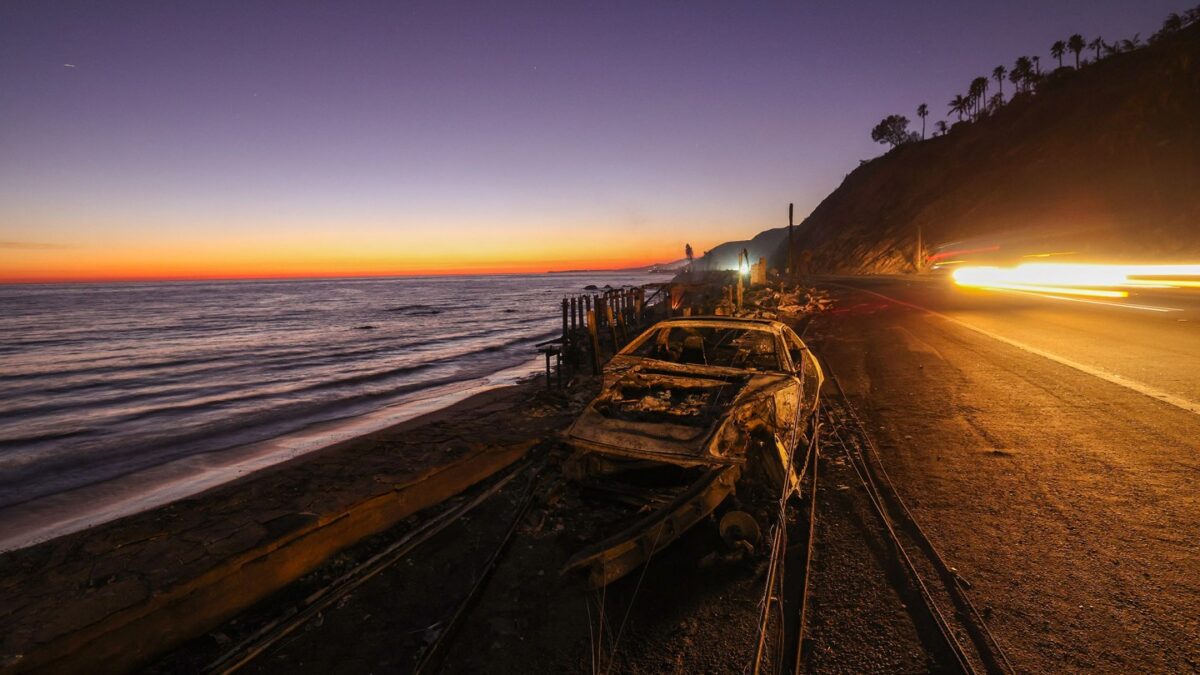
The remains of houses that burned along the Pacific Coast Highway in the Palisades Fire.
Jeff Gritchen/MediaNews Group/Orange County Register/Getty Images
In the absence of a clear symbolic or geographic center — the fires did much of their most aggressive work along L.A.’s margins, after all: the western edges of Malibu and the Palisades, its northeastern fringe of Altadena — it’s easy for many Angelenos to have experienced them as somewhat out-of-sight, out-of-mind to begin with. I live in West Hollywood, and the honest answer to everyone who asked me what it was like at the time was that, other than frighteningly foul air quality and a frantic ongoing cycle of text messages and phone calls with those closer to the front lines, there wasn’t much on the surface to notice.
An Aerial view of Altadena in the wake of the Eaton Fire.
Mario Tama/Getty Images
This city has never had the kind of concentration, geographic or otherwise, that might give rise to a #BostonStrong or to the rhetoric that prompted us to ‘Never Forget’ 9/11. This may also be a point in its favor, or at least a triumph of proportion, given that the fatality count of the fires was thankfully nowhere near comparable to the latter, but it doesn’t answer the question of what to do in a world that might not seem to consider a disaster that razed more than 55,000 acres, evacuated several hundred thousand people and killed () several hundred to be particularly memorable. If we don’t remember those losses, after all, who will? And if we don’t record them as part of our day-to-day existence, if we don’t consider them and those who might yet die from heart attacks and respiratory ailments as part of a common fate — we’ll be gone too, as surely as those people and places are — what chance do we have of remaining, or becoming, a city that’s worth the pains it takes to live here?
At the risk of being a killjoy, L.A. is a city built on a series of amnesias — its and displacements over the years, , are still somehow under-recalled and -discussed — and past a certain point, one starts to wonder how much more forgetting it can stand in order to remain a viable place at all. Is this a city you, or anyone, would want to live in? One in which anything or everything always seems to be happening, but nothing definitive ever did?
A Eucharistic procession in June passed through properties destroyed by the Eaton Fire. The event began at Sacred Heart Catholic Church, with about half its parishioners having lost their homes.
Mario Tama/Getty Images
Of course, the collective memory of the city, and its residents, can take irregular, even subterranean, forms. I have yet to see any public, tangible memorializing of the Eaton or Palisades fires, but the qualities for which the city’s detractors have assailed it over the years might not be entirely negative. The “plastic” aspect Warhol spoke of (not that he even meant it as criticism, necessarily) speaks, too, to our malleability, to the possibility of being reshaped by circumstances. Not so great, maybe, when you’re dealing with studio execs or matters of political citizenry — there, one might prefer people of firm and well-established principles and convictions — but when it comes to the life of a place, slightly different. The very vaporousness, the pained yet glittering intangibility of our recall — our knowledge that something happened here a year ago, even if we can’t yet fully face what it was or insist upon viewing it obliquely — need not be damning, at least not if we allow memory to persist in this form rather than releasing it altogether.
L.A. has always been a little diffuse, a little vague, a little dreamy: defined as much by what isn’t here as by everything that is. There’s no reason its memory lines and its sense of history should be any different, provided we hold fast to our understanding that history is inescapable and that what remains — its freeways and beaches, museums and uncharred parks, as well as what’s left of our own moral capacity — belongs to it, as much as it does to all of us.
The aftermath of the Eaton Fire in March.
Mario Tama/Getty Images
***
Rebuilding by the Numbers
One of the clearest differences in how the two communities are recovering comes down to land value. In Pacific Palisades, where fire-damaged lots have averaged slightly more than $2.1 million this year, homeowners often have the financial flexibility to choose their next move — whether that means rebuilding, waiting out the permit process or selling quickly at a price that can more than cushion the loss. In Altadena, where comparable lots have averaged closer to $600,000, that safety net is far thinner. The price gap helps explain why more Altadena residents are pursuing rebuilding permits despite longer waits, while fewer Palisades owners are entering the system at all. In some cases, the fire has left Palisades owners positioned not just to recover, but to do well — a dynamic that underscores how uneven the road back can be after the same disaster.
THR Staff
This story appeared in the Jan. 2 issue of The Hollywood Reporter magazine. Click here to subscribe.
Publisher: Source link



‘The Rookie’s Best Season 8 Episode Goes Completely Different With Full Zombie Horror
Editor's Note: The following contains spoilers for The Rookie Season 8, Episode 10.It's crucial for procedurals to come up with a winning formula that entices viewers to tune in every week. But it's just as important for these types of…
Mar 13, 2026
Sidney Prescott Leads a Brutal Throwback
Walking into Scream 7, I wasn’t sure if this entry would be a new reinvention. I know I wanted tension. I know I wanted that uneasy calm before the snap. And most of all, I wanted to see why Sidney…
Mar 13, 2026

Eggs – Film Threat
In writer-director-star James Clair’s short drama Eggs, a man struggling to rebuild his life finds his quiet mornings turning into strange conversations with the very eggs he is meant to cook. I mean, they want him to eat them. So…
Mar 11, 2026
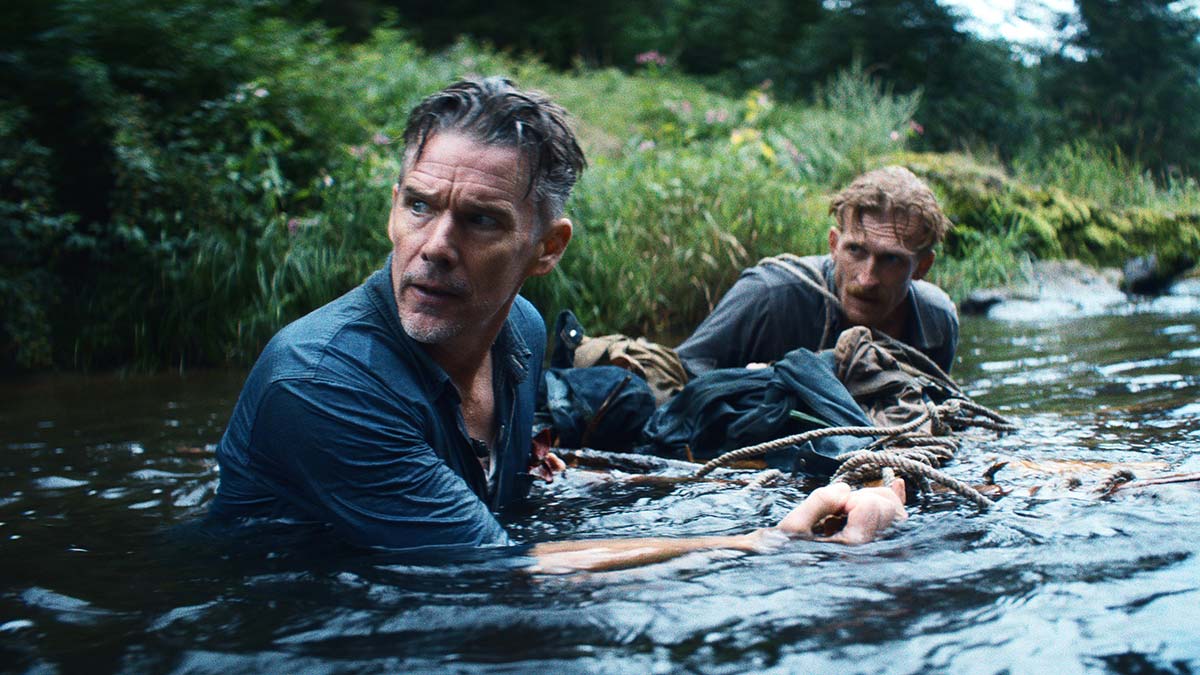
Ethan Hawke Elevates A Rugged, Predictable Gold-Run Survivalist Western[Sundance]
As far as one can tell, Murphy (Ethan Hawke), a father, WWI veteran, and avid car mechanic, has never encountered an insurmountable challenge. Living in Eugene, Oregon, in 1933, four years into the Great Depression, Murphy and his young daughter,…
Mar 11, 2026