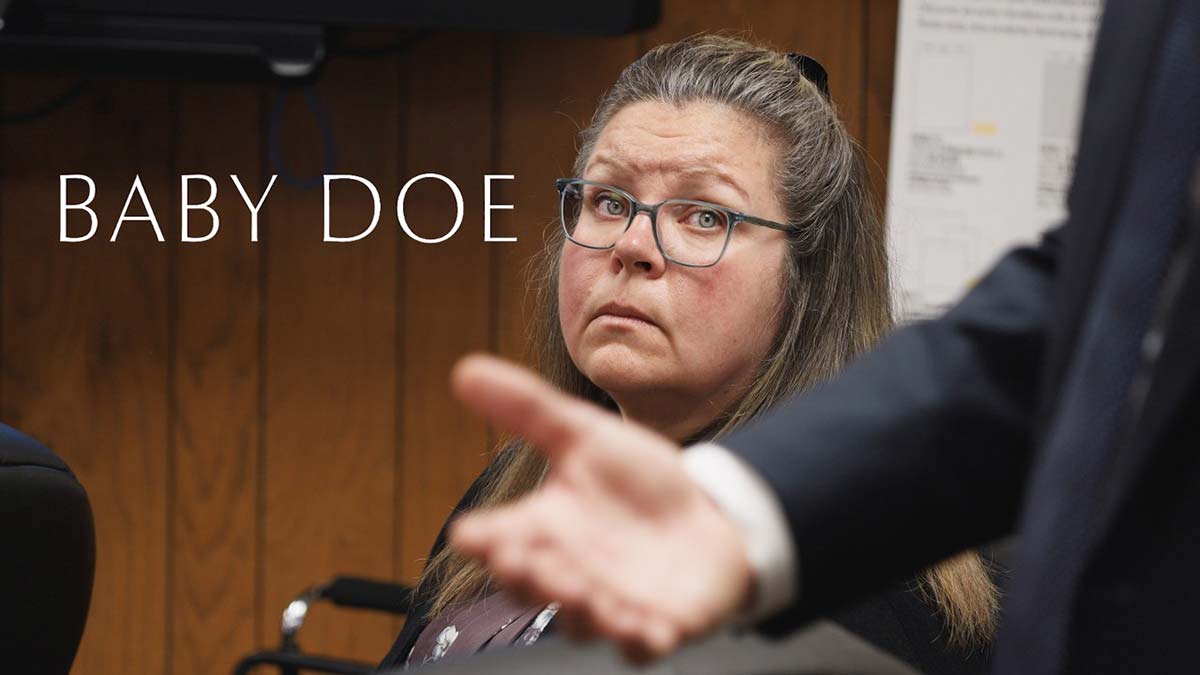
Jessica Earnshaw’s Remarkably Complicated True-Crime Story Refuses Easy Answers
Oct 19, 2026
When two women discovered the remains of a newborn infant in Ohio in 1993, no one could have known where the case would lead more than three decades later. “Baby Doe” examines everything that followed, gradually revealing a story in which choosing a side can seem deceptively easy until nearly every new detail complicates that judgment.
Gail Ritchey says she had no idea she was pregnant. After unexpectedly giving birth to a son in 1993, she disposed of the infant’s body and later maintained that the child had been stillborn. Ritchey went on to marry her high school sweetheart, raise children, and eventually become a grandmother, all while keeping what happened hidden from those closest to her. Decades later, DNA evidence connected her to the abandoned infant, and prosecutors charged her with murder.
READ MORE: 88 Must-See Movies This Fall: ‘Dune: Part Three,’ ‘Digger,’ ‘Avengers: Doomsday,’ ‘The Adventures Of Cliff Booth’ & More
Her defense centers on pregnancy denial, a documented condition in which a person may remain unaware of, or psychologically unable to acknowledge, a pregnancy. Ritchey’s attorneys argue that her state of mind extended into the moments surrounding the birth, leaving her psychologically detached and unable to process what was happening. Prosecutors contend that the baby was born alive and that what followed constitutes murder.
“Baby Doe” widens its scope by examining other women prosecuted under strikingly similar circumstances. Again and again, the legal question collides with a psychological one: whether these women knowingly killed their newborn children or acted during profound episodes of dissociation and denial. The prosecution in Ritchey’s case rejects that explanation, while the defense argues that understanding her mental state is essential to understanding the crime itself. The documentary wisely recognizes that neither question produces a comfortable answer.
Ritchey sits for extensive interviews throughout the film, and one of its most unsettling strengths comes from how little certainty those conversations provide. Her tears may reflect remorse, terror over what she did, fear of losing the family she built, or some impossible combination of all three. The film refuses to dictate which interpretation audiences should accept.
Her husband remains firmly beside her despite his disbelief that she concealed such an enormous secret for so many years. Ritchey, meanwhile, has returned to religion and become active in a church, only to step away as publicity surrounding the case intensifies. Her husband continues attending Mass, while several parishioners question her absence and insist that the church may be precisely where she belongs. Ritchey sees things differently, unwilling to bring the attention surrounding her case into the congregation.
Director Jessica Earnshaw, whose acclaimed “Jacinta” similarly examined a woman caught between trauma, family, and the criminal justice system, constructs “Baby Doe” largely from observational fragments: Ritchey at home with her husband, daughter, and grandchild; meetings with her lawyers; conversations conducted over Zoom; and extensive courtroom footage. Earnshaw, who also serves as cinematographer, never overplays the material. That restraint proves remarkably effective, allowing uncertainty to accumulate naturally as each side builds its case rather than imposing artificial suspense onto proceedings that already carry enormous emotional weight.
Footage involving other women accused in comparable cases deepens that uncertainty rather than neatly contextualizing it. Were these acts committed during genuine psychological crises? How should the law account for pregnancy denial or dissociation when determining culpability? And how much confidence can anyone have when reconstructing a birth and death that occurred more than thirty years earlier?
One of the film’s most difficult sequences comes when Ritchey finally looks at photographs of her son’s body and the autopsy conducted after his remains were discovered. The images themselves remain offscreen, but the body’s condition is described in enough detail to make the scene devastating. More importantly, the moment confronts Ritchey with something she had deliberately avoided seeing for decades, collapsing the distance between the life she built afterward and the child whose death made that life possible.
For all the enormity of its subject, “Baby Doe” never resorts to sensationalism. Its straightforward construction makes an extraordinarily tangled case easy to follow without pretending the moral questions surrounding it are equally simple. That restraint distinguishes the film from the more manipulative corners of true crime, where ambiguity often becomes merely another mechanism for suspense.
The documentary instead leaves audiences trapped inside the same contradictions facing everyone involved. It is possible to feel sympathy for Ritchey without absolving her, to recoil from what happened while accepting that pregnancy denial may have profoundly altered her state of mind, and to question whether punishment decades later can ever resolve what occurred that night.
Support independent movie journalism. Sign up for The Playlist Newsletter for the latest film and TV news, reviews, interviews, and more—free.
Perhaps the most disturbing thing about “Baby Doe” is that certainty never arrives. Ritchey knows what she remembers. Prosecutors have their evidence. Doctors and psychologists offer explanations. Her family has its own understanding of the woman they know. Somewhere among all of those accounts lies the truth, but the film understands that finding it may no longer be possible. “Baby Doe” doesn’t solve that contradiction. It does something considerably harder: it allows it to remain unresolved. [A]
Brian Farvour is a film/television critic and entertainment journalist whose work has also appeared on Fandomwire. He previously co-hosted The Playlist Podcast.
Publisher: Source link




Goodbye ‘Lioness,’ Paramount’s Hit 114-Episode Military Thriller Is Officially KIA on Streaming
Taylor Sheridan's Lioness might be one of the biggest shows on streaming (with a fourth season on the way), but Paramount's perfect military action thriller replacement just suffered a major defeat. With Taylor Sheridan set to leave Paramount and CBS…
Oct 19, 2026
Original ‘NCIS’ Icons Officially Reunite in First Look Images 10 Years in the Making
NCIS remains one of the biggest macro-franchises in the TV world, as three different shows are still delivering new seasons, along with a brand-new spin-off in its first season. The original NCIS is now in its 24th season on television,…
Oct 18, 2026
Forget ‘Game of Thrones,’ Prime Video’s Epic New Fantasy Adaptation Moves Forward With Official Cast
Since Game of Thrones ended in 2019, every major streamer has tried to find its answer in high-fantasy series. From The Lord of the Rings: The Rings of Power to Apple's ambitious plans to adapt Brandon Sanderson's Mistborn series, the…
Oct 17, 2026

Netflix’s “Taylor Sheridan Meets Blade Runner” Action Western Shoots Onto Streaming Next Month
Netflix will add an all-new series to the historical list of science fiction-meets-western epics when it unleashes its new show to streaming next month. An explosive new trailer for the series has now been unleashed, smashing together tropes from both…
Oct 16, 2026