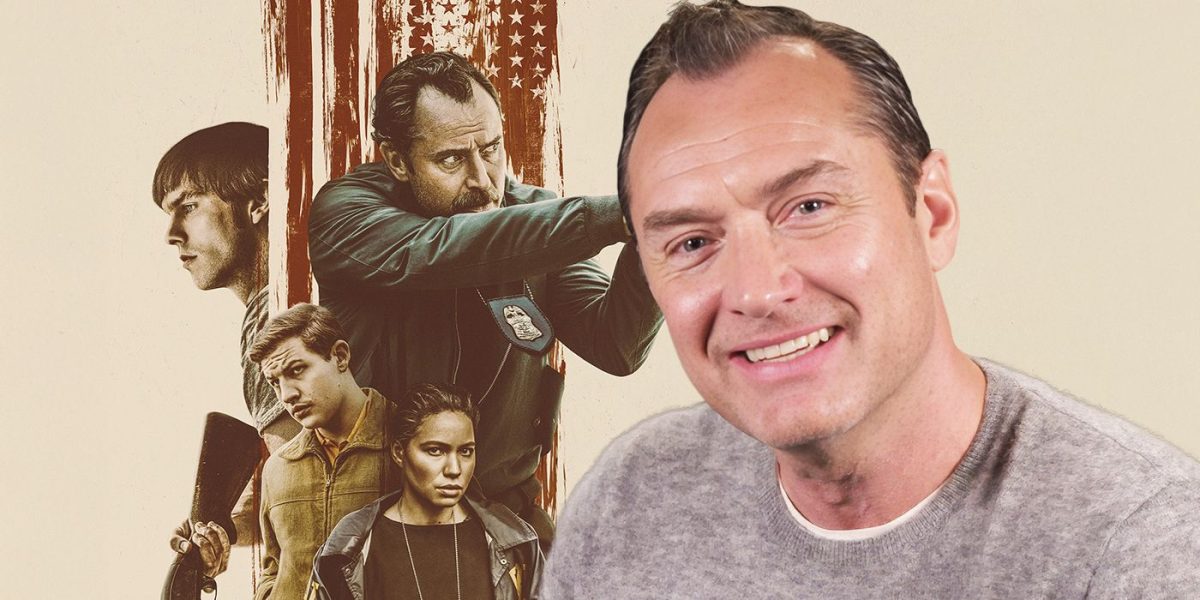
Jude Law Would Love to Revisit This “Indulgent,” Oscar-Nominated Role One More Time
Dec 9, 2024
The Big Picture
Collider’s Steve Weintraub speaks with Jude Law for
The Orde
r.
In this interview, Law discusses the ins and outs of Hollywood and the more challenging aspects of the industry, which role he’d love to return to, and the movies he thinks fans should check out.
Law also talks about working with filmmaker Justin Kurzel, perfect casting choices, and the preparation needed for his role in
The Order
.
Two-time Oscar-nominee Jude Law is having a banner year after hitting the festival circuit for The Order and Ron Howard’s Eden and joining a galaxy far, far away with his coming-soon Disney+ series Star Wars: Skeleton Crew. The work has been nonstop, gracing the call sheets of countless blockbusters for decades, and for many, the workload could be daunting. For Law, his work ethic and the joy he finds on set is evident, as well as his deep appreciation for his fellow castmates and crew.
In The Order, a crime thriller adapted from the bestseller and true story The Silent Brotherhood, Law plays Agent Terry Husk, an FBI agent investigating a series of organized crime outbreaks. Husk, alongside Agents Jamie Bowen (Tye Sheridan) and Joanne Carney (Jurnee Smollett), believes these heists to be something more sinister — the work of a neo-Nazi white supremacist, Robert Jay Mathews (Nicholas Hoult).
In this interview with Collider’s Steve Weintraub, Law talks about working with filmmaker Justin Kurzel as both a producer and lead on The Order, how crucial the perfect casting was to telling this story, and the preparation it takes to get into this kind of headspace. He also shares which of his films he would love to have a second life post-COVID, the iconic role he’d love to spend another day on, and more.
Don’t Miss Out on This Jude Law Period Piece
In Firebrand, Law plays the tyrannical King Henry VIII.
Image via Larry Horricks
COLLIDER: What do you think would surprise people to learn about being an actor in Hollywood?
JUDE LAW: Honestly, the thing that I think always surprises folks when I tell them is how hard working on a film set is, how much effort it takes. Even people in the industry who don’t necessarily have a participation on set don’t understand how hard it is. Now, there are harder jobs, no doubt, but it’s the different hours, the shifting hours, the demands of attention, the focus being on you and then not on you, all weather, nothing stops us, keep going — time is money. It’s grueling, and I just don’t know that people really think– I think they think we just somehow magic it all up, and we’re sat around eating hors d’oeuvres.
I’ve been on a lot of movie sets, and I’ll tell you, I’m good after a few hours. It’s just a lot of standing around and waiting. It’s not glamorous at all.
LAW: But when it’s your time, the fun part is it’s all these different units and skill sets who have their own time and moment and needs and focus. When it’s working smoothly and when people are really working at their best, and you’re feeling good, and your contribution is at its best, it’s like a beautiful oiled machine. It’s a wonderful thing to behold.
You’ve done, like, 80 or so projects. Is there one in the resume that you really wish more people had seen?
LAW: The one that comes to mind is one that I just made recently, which is a film called Firebrand.
Sure, and you’re very good in that.
LAW: Oh, thank you. It was just one of those times when, and it’s happened before, but the timing. That and a film I made a couple of years ago called The Nest, Sean Durkin. Again, one was just during COVID and therefore lost any opportunity for people really to see it, and I think got no real promotion and therefore just disappeared. You can probably get it on a streamer somewhere. Firebrand, again same, we were delayed, we got a great reception at the Cannes Film Festival, and then the strike happened, so we couldn’t promote it. It sort of got pinned until the next year, by which time it had lost momentum. Those little things have a great effect on the release of a film, and it’s sometimes heartbreaking when you’re very proud of the work and the part you played or the piece as a whole, and you want people to see it.
You did Firebrand with Alicia Vikander, and you’re very good in it. You play a fucked up guy.
LAW: Yeah, he’s not nice. [Laughs]
No, not even a little.
Related Jude Law and Alicia Vikander Discuss ‘Firebrand’ and If Henry VII Was a Serial Killer or Just An A**hole Law and Vikander also reveal the first thing you should watch if you’ve never seen their work.
What is the most nervous that you’ve been the night before the first day of filming something?
LAW: Well, usually the night before I actually go to film I’m okay because I’ve done my work. I’m prepared, and I’m actually excited. So, when was the last time I was nervous?
I’m making you think, I’m sorry.
LAW: No, it’s nice. It’s nice to think. It’s a hard one. It wasn’t really a film, but it was a filmed event. I did a 12-hour live event, which was one single shot, and we hadn’t had a huge amount of time to prep it, and we filmed it. If it had rained the next day, if anything had gone wrong, it could have been a nightmare. Luckily, it was the most extraordinary experience, and adrenaline rush, getting it done, but I was pretty nervous before I did that.
If you could go back in time and play a character you’ve played before for one more day, whether it be on stage or on screen, what role would you love to go back to and do one more day of filming or one more day on the stage?
LAW: I think it would definitely be Dickie Greenleaf. It was 25 years ago, and it was such a beautiful experience, that film, and playing him was indulgent, and yet I was very young. I hadn’t really made many films and didn’t realize quite how wonderful an opportunity it was. I was just sort of there doing it and enjoying it and giving it my best. But I would love to go back and maybe spend a day on that yacht.
Image via Miramax
Sure. Also, you were working with a pretty talented director.
LAW: A very talented director, and an incredible group of actors.
100%. Which shot or sequence do you think was the toughest that you’ve done in your career, whether it be because of a camera move, whether because of dialogue and a camera move, or whatever the reason? Is there one that really stands out?
LAW: The one that comes to mind is the escape sequence in the second Sherlock Holmes, A Game of Shadows, when Robert [Downey Jr.], Noomi [Rapace], and myself are running through a wood, and it’s the first time they used, I believe it’s called The Phantom, which is a camera that they have to fire down a runway and it’s shooting, I’m not even sure of the frames per second, but you can hear the film literally ripping through the camera because it goes so quickly. Anyway, we did that for days, and it was pretty exhausting — pieces of wood flying everywhere, going in your mouth and your ears — but it’s thrilling. It’s that or probably a fight sequence or two because sometimes getting fight sequences right is incredibly hard and you always end up with a bruise or a busted rib or something going wrong.
‘The Order’ Director Kept Jude Law and Nicholas Hoult Apart
“I didn’t really know that he was doing it until we were nearly a week in.”
Jumping into why I get to talk to you, we spoke at Toronto for this film, and one of the reasons I think this film works so well is you have this killer cast. Talk a little bit about working with this incredible cast and how the alchemy of this cast and Justin [Kurzel] works.
LAW: You never know it’s going to work until it does. Looking back, it’s always easy to go, “Oh, that’s why people really connected with the piece.” Justin’s ideas and the casting team’s ideas were really good, and it was a cast not being led by anything other than who is right for this role and who can bring more to this role. But honestly, I love that you use the word alchemy because I think there’s a big part of that in filmmaking. Justin is a master at allowing that to occur and creating the kind of dynamic where it can occur. He knows how to help actors on their journey to get where they wanna be. He sends us provocations and little ideas in that prep to get us a little closer so that he’s invested, like you, in the characters that immediately starts to spark relationships, or not, between characters.
Even the fact that he kept Nic [Hoult] and I apart, I didn’t really know that he was doing it until we were nearly a week in, and it was like, “Oh, yeah, they’re just off doing their film.” But equally, really, putting Jurnee [Smollett] and Tye [Sheridan] and myself together and creating a real bond there. All those little moves are just very, very smart. And as I said, the investment by each person. Jurnee’s role was originally written to be an elder man. We saw the potential in, first of all, making the role younger and more of a protege of Husk, but also, if you made it a woman, it would have to be a woman who was really motivated to be in the bureau in that position in that era, and a Black woman even more so, and Jurnee brought such intellect and insight and curiosity. But that’s true of all the actors.
Image via Amazon MGM Studios
Again, going back to Justin, he just allowed the relationships to work, and the faith he had in us and how to encourage us in our roles. No one felt scared. It was like if he wanted more, we’d all go there, and that’s a really tricky thing to establish on a piece like this. Someone like Nic could very easily have been like, “Okay, I’ll play the role, but I’m not doing that scene,” or, “I’ll do this,” or, “I can’t…” And with Justin, you know you’re safe. You know you’re in good hands; you’re in tasteful hands.
I really enjoy your work, and I love talking to actors about how they get ready for a role. For something like this, how early on are you preparing mentally for how you want to play the character, how you wanna speak, how you wanna look, just getting yourself mentally ready, and is it months in advance? Is it as soon as you get a script? Can you sort of take me through that?
LAW: It all depends on how long you’ve got. The sweet spot is when you’ve got a long time, but you may not have because you may be finishing something or scheduling is like you wanna do it, but you need a certain amount of time. I’ve certainly actually walked away from films because the time to lead up is just too short, and you wanna do it, but you think, “I can’t do this half-arsed.”
With this, because it came to me first as a producer, I had a really good period of time to not just even subconsciously think about him as a character but understand the piece as a whole. Also, because Zach [Baylin] is a very collaborative writer, as is Justin as a director, we were, really early days, discussing as a team who Husk could be, and we wanted to draw on the real agents. We wanted to create our own backstory based on other agents that we’d heard about, so we were really putting together this guy as it suited us. And what’s wonderful about having those months is you can do the reading, you can do the accent work just in drips, and let it really drip feed you. You can follow the guidance of someone like Justin when he offers little ideas like, “Spend the day as the guy, wake up, eat your lunch as him, leave me phone messages. Really just start to get used to sitting in this guy’s skin.” You can’t force it.
Image via Amazon MGM Studios
You also can’t necessarily have a plan. I always like to start at the beginning, rather obviously, like where were they born, what were their parents like, what was their childhood? And you progress. But as you progress forward towards the character that you’re about to play in that time space, you don’t know what path it’s gonna throw up and what you might learn and what might make you curious or make you think, “That’s the key.” And that’s why it’s always a challenge and always interesting.
Jude Law Reveals What It Takes to Prepare for a Role Like Husk
I spoke to Daniel Craig yesterday, and he was talking about how Monday through Friday, before he’s getting ready to film, in the weeks leading up, he is thinking about the character, spending at least a few hours every day, sometimes just silently thinking, and it was just fascinating to hear. I’m curious if you do something like that, where every day, Monday through Friday, you’re thinking about a role, or is it like it starts and stops?
LAW: No, as you’re building up to it, it’s Monday through Monday. I mean, you’re just going. So, I’ll have different things on one day, and maybe I’ll go, “Okay, so Monday and Wednesday, I know I’ve got a two-hour session on the accent,” right? But then you may have little practices that you’ve got to do in the other days, so you just do an hour where you’re doing your sounds, because you’re teaching your muscles in your mouth to do different things. You may have a skill that you have to learn. I mean, I’m just going random, but you may have a musical instrument you’ve got to learn. For Firebrand, I learned the recorder, I learned the harpsichord, so you gotta practice that.
I work with an acting coach, too, and she and I have all sorts of fun games where you physicalize the past, and you kind of emotionally picture the past so you can put that into memory banks. You talk about the past so that the sense of what the relationship with the mother was sits somewhere in you. You’ve got reading to do. Then, as Daniel said, you also have days where you’re not necessarily doing anything, but all that is gestating and germinating in the back of your head.
The Order is now playing in select theaters.
A series of bank robberies and car heists frightened communities in the Pacific Northwest. A lone FBI agent believes that the crimes were not the work of financially motivated criminals, but rather a group of dangerous domestic terrorists.Runtime 120 Minutes Writers Zach Baylin , Kevin Flynn , Gary Gerhardt
Get Tickets
Publisher: Source link




‘The Rookie’s Best Season 8 Episode Goes Completely Different With Full Zombie Horror
Editor's Note: The following contains spoilers for The Rookie Season 8, Episode 10.It's crucial for procedurals to come up with a winning formula that entices viewers to tune in every week. But it's just as important for these types of…
Mar 13, 2026

Sidney Prescott Leads a Brutal Throwback
Walking into Scream 7, I wasn’t sure if this entry would be a new reinvention. I know I wanted tension. I know I wanted that uneasy calm before the snap. And most of all, I wanted to see why Sidney…
Mar 13, 2026

Eggs – Film Threat
In writer-director-star James Clair’s short drama Eggs, a man struggling to rebuild his life finds his quiet mornings turning into strange conversations with the very eggs he is meant to cook. I mean, they want him to eat them. So…
Mar 11, 2026
Ethan Hawke Elevates A Rugged, Predictable Gold-Run Survivalist Western[Sundance]
As far as one can tell, Murphy (Ethan Hawke), a father, WWI veteran, and avid car mechanic, has never encountered an insurmountable challenge. Living in Eugene, Oregon, in 1933, four years into the Great Depression, Murphy and his young daughter,…
Mar 11, 2026