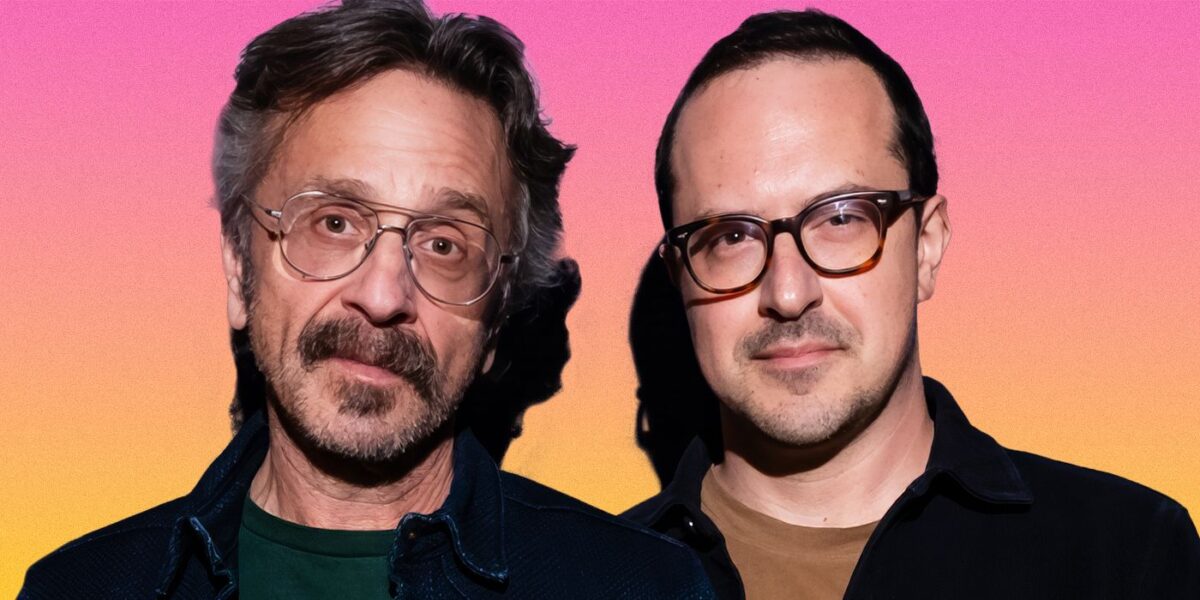
Marc Maron Talks About the “Humbling” Experience of Filming ‘Are We Good?’ and His Legion of Cats
Mar 29, 2025
Summary
Collider’s Steve Weintraub talks to Are We Good? director Steven Feinartz and comedian and star Marc Maron at SXSW 2025.
Maron reflects on personal loss and his comedic career, revealing vulnerabilities and revelations in the documentary.
Maron and Feinartz discuss their collaboration, love for cats, the filmmaking process, and Maron shares some of his experience working on the upcoming Bruce Springsteen movie, Deliver Me from Nowhere.
For more than three decades, comic and podcast pioneer Marc Maron has dabbled in all forms of ventures, be it for print, stage, or digital media. However, underneath his public persona, Marc is just like any other human being—one who has tasted the highs of his comedic career, and bit the bullet in the wake of personal loss and tragedy. In Steven Feinartz’s latest documentary Are We Good?, Marc attempts to pick up the pieces a year after the death of his partner and filmmaker Lynn Shelton. While processing his grief on and off-stage, his ruminations on mortality have brought him even bigger revelations as he looks back over his life.
With his career beginnings in the ‘80s with Sam Kinison, Marc eventually became the face of his culture-defining podcast “WTF with Marc Maron”. Since its inception in 2009, it has gained more than 55 million listens per year, and welcomed esteemed guests such as Robin Williams and former US president Barack Obama. An actor on the side, Marc has starred in GLOW, Joker, and The Bad Guys. Marc has lived every professional comic’s dream: to make it big in the industry. But having turned 60 recently, he now faces a reality that involves reconciling with a declining father, and a possibility of retiring from the changing comedic landscape.
Collider’s Steve Weintraub had the opportunity to sit down with director Feinartz and the documentary subject himself, Marc, at the Collider Media Studio at the Cinema Center at SXSW 2025. Throughout the conversation, Feinartz gave a rundown of how filming took place, and Marc shared his love for cats and what it’s like working with Jeremy Allen White in the upcoming Bruce Springsteen biopic Deliver Me from Nowhere.
Marc Maron Voiced Lex Luthor in ‘DC League of Super-Pets’
“I have a sense that Lex Luthor was important in the DC Universe.”
COLLIDER: When you were growing up, did you ever think you would voice Lex Luther in an animated movie?
MARC MARON: No, because I’m not even sure I knew who he was up until I got that part. I have a sense that Lex Luthor was important in the DC Universe. But, yeah, I had no idea. Nor would I have thought it would happen. Ever.
Did you enjoy that experience?
MARON: I think so. When you do voiceover for animated things, you don’t always know really what’s happening. You’re just in a booth, and you’re doing a thing, and then someone will come up to you a year later and go like, “Hey, I saw you in DC Super-Pets.” And I’m like, “Oh yeah, I haven’t seen that. How was it?”
Okay. My other thing, if you don’t mind. I love the movie Almost Famous. Just love. And you were an angry promoter.
MARON: That’s right.
What do you remember about that experience? That was early in your acting career.
MARON: Yeah, there was a big gap. I think about 20-year gap between parts. What I remember were two things. Cameron Crowe was very nice. I had that small part, and he had dinner with my wife at the time and myself. He was into hanging out with a guy who had two lines. The other thing was, I didn’t really know the difference between this sort of B-unit crew. When I was driving up that ramp, chasing the bus, everyone else had gone. There was nobody there but me and a second camera crew running up and down that ramp for, like, 10 or 12 takes.
Marc Maron Initially Said No to Steven Feinartz’s Documentary
“How much more do we have to do?”
Image by Photagonist
Jumping into why I get to talk to you guys. You guys have worked together before. You’re obviously friends. When did you realize that you wanted to make this film? When did you realize you were okay with making this film?
STEVEN FEINARTZ: We talked about making the film in April of 2021. That’s kind of when it started. I’ve always been a fan of Marc’s, and I’ve known him for about 12, 13 years. I thought he’d be a very difficult documentary subject, so I went into it with a little bit of nerves. But once we started shooting, I was very comfortable. I knew we had something unique for sure.
MARON: He had done a doc on my buddy Eddie [Pepitone], and I think I was in that, right? I liked his work, and he’d always been around comedy. He expressed interest, and I said, “Why?” And then he expressed interest again. I said, “No!” And then maybe the sixth or seventh time, I’m like, “Okay, go ahead. Do it.”
When you agreed to do the doc, and when you decided to make it and the stars aligned, how much were you filming? What is it actually like when you’re following him around and filming? Is it one of these things where you’re around all the time, or do you designate certain days?
MARON: Oh my god, so much. He was around, like, always, it felt like. Then I’d be like, “No, how much more do we have to do?” And he’s like, “Just a little more. Just a little bit.” Then that would go on for a year.
FEINARTZ: I kept annoying you at the Comedy Store.
MARON: For a while. But once we got it going, it was fine. But I felt like it was never-ending.
What is it like when someone’s in your home following you around, doing what you’re doing, watching you do stuff?
MARON: Well, it’s a little heightened. You can’t claim to not know it’s there. Because I’m a performer, there is an element of being conscious of the camera. But depending on the tone of what we were doing, if I’m just at the Comedy Store hanging out, then I can focus on other things, but if it’s just me baking a pie, I’m gonna add a little juice to it.
FEINARTZ: Well, that’s why you overshoot in these documentaries, too.
MARON: You gotta wait until the performer stops performing.
FEINARTZ: Yeah, you gotta wear ’em down a little bit.
Image by Photagonist
I would imagine that’s true. When you start filming at the beginning of the day, the camera’s there. But after five hours, maybe you shut off to it.
MARON: Well, yeah, but it’s a matter of engagement. If I’m talking to him, I’m going to shift gears. If I’m talking with my dad or with other people, I am able to focus on what’s happening as opposed to the camera being on. But there’s an impulse to address the camera.
FEINARTZ: Most of the film was just me and a camera with Marc. We didn’t have a big crew. Only on certain days, but mostly it was just a one-off thing.
When Marc’s Not Working, He’s Taking Care of His Many Cats
“I always used to wonder, ‘How come all my cats are nervous?'”
Image by Photagonist
I think the film is fantastic, but I do have one note and one objection to the edit. I really loved him with his cats. I am a big cat person, and there really wasn’t enough footage of that. That’s a real problem for me, so can you please address that as the director?
MARON: I think we got the all in there.
FEINARTZ: I think they were definitely in there. Yeah, you’re being facetious, but yeah.
I’m not being facetious. I’m dead serious.
MARON: That’s a different documentary.
FEINARTZ: There are a lot of cats in this one.
MARON: It’s a documentary called Marc’s Cats.
And I’m fine with that.
MARON: Yeah, yeah, yeah. That’s a whole other movie. We’ll get to work on that one.
I love animals, I love cats, I love dogs. Talk about your love of cats, and the fact that you put up with them when you don’t put up with a lot of other things.
MARON: I grew up with a lot of dogs when I was a kid, a lot of old English sheepdogs, and there were a few cats around. There’s always a lot of animals around. I just don’t live the life that would be good for a dog. Then at some point, Mishna [Wolff], my second wife, bought me a kitten, Butch. She made it to LA the first time I moved out there, but then she had a congenital heart problem and died fairly young. We had gotten another cat, Boomer, for Butch. Boomer, I remember, I went to a shelter, and we were looking at these cats, and it was one of these sorts of, I don’t know what kind of shelter it was, but it looked like a lot of old cats and people just had enough of. Just very tired cats. There was one that was out of his mind, and I’m like, “Let’s get that one.” But then, having had experience with feral cats later, I realized that was a feral cat, Boomer was.
Then, it evolved because I was in Queens and I ended up trapping these three feral cats in the back of my yard, and I didn’t realize they were feral. They just destroyed everything in my house. It took years to make them calm, but they were the original cats. That was Monkey and Lafonda, and then we had Boomer from when Butch was alive. I had Monkey and Lafonda for 16 years, and then Buster showed up at my door, I don’t know why, when he was very young.
Image by Photagonist
Was that in Queens or in L.A.?
MARON: That was L.A. He just showed up. He was eating the food I put out for the ferals that were out by my house, or a few cats outside, and he showed up. He was too young to really be out in the wild. I don’t know, he must have gotten away. So we took him in. I took him in and cleaned him up. He’s there now, Monkey and Lafonda passed. And then…
FEINARTZ: Sammy.
MARON: Yes. Sammy came from a litter of a friend of my girlfriend’s. Then, again, Charlie was under my backyard. He showed up at my house to a feral mom that had a litter, and she was moving them all over the place, but she left this one. She left him, probably coming back for him, but I took him, and he’s very young. I’ve always liked cats. I have an adversarial relationship with a lot of them. I talk about it on stage, but I always used to wonder, “How come all my cats are nervous?” And I realized I don’t talk to them like regular cat owners. I’m like, “What’s going on, guys?!” So the cats are like, “What? What’s happening? Why’s he yelling?” So, it took me a long time to realize. I mean, I’ve calmed down with them, though.
I have to say, I really love what you do. I also have done similar things, but respect.
MARON: Thank you.
Marc’s Father Becomes “A Bigger Part of the Story”
“I trusted him with his vision.”
Image via SXSW
I’m always fascinated by editing, and especially on a documentary when you have so much footage. Talk a little bit about when you started filming. Did you have an idea of where it was going, or was it more like, “Let’s film, and then we’re going to find it in the edit?”
FEINARTZ: No, we knew we were going. We didn’t know where the third act was going to be, to be honest with you, but we knew where we were going with most of the film. It was the trajectory of building the material after Lynn Shelton had passed away, and Marc figuring out how to talk about it on stage. That was the core of the film. When we brought on our editors, our lead editor, Derek Boonstra, a fantastic editor, we sat down and figured out some new directions for the film, not the typical sort of A to B sort of thing. Marc’s father became a part of the story, as well. There were sort of new elements that came in later on as we were filming.
Were there any storylines or big changes that happened in the edit that you weren’t expecting, or you showed the film, and you were like, “Oh, maybe we need to do this?”
FEINARTZ: No. No major storyline changes. I think your father would be the biggest one, being a part of the end. In the last 30 minutes, his father becomes a bigger part of the story.
Are you watching cuts along the way, or are you only seeing it when he has a cut? Then, when you watch it, how much are you like, “This is pretty personal. I don’t want this in there?” How much do you sort of like, “It’s all okay?”
MARON: No, it was all okay. I trusted him with his vision. It’s his movie. He showed me one cut early on that I had notes on, and he got notes from other people. I had input in terms of just tightening it up a little bit. Then I only saw one other cut, a more complete cut, and I didn’t have anything personal. The problems I had with it were cringey with me; they weren’t problems with the film. They were just problems with me. It’s kind of hard to see that stuff.
FEINARTZ: You were so minimal in terms of your notes. You had, like, one thing, essentially.
MARON: On the people that you interviewed?
FEINARTZ: Yeah.
MARON: Well, you interviewed a bunch of my peers. The film itself is a little hard on me in a way, only because I’m me, and I didn’t see myself the way that I saw the guy in the film. But he interviewed all these peers of mine, like [Nate] Bargatze and [David] Cross and my friend Sam. And all the clips were them bustin’ on me, and I’m like, “Didn’t they say anything nice? Can you put in one nice thing? The film’s hard enough on me just as it is. Have these guys talk me up a little bit.” And I thought that was a reasonable note.
When you watch a film like this, which you see yourself in a different light, is there anything that you saw that you’re like, “Wow, this is something I’ve never really thought about as myself that I actually maybe want to work on because of the film?”
MARON: Well, yeah. I think that seeing yourself from the outside point of view or from Steven’s point of view, as opposed to me seeing myself—and I think I’m pretty self-aware—you don’t really get to see who you are in the world from that point of view. There were things where I was like, “I could probably tighten my belt.” My pants were falling down a lot. It was kind of humbling in that I did get to see how other people react to me from an external point of view. I don’t know if there’s anything I need to work on, other than maybe not being so worked up all the time.
Marc Hung Out with Bruce Springsteen on the ‘Deliver Me from Nowhere’ Set
“I had interviewed him, so he knew me enough to hang.”
Photo by Jefferson Chacon
Marc, I’m a huge fan of Scott Cooper. You’re in the upcoming Bruce Springsteen film. What can you say about your role and getting to watch Jeremy [Allen White] and work with Scott? It’s a really big deal, a really big film.
MARON: Well, it’s weird because it’s really a very small part, but the guy is pivotal in the story of the making of Nebraska, this engineer named Chuck Plotkin. I agreed to do it a while back, and then I’d done another movie, and then I revisited the script, and I texted Scott, and I’m like, “There’s not much for me to do here, man.” He’s like, “You don’t have to do it. I just thought it would be fun.” I’m like, “Alright, I’m sorry.” But I love Scott and I love his movies. He’s got a very specific vision and it’s compelling. He’s great, so I went out there.
The best part of it, really, was there was no reason for me to research this guy. He was the engineer. I just needed to work like I knew how to run a board. There were lines and stuff, and I had scenes with Jeremy Strong, and I had one scene with Jeremy Allen White, but it all took place in the studio, and it was the studio where they did some of the recording of trying to get Nebraska right, so it’s the real studio.
The real perk of doing that movie was Strong is playing Jon Landau, and White is playing Bruce, but Bruce and Jon, the real ones, were just out at Video Village. They were hanging out the whole time. So, Scott would yell cut, and then you’d just go hang out with Bruce for a while. So, that was pretty great. I had interviewed him, so he knew me enough to hang. So anytime you had a minute to get off the set, you’d just go ask Bruce some questions. It was kind of fun to see Jeremy work, both Jeremys, and [Paul] Walter Hauser was there, too. He’s kind of a funny guy.
This cast and this lineup. What do you think audiences will see when they see Jeremy as Bruce and Jeremy as Jon because they’re both such talented actors?
MARON: Well, I think if you’re a creative person who has come up against yourself in terms of what your vision is, the story of making Nebraska is a very compelling story, and they’re both all in. Jeremy Allen White is doing his own singing, and there were times when Bruce didn’t know whether what he was listening to was him or Jeremy. It’s a good story, man.
Special thanks to our 2025 partners at SXSW, including presenting partner Rendezvous Films and supporting partners Bloom, Peroni, Hendrick’s Gin, and Roxstar Entertainment.
Are We Good?
Release Date
March 7, 2025
Runtime
97 minutes
Director
Steven Feinartz
Producers
Sean Bradley, Rob Guillermo, Ethan Goldman, Ariel Weisbrod, Ryan Bitzer, Damion Greiman, Julie Seabaugh, Dan Baglio, Toby Nalbandian, Tim Rummel
Publisher: Source link



Mason Gooding & James Van Der Beek’s Bad Night Is Aggressively Dull
Ever since the Scream franchise helped put him on the map, Mason Gooding has been a great talent to watch. The genre-bending slasher Heart Eyes is still his best non-franchise role yet, but he's also branched outside of horror in…
Mar 15, 2026
A Grumpy Nick Offerman Keeps This Fish Tale Swimming Along
Animated fish films have been done. Finding Nemo. Shark Tale. Ponyo. So to hear about another doesn't feel like anything new. However, The Pout-Pout Fish, starring Nick Offerman as a grumpy ocean pout named Mr. Fish, is a little different.…
Mar 15, 2026
‘The Rookie’s Best Season 8 Episode Goes Completely Different With Full Zombie Horror
Editor's Note: The following contains spoilers for The Rookie Season 8, Episode 10.It's crucial for procedurals to come up with a winning formula that entices viewers to tune in every week. But it's just as important for these types of…
Mar 13, 2026

Sidney Prescott Leads a Brutal Throwback
Walking into Scream 7, I wasn’t sure if this entry would be a new reinvention. I know I wanted tension. I know I wanted that uneasy calm before the snap. And most of all, I wanted to see why Sidney…
Mar 13, 2026