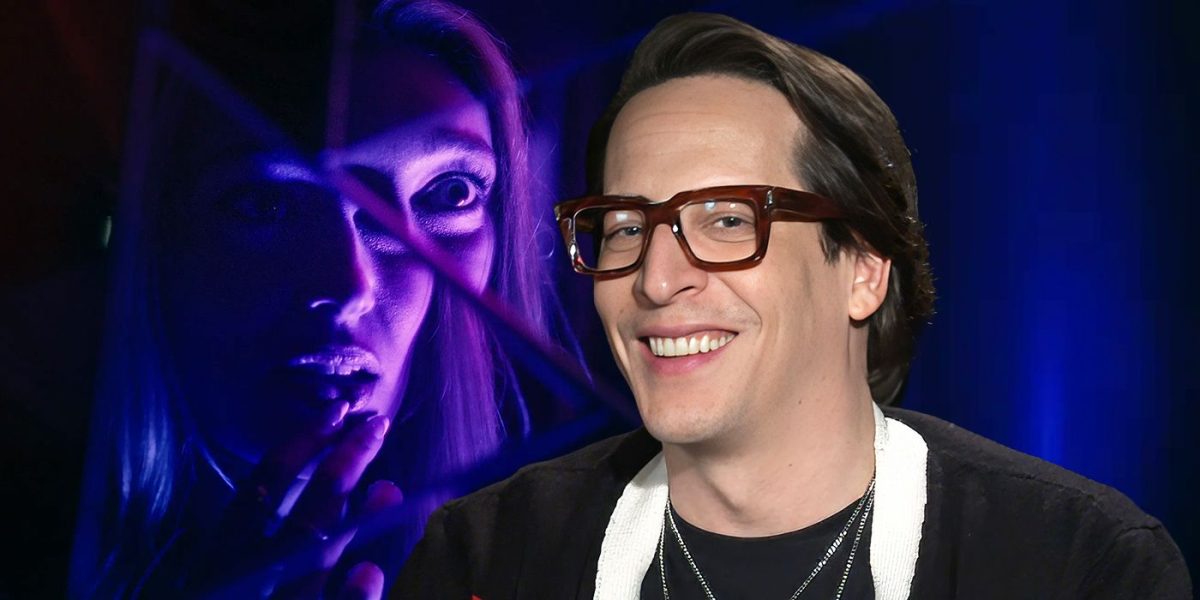
Netflix’s ‘It’s What’s Inside’s Major Twist Was Almost Something Else Entirely
Oct 7, 2024
[Editor’s Note: The following contains spoilers for It’s What’s Inside]
The Big Picture
Collider’s Steve Weintraub talks with
It’s What’s Inside
writer and director Greg Jardin.
The film follows a group of friends at a pre-wedding party that spirals into chaos with a mysterious game.
During this interview, Hardin discusses how his unique style of editing, known as “Anxiety Chic,” enhances the film’s atmosphere, creating a sense of anxiety for viewers.
Greg Jardin is experiencing the filmmaker’s ultimate thrill of a lifetime. From producing an original screenplay, getting into a prestigious festival, inciting a bidding war, to streaming on the largest platform on the planet, this writer-director is genuinely living the dream. With an incredible young cast, a fresh story, and a brand-new style of editing, Hardin’s comedy-thriller It’s What’s Inside stunningly sold to Netflix for an astounding $17 million, making it the largest deal made at the year’s Sundance Film Festival. Now, Hardin’s little indie-that-could is celebrating its much-anticipated streaming drop this weekend.
It’s What’s Inside centers on a group of friends coming together for a pre-wedding party. Soon, the gathering descends into an existential hell after an uninvited guest arrives with a mysterious game, awakening deep-seated secrets, dreams, and conflicts. The film stars James Morosini (I Love My Dad), Nina Bloomgarden, (The Resort), Alycia Debnam-Carey (Fear The Walking Dead), and Brittany O’Grady (The White Lotus), Gavin Leatherwood (Chilling Adventures of Sabrina), Reina Hardesty (Brockmire), Devon Terrell (Barry), and David Thompson (Gotham).
During this interview, Jardin talks with Collider’s Steve Weintraub about his new Netflix hit. They discuss the filmmaker’s early days to selling his movie in a massive bidding war, the mandates he set for himself when writing the screenplay, and Hardin’s personal brand of visceral filmmaking dubbed “anxiety chic.” For more on deleted scenes, what changed throughout production, and that twist, check out the full conversation in the video above or the transcript below.
Selling at Sundance Was Surreal
Image via Netflix
COLLIDER: I really wanna say sincere congratulations on this movie. I’d heard all the buzz, and I’m like, “Will it live up to this buzz?” And it does. It’s real good. What the hell is this journey like for you, though? For people who don’t realize, this is an indie movie. You bring it to Sundance and then you sell it for a crazy amount of money, and now it’s gonna be on Netflix.
GREG JARDIN: It’s surreal. I mean, hearing you say that is surreal. I still can’t even believe that we got into Sundance. We shot this movie at the end of 2022 on a $2 million budget. You kind of make it in a bubble. I had written the script six years prior, so just getting to shoot it was like, “I can’t believe we’re shooting this. I can’t believe that this is a thing.” You make it, and you have no idea what’s gonna happen. You hope that someone buys it, and you just send it out to film festivals. We did. I really didn’t even expect to get into Sundance. It seemed like a pipe dream. So when we got in, it was amazing. Being there, it was amazing. Having one person interested in buying was amazing, so having multiple people — it’s crazy. It’s been a dream and very surreal.
What was it like for you after Sundance and after the sale? Y ou get back to LA, and how many meetings did you do? What was it like when the door finally opened?
JARDIN: It’s great. I got COVID 24 hours after the sale, so I ended up being laid out in Utah for a week. Everyone left, and I was still there. I got here, and my agent was setting me up to do the proverbial “water bottle tour.” It’s been amazing that people have responded to the movie so much, especially after being unsuccessful at getting it made for so long. I’m thrilled that people like it.
Related This Is One Hell of a Party Game: 6 Things You Need To Know About Netflix’s ‘It’s What’s Inside’ Anybody up for some good old-fashioned body-swapping tonight?
Do you have a whole bunch of unproduced scripts? Because in those meetings everyone’s like, “So what do you want to do next?”
JARDIN: Totally. That is exactly what they said. Yes, I was trying to get another movie made prior to this one for, like, 10 years, and I couldn’t get financing. That led me to say, “I got to write a one-location thing that I can make as cheaply as possible.” But yes, at this point, I have a backlog of ideas all in various stages of outline. I have one script fully written. I’m hoping to get one of those going as my next project, knock on wood.
That Major Twist Was Almost Completely Different
Jumping into the film, I’m so fascinated by where an idea starts versus where it ends up. What were some of the big things that this went through? Was it ever radically different?
JARDIN: Like I said, I started with the mandate of it being as low-budget as possible. I gave myself the mandate of one night, one house, eight people, sci-fi. I’m a sci-fi nerd. You know what I’m saying?
It’s my favorite genre.
JARDIN: Same, same, same. Yeah — “Guy comes with a suitcase. Some sci-fi shit happens.” The overall bones of the story were always there. The big change from that first draft to now is, initially, the person in Forbes’ body was not his sister; it was his lackey at the lab who was just disgruntled. They were just doing this to essentially go to this party, get this trust fund money, and get out. I showed it to a handful of friends and I got the sort of recurring note, “It’s too bad this lackey character has nothing to do with the group. Kind of comes out of nowhere.”
I was talking to one of my friends, Matt Pope, who’s also a filmmaker, and I was like, “Maybe it should be Forbes’ sister. Maybe she was the person who Dennis cheated on Nikki with,” because I had that plot point already in the script. That fell into place around, I wanna say, draft four. That was the biggest plot change that happened from the beginning to what we have now.
Greg Jardin Explains Why Certain Scenes Were Cut
And why others were added…
Image via Netflix
So you’re in the editing room, you have a cut, and you’re showing it to friends and family, whoever you trust. What were some of the big notes you got that ended up tweaking the film for the better?
JARDIN: We had two test screenings, smaller screenings. One in June and one in September. I found them very helpful. The biggest things were the beginning needed to be tightened — everything before they get to the house originally was twice as long. We cut a scene out. It’s one of those things where you think you need a scene to set up what the party is, and then you realize it’s in the totality of the movie people are seeing. It’s like, “I guess we don’t need any of that information setting up the wedding,” because that all gets set up in the Instagram montage. We really tuned the beginning down. Then the end, the clarity of who winds up in whose body. We got a note that was kind of unclear, and so we did go back and do a pickup shoot where we shot some red light stuff where we show the audience who’s in who at the end.
Did you end up with a lot of deleted scenes?
JARDIN: We have two deleted scenes. There’s a scene at the house where they’re basically just finishing up their bedroom argument, talking about, essentially, the exposition of the party and the scene where they’re packing the car. There was the longest scene where Shelby is making this post at the gas station, where this thirsty gas station clerk is oogling over this attractive girl. It goes into the organ Bach music, and the spotlight comes on her, which is the same thing that happens later when she’s in Nikki’s body. That was supposed to be a callback to that, but it was just one of those things where, in the totality, “You know what? This is kind of a double beat.” We understand that Shelby doesn’t feel valued. I think that was all that we cut out.
Greg Jardin Coins “Anxiety Chic”
Image via Sundance
I really enjoyed the editing and the pace of the editing. It’s not fast. You can’t cut what you did with this movie in a week. This is like real editing. Talk a little bit about the challenges and establishing the look you were going for with the edits.
JARDIN: I’ve been editing my own stuff since I’ve been in LA, initially out of necessity because I couldn’t afford anyone. I would teach myself After Effects, visual effects, doing low-budget music videos. I very much shot the movie with the edit in mind. There wasn’t a whole lot of extra footage. We didn’t really shoot a lot of coverage. The sporadically jittery style of the editing was all in service of making the film feel what I call “anxiety chic,” which is essentially a film that makes you anxious. We want to make you feel like Shelby. She’s an anxious character — we see her take a Xanax. Can this film, via the editing, or really everything — sound design, camera work — give you the experience of what it feels like to be an anxious person?
How much did you debate the opening shot and the closing shot? I’m always fascinated by what a director wants that first thing you see and the last thing you see to be.
JARDIN: Oh man, I love this question! I love this question, actually. So initially, the plan was to start on Shelby’s face and end on Shelby’s face. I forgot to mention this: initially, we started in the bathroom, where she closes the mirror; we’re seeing her face, and then it ends on her face. That came out of a test screening, too, where people were a little confused about the tone. There were no sci-fi danger elements in the first seven minutes, so because of that, I came to the conclusion, “I gotta insert a new opening that has a sci-fi vibe.” That’s when I came up with, “Let’s pull out of the machine and set up the red, green, blue particles.” But yes, I always pay attention to the first and last shot of a movie. Always.
This Was the Trickiest Character to Cast
Image via Netflix
Which character or casting ended up being the toughest to figure out and why?
JARDIN: Oh, man, that’s a good question. Probably the one I was the most nervous about going into was Forbes. With Forbes, my philosophy was, “Let’s get an unknown actor.” He has to have a very special quality. It’s hard to articulate what he needs to be like. We had an open audition. David Thompson came in, I saw his face, and I was like, “Oh, this guy’s got a really interesting face.” I didn’t even realize that he was in Green Room. I mean, I’ve seen Green Room, like, four times. I did not realize that he was Tad from Green Room. He didn’t have the mohawk. Just seeing him was like, “Wow, like this guy is amazing.” I would say that was the hardest role to cast because it’s the hardest one to describe. He has to be a little weird, but not so weird that you kind of wouldn’t wanna avoid him physically.
It’s What’s Inside is available to stream on Netflix now.
It’s What’s Inside A group of friends gather for a pre-wedding party that descends into an existential nightmare when an estranged friend arrives with a mysterious game that awakens long-hidden secrets, desires, and grudges.Director Greg Jardin Runtime 103 Minutes Writers Greg Jardin
Watch on Netflix
Publisher: Source link





Eggs – Film Threat
In writer-director-star James Clair’s short drama Eggs, a man struggling to rebuild his life finds his quiet mornings turning into strange conversations with the very eggs he is meant to cook. I mean, they want him to eat them. So…
Mar 11, 2026
Ethan Hawke Elevates A Rugged, Predictable Gold-Run Survivalist Western[Sundance]
As far as one can tell, Murphy (Ethan Hawke), a father, WWI veteran, and avid car mechanic, has never encountered an insurmountable challenge. Living in Eugene, Oregon, in 1933, four years into the Great Depression, Murphy and his young daughter,…
Mar 11, 2026
The Moment Review | Flickreel
Brat Summer was a cultural phenomenon that I didn’t understand at all. I knew that it was connected to an album that Charli XCX had released. Whenever I asked what Brat is, though, nobody could seem to give a straight…
Mar 9, 2026
Cillian Murphy’s Netflix Crime Hit Delivers a Brutal, Bleak Finale
It’s been four years since we last saw Cillian Murphy play Tommy Shelby, but seven have passed in the world of Peaky Blinders, with The Immortal Man taking place in 1940, in the middle of World War II. Tommy’s gone…
Mar 9, 2026