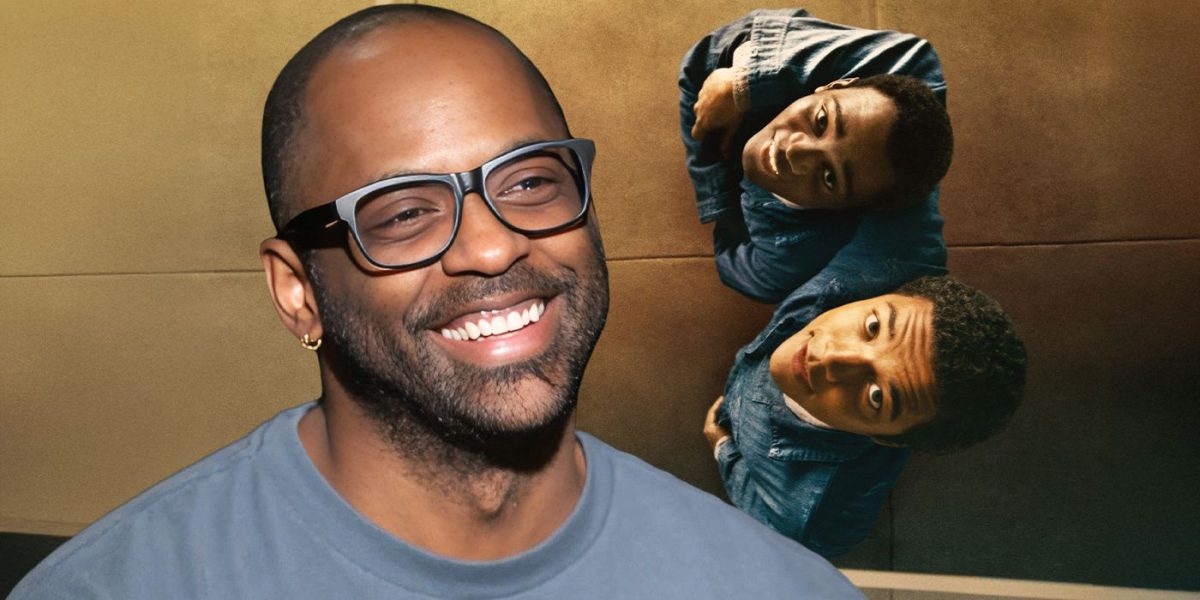
‘Nickel Boys’ Director RaMell Ross on Oscar-Nomination Morning Jitters
Feb 7, 2025
Summary
Collider’s Robert Brian Taylor talks with Nickel Boys co-writer and director RaMell Ross about the film’s two Academy Award nominations.
Nickel Boys, adapted from Colson Whitehead’s Pulitzer Prize-winning novel and now a Best Picture nominee, tells a powerful story from a first-person POV perspective.
In this interview, Ross discusses the impact of Nickel Boys’ award-season success, the film’s unique POV, and documentary versus narrative filmmaking.
Of all the Best Picture nominees at this year’s Academy Awards, it’s possible that director RaMell Ross’ Nickel Boys is the most distinct. Adapted from Colson Whitehead’s novel, Ross’ film tracks two African-American boys, Elwood (Ethan Herisse) and Turner (Brandon Wilson), who are sent to an abusive juvenile reform school during the 1960s. Both the film and the book are partially based on the real-life horrors of the Arthur G. Dozier School for Boys, a Florida reform school where abuse, torture, and even murder went on for decades unimpeded. Ross tracks the boys’ poignant and heart-breaking journey by making their eyes the audience’s eyes, as Nickel Boys presents its story from a first-person point-of-view that bounces back and forth between the two characters. The audience only sees what they see.
Authentically told and deeply emotional, Nickel Boys was expected to be in contention for a host of Oscars and ended up with two key nominations, one for Ross and his co-writer Joslyn Barnes for Best Adapted Screenplay and another for the coveted Best Picture award. In this one-on-one interview with Collider, Ross talks about what he hopes the nominations will mean for his movie, the stresses of Oscar nomination morning, and why he considers the line between documentary film and narrative film to be a mighty thin one (if it exists at all).
RaMell Ross on What the Oscar Nominations Mean for ‘Nickel Boys’
“To me, that’s kind of what award season is about: increasing the audience.”
Image via Amazon MGM Studios
COLLIDER: Thank you for taking the time to talk to me today and congratulations on Nickel Boys’ Academy Award nominations for Best Picture and Best Adapted Screenplay.
RAMELL ROSS: Thank you. It’s pretty amazing!
So let’s start with those nominations. For you, what part does Nickel Boys’ award-season success play in what you hoped the film would accomplish overall, as far as connecting with audiences and resonating with people both in and out of the industry?
ROSS: I think it does just that. It accomplishes the idea of providing the opportunity to connect, the potential to be moved. I think, given that these young boys’ lives were taken quite early, and they were literally buried — and the metaphor of burying history applies here — it’s ironically like being resurrected and elevated to the highest echelons or annals of cinema. To me, that’s kind of what award season is about: increasing the audience.
To me, Nickel Boys is a film that carries historical significance. It carries social significance. Do you think that there’s a bigger impact when that type of film gets Oscar nominated or gets some awards-season love, just because it might allow for more audiences to see it or allow for more of that type of film to get made?
ROSS. Yeah, I think it does both. But impact is a funny thing because it’s really difficult to measure. It’s like, impact for who? I know you’re dropping into those details with: “Does it help [movies] get made? What exactly is it doing?” I’m unsure. But, for a film like Nickel Boys, because it has formal gestures that are interesting and are confrontational, I think that it being elevated to the Academy space is a different type of accomplishment. Because this story is just as much about the way that a story is told, as it is a story itself. And, with that, it allows someone to question narrative form as it relates to language in general and art in general.
About That One Oscar Nomination ‘Nickel Boys’ Didn’t Get
“I can frame with the best of them — at least my version of framing — but to build the emotion of a scene with light is no small task.”
Image via Amazon MGM Studios
So I have to tell you that I’m a member of the newly formed Pittsburgh Film Critics Association. We gave out our inaugural awards a few weeks back, and Nickel Boys was actually our winner for Best Cinematography.
ROSS: Wait, really? Sick!
Yeah, so I don’t know if you can say it, but I’m going to say it: We really should be talking about Jomo Fray, your cinematographer, today, too, right?
ROSS: [Laughs] Yeah, yeah, Jomo was a treat to work with.
Just an amazing-looking film you guys made.
ROSS: He’s a pretty brilliant dude, and I can’t imagine having worked with someone else. His fluency with the color and the light is out of my wheelhouse. I can frame with the best of them — at least my version of framing — but to build the emotion of a scene with light is no small task. It’s a lot of pressure. We didn’t have much time. And he invented some stuff. He just rerigged all these crazy machines.
The Unique Perspective of ‘Nickel Boys’
“I would recommend that people make any film because all films, to me, are documentaries.”
Image via Amazon MGM Studios
Moving on to the nominations you did get: You were nominated, along with your co-writer Joslyn Barnes, for Best Adapted Screenplay. Anyone who has seen Nickel Boys knows that it makes some brave and impactful choices in how it presents its point of view and how it tracks its POV through your two lead characters in the first person. Correct me if I’m wrong, but I believe all those POV flips were built into the screenplay. What degree of difficulty did that add to the writing process and to getting what you thought was the best version of the story down on paper?
ROSS: It didn’t present a challenge, necessarily, because that just was the film-writing process. The first question you ask yourself, if you’re going to make a point-of-view film, is who gets point-of-view? Like, why not everybody? Why not Hattie? Why not Spencer? And then once you figure out that it’s just Turner and Elwood — if that’s the core organizing mechanism — you just go into the process deciding when to switch for reasons that align with how you want the audience, who is also the character, to participate in the moment. And so, it’s actually quite fun, right? You get to think about many types of participation: The audience consciously participating that they’re Elwood, consciously participating that they’re Turner, and then consciously participating that they’re unsure if they’re Elwood or Turner, and what does that mean?
When you first started thinking about turning Colson Whitehead’s book into a film, at what point did you realize that you wanted to tell the story entirely from a first-person perspective and split it amongst those two characters? Was that immediately in mind when you started thinking about this film? Did it come later?
ROSS: Yeah, it was immediate. It was right after I finished the book. But it was just a seed of an idea, right? I wasn’t like, “I’m going to make this movie, and I’m going to make it point-of-view, and this is how it’s going to be.” It was more like, “Whoa, what a powerful narrative. I wonder if this could be a point-of-view film? Huh, anyway, what’s that … a bird? Hi, bird!” You know, just going about your day. And then I chatted with Joslyn, and the first thing I said was, “Yeah, I think it’d be really cool if it was shot in POV.” And, normally, I think someone would be like, “Man, that’s crazy.” But Joslyn was like, “Oh, that’s pretty interesting.” And we just never looked back.
Related
‘Nickel Boys’ Review: RaMell Ross’s Brilliantly Crafted Adaptation Is One of 2024’s Best Movies
This stunning adaptation of Colson Whitehead’s novel feels like it’s breaking new ground with its impressive first-person perspective.
I find it interesting that we have two films in awards contention this year, Nickel Boys and Sing Sing, that I think, to some degree, address their stories using almost documentary-like principles, even though neither is a documentary. And I know that you and Greg Kwedar, the director of Sing Sing, both have a bit of a background in documentary filmmaking. Do you think that skill set comes in handy — or how do you even apply that skill set — when you’re tackling a film like Nickel Boys, which is a historical drama but is also very much rooted in real-life events?
ROSS: Yeah, I think any type of filmmaking is good as an on-ramp to making films. But I will say that documentary filmmakers have a certain — and I could be wrong — but there’s something non-fiction or actual or real-life about the way in which they look at the relationship between truth and the image. There’s some allegiance to the type of truth that is not fiction. I know that’s really easily understood. It’s almost a platitude. But I definitely see that connection in Sing Sing, as well. It makes a lot of sense why his film feels as alive as it is, because he’s looking for that type of aliveness when you’re just in a moment. I would recommend that people make any film, because all films, to me, are documentaries. The language that we use is so confusing because it has more to do with the industry of and the dissemination of films than the actual process and content of films.
Was there anything from Whitehead’s book that you wish you could have fit into the film, but ultimately you just couldn’t find a place for it?
ROSS: Oh, my God … everything. [Laughing] Joslyn and I really, really distilled that masterpiece. We both really loved the encyclopedias. I don’t know if you’ve read the book, but there is an element where Elwood gets tricked into washing dishes — a washing-dishes competition. And then he wins, and they give him a set of encyclopedias. He goes home, and he memorizes essentially the “A.” And then he goes to “B,” and he realizes the “B” is empty. Then he goes to “C,” and the “C” is empty. He had gotten one of those prototypes, where it was only one letter, and all the rest were just dummy books to show you what [the encyclopedia] looks like. And it was a wonderful metaphor that Colson rolled with, but we just couldn’t get it in.
I’m sure it’s tough when you’re adapting.
ROSS: Impossible, Robert. Impossible.
RaMell Ross Talks About Oscar-Nomination Morning
“There’s nothing but anxiety and dread, you know?”
Image via Amazon MGM Studios
I’m curious how Oscar nomination morning went for you. Because I feel like, if you’re following along with the narratives and the smaller awards, there always ends up being some movies that feel like shoo-ins and some movies that feel like long shots. And then there are some that are in the middle, and you’re really not sure. I don’t think I’m out of line in saying that Nickel Boys kind of felt like it was part of that last group. So is it fair to say that there was some suspense on your end? And how did that morning play out for you?
ROSS: Oh, my god, so much suspense. [Laughs] There’s nothing but anxiety and dread, you know? I think the process of sharing the film with as many people as one does during the campaign was really, really, really fulfilling. But that morning, by myself, under the covers, eating popcorn — Smartfood popcorn, of course — just kind of curled up in a ball watching everything happen outside of my control. And then they say “Nickel Boys,” and it’s like, “Well, that was fast.” [Laughing] Because they just say the films! There’s no drumroll! Actually, there was a bit of a delay on my end because my dad was calling me right before they announced, and I was like, “Do I have …? Why is my dad calling me?!” It was funny.
This is your second trip to the Oscars after being previously nominated for Best Documentary Feature. What do you think the big differences are going to be for you this time, just as far as going to the ceremony? Are you preparing in any different ways?
ROSS: I think this time is even more astounding. But that’s hard to say because Hale County This Morning, This Evening is an experimental film. People call Nickel Boys experimental, and I’m like, “Yeah, I guess so.” But to get [Hale County] nominated was wild, so that was a shock. I think I’ll always try to be present, I guess, for lack of a better word. I don’t know if I’m going to prepare. I’m just going to go and try not to say something stupid or trip down the stairs or do anything embarrassing and kind of enjoy it for whatever it is.
Amidst all this chaos, have you had any time to start thinking about what might come next?
ROSS: I haven’t had time. I haven’t gone to the bathroom in like a week. I don’t remember the last time I changed clothes. [Laughing] Just kidding, but it’s tough. Because there are so many conversations and so much thinking and travel. I find it really difficult to do anything but stare at the wall in the meantime or play chess — sheer distractions. I’ll do something eventually, but I’m in no rush.
Nickel Boys
Release Date
January 3, 2025
Runtime
140 Minutes
Director
RaMell Ross
Writers
RaMell Ross, Joslyn Barnes, Colson Whitehead
Cast
Publisher: Source link



Dishonest Media Under the Microscope in Documentary on Seymour Hersh
Back in the 1977, the legendary investigative journalist Seymour Hersh shifted his focus from geopolitics to the world of corporate impropriety. After exposing the massacre at My Lai and the paid silencing of the Watergate scandal, Hersh figured it was…
Dec 19, 2025
Heart, Hustle, and a Touch of Manufactured Shine
Song Sung Blue, the latest biographical musical drama from writer-director-producer Craig Brewer, takes a gentle, crowd-pleasing true story and reshapes it into a glossy, emotionally accessible studio-style drama. Inspired by Song Sung Blue by Greg Kohs, the film chronicles the…
Dec 19, 2025
After 15 Years, James L. Brooks Returns With an Inane Family Drama
To say James L. Brooks is accomplished is a wild understatement. Starting in television, Brooks went from early work writing on My Mother the Car (when are we going to reboot that?) to creating The Mary Tyler Moore Show and…
Dec 17, 2025
Meditation on Greek Tragedy Explores Identity & Power In The 21st Century [NYFF]
A metatextual exploration of identity, race, privilege, communication, and betrayal, “Gavagai” is a small story with a massive scope. A movie about a movie which is itself an inversion of classic tropes and themes, the film exists on several levels…
Dec 17, 2025