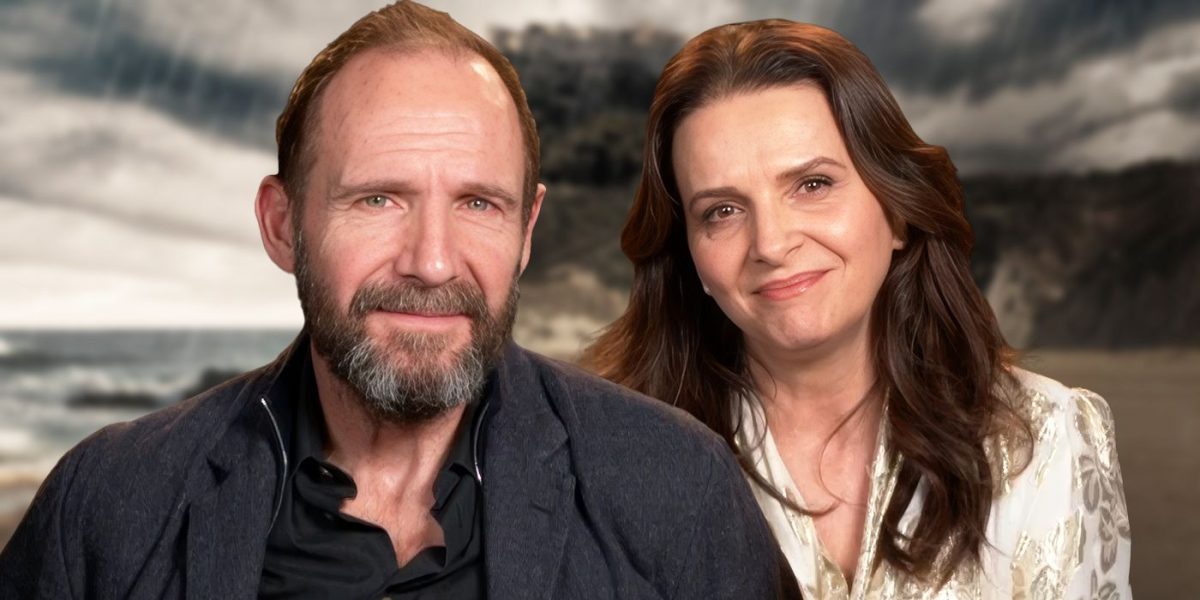
Ralph Fiennes and Juliette Binoche on Their Complex Odysseus and Penelope Dynamic In ‘The Return’
Dec 7, 2024
The Big Picture
Ralph Fiennes and Juliette Binoche reunite in
The Return
after nearly 30 years, delivering award-worthy performances.
The film explores Odysseus’ return home, his actions’ impact on his wife and son, and their complicated dynamic.
A key scene where Odysseus and Penelope finally reunite is emotionally powerful, showcasing the ache of absence and war.
From Troy to O Brother, Where Art Thou? to even The SpongeBob SquarePants Movie (yes, really), there have been many movies adapted from and based on (albeit sometimes quite loosely) Homer’s the Odyssey, but there have never been any quite like The Return. Instead of focusing on Odysseus’ (Ralph Fiennes) younger years in the midst of war, the film examines the aftermath — as well as his actions’ impact on his wife, Penelope (Juliette Binoche), and son, Telemachus (Charlie Plummer).
After nearly 30 years, Fiennes and Binoche reunite to share a screen for a third time after 1992’s Emily Brontë’s Wuthering Heights and 1996’s The English Patient, for which Fiennes was nominated for an Oscar and Binoche won. Fiennes is currently getting Oscar buzz again for his performance in papal thriller Conclave, though his turn in this film is just as award-worthy — not only does he manage to tap into Odysseus’ deep conflict and sadness, but he also fully embodies the demanding physicality the role requires. Binoche, who was most recently seen in the highly acclaimed The Taste of Things, is a breathtakingly powerful presence in The Return as Odysseus’ strong and steadfast wife.
Collider got the chance to speak to these two icons about a key scene halfway through the film, which acts as the climax for these characters and their complicated dynamic.
Ralph Fiennes and Juliette Binoche Deep-Dive Into ‘The Return’s “Most Wonderful and Challenging Scene”
COLLIDER: I love the scene where Odysseus and Penelope first reunite about halfway through the movie — I feel like they speak to each other in this thinly-veiled code. Can you talk about preparing for and then shooting that scene?
RALPH FIENNES: I remember it being the scene I think spoke to us both the most — maybe even more than the final reunion — because this is where they are reunited, but he can’t identify himself because I think he doesn’t know who he is. He’s got the weight of 20 years of absence, of fighting, of killing, of, in fact being with another woman. We know that in the Odyssey, he has at least one relationship away from her with someone else, but it’s not just that — it’s the whole ache and pain of being away, and she has her ache and pain of absence.
We both love the way it was written. She can’t quite see him, and then, when he walks closer to the light, can she see him? I think she’s probably talking to him. She does see him — Juliette can talk about that — but that seemed to me the most wonderful and challenging scene of two people who have been longing to see each other, and they can’t. In the moment that they are in the same space, they can’t identify themselves. There’s a world holding them apart — an ache of pain, of absence, of loss, of confusion, of despair, of all these human things that are a well of unconnectedness between them, and they’re looking for the point of connection. It was a great piece of writing, I think.
JULIETTE BINOCHE: For Penelope, she has a sense that she needs to see this beggar, and she doesn’t know why, but she needs to go no matter what. So at the beginning, there’s a curiosity, because she’s heard this beggar had probably met Odysseus, and she wants to know, so it was interesting to start from a warm, interested, curious place. And as the scene is unraveling, then it becomes something else, and it’s almost anger. Because, of course, she recognized him — because how can you forget the voice, the eyes, the presence of someone? — even though he’s been through hells and paradises in his life because this is going through so many different stories in the Odyssey.
So going through this warm place into a woman asking those questions about, “What was it to be away from you? What was it to be in this war?” It was quite amazing. The scene itself, the words that the writers and Uberto had been working on, felt like they were at the core of what they could be in the intention, in the emotions. And I was so happy that it was not too wordy, having to explain everything emotionally. It allowed us to be bigger emotionally and just put in the concentration — those words to each other. It felt very important to have that scene the center of the coming back, and to play it was just so moving. And I have to say, the fire next to me was very hot. It was very big, and the smell was terrible, but you try to forget that when you’re acting because you know where the ascent is, and that’s in the sharing of those emotions.
The Return is now in theaters.
Get Tickets
After 20 years away, a weary warrior returns to his homeland of Ithaca, only to find his kingdom in disarray and his wife besieged by suitors. This retelling of the classic myth explores the hero’s journey to reclaim his home, confront the changes in his absence, and restore order amidst the upheaval. Themes of loyalty, perseverance, and the impact of time shape this powerful reimagining of Homer’s “Odyssey.”
Release Date December 6, 2024 Director Uberto Pasolini Runtime 116 Minutes
Publisher: Source link




‘The Rookie’s Best Season 8 Episode Goes Completely Different With Full Zombie Horror
Editor's Note: The following contains spoilers for The Rookie Season 8, Episode 10.It's crucial for procedurals to come up with a winning formula that entices viewers to tune in every week. But it's just as important for these types of…
Mar 13, 2026
Sidney Prescott Leads a Brutal Throwback
Walking into Scream 7, I wasn’t sure if this entry would be a new reinvention. I know I wanted tension. I know I wanted that uneasy calm before the snap. And most of all, I wanted to see why Sidney…
Mar 13, 2026

Eggs – Film Threat
In writer-director-star James Clair’s short drama Eggs, a man struggling to rebuild his life finds his quiet mornings turning into strange conversations with the very eggs he is meant to cook. I mean, they want him to eat them. So…
Mar 11, 2026
Ethan Hawke Elevates A Rugged, Predictable Gold-Run Survivalist Western[Sundance]
As far as one can tell, Murphy (Ethan Hawke), a father, WWI veteran, and avid car mechanic, has never encountered an insurmountable challenge. Living in Eugene, Oregon, in 1933, four years into the Great Depression, Murphy and his young daughter,…
Mar 11, 2026