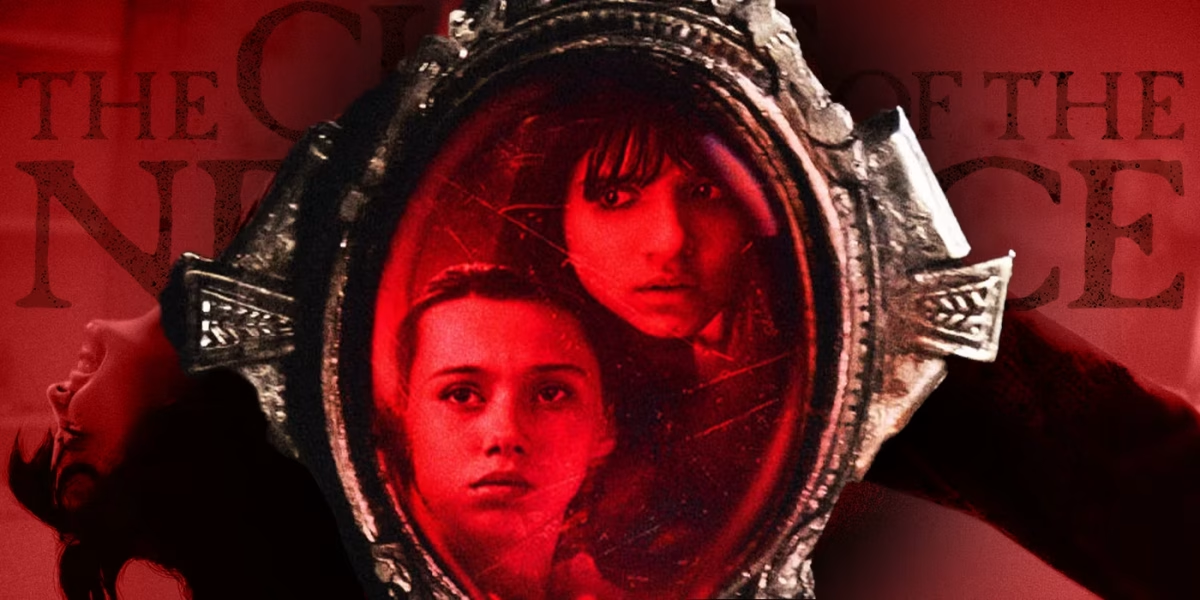
‘The Black Phone’s Madeleine McGraw and ‘M3GAN’s Violet McGraw Take on Possession in ‘The Curse of the Necklace’
Sep 28, 2024
Looking for a movie to kick off the spooky season? The Curse of the Necklace is hitting theaters and VOD just in time for Halloween. From Warner Bros., ESX productions, and director Juan Pablo Arias Muñoz (Pumpkinhole) with his sophomore feature, this chilling ’60s period movie stars The Black Phone’s Madeleine McGraw and M3GAN’s Violet McGraw as on-screen sisters who find themselves in the middle of a sinister ghost story.
The Curse of the Necklace, written by John Ducey (A Hollywood Christmas), reunites Violet with The Haunting of Hill House co-star Henry Thomas, who plays Frank Davis, a husband and father who struggles with alcoholism. Because of this and his unpredictable temper, his wife Laura (Sarah Lind) throws him out of the house. Now, Laura must raise her two daughters while maintaining her job as a nurse, but Frank isn’t giving up on his family that easily. To prove his love, he brings Laura an antique necklace he finds in an evidence bag from the 1930s — unfortunately, that necklace harbors the anguished soul of a young boy. The movie also features Roma Maffia (Double Jeopardy), Christina Moore (90210), Madeleine’s The Black Phone co-star, Jacob Moran, and Archer Anderson in his debut feature role.
Collider’s Steve Weintraub had the privilege to moderate an extended Q&A after the movie’s premiere, where the cast and creatives behind this horror sat down to talk about their experience on set, shooting a film in only 17 days. In addition to both Madeleine and Violet McGraw, Thomas, Muñoz, Ducey, Maffia, Moore, Moran, and Anderson, producer Ali Afshar and executive producer Jackie McGraw discussed their airtight script, whirlwind production from filming to post, working with Warner Bros. and the goriest, most exciting scenes to film. You can check out the full conversation in the video above or read the transcript below.
The McGraw Sisters Check Working Together Off Their Bucket List
Image via ESX Productions
COLLIDER: I think we’ve all learned, or at least I hope we’ve all learned, that if you find a necklace and there’s blood on it, for the love of god, don’t keep it and don’t put it on.
HENRY THOMAS: I washed it off.
[Laughs] You did not do a good enough job.
THOMAS: Could be worth a lot of money.
Image via ESX Productions
Henry, I actually want to start with you. What is it like for you to start as a child actor in The Steeler and the Pittsburgh Kid — you thought I was gonna say E.T. , didn’t you — and now be the father in movies? You’re in a very unique position to have gone through this journey in Hollywood and also to be able to help other child actors that you’re working with because you’ve experienced what they’re going through.
THOMAS: Well, these guys don’t need any of my help. They’re doing really, really wonderful work all on their own and with the help of their mother and their father, and they have a great family. It’s wonderful for me to see young actors producing their own films, and I think that Violet and Madeleine both have some wonderful things ahead for all of us in their careers.
Maddie and Violet, how much fun was it making this movie and being able to play sisters on screen? I’m also curious, how much did you actually use any possible built-up hostility when you were filming the fighting scenes?
MADELEINE MCGRAW: A lot, actually. No, I’m kidding. We actually get along really well. We’re actually best friends in real life. That is not a good description of what we act like with each other at home. But no, it was really, really fun getting to work with her and getting to watch her in her craft. That broken arm scene is a really hard watch, especially when you’re there. Violet is so talented and it was actually on our 2024 bucket list to get to work together, and I did not think it was gonna happen, so thank you, John and Christina, so much.
VIOLET MCGRAW: It was great working with you, Maddie. I knew she was talented, but I don’t know she was that talented. So, it was great getting to work with my sister because she gave me a lot of advice and tips to become a better actress. So, thank you, Maddie! [Laughs]
John, this is for you. I have a lot of questions about the actual script, but I read that you went to Harvard Engineering School and got an electrical engineering degree. How the hell are you out here in Hollywood? How did you end up being a screenwriter and actor?
JOHN DUCEY: Oh, wow. Well, when Violet puts the necklace on in that first scene, and the lights flicker? That’s electrical engineering. I wanted to use those skills that I learned there, and so I came to this city to do that.
How the ’60s Influenced ‘The Curse of the Necklace’
One of the things that’s interesting and cool about this is that the script introduced or talks about the changing family dynamics in the ‘60s and what a lot of families were going through while also making a horror film. How did that all come about?
DUCEY: That’s a pretty complicated question. It’s funny to say that I wrote the movie because this man, JP, has many ideas that are in the movie — our director, fantastic — and my wife, who’s my script development executive, has a lot of ideas that are in the movie. Ali had a lot of ideas — none of them are in the movie, but he has a lot of ideas. No, that’s not true. This came up at a dinner. We had the McGraws over for dinner, and Ali, and it was just because we love Violet, and we’ve done all these movies with Violet, and every other script I write stars Violet, and I was like, “Why don’t we just use both McGraw girls? That would be twice the star power as one.” And it was born. Ali and Jackie were there at the moment that we conceived this thing to happen, and Ali said, “Oh, make sure there’s someone that helps them when you find out at the end they’re dead.” And that was Callahan, and then that was cut. So, it was a great idea, but it did not make it until the final cut. Sorry.
So then, yes, the dynamic of the family and the ‘60s and feminism, and these three women on their own, that was a big part of the motivation of how do they work together to find each other, find their voice when the world and the man is keeping them down? JP and I talked about that a lot when we were talking about the script and the story. And then just getting these three people connected to the spirits, it was like, “Alright, well, Violet is the innocent young one; she’ll connect to the little boy. The mom will connect to the mom, and obviously, the teenager will connect to the evil spirit.” [Laughs] Because really, how do you tell if a teenager is possessed or just being a teenager?
So you see the shooting schedule in front of you. What day do you have circled in terms of, “I cannot wait to film this,” and was there any day you had circled in terms of, “How are we filming this?”
MADELEINE MCGRAW: For me, it was the blood scene with Christina. It was really fun, but the blood tasted like soap and it got all in my mouth. But, oh my god, did it turn out so good. The blood was really cold, too. But I would do it all over again. It was so fun.
ARCHER ANDERSON: For me, it was probably getting all the stabs in your back scene. All the blood running down your back — that’s terrible, but also fun.
That was not what I expected you to say, and it was awesome .
CHRISTINA MOORE: I just want everybody to know that takes, like, seven hours to put a pregnant tummy on you and it weighs, like, I don’t know, 20 pounds. And then your director’s like, “We’re gonna just do it a lot, and can you scream more? Do you have a deeper scream? Do you have a more animalistic scream? Is there one that could crack a vocal cord just right at the very, very, very end?” I don’t know that I was anticipating it. I was like, “This is gonna be chill and easy,” and it was not.
SARAH LIND: Getting lifted up doing the necklace stunt. That was what I was excited about — to live my Cirque du Soleil dreams.
VIOLET MCGRAW: I would say mine is probably when I got to get covered in blood. It was fun. But also I couldn’t see and I was cold, but that’s okay.
Image via ESX Productions
JACOB MORAN: Going off the special effects and everything, I have to go with the stab scene. Originally, I don’t think I was supposed to get stabbed. I was supposed to be lit on fire. So, that was a cool change. But yeah, that was really fun.
ROMA MAFFIA: I was easy. I didn’t have to do anything like that. I didn’t have to do any blood except for my eyeballs, so that was it. I had it off easy. Oh! I did get stabbed. I forgot, I got stabbed. I did, I got stabbed.
MOORE: Twice!
MAFFI: I did. But I forgot.
Image via ESX Productions
ALI AFSHAR: I had to study hard for my line.
MAFFIA: You were very good.
THOMAS: It was the blood. It was the prosthetics neck rig thing. It was funny because they had it all planned out, but then when we got there, wardrobe was done all the way up, and the special effects guys had made it a little too far down, so I had to kind of do one of these things, which ended up working out I guess.
MADELEINE MCGRAW: I guess there’s a reason we all like horror so much because we all loved the most graphic things that happened to us.
‘The Curse of the Necklace’ Shot in Only 17 Days
Image via ESX Productions
For everyone here and for the soon-to-be fans that will be watching this Q&A, what do you think might surprise people to learn about the actual making of the film?
MOORE: It was 17 days.
MADELEINE MCGRAW: And $2 million dollars.
MOORE: 17. The end. And like three months from the day we started shooting to the day it was delivered. We’re all GOATs.
LIND: I think it would be nice if people did not remember me for saying terrible things to children. They loved it. You’re Demonoid, and you’re Homunculus, and they loved it!
MADELEINE MCGRAW: She literally got us bags that said that. It means so much, actually.
LIND: I love you.
MADELEINE MCGRAW: I love you, too. [Laughs]
JUAN PABLO ARIAS MUÑOZ: I think it’s how much fun we had and how much of a family we became on set. The movie is really creepy and really dense, and it’s eerie, but then we called cut and everyone was having a lot of fun after the shots. That’s probably something interesting for people — the horror is on the screen, but it’s not a horror film behind the scenes. It’s kind of a comedy a little bit.
Image via ESX Productions
JP, I’m fascinated by the editing process because that’s where it all comes together. Talk a little bit about what you learned as you were cutting the film and also how you figured out where and when you wanted to reveal key information to the audience because those choices are incredibly important.
MUÑOZ: In this film, in particular, we went in with a really good script, with a really greatly crafted structure which I think really helped us in the little time that we had. Usually, when you’re in production, you don’t have the time to worry about the structure of the film and you don’t have the time to worry about how each piece of information connects because you can only focus on the present, and, of course, you’re shooting things out of order. So, you kind of have an idea how things are gonna tie together later, but you don’t have the time to worry about that, so you can only hope that you did that work before. And John did a wonderful job giving us a script that was airtight, so then when Brett [Hedlund] and I, our wonderful editor, got into the cutting room, it really allowed us to focus not on achieving a structure or a well-told story, it was more about crafting the atmosphere and crafting the relationships between these characters.
One thing that I also learned, besides going into it with a great script is already a leg up, is having a wonderful cast that just won’t miss because, also, the other thing that happens in the editing room is that you end up fixing a lot of performances sometimes. You craft performances a lot. With this cast, that was never an issue. This cast was on point in every single scene. And that also, again, allowed me the space to craft the film and to focus on the precision and the rhythm of building a jumpscare, and not have to worry about editing around things. That speaks greatly of the work of our casting directors, it speaks greatly of the work of this cast, of our writer, of our producers, and, again, of Brett, who’s such a wonderfully talented and also experienced editor who has made most of ESX’s films. I learned that when you’re working with people who you have a track record with that, you have a shorthand with, again, it just allows you to focus on the creative and the problems sort of just flow. They kind of solve themselves in the process.
This Was the Trickiest Scene to Get Right in ‘The Curse of the Necklace’
“There’s always an opportunity to make it better.”
Image via ESX Productions
I’ve spoken to a lot of directors and they always talk about how there’s always one scene that they’re fine-tuning until the very end. Which scene or sequence in this film was the one that you kept going back to, if any, to sort of tweak or adjust?
MUÑOZ: That’s a good question. I think it would be the séance. There’s such a great opportunity to tell a scene in the perspective of three different characters or three different moments, and we were jumping in and out of reality, and we were going from the living room into the bedroom, and we were trying to, yes, tell the story, but we were also trying to craft a sense of rhythm and a sense of pace that kept building up and kept building up into a climax, building up valleys and peaks so you could get scared, but you also could kind of settle down and then get scared again. The importance of contrast really comes into mind there, because you can’t get scared if you’re getting scared all the time. So, you need silence to kinda settle in before you can go back into it. So, I think that the séance sequence was something that we ended up coming back to and refining and refining, even though the first version was pretty great.
It was all there. These guys have done their job, so once we got into the edit, and then once we got the music in, Jamie [Christopherson], our great composer, had to come in and really light the fuse in the whole thing to make it a continuous sequence. That’s the sequence I would say we kept coming back to, not to fix it, but to make it better. There’s always an opportunity to make it better.
This question is for the producers. Every film has unique challenges. What were some of the big obstacles you guys came up against besides trying to make a miracle happen in 17 days?
AFSHAR: A big one would be the two Davids that you all stood up for, which was really funny. That was the best thing ever. To get the executives here at Warner Bros. to believe in us, to actually pull a trigger, to say, “Go do this.” Because right now in the way the world is, it’s not easy to get a movie greenlit with streaming and theatrical, and this and that. I think our challenge to try to get this off the ground is to get people to trust you. I mean, we are fast, and we’ve never done it this fast. You tell somebody you’re gonna shoot this in Atlanta in 17 days with two young stars, with a new director, and, “I’m gonna deliver it to you on time, on budget,” which we always do thanks to [Christina Moore], that’s really the biggest challenge that I face at the ground level if you will. But once you get those people believing in you and you do right by them and you don’t sleep and you just work, work, work, it’s a team, it’s a village and a family that does it. I think that’s kind of where it gives birth. That’s where it started.
And also, the cars were hard to get. Literally, we couldn’t get cars. I’ll tell you a secret about one of them — a couple of them are actually newer than the year we’re in. You won’t notice that, but we went to a Cars & Coffee, because I’m a car guy, and literally walked around like, “Do you want your car in the movie?” They’re like, “Yeah.” “Do you want your car in the movie?” “Yeah.” “Do you want your car in the movie?” “Yeah.” Because we had to find cars in the ‘60s, so that was one of the technical challenges. But other than that, usually for me, it’s the getting it off the ground and getting the folks here at Warner Bros. to believe in you, to give you millions of dollars to go out there and say, “No, I can actually do it.” And they were like, “How do you do it?” “I promise you, we’ll do it.” So, really, thanks to them.
MOORE: It’s funny, I think I’m gonna go and echo what JP said — that it was weird. You would expect a horror movie to be kind of crunchy or to be full of conflict or to have people be uncomfortable, and it was like we were shooting a rom-com. I mean, the hugging, the speeches, the “thank you for everyone’s hard work.”
AFSHAR: That made me uncomfortable. Too much hugging.
MOORE: So much hugging. They yelled cut and you could just hear echoing sobs and all the hugging and all the hugging. So, am I gonna get in trouble if I say it wasn’t that challenging? Things kind of fell in…
AFSHAR: It was horrible. We need twice the money and twice the time next time, right John?
MOORE: [Laughs] We have a great group, and everybody really brought it. And then, in our post, that would have been a struggle that would have killed us dead, but we had an amazing DP, [Reuben Steinberg], amazing post houses that we’ve worked with. We have big, big, big relationships — seven years with these people — so they will bend over backwards, they will get VFX done in a minute and a half. That, I would say, is similar to what it was on the set. It’s relationships. It’s always about love and friendship.
AFSHAR: [To the audience] And you guys are part of that because there are so many familiar faces that were here before, people who flew in. My cousins Tina and Charlie. Charlie Benedetti. She financed our last movie last year. So, you guys are part of this mission. We couldn’t do this without you. So, it’s all love, and you guys are part of it.
Rising Stars and Directors on the Rise
Image via ESX Productions
What are you most looking forward to audiences experiencing and seeing in the film when it comes out on September 27?
DUCEY: This is an easy one because it’s seeing these McGraw girls together on screen. What an amazing pair they are, how talented they both are. I think a lot of people are going to be impressed.
LIND: I think people will come away from this thinking JPs the shit, and that’s what they should think. He’s someone to watch. He’s really great.
MADELEINE MCGRAW: I agree with that.
I agree.
LIND: He’s genuinely the most thoughtful, generous person to work with, so thank you, JP, and bravo. Bravo, everyone.
AFSHAR: Jackie has to say something. She hasn’t said one word. Say something, Jackie.
JACKIE MCGRAW: I’m just grateful to be here.
DUCEY: I also think people are going to be super impressed with the look of the film, especially if they know how much money we had to spend. And that, of course, is this guy, our director, and then our DP, Reuben Steinberg. You wouldn’t know he makes flashy commercials in his spare time as a side hobby because he makes dark horror movies look really good.
This is no BS, I am so impressed with JP. What you guys pulled off in 17 days and the look of the film, and how cinematic it can be when you had no time to make this? For real, I’m giving you huge props.
MUÑOZ: I didn’t do anything. I was sitting behind a monitor. It was them.
MOORE: Something I would love for audiences to take away is — Jackie, I think it was the phrase you used — the little movie that could. Go, guys. Anybody. If you’ve got an idea, you’ve got a dream, you’re young, you want to put something out there, now especially — iPhones — you can do it! Hollywood is not sad, it’s not over, it’s not dying. Like, come on, come on! The indie movie lives! You can do it.
The Curse of the Necklace is in theaters on September 27 and VOD on October 1. Check out the link below for showtimes near you.
Get Tickets
Publisher: Source link




Eggs – Film Threat
In writer-director-star James Clair’s short drama Eggs, a man struggling to rebuild his life finds his quiet mornings turning into strange conversations with the very eggs he is meant to cook. I mean, they want him to eat them. So…
Mar 11, 2026
Ethan Hawke Elevates A Rugged, Predictable Gold-Run Survivalist Western[Sundance]
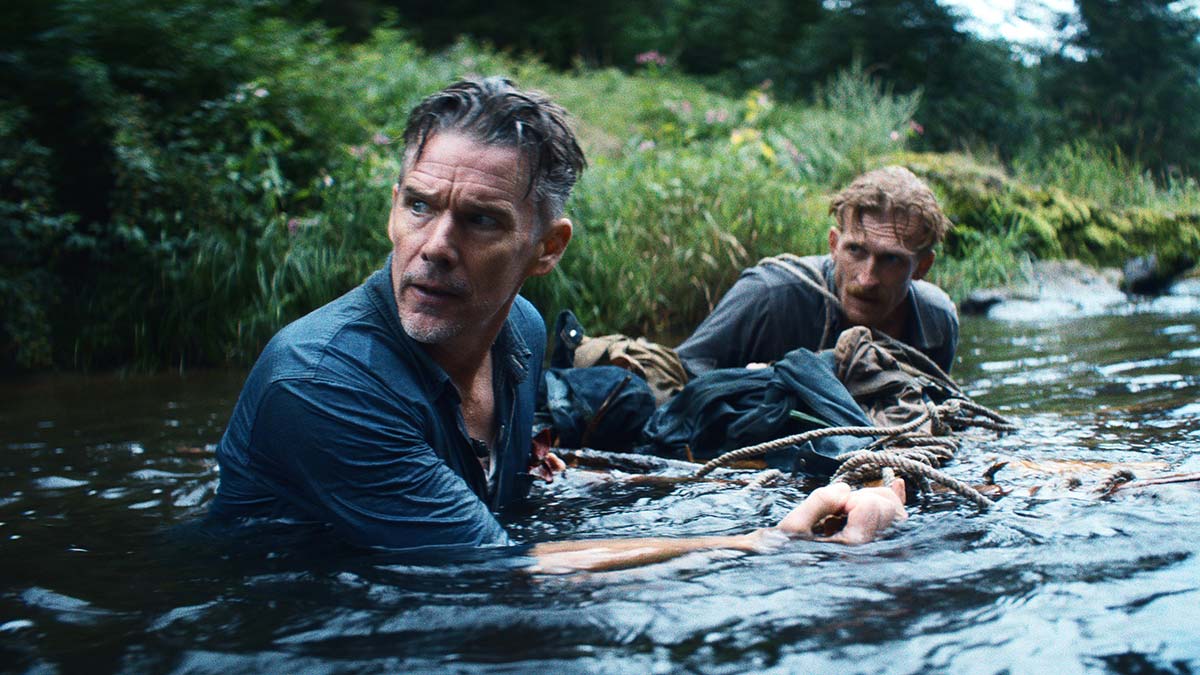
As far as one can tell, Murphy (Ethan Hawke), a father, WWI veteran, and avid car mechanic, has never encountered an insurmountable challenge. Living in Eugene, Oregon, in 1933, four years into the Great Depression, Murphy and his young daughter,…
Mar 11, 2026
The Moment Review | Flickreel
Brat Summer was a cultural phenomenon that I didn’t understand at all. I knew that it was connected to an album that Charli XCX had released. Whenever I asked what Brat is, though, nobody could seem to give a straight…
Mar 9, 2026
Cillian Murphy’s Netflix Crime Hit Delivers a Brutal, Bleak Finale
It’s been four years since we last saw Cillian Murphy play Tommy Shelby, but seven have passed in the world of Peaky Blinders, with The Immortal Man taking place in 1940, in the middle of World War II. Tommy’s gone…
Mar 9, 2026