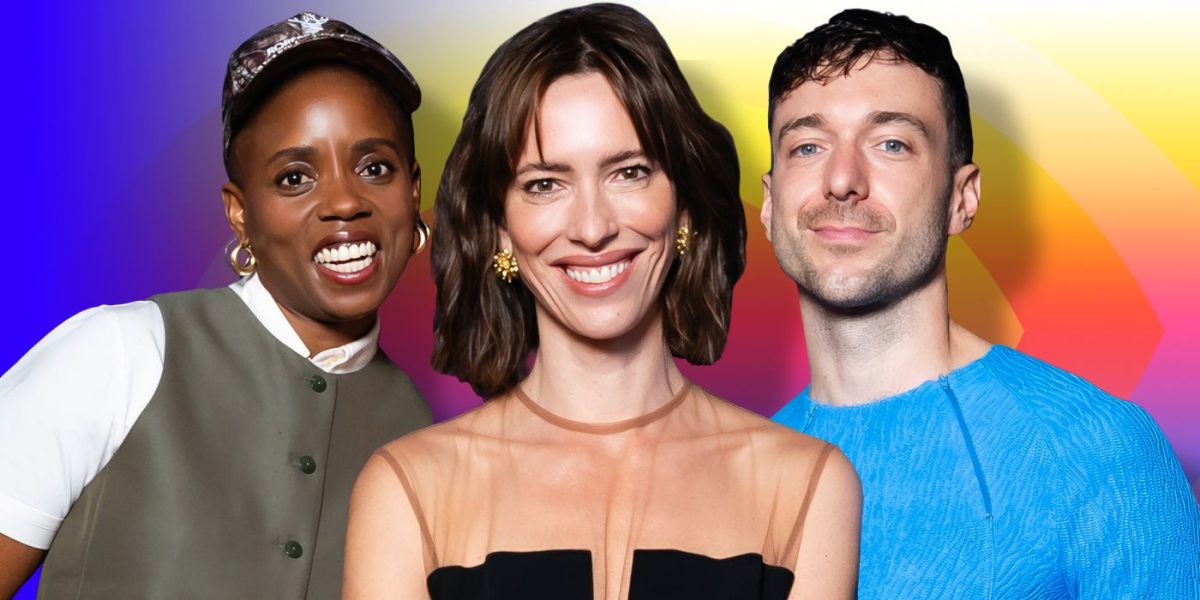
‘The Listeners’ Rebecca Hall Wanted to “Force a Crisis” With the Series
Sep 29, 2024
The Big Picture
Collider’s Perri Nemiroff sits down with
The Listeners
director Janicza Bravo, writer Jordan Tannahill, and star Rebecca Hall at TIFF 2024.
The series follows a teacher, Claire, who hears a mysterious hum, leading to a conspiracy-filled journey and quest for connection.
Bravo, Tannahill, and Hall discuss being flexible with the source material, treating the production like a feature film, and creating a unique soundscape.
Sometimes the tiniest real-world questions prompt the most immense existential answers. What if you were the only person who could hear a noise? It’s not inside your head, you simply can’t locate its source. How would you unravel? How would your relationships and fundamental beliefs change or evolve? The director of award-winning crime comedy Zola,Janicza Bravo, and BAFTA-nominated actress Rebecca Hall invite the audience to ask these exact questions in their new limited series, The Listeners, adapted from screenwriter and author Jordan Tannahill’s second novel.
The Listeners depicts the life of Claire (Hall), an English teacher, wife, and mother who begins to hear a low humming sound nobody else around her can hear. With no obvious source of the sound, Claire’s family life begins to spiral as she grows increasingly more isolated. Soon, she discovers a student of hers, Kyle (played by Ollie West), can also hear the sound. The two form a friendship and together meet more neighbors also tracking down the source of the mysterious, maddening hum. The Listeners explores our human search for the transcendent, conspiracy culture in the West, and the innate desire for community and connection.
In celebration of the Toronto International Film Festival world premiere of it’s first two episodes, Bravo, Hall, and Tannahill came through the Collider interview studio at the Cinema Center at MARBL to talk with Perri Nemiroff about how banal events and miniscule sounds can drive one’s life. Together, they discussed how the team created and executed a limited series as a singular film, the joys of adapting one’s own novel into a continuing screenplay, and finally letting Hall speak with her real voice. You can watch the full interview from TIFF in the video above or read the conversation transcript below.
‘The Listeners’ Explores a “World of Conspiracy, Faith, and Mania”
Image via BBC
PERRI NEMIROFF: I’ve seen two episodes of your series. I find it so enthralling and fascinating, and I desperately need answers, so Jordan, I immediately downloaded your audiobook, and now I’m three quarters of the way through. I don’t quite know where everything ends, but what a captivating story.
JORDAN TANNAHILL: Thank you so much.
Clearly, I know about The Listeners , but because it’s a festival premiere, a lot of our viewers will not know about it just yet. Jordan, I’ll give you these duties as the author of the book. Would you mind giving a brief synopsis of your story?
TANNAHILL: The Listeners centers around Claire, who begins to hear a low humming sound that nobody else in her life can hear, not her friends, her family, or her colleagues at work where she’s a teacher at school. It slowly begins to unravel her life, her sanity, her marriage until she discovers that a student of hers and then gradually disparate neighbors of hers also hear this hum. It implicates her in a pretty wild world of conspiracy, faith, and mania.
Many questions about adapting your book to the series format. You’re obviously a very, very experienced writer, but this marks your first time writing a limited series. Is there any particular writing learning curve you experienced writing for that format?
TANNAHILL: Absolutely. I think you have to not be precious with anything. It’s a lot of iterative drafts. It’s a story that I’ve lived inside now for almost eight years, so it’s a story that I know really well, and it can actually feel quite elastic like it can actually be told in so many different ways. We tried a bunch of them and found the best one, I think. [Laughs] But yeah, just not being precious, and also being able to be really responsive to the amazing ideas that were being thrown, particularly by Janicza, who had some amazing visions for this project.
Image by Photagonist at TIFF
Many follow-ups. First, I’ll follow up on the idea of not being precious about it. Can you tell me one element of your original book that you had to be precious about and you held tight to it, but then also something that you really wanted to include in the show but came to realize, “No, this does not serve the story in the series format?”
TANNAHILL: Interesting question. For me, the non-negotiable thing is Claire’s interior world and journey and primacy in the piece. I think what the film does, perhaps even better than the book, is really center her thought process and her gradual descent into this kind of madness, perhaps, but also a very kind of empathetic thinking. I think we’re really with her as she kind of moves through the challenges of this terrible condition, terrible experience, and ultimately a kind of revelatory experience, perhaps for her.
In terms of things that were jettisoned, the book is set somewhere in the American Southwest, and we transposed the story to Britain. Actually, at first, I thought, “What are we gonna lose in that process?” But I think we actually found a lot, and I think it’s a different story. It showed me that, actually, the story is something of a parable and could probably be resituated in a number of different places around the world, and it would be unique each time.
Rebecca Hall Is in the DNA of ‘The Listeners’
“Until there was Rebecca, it didn’t really exist.”
Image by Photagonist at TIFF
Digging into your collaboration now, you were saying that Janicza found some new things and you evolved it along the way. What would you two say is the biggest difference between the draft of the script you two started with together and the show you ended up with that everyone’s going to see?
JANICZA BRAVO: With anything, the experience of reading it, the experience of making it, and then the final product, there are so many stages of rewriting that it goes through. And I think in either iteration that we had created, until there was Rebecca, it didn’t really exist. Once there was Rebecca, she’s so connected to the DNA of the piece. It’s a piece of all of us, but I just think the final version of it is just so her. I’ve looked at her face so much for the last year that when I saw her yesterday, I hadn’t seen her in a year, but it felt like I had because I had memorized so much.
REBECCA HALL: It was an anticlimactic reunion. [Laughs]
BRAVO: It was a little anticlimactic, and I was trying to explain to her that I was meeting her at a lull only because I had just looked at her face actually right before I walked into seeing her in a room, and it was odd. It felt sort of strange.
HALL: It made me a tad self-conscious. “Are you seeing how tired I am right now?”
BRAVO: [Laughs] No, it’s just that I know you so intimately. I don’t know that that’s really answered your question.
Janicza Bravo Sold Rebecca Hall on the Series
The actress chose to do the project before reading a word.
Image by Photagonist at TIFF
Rebecca, when this opportunity first came your way, what was the single thing about it that you were most excited to get to do, but then can you also tell me something that wound up being more creatively fulfilling than you ever could have imagined at the start?
HALL: I actually decided that I really wanted to do it before I read a single word of the script, if I’m being completely truthful. That’s not me blowing smoke up these guys’ behinds. One of my agents said to me, “There is a project out there. It’s a limited [series], and it’s about a woman who starts hearing a hum that nobody else can hear, and it’s directed by Janicza Bravo.” I was like, “That sentence. I’ll take it. I want that job.” Because before I’d even read the material, I was already so compelled by the idea of something so banal and miniscule, like, what does that do to a person if they can’t stop hearing something? It’s not a situation of, like, you block your ears and then you hear it inside your head. It’s clearly outside. What does that do to how you recontextualize your whole environment, all of your choices, and how you see the world? I think we’re constantly living in this sort of reality where we look at everything and see it one way, and sometimes weird things can happen and make you see everything completely differently. I recently painted my house, and suddenly I’m like, “The house looks completely different.” It’s just that. It’s these tiny things throwing your understanding of humanity into question, I think, is a really potent idea.
Then I read the scripts, and all my hopes for it were fulfilled. I was like, “This is actually what I want it to be, and it is the thing that I thought it might be.” And so I was just really excited to do it. I think there’s a criteria for me for things that feel appealing. I recently saw an old interview with Philip Seymour Hoffman saying exactly what I’ve been trying to articulate for years where he said, “Sometimes you just want to force a crisis.” It’s not about being challenged. You want a crisis because the challenge implies courage and valor, and that’s not what you’re thinking. Sometimes you just want a situation where you’re forced to actually get right up to humiliating yourself in front of humans. In a crisis, you have to go up there, and you have to do it. You have to follow through because it’s a crisis, so you don’t have any choice. I think that’s a really brilliant way of articulating the thing that I’m always looking for. “Does this scare me in some way? Is there a possibility that I’m going to be embarrassed on set doing this? Yes, absolutely. Is there a possibility that I’m going to feel incredibly vulnerable? Yes.” Then, if you go there, if you do those things, then you do get creatively fulfilled in a way that you don’t anticipate, and you do push yourself further than you even really understand. That’s the truth of what this was for me.
Of all of the incredible roles you’ve played, what was the scariest of the bunch, and how does this one compare?
HALL: “Scary” is the wrong word again. They’re all like mini-crises, aren’t they? I don’t know that I can pit them against each other in that way. I will say that this has been one of the more fulfilling jobs of my life, without question. Something about the alchemy of these two people sitting here, all of us on this couch. It had a special flavor to it. I have so much respect for Janicza Bravo, like so much. She’s a mad visionary.
BRAVO: I make her say my whole name, just so you know.
HALL: I always say her name. It’s Janicza Bravo. And Jordan, I didn’t know his work before this, and now I do, and I’m so in awe of it. I have so much respect for him, also. I’d be really happy working with these two for the rest of my life, honestly.
After ‘Zola,’ Janicza Bravo Leaned Into Her Discomfort
“I think what turned me on the most was that it scared me.”
Image by Photagonist at TIFF
Janicza, I want to come back your way because I was lucky enough to get to talk to you about Zola at Sundance a couple of years ago, and I was very eager to see another feature film from you …
BRAVO: Me too. [Laughs]
That’s kind of my question! You veered towards the TV format instead. Is there anything particular about that format that’s calling to you, or is it more about the nature of the industry and where those waves push you?
BRAVO: I’ve been fortunate enough to go where I want to go, not just go where I am desired but go where I desire. I’ve found myself in this pocket where there really is very little that I’ve worked on where I haven’t actually wanted to be there. I really struggle with showing up if it’s not turning me on, and I’ve tried that. It’s just a very bad recipe. I start shutting down in a way that I didn’t even know was possible, actually. So after Zola, I think what I was most craving was to differentiate myself from whatever that movie might have decided about me. There were things that came my way that felt like variations on the same theme.
Actually, my manager had put this in front of me. It had come my way, and he put it in front of me, and I think I was overwhelmed and wasn’t looking at things, and he sort of reminded me about it again, and also articulated that I wasn’t the first or only choice, and I was like, “Understood.” I read it, and I really fell for it. I think what turned me on the most was that it scared me and made me a little uncomfortable. I wasn’t sure if I could land it. I was like, “I should go there if it’s making me a little worried. That feels right.”
So you feel worried jumping into it and then you come to the conclusion that you should direct every single episode. More often than not, when it comes to any series, whether it’s limited or not, we do often see a bunch of directors working on something. Why did this particular story benefit from having one voice as a director?
BRAVO: I did want to make another film, and I’m not very good at giving 100% of myself to multiple things at a time. The pandemic had affected the flow of how Zola was meant to leave my body, and so by the time it actually left my body, there was this gap, and in that gap, I had the opportunity to walk through the door of continuing the road of making the next film that I wanted to make, or The Listeners was there and it existed and it had a home, and I liked it — I loved it — and so I just went towards that. But it felt like a film to me, and I think we all approached it in that way.
Also, I feel it’s important to articulate because I know I keep saying, “I approached it like a film,” but I don’t want to say that because I think television is diminutive, but my experience in TV had always been episodic. So it’s kind of the Airbnb experience — it’s like you’re there for a week, it feels nice, and then you leave, you rate it. So, this was an opportunity to immerse myself in the entire arc of the experience. So it did feel more like a film only because I did all of the episodes and was with it from its birth until its infancy, which I guess is happening today… We homeschooled and now we’re going to regular school.
Creating ‘The Listeners’ Soundscape
Image by Photagonist at TIFF
Turning toward the hum now, first, Rebecca for you from a character perspective, I’m learning a little bit about Claire’s backstory from the book that the show, thus far, hasn’t given. What kind of backstory work do you have to do for your character to establish a foundation so that when the hum appears and shatters that foundation, it means something to a newcomer?
HALL: I didn’t do a lot of that sort of work. I felt that something that was very important about Claire is that she could be any of us. When you approach a character like that, I tend to think, “Well then, she’s going to be me. She’s going to be a version of myself.” I very rarely get to sound like I sound, and this is one of the few things that I sound like I sound when I talk.
BRAVO: Oh, she’s English! I forgot.
HALL: [Laughs] So, I didn’t do that much backstory as much as I just tried to bring me to it and then let myself live the experience, really, is the truth of it. There wasn’t that much else to think about.
Janicza, I want to loop in working with your composer and the sound team because I’m curious about the kinds of conversations you have with them in terms of using those elements to make sure the audience thinks they can hear it, but without literally hearing it. I found that shockingly effective here!
BRAVO: Oh, thank you. We talked so much about, from the offset, the experience of I think I wanted to slightly invalidate her experience because that’s what Claire was going through, was that no one believed her. So, the question was, “When do we get to invite the audience into hearing it,” but also peppering it in so that it feels slightly false to them, too. It isn’t so present that they’re wondering, “But is it my house, or is it the show? What’s happening? Am I okay?” I think I wanted us all to question our own sense of what is and isn’t there. Both the composer, [Devonté] Hynes, and our sound designer, Steve Fanagan, were so intimately involved in how we built it, also because it is an extension of Claire, right? It is also at the foundation of the world that Jordan built. It’s like very much like the house stands on that.
It’s too effective. When I stopped watching it, I felt like — and I’m sure this is intentional — I took it with me, and I was second-guessing what I was hearing.
BRAVO: You start to realize that you hear stuff, right?
Image by Photagonist at TIFF
Jordan, I love how you can find new layers of your own story by sharing it with other artists, so is there any particular thing about The Listeners you have come to love more by seeing it adapted into a limited series?
TANNAHILL: Absolutely. Great question. Just to vouch for what has already been said, Janicza is a true visionary, and I think what she was really encouraging me to do from the outset was to think of the story imagistically, both obviously sonically, which is sort of embedded in the material, but also through images, bold images and bold sequences that may not even exist in the novel. There’s a way in which Claire’s emotional journey and her psychic journey get to some pretty intense places, and we wanna be able to see that not just watching her through a passive realism but trying to get under the skin of that journey a little bit more through cinema, through bold imagery, which Janicza is so adept at creating. And so that was, perhaps, the thing that I feel most. It’s one of several things that are different than the book that I am so proud of, and I think works really effectively in the series.
Directing Again Is “the Next Frontier” for Rebecca Hall
Image via Netflix.
Before I let you go, I have one unrelated question for you, Rebecca. I love Passing , and many people out there love Passing. You are directing another film, but in that particular case, you’re not just directing it, you’re also acting in it. While prepping, how do you expect your process to change when wearing two hats on that production?
HALL: I don’t know. Ask me in a couple of years.
I want the answer now and then compare after the fact! [Laughs]
HALL: It feels like the next frontier. I’ve got no idea how it’s going to go down, and I don’t even know when I’m gonna make that movie. There might be something else before that.
Special thanks to this year’s partners of the Cinema Center x Collider Studio at TIFF 2024 including presenting Sponsor Range Rover Sport as well as supporting sponsors Peoples Group financial services, poppi soda, Don Julio Tequila, Legend Water and our venue host partner Marbl Toronto. And also Roxstar Entertainment, our event producing partner and Photagonist Canada for the photo and video services.
Publisher: Source link




Eggs – Film Threat
In writer-director-star James Clair’s short drama Eggs, a man struggling to rebuild his life finds his quiet mornings turning into strange conversations with the very eggs he is meant to cook. I mean, they want him to eat them. So…
Mar 11, 2026
Ethan Hawke Elevates A Rugged, Predictable Gold-Run Survivalist Western[Sundance]
As far as one can tell, Murphy (Ethan Hawke), a father, WWI veteran, and avid car mechanic, has never encountered an insurmountable challenge. Living in Eugene, Oregon, in 1933, four years into the Great Depression, Murphy and his young daughter,…
Mar 11, 2026
The Moment Review | Flickreel
Brat Summer was a cultural phenomenon that I didn’t understand at all. I knew that it was connected to an album that Charli XCX had released. Whenever I asked what Brat is, though, nobody could seem to give a straight…
Mar 9, 2026
Cillian Murphy’s Netflix Crime Hit Delivers a Brutal, Bleak Finale
It’s been four years since we last saw Cillian Murphy play Tommy Shelby, but seven have passed in the world of Peaky Blinders, with The Immortal Man taking place in 1940, in the middle of World War II. Tommy’s gone…
Mar 9, 2026