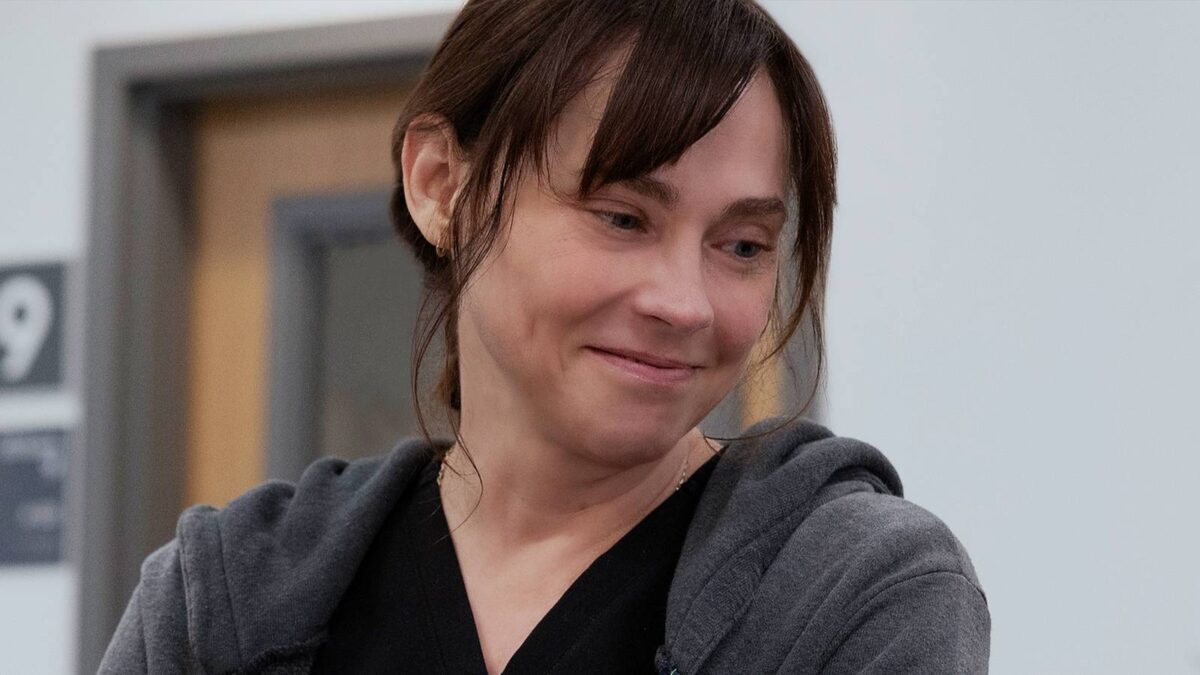
‘The Pitt’ Just Revealed How Close to the Edge Dr. Robby Could Be After This 2-Minute Scene
Mar 27, 2026
Editor’s note: The below interview contains spoilers for The Pitt Season 2 Episode 12. With Noah Wyle and R. Scott Gemmill’s hit HBO medical drama The Pitt heading into the last three episodes of Season 2, the current Fourth of July shift at fictional Pittsburgh Trauma Medical Center hasn’t gotten any easier. With the network offline in the wake of a cyberattack hitting other hospitals, being forced to work in analog mode is only adding stress for doctors, nurses, and patients alike — and now, they’ve just lost one of their own to a detainment by ICE.
Season 2’s latest hour, “6:00 P.M.,” directed by Amanda Marsalis and written by Danny Hogan and R. Scott Gemmill, finds every character navigating different stressors. When a patient attacks nurse Emma (Laëtitia Hollard), Dana (Katherine LaNasa) is quick to intervene, but her actions with the all-too-convenient syringe in her pocket immediately raise Robby’s (Wyle) suspicions, leading to a telling confrontation between the Pitt’s two biggest pillars. Meanwhile, there’s little time for other doctors, like Cassie McKay (Fiona Dourif), to think about slowing down — or, as she reveals to Dr. Frank Langdon (Patrick Ball), even taking the time to cry over the loss of a patient. Ahead of the episode’s premiere, Collider had the opportunity to speak with Dourif about her character’s most pivotal moments in Episode 12, including what Cassie’s conversation with Robby really means, why Season 2’s ICE storyline made everyone in the cast “uncomfortable,” and more. COLLIDER: There’s so much to talk about, starting with Roxie, whose storyline is so heartbreaking already, with her making the decision to die on her own terms. Cassie, unfortunately, isn’t present, and has to find out from Robby that Roxie passed while she was tending to Kiki with Ogilvie. It feels like you really get to dig into the tough emotions of that storyline. How does getting to play that storyline over a series of episodes, as opposed to being confined to just one hour, prove more beneficial as an actor? FIONA DOURIF: I felt like I was dealing with that for months while we were shooting. I looked at it like it was Cassie confronting the fact that we’re all going to die. It was specific that she was exactly my age. She had children, like I have. She also had a family, which I don’t. So, there was a lot to think about. It came down to this question of, “What do I want my life to look like when I die?” I started to think about that, personally, actually, as Fiona, because Cassie’s quite close to the bone for me. When a family member dies or when you’re confronted with it, like a lot of E.R. doctors are constantly, that becomes real, and that can change how you feel throughout the day, in ultimately a positive way, has been my experience. But yeah, I was thinking about those things for a long time in 2025. And those beautiful performances, you know? All of it felt very sincere while we were shooting it. Very moving.
Fiona Dourif Teases an Emotional Future for Cassie on ‘The Pitt’ Season 2
“It hits you two days later when you’re on your couch — not necessarily tears, but just the gravity of it.”
Lorna Lominac, Lucas Iverson, and Fiona Dourif in The Pitt Season 2 Episode 11Image via HBO
Later on, there’s that exchange that Cassie and Langdon have, where Cassie admits she can’t remember the last time she cried, and she’s worried that she’s forgotten how. Is that teeing up any possibility of her becoming overwhelmed later? DOURIF: I can’t answer that. [Laughs] I had a feeling. DOURIF: But that’s very real. You toss a penny on the side of The Pitt, and you hit an actual medical professional, and they talk to me about it. I’m pretty close friends with one of the consultants, Dr. Jacob Lentz, and he talks about that a lot; that stuff is very moving, but you do it for some amount of years, and you feel sort of separate, and it hits you later. It hits you two days later when you’re on your couch — not necessarily tears, but just the gravity of it. On a somewhat lighter note, I really like seeing you get to step into more of a teaching role than we even got in Season 1, specifically with characters like Ogilvie, but also Javadi. How do you feel like Cassie’s approach to mentoring or teaching echoes her overall approach to medicine? DOURIF: Cassie understands that her strong suit is more human connection than technical, and it’s because she had a long road to get to medical school. Most often, doctors go from a very good college to a very good med school to residency to being a doctor. Cassie dealt with addiction and wrong choices and an early pregnancy, all kinds of things. Because she’s had very hard things happen, she can relate to people in the hospital who also have. I think that that is both good and bad with teaching. There’s an element of frustration for kids who don’t understand how hard the world can be for people, and that has shown its face with dynamics with Javadi, and certainly with Ogilvie. It’s sort of like, “How can you not get this? Not everybody has been as lucky as you.” And I think [the writers] probably tee it up purposely so there’s that conflict.
Related
‘The Pitt’s Biggest Secret to Success Started With a Note From Noah Wyle
Director Damian Marcano sits down with Collider for an in-depth chat about his journey to ‘The Pitt’ and Season 2 Episode 10’s biggest moments.
Just talking about Cassie’s past, we’ve seen Robby making the rounds before his sabbatical, and the two of them have what seems to be their parting conversation, where she says, “I’ve had friends who liked to see how close the edge was.” You can see on Noah’s face that the emotions are there, but he doesn’t quite know how to respond to that. How long do you think Cassie’s been picking up on those vibes from Robby, and what is her biggest concern about him heading into this sabbatical? DOURIF: Cassie is very intuitive, which is something you can’t really even describe. It’s just a feeling. I think that Robby and all the doctors are dealing with the aftermath of the mass casualty, and there’s a degree to which self-care can sort of fall away, and that feels very crystal clear with Robby’s case. He’s like, “It’s fine. It doesn’t matter,” but yet he’s doing what Cassie perceives as something quite reckless. If you don’t know that you’re doing that, consequences can follow that can be life-threatening. I think she’s worried about his genuine safety, actually. On a variety of levels — not the least of which is because he doesn’t want to wear that helmet. DOURIF: Or why doesn’t he want to wear the helmet? Exactly. Last time we talked, you hinted at how much bloodier Season 2 gets, and there’s that gnarly scalp lac case in this episode. DOURIF: [Laughs] Oh, just you wait.
Fiona Dourif on Why She Prefers Working With Practical Effects on ‘The Pitt’ — No Matter How Bloody It Gets
“It’s also just very cool what modern medicine can do to save an actual body.”
Isa Briones, Fiona Dourif, and Tim Van Pelt in The Pitt Season 2 Episode 12Image via HBO
I know! But in terms of getting to interact with practical effects like that, what do you enjoy about having something tangible to work with? DOURIF: When acting is really good is when you forget yourself, and when you’re doing something that is really tactile and specific, you have to. Also, just the way we shoot The Pitt, we shoot every scene from beginning to end, and you don’t know where the camera is, so it very much feels like a stage play when you’re shooting it. You are fully focused on what you’re doing, so it’s almost helpful that way. Though when there’s a major reset, also, it’s kind of scary because we’re a television show that has a time frame. I always appreciate the surgeries and the technical aspect of it. We get rehearsals. It’s also just very cool what modern medicine can do to save an actual body. I had no idea how good we’ve gotten at saving a body going through trauma. It’s pretty exceptional. I may have said this to you before, but when we were going to medical school, we would watch actual surgeries, and we watched a double thoracotomy from a gunshot wound, and somebody staple a beating heart, and the person lived, which is wild. I mean, I can say this to you, but when you watch it, it’s phenomenal and genuinely shocking. There’s been a lot of chatter about Season 2’s ICE storyline. McKay is thrust into the center of that, and at the beginning of Episode 12, we see the immediate aftermath of Jesse being detained, but how did you want to approach playing someone who’s just trying to get through the day with this added stressor?
DOURIF: I think the secret weapon of the show is that all of us, everybody, is a flawed person trying to do their best, which is sort of the case with America and most of the population of the earth, anyway. We are dealing with some real-life circumstances that are happening in American hospitals and trying to portray real-life people in those situations, and so it’s a mixed bag. It was very uncomfortable to shoot for everybody — for the actors playing the ICE agents, for the patient getting arrested, for all of us. You could feel it on set, for all 150 people in that room. So, we were all in it together. It’s a wild time.
Collider Exclusive · TV Medicine Quiz
Which Fictional Hospital
Would You Work Best In?
The Pitt · ER · Grey’s Anatomy · House · Scrubs
Five hospitals. Five completely different ways medicine goes sideways on television — brutal, chaotic, romantic, brilliant, and ridiculous. Only one of them is the ward your instincts were built for. Ten questions will figure out exactly where you belong.
The Pitt
ER
Grey’s Anatomy
House
Scrubs
FIND YOUR HOSPITAL →
01
A critical patient comes through the door. What’s your first instinct?
Medicine under pressure reveals who you actually are.
AStay completely present — block everything else out and work through it step by step, right now.
BTriage fast and delegate — get the right people on the right problems immediately.
CTrust my gut and move — I work best when I stop overthinking and just act.
DAsk the question everyone else is ignoring — what’s the thing that doesn’t fit?
ETake a breath, make a joke to cut the tension, and then get to work — panic helps no one.
NEXT QUESTION →
02
Why did you go into medicine in the first place?
The honest answer says more about you than the one you’d give in an interview.
ABecause I wanted to be where it matters most — right at the edge, when someone’s life is actually on the line.
BBecause I wanted to help people — genuinely, one patient at a time, in a system that makes it hard.
CBecause I was drawn to the intensity of it — the stakes, the drama, the feeling of being fully alive.
DBecause medicine is the most interesting puzzle there is — and I needed a problem worth solving.
EBecause I wanted to make a difference — and also, honestly, I didn’t know what else to do with my life.
NEXT QUESTION →
03
What do you actually want from the people you work with?
Who you want beside you under pressure is who you are.
ACompetence and calm — I need people who don’t fall apart when things get bad.
BTrust and reliability — I want to know that when I pass something off, it’s handled.
CConnection — I want colleagues who become family, even if that gets complicated.
DIntelligence and the willingness to be challenged — I have no interest in people who just agree with me.
EFriendship — people I actually like spending twelve hours a day with, because those hours are going to happen either way.
NEXT QUESTION →
04
How do you actually perform under extreme pressure?
The worst shifts reveal things about you that the good ones never will.
AI narrow in — everything irrelevant falls away and I become completely focused on what’s in front of me.
BI lead — pressure is when I’m at my most useful, keeping everyone else on track while managing my own fear.
CI feel it fully and work through it — I don’t pretend the fear isn’t there, I just don’t let it win.
DI get sharper — high stakes are clarifying. This is exactly the environment I think best in.
EI hold it together in the moment and fall apart slightly afterwards — which I’ve made my peace with.
NEXT QUESTION →
05
You lose a patient you fought hard to save. How do you carry it?
Every doctor who’s worked a long shift has had to answer this question.
AI carry it. All of it. I don’t look for ways to put it down — that weight is part of doing this work honestly.
BI process it and move — you have to, or the next patient suffers for the one you just lost.
CI feel it deeply and lean on the people around me — I don’t think you’re supposed to handle that alone.
DI go back over every decision — not to punish myself, but because I need to understand what I missed.
EI grieve it genuinely, find some way to laugh about something unrelated, and try to be kind to myself — imperfectly.
NEXT QUESTION →
06
How would your colleagues describe the way you work?
Your reputation on the floor is usually more accurate than your self-image.
AIntense and completely present — no small talk during a shift, but exactly who you want there.
BSteady and dependable — not the flashiest in the room but never the one who drops something.
CPassionate and occasionally chaotic — brilliant on the hard cases, prone to drama everywhere else.
DBrilliant and difficult — right more often than anyone else, and everyone knows it, including me.
EWarm and self-deprecating — not the most intimidating presence, but genuinely good at this and easy to like.
NEXT QUESTION →
07
How do you feel about hospital protocol and procedure?
Every institution has rules. What you do with them is a choice.
AProtocol is the floor, not the ceiling — I follow it until the patient needs something it can’t provide.
BI respect it — the system is broken in places, but the structure is there for a reason and I work within it.
CI follow it until my instincts tell me not to — and my instincts are usually right, even when they cause problems.
DRules are for people who haven’t thought hard enough about when to break them.
EI try to follow it and mostly do — with a few memorable exceptions that still come up in meetings.
NEXT QUESTION →
08
What kind of medical work do you find most compelling?
What draws your attention when you walk through those doors matters.
AEmergency and trauma — I want to see everything, handle anything, and never know what’s coming next.
BGeneral emergency medicine — breadth over depth, keeping the whole machine running under impossible conditions.
CSurgery — I want to be in the room where the most consequential thing happening is happening right now.
DDiagnostics — the cases no one else can solve, the symptoms that don’t add up, the answer hiding underneath everything.
EWhatever needs doing — I’m a generalist at heart and I find something interesting in almost every patient.
NEXT QUESTION →
09
What does this job cost you personally?
Nobody works in medicine without paying a price. What’s yours?
AEverything outside these walls — I’ve given this job my full attention and the rest of my life has gone around it.
BMy idealism, mostly — I came in believing the system could be fixed and I’ve made a complicated peace with that.
CStability — my personal life has been as chaotic as the OR, and that’s not entirely a coincidence.
DMy relationships — I am not easy to know, and the people who’ve tried to would probably agree.
EMy sense of gravity — I use humour as a coping mechanism, which not everyone appreciates in a hospital.
NEXT QUESTION →
10
At the end of a long shift, what keeps you coming back?
The answer to this question is the most honest thing about you.
AThe fact that it’s real — that nothing else I could be doing would matter this much, right now, today.
BThe patients — individual human beings who needed something and got it because I was there.
CThe people I work with — I have walked through impossible things with these people and I’d do it again.
DThe next unsolved case — there’s always another puzzle, and I’m not done yet.
EBecause despite everything — the exhaustion, the loss, the absurdity — I actually love this job.
REVEAL MY HOSPITAL →
Your Assignment Has Been Made
You Belong In…
Your answers have pointed to one fictional hospital above all others. This is the ward your instincts, your temperament, and your particular brand of dysfunction were built for.
The Pitt
You are built for the most unsparing version of emergency medicine television has ever shown. The Pitt doesn’t romanticise the work — it puts you inside a single fifteen-hour shift and doesn’t let you look away. You are someone who needs their work to be real, who finds meaning not in the drama surrounding medicine but in medicine itself, and who has made peace with the fact that this job will take from you constantly and give back in ways that are harder to name. You don’t need the chaos to be aestheticised. You need it to be honest. Pittsburgh Trauma Medical Center is exactly that — and you would not want to be anywhere else.
ER
You are the person who keeps the whole floor running — not the most brilliant in the room, but possibly the most essential. County General is built on the shoulders of people who show up, do the work, absorb the losses, and come back the next day without requiring the job to be anything other than what it is. You care deeply about patients as individual human beings, you believe in the system even when it fails you, and you understand that emergency medicine at its core is about holding the line between order and chaos for just long enough. ER is television about endurance, and you have it.
Grey’s Anatomy
You came to medicine with your whole self — your ambition, your emotions, your relationships, your history — and you have never quite managed to leave any of it at the door. Grey Sloan is a hospital where the personal and the professional are permanently, chaotically entangled, and where that entanglement produces both the greatest disasters and the most remarkable saves. You are someone who feels things fully, who forms deep attachments to the people you work with, and who understands that the most extraordinary medicine often happens at the intersection of clinical skill and profound human connection. It’s messy here. You would not have it any other way.
House
You are drawn to the problem above everything else. Not the patient as a person — though you are capable of caring, even if you’d deny it — but the case as a puzzle, the symptom that doesn’t fit, the diagnosis hiding underneath the obvious one. Princeton-Plainsboro is a hospital that exists to house one extraordinary, impossible mind, and everyone around that mind is there because they are smart enough and stubborn enough to keep up. You work best when the stakes are highest, when the standard answer is wrong, and when the only way forward is to think harder than everyone else in the room. That is exactly what you would do here.
Scrubs
You understand that medicine is tragic and absurd in almost equal measure, and that the only sane response is to hold both of those things at the same time. Sacred Heart is a hospital where the laughter and the grief are genuinely inseparable — where a terrible joke can get you through a terrible moment, and where the most ridiculous people are also, on their best days, remarkably good doctors. You are warm, self-aware, and funnier than most people in your field. You lean on the people around you and you let them lean back. Scrubs is a show about learning to become someone worthy of the job — and you are still very much in the middle of that process, which is exactly right.
↻ RETAKE THE QUIZ
As we’ve been talking about with Cassie and her ability to kind of bury the emotions, is that also her approach to dealing with a patient in this situation? DOURIF: It’s always the patient first. It’s the situation first and yourself second. But I think Cassie is not bad at self-care, actually. Of all of the doctors and their various ways of dealing with hard situations, Cassie has a lot of experience with it because of her life. I’m still hoping that the date that she got asked out on works out. DOURIF: Me too! [Laughs] Actually, that scene gave me a little bravery in my personal life. I was like, “I’m just going to ask somebody out someday soon,” and I did. New episodes of The Pitt Season 2 premiere Thursdays on HBO Max.
Publisher: Source link






Paramount+ Renews ‘Criminal Minds: Evolution’ for Season 19
The start of its new season is still weeks away, but fans of Criminal Minds: Evolution won't have to wait that long to learn the fate of the long-running hit crime procedural. Execs at Paramount+ have already decided what the…
Mar 27, 2026

‘A Tale of Two Cities’ First Look Reveals Kit Harington in MGM+ Series
The BBC and MGM+ are teaming up with a new four-part limited series adaptation of Charles Dickens' classic 1859 novel A Tale of Two Cities. Game of Thrones veteran Kit Harington will play Sydney Carton, a cynical English lawyer who…
Mar 26, 2026

HBO ‘Harry Potter’ Series Image Reveals Dominic McLaughlin in Title Role
The first official look at HBO's upcoming reboot of Harry Potter has finally arrived, and it is already teasing a magical trailer release. As we inch closer to the show's expected 2027 release, the network has begun to reveal more…
Mar 25, 2026

‘Dutton Ranch’ Trailer Reveals ‘Yellowstone’ Sequel Release Date
Rip Wheeler and Beth Dutton gamble everything on a new life in South Texas in the first trailer for the Yellowstone spin-off, Dutton Ranch. The footage reveals all manner of gun fights, fist fights, explosions, galloping horses, and even mysterious…
Mar 24, 2026