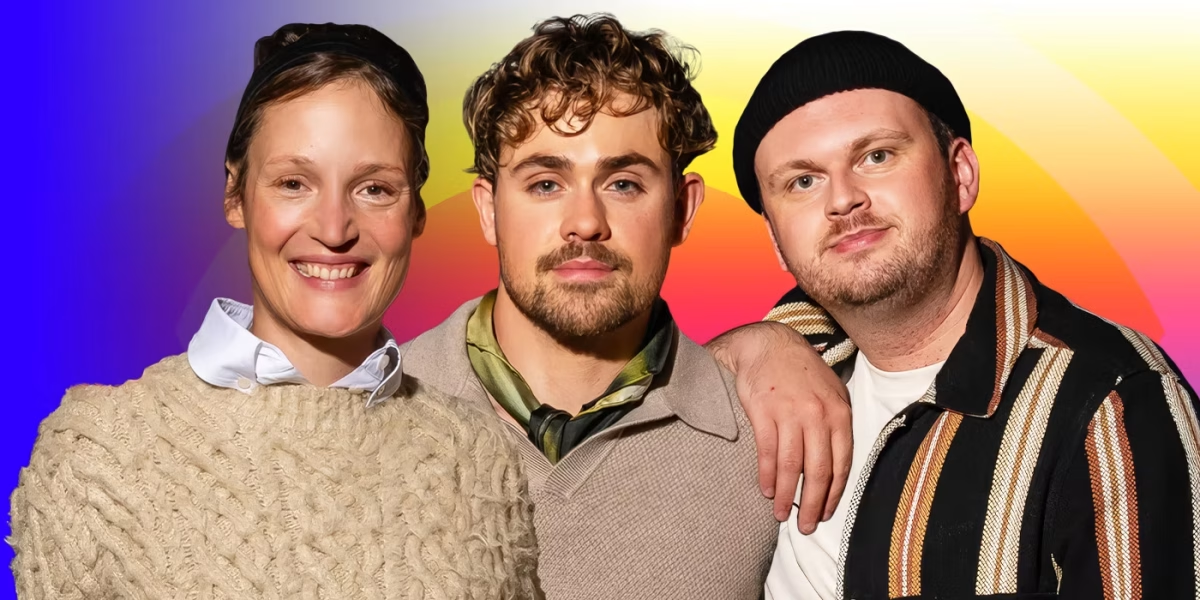
‘Went Up the Hill’s Dacre Montgomery Might Be Marlon Brando Reincarnated
Sep 26, 2024
The Big Picture
Collider’s Perri Nemiroff sits down with
Went Up the Hill
director Samuel Grinsven and co-stars Dacre Montgomery and Vicky Krieps at TIFF 2024.
Went Up the Hill
is a chilling story about two strangers possessed by their late mother and wife’s spirit.
During this interview, Grinsven, Montgomery, and Krieps discuss the film’s unique possession concept and on-set dynamics, as well as upcoming projects like
Faces of Death
.
Spooky season is still a few weeks away, but it’s never too early for a chilling horror flick to kick things off. Fresh from the Toronto International Film Festival 2024 comes Went Up the Hill, a brooding story of how two strangers are united by the spirit of an estranged family member through possession. Jack (Dacre Montgomery) flies to New Zealand to attend the wake of his estranged mother Elizabeth. Upon chance encounter, he meets Jill (Vicky Krieps), his mother’s widow. Following the funeral, the two feel obliged to get to know each other out of respect for their late mother/wife, only to further strain their non-existent relationship. But when the spectral presence of Elizabeth makes itself known, Jack and Jill are thrown into a maddening pool of chaos and confusion.
Directed by Aotearoa New Zealand filmmaker Samuel van Grinsven, Collider’s own Perri Nemiroff had the opportunity to talk more in-depth about Went Up the Hill with Grinsven and cast members Montgomery and Krieps at the Collider interview studio at the Cinema Center at MARBL. During their conversation, which you can watch in the video above or read in the transcript below, the trio discuss how opposite processes and on-set friction can produce positive results, how the two co-stars inspired one another, and upcoming projects like Faces of Death.
‘Went Up the Hill’ Takes Inspiration from a Nursery Rhyme
Image by Photagonist at TIFF
PERRI NEMIROFF: Clearly, I’ve seen your movie. I know it, but a lot of our viewers will not know what it is just yet. Would you mind giving a brief synopsis to kick us off?
SAMUEL VAN GRINSVEN: It’s called Went Up the Hill. It’s loosely inspired by the nursery rhyme “Jack and Jill Went Up the Hill,” and it centers on two grieving individuals who are both in remote New Zealand for the funeral of a woman. Over a series of nights, we learn that this woman who has passed away possesses each of their bodies. So it’s two physical bodies and three souls, and it turns into this very intimate, very raw nocturnal dance between these three individuals.
I love asking this question in general, but particularly when a movie has such a cool core concept like this. Samuel, can you tell me what was idea number one when you were first crafting this script, but then also, did you have a breakstory moment? Something you came up with that made you think to yourself, “Yes, it is whole, and it will work now?”
GRINSVEN: The instigating thing was just an image, which was that idea of a coffin in the center of a room, two people on either side, they’re both equally grieving about the person, but they know nothing about one another. That was the inciting image, and then as it went on, I guess in terms of a big break moment, it was the idea of using possession as a mode but not having it stuck to one kind of character. It’s this idea that it can pass between two characters and that we get to see a male interpretation and a female interpretation of the same character.
‘Went up the Hill’ Is “a Ghost Movie Made by Ingmar Bergman”
Image via TIFF
Again, this makes all the sense in the world to me because I have seen the movie. I do feel like it might be a difficult thing for someone to wrap their head around when you’re fighting to get a green light for the film. So who was the key person you met, the resource you got, the thing that made you think, “Someone gets it, and we’re gonna be able to make it now?”
GRINSVEN: I think a lot of it was the visuals. That’s how we explained it. It’s a deeply visual film, even the final product. And I think getting people to understand it really came down to the visual language and how we pitched that and our references, which were images like Francis Bacon.
VICKY KRIEPS: It’s like a ghost movie, but made by Ingmar Bergman. So it’s very Ingmar Bergman in the energy, but it’s like a ghost movie in the visuals and in the whole concept of it.
That does make all the sense in the world. I’ll build on that with the two of you now. So, the script comes your way. What were some of your biggest burning questions for Samuel in terms of how you would actually go about pulling this off?
DACRE MONTGOMERY: The rules of engagement of possession are very clear in the script, so I don’t think I had any question as to why. He had laid out, “When asked a question, Elizabeth can respond. If not asked a question, she can’t respond.” Obviously, it was all incredibly well-thought-out, so I didn’t feel like there were any holes or burning questions. We worked on Jack for like a year. I took like a year off and worked with Samuel every week on Zoom to create Jack. But we both knew that when we arrived in New Zealand, we would be with the Jill, creating Elizabeth together. And I think, honestly, there ended up being less and less questions because it became more of a symbiotic relationship between the three of us, where we were kind of melded and intertwined into our characters and the story. So it felt very real and very natural in a way. And I think it would be a discredit to say that there were questions around the script or the possession, I think.
GRINSVEN: Vicky had questions. [Laughs]
MONTGOMERY: Just personally, in the instance of reading the script. In the initial stages, I was very fascinated.
KRIEPS: I wasn’t really questioning the script or the character. It was just, I read the script, and then I called him, and I said, “Why is there a scarf?” There used to be a scarf that would fall onto the face, and then you were possessed.
MONTGOMERY: Elizabeth’s scarf.
KRIEPS: That was my question. I said, “Why is there a scarf? Couldn’t it be without the scarf? It would be more tricky probably.” I didn’t expect that they would call me back and say, “Okay, so we’ve taken on the ideas.” But that was my only question really.
GRINSVEN: When I met with Vicky, and she mentioned that, we were in the process in the screenplay of making the scarf less of a feature. Then I met you in person for the first time, and by that point, it just naturally happened to the point that it didn’t need it. It just fell away.
I loved that you brought that up because, I can confirm, you did not need that.
Vicky Krieps “Tested” Dacre Montgomery at Rehearsals
Image by Photagonist at TIFF
I was very impressed by how quickly I fell into step with what was happening and how right it felt so quickly, which does not feel like an easy thing to pull off. But maybe it is when you two get to work with a wonderful scene partner. Can you each tell me the first thing you saw in the other that made you say to yourself, “Yes, this is my scene partner for this project; it’s the right person?”
KRIEPS: That’s such a beautiful question!
I’ll start there.
MONTGOMERY: Vicky instantly tested me, which I liked. The first day we met at rehearsals — let’s forget about the dinner party — the first day we met at the rehearsals, she was, I think, testing me, figuring me out. And I so desperately want that in my career as a director, and Samuel tested me. By the way, the connotation of “tested” is positive for me. I want to be pushed. It’s exactly what these two did. I need that. I needed that. I yearned for that in a creative partnership more than I could have ever asked for. I feel like it pushed me to be the best version of myself.
KRIEPS: How did I test you? That’s interesting.
MONTGOMERY: There are so many things. [Laughs] I shouldn’t say. No, I just remember in our first rehearsal together, you were talking about your process, and I was like, “Well, my process isn’t your process.” I think in that moment, I also wanted to prove to you, obviously, that we have different schools of thought, and that was important to me. But the fact that you continued to push me throughout the process of the shoot, I’ve never said that to you, but it benefited me immensely. Do you know what I’m trying to say?
KRIEPS: I probably was, as you mentioned, you prepared for a year, and I like to not prepare, but rather unprepare or something. Maybe that’s what I was mentioning. I like to not know what I’m going to say next in order for it to be maybe more interesting, intelligent, or more natural in life in general.
MONTGOMERY: Everything I’m not, basically. [Laughs] I’m joking.
KRIEPS: So probably that’s what I meant. That is my process, you know? But then I already forgot about it because it became so unimportant since the work was shared.
Image by Photagonist at TIFF
MONTGOMERY: And all of this to say, flippantly, it became so unimportant so quickly because we fell into step together the first day of rehearsals. I feel like by lunchtime, the connective tissue was folding out of me and folding out of Vicky as we met in the middle with Elizabeth the first day. But then, very quickly, Samuel was like, “I’m adjusting this whole rehearsal process because…”
GRINSVEN: It was great. We had just over a week of rehearsals planned. We got about three days in and I could just tell there was an energy between the two of them that was quite raw and fragile. I thought, “If we keep pushing this, we’re gonna ruin it, right?”
KRIEPS: Basically, I became the dictator and said, “We are not…” No, I’m joking.
GRINSVEN: [Laughs] No, you didn’t!
KRIEPS: Because I just said I don’t like to prepare and then we stopped. I’m actually a very nice person, but I can be very direct about what I think.
GRINSVEN: She is. I can attest. She’s nice.
I think that’s a beautiful way to describe it all. I’m constantly obsessing over the fact that there are a million ways to approach your work as an actor. Someone was recently talking to me about how the word “friction” is used in a negative way, when really, when two actors are coming at it with a different approach to the work, that’s when you can find that unexpected magic that you’d never be able to tap into if you were totally aligned right from the start. I love that.
KRIEPS: Exactly.
MONTGOMERY: Yeah, exactly that question. What’s the mystery that the performer is bringing? And I think even for me as a performer opposite Vicky, I was constantly like, “No, no, no. What’s your truth? What’s your mystery? What’s your thing?” But she’s sharing it all the time. It is her. She’s a very generous artist in sharing herself. It’s an unfiltered version of self which I thrive on because there’s honesty and truth, and it creates mutual respect immediately. We didn’t speak to each other the whole shoot, really, but nothing needed to be said. It wasn’t a thing that needed to be talked about, like, “Oh, we’re friends. Let’s do this and that and the other.” It was already, I felt, there.
Dacre Montgomery “Might Be the Reincarnation of Marlon Brando”
“You’re like a director in your head.”
Image by Photagonist at TIFF
Absolutely. You clearly knew you were the right pairing right from the start, but even then, can you tell me something you saw the other one do on set that made you go, “I can’t even believe you were capable of that?”
KRIEPS: I had a few of those. I don’t know if I, from the beginning, thought, “Yes, this is…” because I didn’t know you at all. I had seen a little bit of your work in Elvis, and I did remember that performance because it was very nice, but it’s not like I knew your work, so it’s not like I could trust anything. Then I met you, and you could have been, very much, this type of American, and you’re not American, actor — Netflix, TV, thinking about only what you eat and workouts. Not to say anything about workouts, I’m just saying some actors are very superficial in that way.
So I met you, and for a moment, you could have been that person. Then, very quickly, because of the dance thing we did where there’s nothing to rely on — because when your body moves, you have to be honest — immediately when we started doing that, I felt that you are honest, open, and ready to act in the sense of acting where it’s not about you, but it’s about what is about to be found or what is about to happen between two people.
Then, another moment on set — and I even told someone — I looked at you acting, and not only did you look incredibly beautiful as a man, but the way you were acting made me think, “He might be the reincarnation of Marlon Brando.” I’m not joking. Because of the way you combine personal experiences, like trauma or things, you bring them into the world, but at the same time, you’re very intellectual. You want to understand. You’re like a director in your head, so it’s very important for you in what it means and how you understand it. So, I had these two decisive moments.
Great example. Dacre, you got anything?
MONTGOMERY: I kind of feel like we’ve met for the first time because we didn’t speak. That’s very sweet. I’m hearing this in real time, and it’s very, very sweet and kind. Vicky put so much of her own pain on the screen, and I think that’s very hard, very beautiful, and very generous. I hadn’t worked with anyone who was that generous, in a way, with their spirit and their soul, and it’s very affecting and quite staggering. I felt quite shifted and nervous, but then there’s this incredible like warm blanket that kind of comes over your soul when someone shows you theirs. I said earlier, I may never work with someone like that again, so I’m happy, and I’m very grateful for the experience to work with her.
Such beautiful answers.
How the ‘Went Up the Hill’ Stars Tapped Into Possession
Image by Photagonist at TIFF
I wanna tap into playing Elizabeth a little here. This is a big question, but I am curious. Is there any kind of consistency that you wanted to maintain in your portrayals, but then also something specific you wanted to do differently to reflect the fact that technically you’re playing different sides of her, like the mother and the wife sides?
KRIEPS: Watch the movie. You have to see it.
MONTGOMERY: Perfume. We’ve talked a lot about how we both had our own scents for Jack and Jill, and Elizabeth. Vicky brought a scent that we used when playing Elizabeth, so there was a sensory experience that differentiated the two. Secondly, it will always be different because we’re different human beings. It’s never going to be the same person. I’m not looking to make a replica of what Vicky’s doing and vice versa. I think that’s important. It’s subtle, and, like Vicky said, you gotta watch the movie and see what your opinion is. Everyone has their own thing. But I was happy with our portrayals; they’re completely different in their own way, and then there’s this connection, completely overwhelming, in the same way.
GRINSVEN: I think it’s more of an essence that they share as opposed to a specific sort of movement or anything, but you can feel it. There’s a weight when they’re each inhabited by her.
KRIEPS: We took a risk because trauma is collective; we all carry trauma. And in a way, it’s almost the same trauma with different colors — the trauma of a man, the trauma of a woman, the trauma of a son or the mother or the daughter, and is going to be the mother of someone else. My mother was someone’s daughter before. We all share that, and I think the three of us took the risk of making that more important than agreeing on, “How is this character going to move? How is this character going to talk?” We did not talk about that, but let it happen and leaned into this more maybe spiritual energy, the idea of, “What is a ghost? What is being possessed? What is your trauma you carry around, and how do we fight with it?”
GRINSVEN: It sounds more complex, but it’s actually simpler. What we found was actually the simplest way to do it.
MONTGOMERY: 100%.
GRINSVEN: The effect is more complex on screen.
Image by Photagonist at TIFF
The more I’ve thought about the movie, the more I feel that. I love horror movies, it’s my favorite genre, and I feel like I usually experience ghost and possession stories a very specific way. This, on the other hand, is so incredibly deeply human and shockingly relatable.
MONTGOMERY: When you are performing, just to speak about Samuel for a second, Vicky said color, male/female, each individual — Samuel is so much of himself in his story, which isn’t for me to talk about, but in this project, that when we’re performing in front of the camera, if you could see color, it’s pouring out of him behind the camera. He’s in the scene with us every scene.
GRINSVEN: They made me cry most days.
MONTGOMERY: It’s so affecting. I find it generous because I’m like, “This person behind the camera is just pouring out.”
KRIEPS: That’s why we’re making jokes all the time and pushing each other, because actually, this is for real. This was very intense for us. So, we don’t have to make up, “This is a very interesting project. Go see the film. It’s very intense.” We are constantly joking and pushing each other because what we talk about is actually truly intense, and that’s why we don’t find stupid cool words now maybe to sell the film. You just have to see the film. It’s real.
Dacre Montgomery Shares Small Update on ‘Faces of Death’
I have to end on one unrelated question. Dacre, I think Daniel Goldhaber is one of the best of the best out there.
MONTGOMERY: He’s my favorite.
He excites me so, so much. I’m very curious about Faces of Death . Is there anything you can tease in terms of how far the new movie is going to go with how disturbing is it, and how it either leans into or tiptoes around the controversy of the original?
MONTGOMERY: I’m not going to give too much away. Danny is like Samuel; he puts all of himself into a film. He’s an incredible filmmaker, and he’s incredibly collaborative. We got a great opportunity to really play in that space. It goes all the way. I’m really excited for people to see it.
Special thanks to this year’s partners of the Cinema Center x Collider Studio at TIFF 2024 including presenting Sponsor Range Rover Sport as well as supporting sponsors Peoples Group financial services, poppi soda, Don Julio Tequila, Legend Water and our venue host partner Marbl Toronto. And also Roxstar Entertainment, our event producing partner and Photagonist Canada for the photo and video services.
Publisher: Source link






Eggs – Film Threat
In writer-director-star James Clair’s short drama Eggs, a man struggling to rebuild his life finds his quiet mornings turning into strange conversations with the very eggs he is meant to cook. I mean, they want him to eat them. So…
Mar 11, 2026
Ethan Hawke Elevates A Rugged, Predictable Gold-Run Survivalist Western[Sundance]
As far as one can tell, Murphy (Ethan Hawke), a father, WWI veteran, and avid car mechanic, has never encountered an insurmountable challenge. Living in Eugene, Oregon, in 1933, four years into the Great Depression, Murphy and his young daughter,…
Mar 11, 2026
The Moment Review | Flickreel
Brat Summer was a cultural phenomenon that I didn’t understand at all. I knew that it was connected to an album that Charli XCX had released. Whenever I asked what Brat is, though, nobody could seem to give a straight…
Mar 9, 2026
Cillian Murphy’s Netflix Crime Hit Delivers a Brutal, Bleak Finale
It’s been four years since we last saw Cillian Murphy play Tommy Shelby, but seven have passed in the world of Peaky Blinders, with The Immortal Man taking place in 1940, in the middle of World War II. Tommy’s gone…
Mar 9, 2026