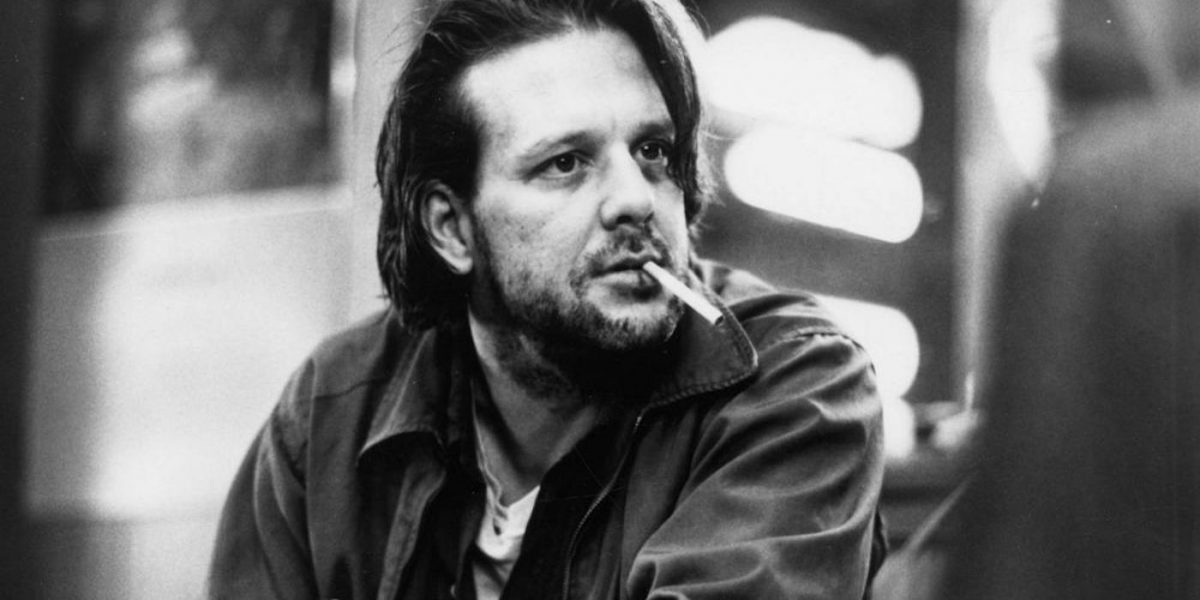
Mickey Rourke’s Swagger Was Unforgettable Playing This Iconic Poet
Jun 18, 2023
When thinking of Mickey Rourke, wrestler or supervillain certainly come to mind, which is ironic given that one of his best roles sees him playing one of the greatest real-life poets to ever put pen to paper. The poet in question is Charles Bukowski, known by fans of his work as the ultimate poet of the working class, who occasionally doubled as a novelist and a screenwriter. A counter-culturalist at heart, landing somewhere thematically and stylistically between Allen Ginsberg and Henry Miller, no one has ever made a single glass of beer sound as meaningful, and no one ever spoke of working-class misery with such admiration and authenticity. In 1987, director Barbet Schroeder brought the semi-autobiographical Barfly (itself penned by Bukowski) to life, with its radically subversive narrative proving the perfect embodiment of the poet’s source material.
COLLIDER VIDEO OF THE DAYSCROLL TO CONTINUE WITH CONTENT
Mickey Rourke, a major star among young people and a sex symbol of the era thanks to his roles in Rumble Fish and 9½ Weeks, proved the perfect star to capture Bukowski’s nihilistic and quotidian obsessions. Like much of Bukowki’s prose fiction, biographical elements are sprinkled throughout. However, the film concerns itself less with telling a Hollywood story than it does with capturing the essence of Bukowski’s poetry, the likes of which are the complete antithesis of the American Dream. However, prior to diving into just how Rourke’s brilliant performance elevates the film to new heights, it’s necessary to discuss why Bukowski’s poetry remains as groundbreaking as it was when he began publishing in the 1940s.
RELATED: Best Movies About Fictional Novelists, Ranked
Who Is Poet Charles Bukowski?
Image via The Cannon Group, Inc.
For those unfamiliar with his work, Bukowski’s poetry broadened the horizons of what poetry is in fact capable of. If you’re struggling to relate to poetry due to its classical and culturally academic nature, Bukowski is your man, as his work doesn’t concern itself with nightingales and meadowlarks as much as it does the everyday life of the working class. It’s the difference between Victor Fleming’s Gone with the Wind and Martin Scorsese’s Mean Streets, which is to say that Bukowski shifted the perception of poetry from exceptionalist and focused it on the grit of the streets. His favorite subjects are alcoholism, prostitution, and gambling, with his instantly relatable and realist writing style challenging the very notion of poetry as high art. His poetry proved so anti-establishment that the FBI even had an extensive file on him but could never uncover any proper dirt.
In his book of collected poems Burning in Water, Drowning in Flame (hands down one of the rawest titles of all time), one has to look no further than the first couple lines of “2P.M. Beer,” in which he writes: “nothing matters but flopping on a mattress with cheap dreams and a beer as the leaves die and the horses die and the landladies stare in the halls”. The lack of punctuation is important, as it captures his unfiltered approach to writing. Much like the absurdist philosophy of Albert Camus, Bukowski is lost in the details of the beauty in everyday life, writing on sensation alone. As much as schoolteachers love Robert Frost’s “The Road Not Taken” or Shakespeare’s “Sonnet 18” (“Shall I compare thee to a summer’s day?”), a poem like “2P.M. Beer” is one that anyone can pick up and find themselves in, even if they’re not exactly proud of it.
Why Does Mickey Rourke’s Performance in ‘Barfly’ Stand Out?
Image via The Cannon Group, Inc.
The leading character in question, Henry Chinaski (a pseudonym for Bukowski and the star of some of his best novels) is a walking middle finger to societal norms. His days are spent drinking, his nights fighting, and in between he makes love, pausing only to write hardcore poetry about the beauty of living by desire. One of his best writing lines embodies his animal spirit: “Some people never go crazy. What truly horrible lives they must live.”
Watching Mickey Rourke play Chinaski is like watching a man from another planet, carrying himself with such confidence and swagger in spite of the fact that he has nothing but his poetry (which he never brings up on his own) to show for it. His teeth are chipped, his knuckles are bruised beyond belief, and he constantly looks on the verge of dropping dead, though that cocky half-smile of his means you know he won’t just bounce back, he’ll enjoy it too. He’s not just a Hollywood pretty boy planted onto a working-class film set, but the genuine article ready to rumble at every turn.
‘Barfly’s Structure Brilliantly Sticks to Its Anti-Establishment Guns
Image via The Cannon Group, Inc.
It’s pretty common for Hollywood biopics to depict the classic rise and fall and rise again of an artist even outside the musical spectrum (something John C. Reilly called brilliant attention to in Walk Hard: The Dewey Cox Story). However, in Bukowski’s case, that doesn’t really speak to the spirit of his poetry. What’s most interesting about the film is it gives Chinaski a method of escape from this life of destitution. A wealthy publisher discovers his poetry and takes him back to her stately manor, the likes of which Chinaski describes as nothing more than “a cage with golden bars”. The protagonist actively resists change even when it means no longer struggling, stating that “growing is for plants” and that “nobody who could write worth a damn could ever write in peace.” Surely anything’s better than stealing food from your neighbors just to have the energy to pick a fight with a bartender but for Chinaski (and by extension, Bukowski), that just isn’t the case.
The film’s ending sees Chinaski resisting the golden ticket offered to him by the upper class, choosing instead to slum it with his alcoholic paramour Wanda (Faye Dunaway) in spite of the pain that her lifestyle brings. It’s a toxic, self-destructive match made in Hell that Chinaski relishes in. After all, if Picasso was happy throughout his life, it’s highly unlikely that he would have ever painted Guernica. The film poetically ends just as it began, with Chinaski picking a fight with Eddie (Frank Stallone) behind the bar, and probably getting more of his teeth knocked out as a result. What the film ultimately contends is that for some, that’s just as much of a calling as an office job or raising a family.
Barfly embodies the true nature of Bukowski’s poetry, warts and all, and let’s be honest… it’s the warts we’re really interested in. Last year, Baz Luhrmann’s Elvis may have prioritized the myth over the man, but for those who like their idols a little more grounded and flawed, then there’s almost nowhere better to go than the cheapest bar in sight where Bukowski’s spirit reigns supreme. Mickey Rourke’s performance in the almost structure-less biopic isn’t a narrative compromise but a work of deadbeat poetry in and of itself.
Publisher: Source link






Paramount’s Action-Adventure Hit Blazes to Its Biggest Audience Ever With Over 10 Million Viewers
Fire Country premiered in October 2022, and four years later, the action drama remains a hit for CBS and Paramount+. The series’ fifth and latest season debuted on October 9, and within three days, it ranked as the seventh most…
Oct 26, 2026
Rebecca Ferguson’s Near-Perfect Sci-Fi Thriller Is Officially a 600-Day Streaming Smash Hit
While it was the Mission: Impossible franchise that put Rebecca Ferguson on everyone's radar, it was her appearance as Rose the Hat in Doctor Sleep that cemented her as a superstar. It led to movies like Dune, Netflix's A House…
Oct 25, 2026
‘The Gentlemen’ Loses 2 Original Stars, Reunites ‘Lord of the Rings’ Icons in Big Season 3 Shake-Up
Guy Ritchie's signature blend of aristocratic elegance and gritty underworld chaos has officially solidified its place as a Netflix powerhouse. Originally launched as a television spin-off of his hit 2019 feature film, The Gentlemen captivated global audiences across its first…
Oct 24, 2026
Taylor Sheridan’s ‘Yellowstone’ Sequel Hits Major Milestone Ahead of Streaming Return
The Yellowstone universe has grown so fast since the main series ended that it’s fair to wonder whether the franchise might be stretching itself a bit thin. That’s part of why Dutton Ranch came as something of a surprise. Beth…
Oct 23, 2026