Elliot Tuttle Discusses His Transgressive Blue FilmFilmmaker Magazine
May 28, 2026
Blue Film
Blue, as it pertains to the material and sociopolitical histories of cinema, is a color associated with legend, conjecture, and etymological ambiguity. During the heightened moral panic and puritanical tyranny of Hays Code–era Hollywood, blue grease pencils were used by censors to mark film stock for sequences considered obscene or ethically dubious, undermining artistic integrity and forcing directors into eleventh-hour cuts and re-shoots. Concurrently, the lápis azul was used by the Estado Novo dictatorship in Portugal to omit words or entire passages from texts that were deemed politically subversive, as well as to censor international films before they reached Portuguese audiences. Other sources claim that although the word “blue” has been connected to ribaldry and profanity since at least the 1860s, the phrase “Blue Movie” likely became synonymous with early pornographic content due to stag films being shot on low grade film stock, lending the carnal proceedings a distinctly bluish pallor.
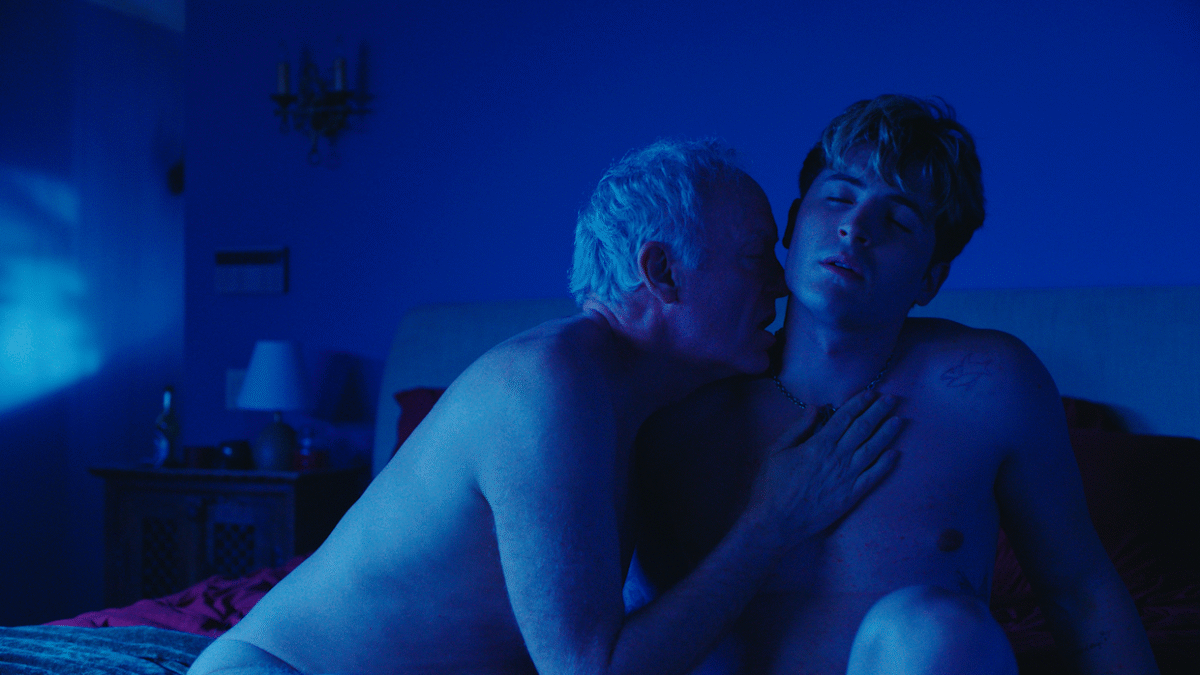
The young provocateur Elliot Tuttle often directly embraces these multivalent affiliations and gradients of blue in his debut feature Blue Film. “That color was used to signify anything that was culturally taboo, especially at the time. There’s the obvious pornographic reference, but it was important to me that these different uses of the term felt linked,” Tuttle tells me via Zoom. In Blue Film the titular color is not only politically loaded, but used in a similar manner to the visceral red fades of Ingmar Bergman’s Cries and Whispers: as a liminal space of pure emotional interiority. “Bergman’s filmography is predicated on the dissonance between our assumed self and our true self, which is so much of what the narrative engine of Blue Film is sustained by,” Tuttle explains. Indeed, the aesthetic and conceptual concerns of Bergman ripple throughout Blue Film, in which two damaged men exchange philosophical musings, destabilized identities, and seminal fluids during a relentless evening of queasy revelation and psychosexual despair.
One of these men is Aaron Eagle (Kieron Moore), a gay FinDom camboy stranded in a feedback loop between his “authentic” and “invented” personas. The film opens in the buffering depths of cyberspace, as the rugged, tattooed Aaron barks commands at an unseen throng of “worthless paypigs,” ordering them to drain their digital wallets while he performs an erotic routine of hypermasculine toxicity. The second of these men is a mysterious elderly client in a ski mask that frequents Aaron’s chatroom, who Aaron agrees to meet at a rented AirBnB home in Hancock Park, Los Angeles, after being promised $50k for his services. As the night progresses, the client is revealed to be Hank Grant (Reed Birney), a disgraced pedophile and Aaron’s former middle school teacher. Hank has believed himself to be in love with Aaron since Aaron was a twelve-year-old boy named Alex. Within the confines of this transactional reunion, Aaron/Alex and Hank perpetually circle around the personas they’ve constructed for themselves and each other, until any semblance of truth is made illusory, diffracted through multiple lenses, mutually consented upon for a moment, and then abruptly flagged for excision.
Through amorphous roleplay and unreliable narration, the film elides convenient trajectories around redemption or repair. “Both characters feel uneasy about the answers they find and have to forge a path forward,” says Tuttle. “It complicates their own perception of themselves. Aaron fully believes himself to be this alpha-male character, and it’s not until that is interrogated that the slip happens around who he considers himself to be.” Reverently operating in a distinct mode of transgressive cinema, Tuttle draws inspiration from Catherine Breillat’s extreme depictions of adolescent sexual agency (A Real Young Girl, 36 Fillette) and the frigid traumatophilia of Agustí Villaronga’s In a Glass Cage. In a process similar to Breillat’s early work, Tuttle began the development of Blue Film as part pubescent smut fantasy, part existential treatise on the nature of desire. These preliminary writings eventually manifested into an intimate hall of mirrors replete with fragmented perspectives and melodramatic edges. “I’m interested in the way that sex informs so much of how we live our life,” Tuttle adds. “It’s not this conceptual thing. It’s actually really rife with danger or potential or possibility.”
Gesturing incidentally towards this threshold between risk and arousal, Tuttle used International Klein Blue (IKB), a highly luminous shade of blue created by artist Yves Klein in 1960, during a climactic final sex scene between Aaron and Hank. A variant of IKB was previously used as the shade that fills the screen in the sole shot for Blue, the final film by Derek Jarman, representing the ocular degeneration that Jarman suffered due to AIDS-related complications before his death. Offering yet another generative link in the storied history of cinematic blues, this choice casts the film in a spectral continuum of queer mourning, evoking the loss of innocence, the deterioration of selfhood, and the ruse of bodily autonomy.
Tuttle describes a trusting atmosphere of collaboration on set between himself and his two lead actors, which partially influenced his decision to include childhood home movies of himself at the beach as interstitial sequences throughout the film, as both a metatextual entry point into the more autobiographical elements of his characters, and as a sobering reminder of the gravity of the situation at hand. In particular, Moore brought a raw physicality and bruised swagger to the role of Aaron that shifted the way he was originally perceived. Birney makes a variety of fascinating choices in his portrayal of Hank, effortlessly vacillating between somber self-reflection and florid feats of rationalization (including romanticizing the pederasty of Roman warriors and receiving the blessing of his priest to visit Aaron) all while maintaining a disquieting sincerity that brings to mind the wholesome demeanor of television personalities such as Mr. Rogers. “I love Reed’s performance so much,” Tuttle says. “It’s so funny how it varies between people who are either charmed by it or put off by it, or put off by being charmed by it. There is this vestigial, teacheresque quality to him, the sense that he is trying to guide Aaron in some way. There are so many interesting things that he brings to his performance that are rich and layered and demand to be picked apart.”
When asked if he is preoccupied with the nature of evil in the story between Aaron and Hank, Tuttle asserted that while he does in fact characterize Hank as a person who has committed evil deeds, he is less concerned with the banality of evil (although he champions The Zone of Interest as a film that has tackled the topic exceptionally) and more concerned with its emotional affect: “It’s not like evil erases an inner world. When someone has done something evil, I think we have a tendency to forget that this person has an entire brain inside of them, or an entire life. I’m interested in capturing that almost ineffable, idiosyncratic way that we respond to evil, to harm done to us and done by us.”
Publisher: Source link



Netflix’s 10/10 Thriller Series Returns After 3 Year Absence With Explosive New Trailer
Over the last five years, Netflix has expanded heavily into non-English content, with international series taking an even bigger focus for the streaming giant. One of the biggest driving forces in that effort is the French thriller series Lupin, led…
Sep 15, 2026
Original ‘Yellowstone’ Dutton Favorite Officially Confirms ‘Marshals’ Return Interest
Yellowstone jump-started a generation-spanning story that has so far spawned four spin-offs that are all interconnected by the Dutton bloodline. While creator Taylor Sheridan has since branched outside that saga with Tulsa King, Landman, Mayor of Kingstown, The Madison, and…
Sep 14, 2026
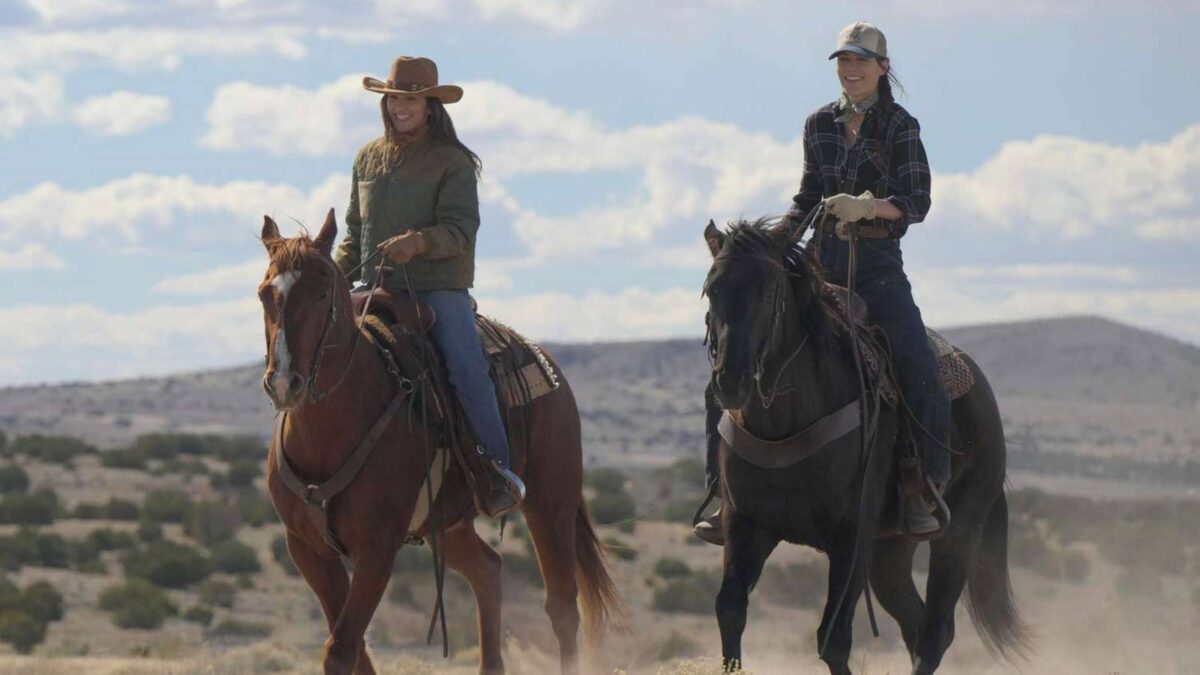
Netflix Officially Cancels Its 2-Part Taylor Sheridan Replacement Western
Netflix Published Sep 12, 2026, 10:30 AM EDT Omar is an experienced editor and writer who sees life and storytelling as one and the same — there’s always a story to tell. He’s helped shape features, headlines, and coverage across movies,…
Sep 13, 2026
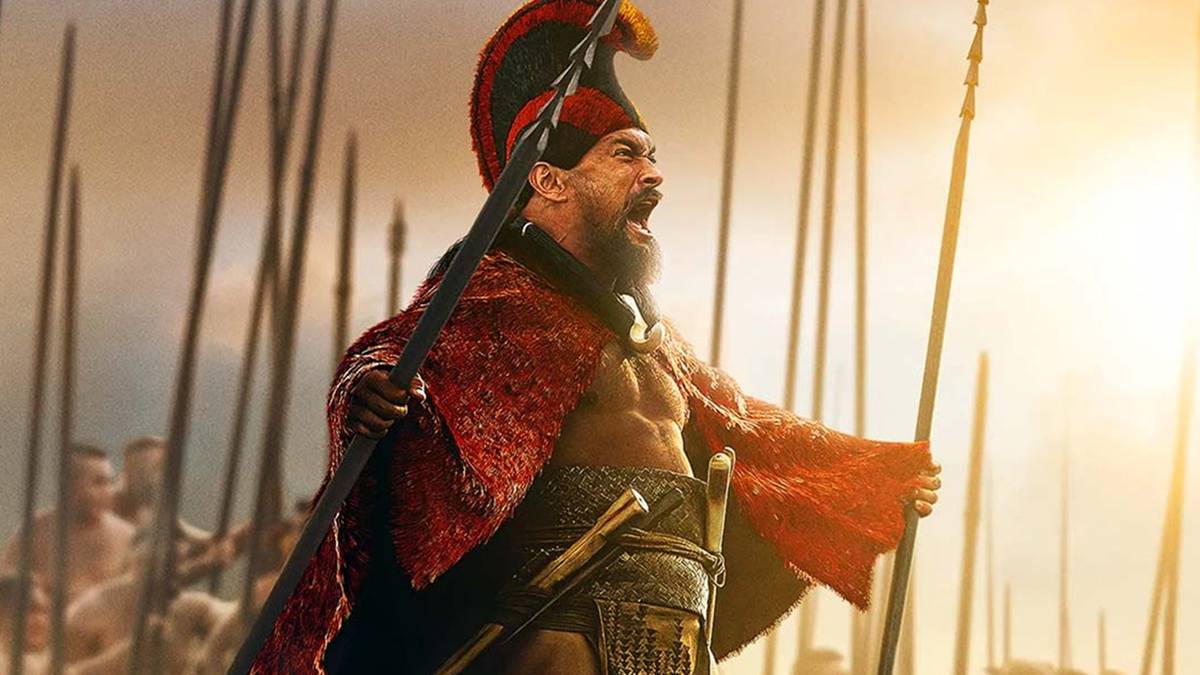
Jason Momoa’s Epic Historical Action Thriller Officially Getting New Release
Apple TV has established itself as a rising force in streaming entertainment. From Silo and Dark Matter to Pluribus and Ted Lasso, there is something for everyone, and not only that, but a ton of huge star power at the…
Sep 12, 2026