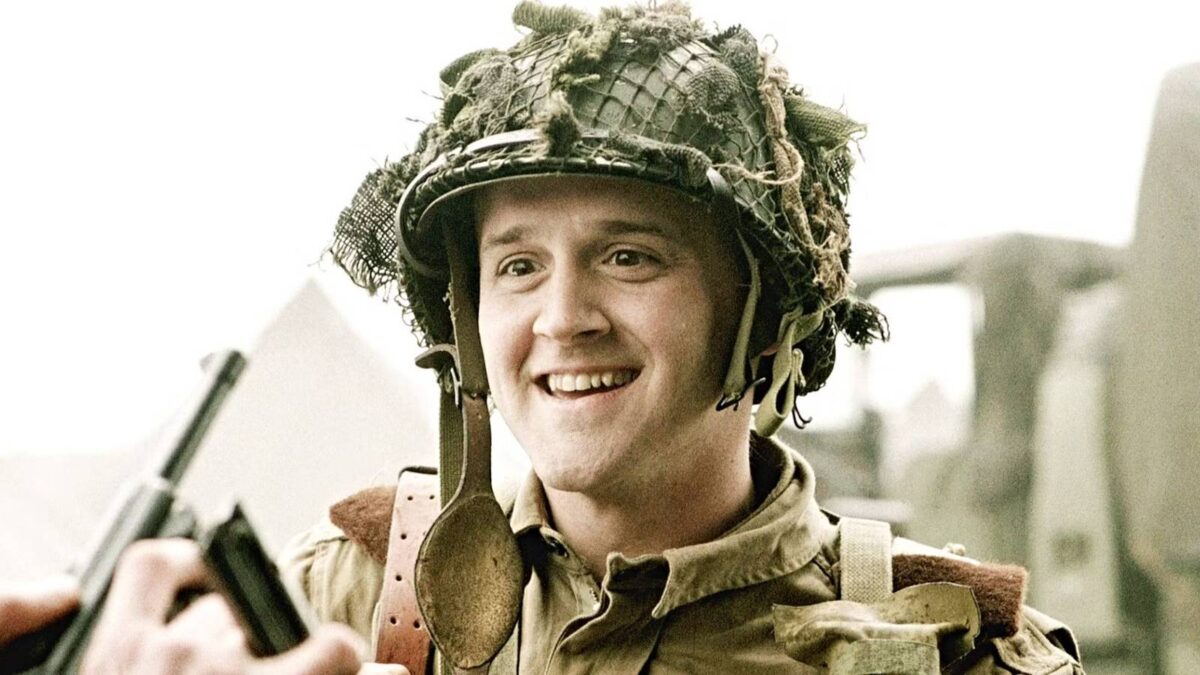
‘Band of Brothers’ Star Explains Why the HBO Classic Still Resonates 25 Years Later [Exclusive]
Oct 6, 2026
25 years ago today, HBO would still be airing new episodes of its acclaimed World War II miniseries Band of Brothers. Premiering in September 2001, the drama, inspired by Stephen E. Ambrose’s historical novel of the same name, landed like an atomic bomb on television, depicting the horrors of war in ways that felt terrifyingly real while honoring the sacrifices of those willing to brave them for their country. It was a harbinger of things to come on the small screen, being one of the earliest entries of the prestige television era with production values closer to those of co-creator Steven Spielberg’s Saving Private Ryan than the average program at the time. However, the series is remembered for so much more than the Emmys it won, how good it looked, or the fact that it was co-created by Spielberg and Tom Hanks.
Band of Brothers follows the dramatic tale of Easy Company, the 506th Parachute Infantry Regiment of the 101st Airborne Division, throughout their deployment in WWII. Across ten episodes, they go from basic training to braving the battlefield on the Western Front, from Normandy into Germany up until the war’s end in 1945. Each young man and their commanding officers have their bravery and resilience tested time and again, whether when fighting against the Germans at the Battle of the Bulge or trying to survive the onslaught of both weather and artillery in the Ardennes. For star Richard Speight Jr., who played Sgt. William “Skip” Muck, though, it’s not the battles, the harrowing situations where morale ran low, or the camaraderie within the regiment that sticks with him to this day, but the individual moments when filming where it all registered that real people endured these challenges. Speight Jr. spoke with Collider’s Maggie Lovitt at FanX Salt Lake City, where he was asked about which scenes were most memorable to film. “I wouldn’t necessarily carve out a scene,” he said, opting instead to focus on those individual moments that occurred when setting up a scene, or something else entirely. Experiencing even a fake boot camp and war zones where no real bullets flew gave him an appreciation for the soldiers they were portraying. The dedication in the production to making set pieces feel realistic, he believes, not only helped each of the stars resonate with the show and what it was trying to accomplish, but in turn, helped viewers better feel what the very real people behind Band of Brothers experienced.
“The moments being boot camp. The moments being working up battle sequences like in Episode 5, where we take the hill and find ourselves face to face with an onslaught of Germans. I think those moments that you’re trying to recreate resonate because they really happened to real people. Only the bullets were real. For us, it was fake, and we were blessed to be able to know that we weren’t in harm’s way. But going through the boot camp, which obviously is nothing like what the real boot camp was, but for us, it was an opportunity to try to understand what it was like to be those young men at that time, and so it was so valuable and so impactful, and changed all of us in many, many ways. I think I’m struck more by those moments than individual scenes.”
Collider Exclusive · Oscar Best Picture Quiz
Which Oscar Best Picture
Is Your Perfect Movie?
Parasite · Everything Everywhere · Oppenheimer · Birdman · No Country
Five Oscar Best Picture winners. Five completely different visions of what cinema can be — and what it can do to you. One of them is the film that was made for the way your mind works. Ten questions will figure out which one.
Parasite
Everything Everywhere
Oppenheimer
Birdman
No Country for Old Men
FIND YOUR FILM →
01
What kind of film experience do you actually want?
The best movies don’t just entertain — they leave something behind.
ASomething that pulls the rug out — that makes me think I’m watching one kind of film and then reveals I’m watching another entirely.
BSomething overwhelming — funny, sad, absurd, and genuinely moving, all at once.
CSomething grand and weighty — a film that makes me feel the full scale of what I’m watching.
DSomething formally daring — a film that pushes what cinema can even do.
ESomething lean and relentless — pure tension with no wasted frame.
NEXT QUESTION →
02
Which idea grabs you most in a film?
Great films are driven by a central obsession. What’s yours?
AClass, inequality, and what people are willing to do when desperation meets opportunity.
BIdentity, family, and the chaos of trying to hold your life together when everything is falling apart.
CGenius, moral responsibility, and the catastrophic weight of a decision you can never take back.
DEgo, legacy, and the terror of becoming irrelevant while you’re still alive to watch it happen.
EEvil, chance, and whether moral order actually exists or if we just tell ourselves it does.
NEXT QUESTION →
03
How do you like your story told?
Form is content. The way a story is shaped changes what it means.
AGenre-twisting — I want it to start in one lane and migrate into something completely different.
BMaximalist and genre-blending — comedy, action, drama, sci-fi, all in one ride.
CEpic and non-linear — cutting between timelines, building a mosaic of cause and consequence.
DA single unbroken flow — I want to feel like I’m living it in real time, no cuts to safety.
ESpare and precise — every scene doing exactly what it needs to do and nothing more.
NEXT QUESTION →
04
What makes a truly great antagonist?
The opposition defines the protagonist. What kind of opposition fascinates you?
AA system — invisible, structural, and almost impossible to fight because it has no single face.
BThe self — the ways we sabotage, abandon, and fail the people we love most.
CHistory — the unstoppable momentum of events that no single person can stop or redirect.
DThe industry — the machinery of culture that chews up talent and spits out irrelevance.
EPure, implacable evil — a force so certain of itself it becomes almost philosophical.
NEXT QUESTION →
05
What do you want from a film’s ending?
The final note is the one that lingers. What do you want it to sound like?
AShock and inevitability — a conclusion that recontextualises everything that came before it.
BEarned emotion — I want to cry, laugh, and feel genuinely hopeful, even if the world is a mess.
CDevastation and grandeur — an ending that makes me sit in silence for a few minutes after.
DAmbiguity — something that leaves enough open that I’m still thinking about it days later.
EBleakness — an honest refusal to pretend the world is tidier than it actually is.
NEXT QUESTION →
06
Which setting pulls you in most?
Where a film takes place shapes everything — mood, stakes, what’s even possible.
AA gleaming modern city with a hidden underside — beauty masking rot, wealth masking desperation.
BA collapsing suburban life that opens onto something infinite — the multiverse of a single ordinary person.
CThe corridors of power and science at a world-historical turning point — where decisions echo for decades.
DThe grimy, alive chaos of New York and Hollywood — fame as both destination and trap.
EVast, indifferent landscape — desert and highway where violence arrives without warning or reason.
NEXT QUESTION →
07
What cinematic craft impresses you most?
Every great film has a signature — a technical or artistic element that makes it unmistakable.
AProduction design and mise-en-scène — every frame composed to carry meaning beneath the surface.
BEditing and tonal control — the ability to move between registers without losing the audience.
CScore and sound design — music that becomes inseparable from the dread and awe of what you’re watching.
DCinematography as performance — the camera not recording events but participating in them.
ESilence and restraint — what’s left unsaid and unshown doing more work than any dialogue could.
NEXT QUESTION →
08
What kind of main character do you root for?
The protagonist is the lens. Who you choose to follow says something about you.
ASomeone smart and resourceful who makes increasingly dangerous decisions under pressure.
BSomeone overwhelmed and ordinary who turns out to be capable of something extraordinary.
CA brilliant, tortured figure whose gifts and flaws are inseparable from each other.
DA self-destructive artist whose ego is both their superpower and their undoing.
EA quiet, principled person trying to make sense of a world that has stopped making sense.
NEXT QUESTION →
09
How do you feel about a film that takes its time?
Pace is a choice. Some films sprint; others let tension accumulate slowly, deliberately.
AI love a slow build when I know the payoff is going to be seismic — patience for a devastating reveal.
BGive me relentless momentum — I want to feel breathless and emotionally spent by the end.
CEpic runtime doesn’t scare me — if the material demands three hours, give me three hours.
DI want it to feel propulsive even when nothing is technically happening — restless energy throughout.
EDeliberate and unhurried — I want dread to accumulate in the spaces between the action.
NEXT QUESTION →
10
What do you want to feel walking out of the cinema?
The best films leave a mark. What kind of mark do you want?
AUnsettled — like I’ve just seen something I can’t fully explain but can’t stop thinking about.
BMoved and energised — like the film reminded me what actually matters and gave me something to hold onto.
CHumbled — like I’ve been in the presence of something genuinely important and overwhelming.
DExhilarated — like I’ve just seen cinema doing something it’s never quite done before.
EHaunted — like a cold, quiet dread that stays with me for days.
REVEAL MY FILM →
The Academy Has Decided
Your Perfect Film Is…
Your answers have pointed to one Oscar Best Picture winner above all others. This is the film that was made for the way your mind works.
Parasite
You are drawn to films that operate on multiple levels simultaneously — that begin in one genre and quietly, brilliantly migrate into another. Bong Joon-ho’s Parasite is a film about class, desire, and the architecture of inequality that manages to be darkly funny, deeply suspenseful, and genuinely shocking across a single extraordinary running time. Your instinct is for cinema that hides its true intentions until the moment it’s ready to reveal them. Parasite is exactly that — a film that rewards close attention and punishes assumptions, right up to its devastating final image.
Everything Everywhere All at Once
You want it all — and this film gives you all of it. The Daniels’ Everything Everywhere All at Once is one of the most maximalist films ever made: action comedy, multiverse sci-fi, family drama, existential crisis, and a genuinely earned emotional core that sneaks up on you amid the chaos. You are someone who responds to ambition, who doesn’t want cinema to choose between being entertaining and being meaningful. This film refuses that choice entirely. It is overwhelming by design, and its overwhelming nature is precisely the point — because the feeling of being crushed by infinite possibility is exactly what it’s about.
Oppenheimer
You are drawn to cinema on a grand scale — films that understand history not as a backdrop but as a force, and that place their characters inside that force and watch what happens. Christopher Nolan’s Oppenheimer is a film about the terrifying gap between what we can do and what we should do, told with the full weight of one of the most consequential moments in human history behind it. You want your films to feel important without feeling self-important — to earn their ambition through sheer craft and the gravity of their subject. Oppenheimer does exactly that. It is enormous, complicated, and refuses easy comfort.
Birdman
You are drawn to films that foreground their own construction — that make the how of the filmmaking part of the what it’s about. Alejandro González Iñárritu’s Birdman, shot to appear as a single continuous take, is cinema examining itself through the cracked mirror of a fading actor’s ego. You respond to formal daring, to the feeling that a film is doing something that probably shouldn’t be possible. Michael Keaton’s performance and Emmanuel Lubezki’s restless camera create something genuinely unlike anything else — a film that is simultaneously about creativity, relevance, self-destruction, and the impossibility of ever truly knowing if your work means anything at all.
No Country for Old Men
You are drawn to cinema that trusts silence, that refuses to explain itself, and that treats dread as a form of meaning. The Coen Brothers’ No Country for Old Men is a film about the arrival of a new kind of evil — implacable, arbitrary, and utterly indifferent to the moral frameworks we use to make sense of the world. It is one of the most formally controlled films ever made, and its controlled restraint is what makes it so terrifying. You want your films to haunt you, not comfort you. You are not interested in resolution if resolution would be dishonest. No Country for Old Men is honest in a way that most cinema never dares to be.
↻ RETAKE THE QUIZ
‘Band of Brothers’ Celebrated 25 Years With a New Documentary
Every aspect of Band of Brothers embraced realism to best honor the real heroes of Easy Company. Each episode was framed by excerpts of interviews with the real soldiers spotlighted, putting the events in their own words and giving a direct connection to Ambrose’s work. The new documentary Band of Brothers: Legacy, which debuted back in September, continues that focus by including archival footage of Easy Company amidst new interviews with the cast, including Damian Lewis, Ron Livingston, Neal McDonough, Michael Cudlitz, David Schwimmer, and more, and behind-the-scenes insights into the production. Beyond a celebration, it was made to dig deeper into how the series accomplished its goal of cementing these soldiers and their sacrifices into the minds of viewers long after the final shot.
Band of Brothers is currently streaming on HBO Max. You can watch Lovitt’s full conversation with Speight Jr. below.
Release Date
2001 – 2001
Network
HBO
Directors
David Frankel, David Nutter, Mikael Salomon, Phil Alden Robinson, Richard Loncraine, Tom Hanks
Writers
Bruce C. McKenna, Graham Yost, John Orloff
Publisher: Source link








New “Terminator Meets Hunger Games” Adaptation of Recent Sci-Fi Action Hit Officially Confirmed
Particularly in the 21st century, TV and movie adaptations of popular video games have taken up a great deal of space in the entertainment industry. In the 2020s alone, Universal hit big with two animated Super Mario Bros. movies behind…
Oct 6, 2026
Taylor Sheridan & Stephen King’s All-Time Favorite Western Officially Lands a Netflix Revival 37 Years Later
Taylor Sheridan is one of the most successful TV producers working today, having created hits like Yellowstone, Landman, 1883, Tulsa King, and more. Although not all of these shows are technically westerns, they all have a western ethos, with embattled…
Oct 5, 2026
CBS Officially Crosses Over Two of Its Most Popular Action Shows in First Teaser
The CBS network has no shortage of entertaining investigative series in its library. From iconic institutions like Blue Bloods and Criminal Minds to newer hit mysteries like Tracker and Marshals, CBS has quite the reputation for twisted comfort plots —…
Oct 4, 2026
Goodbye ‘Reacher,’ Amazon’s Best 8-Episode Action Thriller Substitute Officially Returns To Streaming
And so, we say goodbye to Jack Reacher. For now, anyway. The Alan Ritchson action hero has once again dominated the streaming world (alongside the new franchise spin-off, Neagley), but with Season 4 now in the rearview mirror, it’s time…
Oct 3, 2026