Ann Oren’s Narrative Debut Is An Odd And Memorable Tail Of Sexual Awakening
Aug 24, 2023
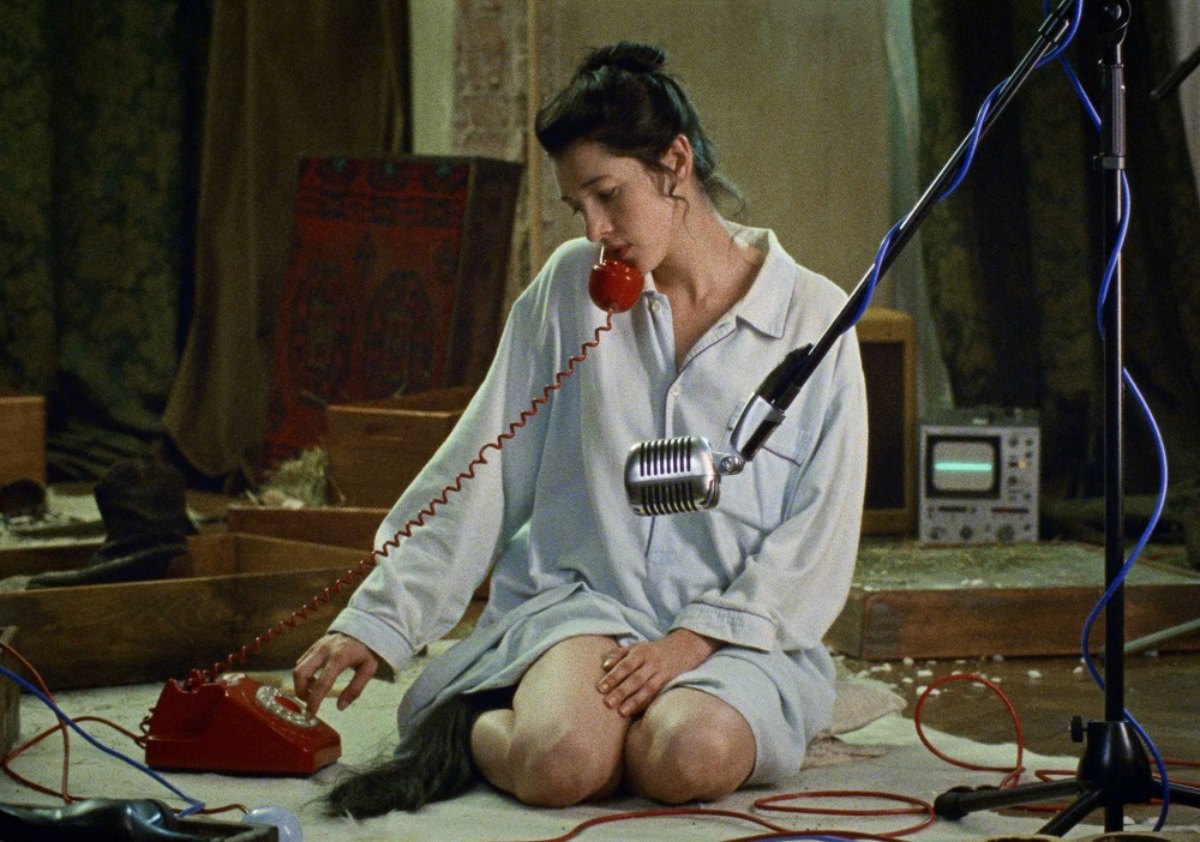
Taking its title from a type of slow trot that is used in dressage, Ann Oren’s narrative debut “Piaffe” both formally mimics this slow progression, while also quite literally being about horses. Or, well, the film is about shy Eva’s (Simone Bucio) burgeoning sexual awakening that happens simultaneously to her developing a horse tail. It’s a setup that might instantly recall Cronenberg-ian body horror, but “Piaffe” isn’t a horror film; far from it. Instead, Oren plays the entire film so entirely straight-faced that it’s a daring debut, even if the set-up is ultimately more interesting than the film itself.
READ MORE: ‘Piaffe’ Trailer: Ann Oren’s Strange Equine Fantasy Film Hits NYC On August 25, LA On September 15
Immediately as the film begins, Eva is forced to take on her sister’s work as a foley artist. Her sister Zara (the non-binary artist Simon(e) Jaikiriuma Paetau) is locked in a mental hospital and the director of a pharmaceutical ad for “Equili” is demanding the “sound” for his commercial. Riffing on its equestrian sounding name, Eva is forced to trot shoes on sand and bite down on chains in the hopes of creating something sounding like a horse.
Getting the right sound proves difficult. Eva is ultimately berated by the director for creating something too mechanical and sent away to re-record the sound, adding a more human element. And with that, the tail starts to grow as Eva exposes herself more to the world, including awkward trips to the local club and a BDSM relationship with a local botanist who visits her work (Sebastian Rudolph).
For most of the film, Oren narrows in on the complicated relationship between Eva and the botanist, who seems more bemused by her growing tail than anything else. Instead of treating the new extremity as an aberration, it instead becomes an integral part of their foreplay. The sex scenes between the two are both comical in their absurdity but also strangely sexy in their willingness to fully commit to the film’s premise.
It helps that Oren and cinematographer Carlos Vasquez shoot the entirety of “Piaffe” on 16mm, creating a grainy but nevertheless colorful aesthetic that pushes against the standard darkness that might be associated with the genre. The same goes for the sound design, which highlights the absurdity and creativity of foley artists.
But Eva is also an incredibly passive protagonist by design. She speaks only a few words throughout the entire film, and it’s often hard to get a read on her interior life outside of sexual repression. Why she is interested in the botanist, outside of mere proximity, is never really explored. Furthermore, the subplot of Zara’s imprisonment in the mental hospital is interesting — and perhaps more inspired by Terry Gilliam than Cronenberg — but also never feels connected to Eva’s story outside of creating an opportunity for Eva to take on Zara’s work. By narrowing in so acutely on Eva, every other character is defined by their relationship to her.
Yet while “Piaffe” isn’t the first film to use chimeras as a method of literalizing one’s sexual awakening, it’s one of the few to do so through a sympathetic lens. Like the characters in the film, Oren treats Eva’s tail not as something to be feared or repulsed by, but as an extension of herself. By twisting the plot’s body horror elements, “Piaffe” may be more accurately described as a romance. It’s a weird movie, to be sure, but never an off-putting one. It’s also one that sometimes feels like a chimera itself, pushing various genres and ideas together without fully synthesizing them. But it’s consistently beautiful, watchable, and a truly memorable debut for Oren. [B]
Publisher: Source link





Earth’ Season 2 Casts Peter Dinklage as Series Regular
While screenwriter, television showrunner, and director Noah Hawley is already lining up his next feature film project, that seemingly hasn't stopped developments on the second season of Alien: Earth. The series, which premiered on FX last year, was a project…
Apr 10, 2026
‘Foundation’s Lee Pace Teases Even “Bigger” Story in Season 4
The return of Apple TV’s critically acclaimed, yet somehow still sorely underrated, three-part science fiction epic has just been given the perfect hype, with a returning star not only offering a production update but also calling the next outing “bigger”…
Apr 9, 2026
![‘Star Wars: Maul – Shadow Lord’ Is the Perfect Jumping-on Point for Newcomers [Exclusive]](https://www.filmibee.com/wp-content/uploads/2026/04/Star-Wars-Maul-Shadow-Lord-Is-the-Perfect-Jumping-on-1200x675.jpg)
‘Star Wars: Maul – Shadow Lord’ Is the Perfect Jumping-on Point for Newcomers [Exclusive]
Lucasfilm and Disney are jumping back into the animated Star Wars universe with the release of Star Wars: Maul — Shadow Lord, centered on Sam Witwer's iconic animated Sith villain. Spinning off from Star Wars: The Clone Wars, Shadow Lord…
Apr 8, 2026

Netflix’s ‘Detective Hole’ Is Now a Global Streaming Sensation
Netflix is no stranger to great crime thrillers, and its newest series is no exception. While the streaming service is already home to such modern classics as Mindhunter, Ozark, and The Stranger, its new show can easily be counted among…
Apr 7, 2026