

Back to selection
Viewfinder
Viewfinder is a column that takes us behind the lens of a filmmaker’s creative process. by Filmmaker Staff
Bird’s Eye View: György Pálfi Gives a Chicken the Star Treatment
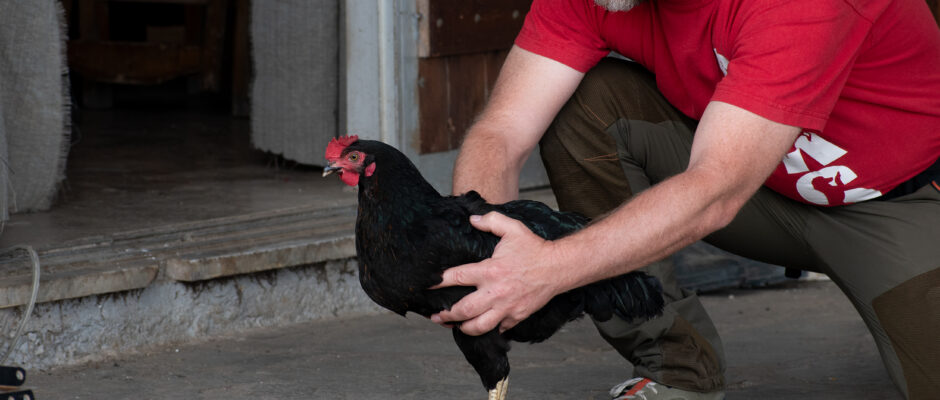
 Behind the scenes of Hen (2026). Photograph courtesy of Dekanalog.
After watching György Pálfi’s Hen (2026), you’ll never look at a chicken the same way again. Pálfi had the idea for the film when he was having trouble launching a new project in his native Hungary, which was then still under the repressive order of prime minister Viktor Orbán. He decamped to Greece to develop his next feature, which he hoped would transcend language barriers. The result is Hen: a film that tethers itself to the perspective of a Leghorn chicken who escapes from an industrial farm, then nests with a family who runs a rural restaurant. As our heroine scurries across treacherous highways and negotiates the pecking order of her new chicken coop, Pálfi and his crew hover low to the ground with her, giving the bird the gravitas of a silent-era star.
Below, Pálfi shares some tips for directing fowl screen divas, including some essential technological innovations that allowed for such graceful photography of his quick-moving cast. —Chloe Lizotte

We shot Hen on the Alexa 35, which we chose because it is a full-frame camera and very good quality. I like to work with video. I’ve shot on 35mm before, but you’re always nervous to see how the material will come out: is it okay, or is it not?

We had enough scripted material to shoot for 50 days, but the budget was only enough for 35. So we used two cameras, shooting simultaneously, and we had eight different chicken actresses to work with. When one of the chickens was performing for one of the cameras, the other camera could shoot a different scene. So that meant there were two monitors in front of me at all times, showing different scenes, which was very intense.

Our biggest problem was the camera angle, which needed to be very close to the floor. We wanted to shoot a classical, Hollywood-style face shot of the chickens, which meant that the camera needed to be a little bit under their eye level. The chicken is a small animal—approximately 30 centimeters tall—so we tried to figure out how we could do it. We tried building a camera, but it didn’t work because we didn’t want a handheld feeling for this. Next we tried digging a hole and putting the camera in it, but a chicken is very fast, and we couldn’t follow her.

So, finally, we created a solution: a periscope lens. It was about a meter long, with a hole at the end for the camera to look through. This meant that the cinematographer could not set up the camera directly facing the chickens. The camera needed to be angled down toward the earth, with the periscope extending down toward the floor. The end of the periscope was pointed upward toward the chicken from below. Panning with this camera was very hard because the cinematographer needed to turn the entire camera body in an unusual way. We also needed to develop special lighting since the periscope couldn’t take in as much light as the normal camera lens. We had setups to simulate three different weather conditions: the sun was always a lamp; when we turned off the lamp, we had cloudy weather, total natural light; and we had rainy weather, which needed to be a little bit darker and much more cloudy. It also meant that we needed to shoot the scenes with humans with the periscope camera to collect the same volume of light across each scene.

The visual language of the movie comes from what the chickens can do. I couldn’t do long, choreographed takes—a chicken’s head is moving 20 centimeters per second; it’s very hard to follow. So we chose a classical Hollywood storytelling method, telling a fairy tale of the chickens. We were looking at films by Billy Wilder, Michael Curtiz, Alfred Hitchock—we tried to make the chickens into movie stars. We found angles that would frame the hen like Marilyn Monroe or Sophia Loren, showing the audience that she is our hero, our superstar.

Our big question in the editing room was how to make it clear that the chicken was watching us. People look at each other head-on, but a chicken’s eyes are on the side of her head—if she looks sideways, she is actually looking at you, but as a human, you only feel the chicken is looking at you when she is facing the camera head-on. To tell this story, we needed to give the audience that feeling. So, as a solution, we used both strategies: sometimes, she’s watching us in her way, while other times, the audience is feeling that she’s watching them. It’s not necessarily something that a viewer of the movie would be thinking about, but it was important to us to do it both ways.
As told to Chloe Lizotte.
Publisher: Source link


